
Buying New Construction vs. Existing Homes: A 2026 Cost Comparison
With the price premium for new builds hitting an all-time low, homebuyers face a complex trade-off between modern energy efficiency and the established charm of older neighborhoods.
By Factlen Editorial Team
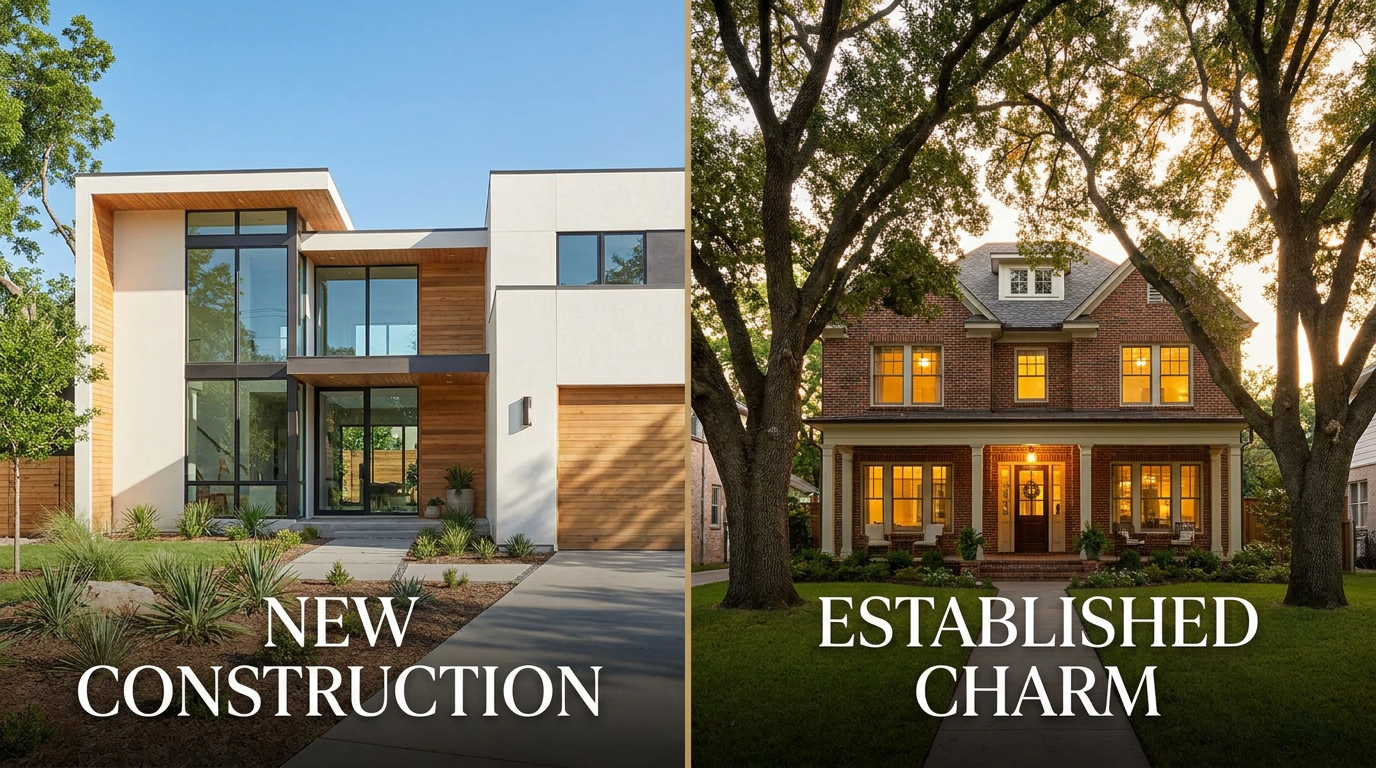
- New Construction Advocates
- Buyers and builders focused on predictability, energy efficiency, and modern design.
- Existing Home Traditionalists
- Buyers and real estate agents who prioritize location, character, and immediate availability.
- Market Data Analysts
- Economists tracking the narrowing price premium and regional inventory shifts.
What's not represented
- · Custom Home Builders
- · Urban Planners
Why this matters
For decades, building a new home was a luxury reserved for those with deep pockets, while buying an existing home was the budget-friendly route. In 2026, that dynamic has flipped in many markets, meaning buyers who automatically filter out new construction might be missing out on significant long-term savings.
Key points
- The price premium for new-construction homes over existing properties has fallen to an all-time low of 7.8 percent.
- Nationally, new builds are now frequently cheaper on a price-per-square-foot basis than older homes.
- New construction offers predictable maintenance and high energy efficiency, but requires a longer move-in timeline.
- Existing homes provide immediate occupancy and established neighborhoods, but often come with high early repair costs.
The traditional real estate rule of thumb—that purchasing a previously owned home is inherently cheaper than building a new one—has fractured in the 2026 housing market. Following years of supply chain stabilization and aggressive builder incentives, the price premium for new-construction homes over existing properties has plummeted to an all-time low of 7.8 percent. This historic narrowing of the price gap has transformed the homebuying process from a simple budget calculation into a complex trade-off analysis regarding long-term ownership costs, energy efficiency, and lifestyle preferences. With builders delivering inventory at a healthy pace to combat a national shortage of nearly four million homes, buyers are increasingly weighing the predictable costs of new construction against the established charm and location advantages of older properties. The decision is no longer just about the sticker price, but about the total cost of ownership over the first decade.[1][5]
In a surprising market inversion, new builds are now frequently cheaper on a price-per-square-foot basis, listing nationally at $218.66 compared to $226.56 for existing homes. This shift is largely driven by production builders utilizing economies of scale and offering aggressive financial incentives to move inventory. In 2026, builders frequently provide closing cost credits, appliance packages, and permanent mortgage rate buydowns—financial levers that individual sellers of existing homes simply cannot match. These incentives can dramatically lower a buyer's monthly payment, making a slightly more expensive new home functionally cheaper on a month-to-month basis. However, existing homes still offer more room for direct negotiation on the base purchase price and repair credits following a home inspection, giving savvy negotiators an opportunity to find value in older neighborhoods.[1][3][7]

The case for purchasing a newly built home centers heavily on financial predictability and modern performance. **For new construction:** Buyers gain open-concept layouts, high energy efficiency, and comprehensive builder warranties that strictly cap early repair costs. **Against:** Construction timelines routinely stretch from seven to twelve months, and new developments are typically relegated to the suburban fringe, far from established city centers and mature landscaping. **Evidence:** Real estate industry data indicates that new homes require an average of only $5,000 in maintenance over the first five years. Because the roof, foundation, plumbing, and electrical systems are brand new and under warranty, buyers are insulated from sudden, catastrophic repair bills. This predictability is a major draw for first-time buyers who may have depleted their savings to cover the down payment and cannot afford surprise expenses.[2][3][4]
Conversely, the traditional housing market offers its own distinct, immediate advantages that appeal to a different segment of buyers. **For existing homes:** Purchasers secure a rapid one-to-two-month move-in timeline, mature tree canopies, and placement in established, walkable neighborhoods with proven school districts. **Against:** Buyers inherit decades of deferred maintenance, outdated insulation standards, and aging mechanical systems that may fail shortly after closing. **Evidence:** Census and industry data reveal that a majority of older home buyers must undertake major maintenance projects shortly after moving in. While the upfront purchase price of an existing home might appear lower in certain markets, the true cost of ownership often spikes unpredictably during the first five years as legacy components reach the end of their functional lifespans.[2][4]
Conversely, the traditional housing market offers its own distinct, immediate advantages that appeal to a different segment of buyers.
The disparity in maintenance costs is one of the most critical factors in the 2026 buying decision. When purchasing an existing home, buyers are essentially inheriting someone else's deferred upkeep. A twenty-year-old water heater is living on borrowed time, and a roof with missing shingles will likely require a full replacement within three to five years. Average early repair costs for existing homes frequently hit $15,000 as buyers are forced to replace aging HVAC units and plumbing systems. In contrast, new homes typically come with builder warranties covering major systems for one to ten years, depending on the component. Structural issues might be covered for a decade, while HVAC and plumbing receive two to five years of coverage, effectively neutralizing the risk of major capital expenditures in the early years of homeownership.[2][3][8]

Beyond immediate maintenance, the financial comparison is heavily influenced by the stark contrast in energy efficiency between new and old construction. Modern building codes mandate tightly sealed envelopes, advanced moisture-resistant insulation, and high-performance dual-pane windows. As a result, new construction homes can cut monthly utility bills by 30 to 50 percent compared to properties built in the 1990s or earlier. According to energy analysts, homes built since 2000 use roughly 2 percent more energy than much older homes, despite being approximately 30 percent larger on average. New builds also come standard with smart home technology, LED lighting, and high-efficiency HVAC systems that optimize energy use throughout the day. For buyers in climates with extreme summers or winters, this superior thermal performance translates into thousands of dollars in operational savings over a decade.[2][3][8]
Regional geography dramatically alters this comparative calculus, as the narrowing price gap is not distributed evenly across the country. In the South and Midwest, where land remains relatively abundant and labor costs are manageable, builders have flooded the market with new inventory. In these regions, the surge in supply has sometimes pushed new-build prices below those of existing homes, resulting in a negative new-construction premium. Texas, for example, continues to lead the nation in construction volume, offering highly competitive pricing for new builds. In stark contrast, the Northeast maintains a massive new-home premium. Strict zoning regulations, expensive union labor, and severe land scarcity mean that building a new home in the Northeast costs roughly 62 percent more than purchasing an existing one—with new builds averaging $784,900 versus $482,700 for older homes.[1][5]

Ultimately, the decision between new and existing housing hinges on a buyer's specific timeline, risk tolerance, and geographic location. **Fits well when:** New construction is the ideal choice for buyers with flexible move-in dates who can accommodate a multi-month build process. It is particularly advantageous for those who demand predictable monthly costs, prioritize modern energy efficiency, and are purchasing in Sun Belt or Midwestern markets where builder incentives are strongest. **Does not fit when:** Building new is a poor strategic choice for buyers facing immediate relocation deadlines, such as a lease expiration or a new job starting in 30 days. It is also ill-advised for purchasers who prioritize historic architectural charm, demand walkable urban neighborhoods, or are operating in coastal and Northeastern markets where land scarcity drives construction costs to prohibitive extremes.[3][6]
The calculus flips entirely for buyers prioritizing location and immediacy over pristine condition. **Fits well when:** Existing homes remain the optimal choice for buyers who need to secure housing and move in within 30 to 60 days. They are the clear winner for purchasers who value mature community infrastructure, established school zones, and the unique character of older architecture, provided they possess the cash reserves to handle unexpected repairs. **Does not fit when:** Purchasing an older home is highly risky for buyers with strict, inflexible monthly budgets who cannot absorb sudden $10,000 to $15,000 outlays for HVAC or roofing replacements. It is equally frustrating for buyers seeking modern, open-concept layouts, smart-home integration, and maximum energy efficiency, as retrofitting a decades-old property to meet contemporary standards often costs significantly more than buying a new build outright.[3][4][6]
How we got here
2021–2022
Supply chain shortages and high lumber prices drive the cost of new construction to record highs.
2024
Builder incentives become widespread as production catches up with demand, beginning to close the price gap.
Q2 2025
The new-construction price premium falls to an all-time low of 7.8 percent.
Early 2026
In many Sun Belt and Midwestern markets, new builds become cheaper per square foot than existing homes.
Viewpoints in depth
New Construction Advocates
Buyers and builders focused on predictability, energy efficiency, and modern design.
This camp argues that the true cost of homeownership is found in the monthly operating expenses, not just the closing price. By leveraging builder warranties and modern insulation standards, they believe buyers can avoid the financial shock of sudden repairs while enjoying lower utility bills. They view the longer wait times and suburban locations as acceptable trade-offs for a pristine, customized living space.
Existing Home Traditionalists
Buyers and real estate agents who prioritize location, character, and immediate availability.
This perspective emphasizes the irreplaceable value of mature neighborhoods, established school districts, and walkable community infrastructure. They argue that older homes possess architectural charm and solid 'bones' that modern production builds often lack. For this camp, budgeting for a new roof or HVAC system is simply part of the investment required to secure a prime location that cannot be replicated on the suburban fringe.
What we don't know
- How long builders will continue to offer aggressive mortgage rate buydowns if broader interest rates begin to fall naturally.
- Whether the negative new-construction premium seen in the South and Midwest will eventually spread to more land-constrained coastal markets.
Key terms
- New-construction premium
- The percentage difference in price between a newly built home and a previously owned existing home.
- Price per square foot
- A real estate metric used to compare the value of homes of different sizes by dividing the total price by the home's square footage.
- Builder warranty
- A guarantee provided by a home builder covering specific materials and workmanship for a set period, typically ranging from one to ten years.
- Deferred maintenance
- Necessary repairs or upgrades on a property that previous owners delayed, which the new buyer will eventually have to address.
- Mortgage rate buydown
- A financing incentive where the builder or seller pays an upfront fee to lower the buyer's interest rate for the first few years or the life of the loan.
Frequently asked
Is it cheaper to buy a new construction home or an older home?
In 2026, the price gap has narrowed significantly. While existing homes may have a lower base price in some markets, new builds are often cheaper per square foot and offer lower maintenance and energy costs.
How much should I budget for maintenance on an older home?
Industry data suggests budgeting around $15,000 for the first five years to cover potential replacements of aging systems like HVAC units, roofs, and plumbing.
Do new construction homes save money on utilities?
Yes. Thanks to modern insulation, tightly sealed envelopes, and high-efficiency HVAC systems, new homes can reduce monthly utility bills by 30 to 50 percent compared to older properties.
Why are new homes so expensive in the Northeast?
Severe land scarcity, strict zoning regulations, and high labor costs drive up construction expenses, making new builds in the Northeast roughly 62 percent more expensive than existing homes.
Sources
Source coverage
8 outlets
3 viewpoints surfaced








[1]Realtor.comMarket Data Analysts
Housing Affordability Divide Widens As Midwest And South Pull Ahead
Read on Realtor.com →[2]ZillowExisting Home Traditionalists
New Construction vs Existing Homes: The Pros and Cons of Both
Read on Zillow →[3]OpendoorNew Construction Advocates
Buying an existing home vs building new in 2026
Read on Opendoor →[4]ChaseExisting Home Traditionalists
Buying new construction vs. an existing home
Read on Chase →[5]National Mortgage ProfessionalMarket Data Analysts
Housing Affordability Divide Widens
Read on National Mortgage Professional →[6]Factlen Editorial TeamMarket Data Analysts
Synthesis by Factlen editorial team
Read on Factlen Editorial Team →[7]Freedom MortgageNew Construction Advocates
2026 Housing Market Forecast
Read on Freedom Mortgage →[8]Brookfield ResidentialNew Construction Advocates
Comparing Long-Term Costs: New Construction vs. Older Homes
Read on Brookfield Residential →
Every angle. Every day.
Get real estate stories with full source coverage and perspective breakdowns delivered to your inbox.