
OLED vs. Mini-LED Gaming Monitors: Choosing Your Next Display in 2026
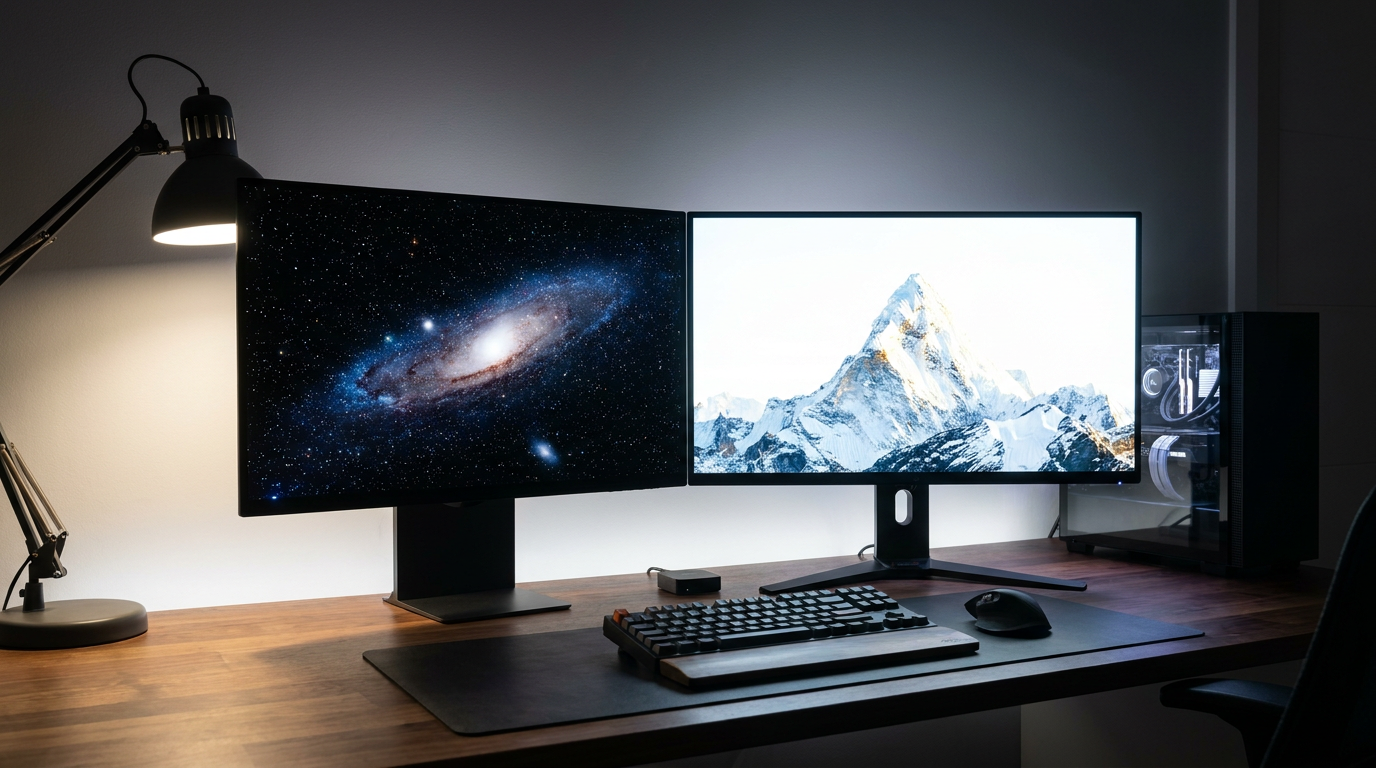
As 4K 240Hz displays become the standard for premium gaming setups, the choice between OLED's infinite contrast and Mini-LED's sustained brightness depends entirely on your room lighting and daily workflow.
By Factlen Editorial Team
- Dark-Room Purists
- Gamers and cinephiles who prioritize perfect black levels, infinite contrast, and absolute motion clarity above all else.
- Hybrid Prosumers
- Users who blend heavy productivity, coding, and bright-room gaming, prioritizing text clarity and zero burn-in risk.
- Display Analysts
- Industry experts evaluating the market trajectory, cost-to-performance ratios, and technological limitations of both panel types.
What's not represented
- · Budget-conscious gamers relying on standard IPS/VA panels
- · Console-only players playing on living room televisions
Why this matters
Dropping $1,000+ on a premium monitor is a major investment. Understanding the physical limitations of these two competing technologies ensures you buy the screen that actually fits your room lighting, gaming habits, and work-from-home needs, rather than suffering from buyer's remorse.
Key points
- OLED panels offer perfect black levels and near-instant response times, making them ideal for dark rooms and competitive gaming.
- Mini-LED monitors deliver significantly higher sustained brightness, making them the better choice for sunlit rooms.
- OLED carries a risk of permanent burn-in from static elements, while Mini-LED is immune to image retention.
- Mini-LED provides sharper text clarity for productivity, whereas some OLED subpixel layouts cause color fringing.
- OLED excels in dark, cinematic HDR scenes, while Mini-LED dominates in bright, daylight HDR environments.
In 2026, upgrading a premium gaming setup no longer means simply buying the monitor with the highest refresh rate. The market has fractured into two distinct technological philosophies: OLED and Mini-LED. While both command premium prices and deliver stunning 4K visuals, they are engineered to conquer completely different physical environments. The choice between the two is no longer about which is objectively better, but rather a side-by-side trade-off analysis of how room lighting, daily workflow, and gaming habits interact with the physics of each display type.[5]
The global display market reflects this intense division. The OLED sector is projected to reach $64 billion by the end of 2026, driven by rapid adoption in premium gaming and cinema displays. Simultaneously, Mini-LED is experiencing massive growth in the high-brightness and productivity sectors. This economic reality means buyers are not choosing between a budget option and a premium option; they are choosing between two heavily funded, highly advanced engineering frameworks that solve different problems.[5][7]
The core difference lies in how the screens generate light. OLED (Organic Light-Emitting Diode) panels are self-emissive, meaning each of the 8.3 million pixels in a 4K display turns on and off individually. Mini-LED, conversely, is an advanced backlighting technology for LCD panels, utilizing thousands of tiny inorganic diodes grouped into local dimming zones to push massive amounts of light through the screen. This architectural divide creates a clear set of advantages and drawbacks for each technology, forcing buyers to weigh their specific needs against the inherent limitations of carbon-based organics versus inorganic diodes.[1][5][7]

The case for OLED centers entirely on infinite contrast and unmatched motion clarity. Because individual pixels can power down completely, OLED monitors produce true, inky blacks without any light bleeding into adjacent dark areas. Furthermore, the lack of a liquid crystal layer allows OLED panels to achieve near-instantaneous gray-to-gray response times of roughly 0.03 milliseconds. For competitive gamers playing fast-paced esports titles, this virtually eliminates motion blur during rapid camera pans. The evidence supporting OLED is overwhelming when the monitor is placed in a light-controlled, dim environment where its perfect black levels can anchor the image.[1][2][3][4]
The evidence against OLED emerges as soon as the ambient light increases or the workload shifts to productivity. OLED panels struggle to maintain high full-screen brightness, often triggering an Auto Brightness Limiter (ABL) that aggressively dims the display during bright, snow-filled game scenes or when maximizing a white web browser. Additionally, the risk of permanent burn-in remains a factor for users who display static elements—like spreadsheet grids, coding environments, or permanent in-game health bars—for thousands of hours, a common concern echoed in community discussions.[3][5][6]
A secondary piece of evidence against OLED involves text clarity. Because many OLED panels use non-standard subpixel layouts (like triangular QD-OLED or RWBG WOLED structures), desktop operating systems often fail to render text cleanly. This results in a subtle but noticeable color fringing around letters. While higher 4K pixel densities in 2026 have mitigated this issue compared to older 1440p models, it remains a point of friction for users who spend hours reading dense documents or writing code.[1][4]
A secondary piece of evidence against OLED involves text clarity.
The case for Mini-LED is built on brute-force brightness, longevity, and versatility. High-end Mini-LED monitors in 2026 routinely sustain brightness levels well over 1,000 nits, with some models pushing past 2,000 nits. This allows them to overpower heavy ambient light in sunlit rooms, maintaining a punchy, vibrant image where an OLED would look washed out. Furthermore, because Mini-LED relies on inorganic materials, it carries zero risk of permanent burn-in, offering complete peace of mind for users who leave static windows open all day.[4][7]

Text clarity on Mini-LED is also universally sharper due to standard RGB subpixel layouts, making it the superior choice for hybrid setups that blend heavy office work with gaming. Additionally, Mini-LED panels do not suffer from aggressive ABL dimming; a bright daytime scene in an open-world game will remain blindingly bright across the entire screen, delivering a consistent and realistic daylight experience that OLED struggles to match.[1][3]
The evidence against Mini-LED focuses on blooming and slower pixel transitions. Because the backlight relies on dimming zones rather than per-pixel control, bright objects on dark backgrounds—like a white cursor on a black screen, or stars in a night sky—often exhibit a visible "halo" or blooming effect. While algorithms and higher zone counts have minimized this in 2026, it cannot be entirely eliminated.[1][3][5]
Furthermore, Mini-LED panels are bound by the physical limitations of liquid crystals, resulting in response times between 1 and 5 milliseconds. While fast enough for most, highly competitive players and community enthusiasts will notice a slight increase in motion blur compared to OLED. Viewing angles also present a trade-off; while OLED looks perfect from any angle, Mini-LED panels (particularly those using VA technology) will show color shifting and increased blooming when viewed off-axis.[1][2][3][4][6]

When evaluating High Dynamic Range (HDR) performance, the trade-off becomes a matter of peak luminance versus black depth. OLED monitors typically secure True Black 600 certifications, delivering HDR impact through the sheer contrast between a moderately bright highlight and a perfectly dark background. Mini-LED monitors, often carrying DisplayHDR 1400 certifications, deliver HDR impact through blindingly bright specular highlights that simulate the actual intensity of looking at the sun or a blazing fire. Side-by-side testing reveals that OLED wins in dark, cinematic scenes, while Mini-LED dominates in bright, open-world daylight environments.[2][3][4]
Ultimately, the decision requires strict adherence to a "fits well when" framework. OLED fits perfectly when the monitor is housed in a dark or light-controlled room, when the primary use is immersive single-player gaming or competitive shooters, and when the user consumes a heavy diet of cinematic, high-contrast media. It does not fit well when the desk sits opposite a large window, when the user works from home in spreadsheets for eight hours a day, or when the anxiety of burn-in will ruin the enjoyment of the hardware.[1][3][5][7]

Conversely, Mini-LED fits perfectly when the gaming setup is in a bright, sunlit living space, when the monitor must double as a full-time productivity workhorse, and when the user prefers eye-searing HDR brightness over perfect shadow detail. It does not fit well when the user is a dark-room purist who cannot tolerate any blooming around subtitles, or when absolute motion clarity is the single most important metric for their competitive ranking. In 2026, there is no universal winner—only the right tool for a specific environment.[1][2][4][5][7]
How we got here
Early 2020s
OLED begins migrating from premium televisions into the desktop monitor space, offering unmatched contrast.
2022-2023
Mini-LED emerges as a high-end alternative, utilizing thousands of dimming zones to rival OLED's HDR performance.
2024-2025
4K 240Hz becomes the new battleground, with both OLED and Mini-LED releasing flagship models at this specification.
2026
The market clearly bifurcates, with OLED dominating dark-room cinematic gaming and Mini-LED capturing the bright-room productivity sector.
Viewpoints in depth
Dark-Room Purists
Advocates for OLED's unmatched contrast and motion clarity.
For this camp, the pursuit of image quality begins and ends with black levels. Because OLED pixels emit their own light and can turn off completely, they provide an infinite contrast ratio that makes colors pop and gives cinematic games a three-dimensional depth. Furthermore, competitive players in this group point to the 0.03ms response times, which virtually eliminate motion blur in fast-paced shooters. To these users, managing room lighting and taking precautions against burn-in are minor inconveniences compared to the flawless visual fidelity OLED delivers in a controlled environment.
Hybrid Prosumers
Advocates for Mini-LED's versatility, brightness, and longevity.
This group views monitors as multi-purpose tools that must handle eight hours of spreadsheets just as well as evening gaming sessions. They argue that OLED's burn-in risks and text fringing make it a liability for serious productivity. Instead, they champion Mini-LED for its standard subpixel layouts that render text crisply, and its inorganic structure that eliminates burn-in anxiety. Additionally, they value the sheer brightness Mini-LED provides, arguing that a monitor must be able to overpower a sunlit home office without aggressively dimming the screen via ABL.
Display Analysts
Experts tracking the economic and engineering trajectory of the display market.
Industry analysts emphasize that neither technology is objectively superior; rather, they are diverging paths in display physics. They note that while OLED dominates the premium cinematic space, Mini-LED is rapidly capturing the high-brightness and productivity markets. Analysts point out that until Micro-LED technology (which combines OLED's per-pixel control with Mini-LED's inorganic brightness) becomes commercially viable and affordable, consumers will be forced to choose between the deep blacks of OLED and the sustained luminance of Mini-LED.
What we don't know
- When Micro-LED technology, which promises to combine the benefits of both OLED and Mini-LED, will become affordable for consumer desktop monitors.
- How long the latest generation of OLED panels will truly last before showing signs of burn-in under heavy, mixed-use workloads.
Key terms
- OLED (Organic Light-Emitting Diode)
- A display technology where each individual pixel generates its own light, allowing for perfect black levels by turning off completely.
- Mini-LED
- An advanced backlighting system for LCD screens that uses thousands of tiny diodes grouped into zones to provide high brightness and localized dimming.
- ABL (Auto Brightness Limiter)
- A protective feature in OLED screens that automatically dims the entire display when a large portion of the screen becomes bright, preventing overheating and burn-in.
- Blooming
- A visual artifact on backlit displays where light from a bright object bleeds into surrounding dark areas, creating a halo effect.
- Gray-to-Gray (GtG) Response Time
- The time it takes for a pixel to change from one shade of gray to another, which determines how much motion blur is visible during fast movement.
Frequently asked
Does OLED still suffer from burn-in in 2026?
While mitigation features like pixel shifting have improved, permanent burn-in remains a risk for users who display static elements like spreadsheets or game HUDs for thousands of hours.
Which monitor is better for reading text and coding?
Mini-LED is generally superior for text clarity. Many OLED panels use non-standard subpixel layouts that can cause color fringing around text, causing eye strain during long work sessions.
What is the 'halo effect' or blooming on Mini-LED?
Because Mini-LEDs use dimming zones rather than per-pixel lighting, bright objects on dark backgrounds (like stars or a white cursor) can cause light to bleed into adjacent dark areas, creating a visible halo.
Do I need a dark room for an OLED monitor?
Yes, to get the most out of an OLED. In bright, sunlit rooms, OLED panels can look washed out and often trigger automatic dimming to protect the screen, whereas Mini-LEDs maintain their brightness.
Sources
Source coverage
7 outlets
3 viewpoints surfaced







[1]RTINGS.comDark-Room Purists
Mini LED vs OLED: Understanding Different Monitor Technologies
Read on RTINGS.com →[2]KTCHybrid Prosumers
OLED vs Mini-LED Gaming Monitor: Which Should You Buy?
Read on KTC →[3]PCWorldDisplay Analysts
OLED vs. Mini-LED: The PC displays of the future, compared
Read on PCWorld →[4]Tom's GuideDisplay Analysts
OLED vs Mini-LED: What's the difference and is one actually better?
Read on Tom's Guide →[5]TechStoryHybrid Prosumers
OLED vs Mini LED: The Definitive 2026 Display Tech Comparison
Read on TechStory →[6]RedditDark-Room Purists
OLED vs Mini-Led -> is OLED that much better?
Read on Reddit →[7]Factlen Editorial TeamDisplay Analysts
Synthesis by Factlen editorial team
Read on Factlen Editorial Team →
More in shopping
See all 9 stories →E-Bike Tech
The 2026 E-Bike Buying Guide: Motors, Classes, and the Safety Specs You Can't Ignore
7 sources

EV Tech
The 2026 Electric Motorcycle Buyer's Guide: Range, Charging, and the Solid-State Shift
7 sources

TV Tech
OLED vs. Mini-LED TVs in 2026: The Complete Technology Comparison
7 sources
Summer Sales
Amazon Shifts Prime Day to June, Triggering Massive Summer Retail Showdown
6 sources

Every angle. Every day.
Get shopping stories with full source coverage and perspective breakdowns delivered to your inbox.