
Wind and Solar Generate More Global Electricity Than Gas for the First Time
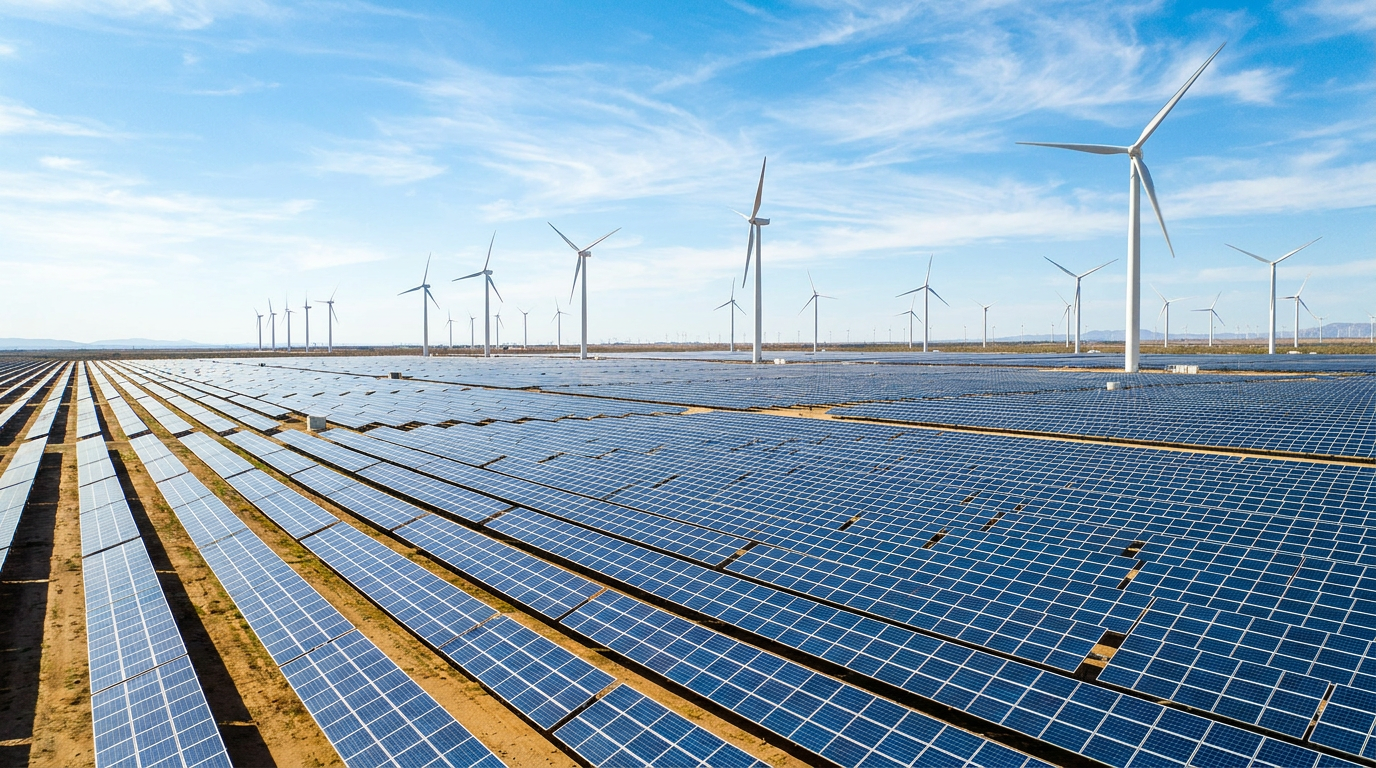
In a historic milestone for the energy transition, wind and solar power accounted for 22% of global electricity in April 2026, surpassing gas generation for the first time on record.
By Factlen Editorial Team
- Energy Data Analysts
- Focus on the mathematical trajectory of capacity additions and the decoupling of grid growth from fossil fuels.
- Sustainability Advocates
- View the milestone as a critical victory for climate targets and proof of an accelerating transition.
- Grid Reliability Planners
- Emphasize that gas remains necessary for peak demand periods until long-duration storage matures.
What's not represented
- · Fossil fuel industry executives
- · Consumers in developing nations facing grid integration costs
Why this matters
This milestone proves that renewable energy is scaling fast enough to fundamentally alter the global power mix. For consumers and economies, the shift toward homegrown wind and solar promises greater insulation from the price shocks and geopolitical volatility of imported fossil fuels.
Key points
- Wind and solar generated 531 TWh of electricity globally in April 2026, surpassing the 477 TWh produced by gas.
- Renewable output has more than doubled over the past five years, while gas generation has remained flat.
- The milestone was aided by favorable spring weather and lower overall electricity demand during the 'shoulder season'.
- Plummeting battery storage costs are helping grids manage renewable intermittency.
- The achievement follows a 2025 milestone where all renewables combined overtook coal as the world's top electricity source.
The global energy system crossed a historic threshold in April 2026, as wind and solar power generated more electricity worldwide than gas-fired power plants for the first time on record. According to data compiled by the independent energy think tank Ember, the two renewable sources combined to produce a record 531 terawatt-hours (TWh) of electricity during the month. This output eclipsed the 477 TWh generated by gas plants, marking a definitive shift in the structural composition of the world's power grids. The milestone arrives as countries increasingly prioritize homegrown clean energy to insulate their economies from the volatility of imported fossil fuels.[1][2]
The data reveals a widening gap driven entirely by the exponential scaling of renewable infrastructure. In April, wind and solar accounted for 22% of total global electricity generation, comfortably ahead of the 20% share held by gas. The 54 TWh difference between the two sources is roughly equivalent to the entire monthly electricity consumption of a large industrial economy. Energy analysts note that this is not a temporary anomaly caused by a sudden drop in gas usage, but rather the logical endpoint of years of compounding renewable capacity additions meeting all new global electricity demand.[1][3]
A five-year retrospective illustrates the sheer velocity of this transition. In April 2021, global gas generation stood at 476 TWh—almost identical to its output today. However, wind and solar combined generated just 245 TWh at that time. Over the span of half a decade, renewable generation has more than doubled while gas generation has effectively flatlined. This decoupling demonstrates that the global economy is successfully expanding its energy footprint without requiring a corresponding increase in fossil fuel combustion.[1][4]

The surge in clean power was distributed across nearly every major global market, with combined wind and solar generation growing by an estimated 13% year-on-year. The United Kingdom led the major economies with a staggering 35% increase in renewable output compared to the previous April. Significant gains were also recorded in Chile (24%), Australia (17%), China (14%), the European Union (13%), and the United States (8%). In China, record additions of clean energy have consistently outpaced demand growth, halting the nation's net growth in fossil fuel generation.[1][2][5]

The surge in clean power was distributed across nearly every major global market, with combined wind and solar generation growing by an estimated 13% year-on-year.
While the structural trend is clear, the specific timing of the milestone relies heavily on seasonal dynamics. April is widely recognized by grid operators as a "shoulder month"—a transitional period between the heavy heating demands of winter and the intense air-conditioning loads of summer. In the Northern Hemisphere, where the vast majority of the world's solar capacity resides, April also delivers a potent combination of strong spring winds and rapidly increasing daylight hours. This convergence of high renewable output and lower overall grid demand makes spring the most favorable window for clean energy records.[1][2]
A critical enabler of this milestone has been the rapid deployment of grid-scale energy storage, which is solving the historical challenge of renewable intermittency. Battery costs plummeted by an unprecedented 45% in 2025, following a 20% drop the year prior. This economic shift has allowed grid operators in markets like Australia and California to capture excess solar generation during midday peaks and discharge it during the evening hours when gas plants traditionally ramp up. The transition from "daytime solar" to "anytime solar" is actively eroding the market share of gas peaker plants.[5][6]

The April 2026 achievement follows closely on the heels of an even broader tipping point. Across the entirety of 2025, all renewable sources—including hydropower, wind, and solar—collectively overtook coal to become the world's largest source of electricity. Renewables captured 33.8% of the global power mix last year, pushing coal's share below one-third for the first time in modern history. Together, these consecutive milestones indicate that the global power sector has likely passed peak fossil fuel emissions.[5][6]
Beyond environmental targets, the acceleration of wind and solar is increasingly driven by hard economics and geopolitical security. The Middle East energy crisis and the resulting volatility in liquefied natural gas (LNG) markets have severely weakened the economic case for imported fossil fuels. For importing nations, LNG-powered electricity is struggling to compete with the localized, price-stable nature of wind and solar generation. Policymakers are treating renewable deployment not just as a climate imperative, but as a matter of national security.[1][3][4]
Despite the optimism surrounding the April data, energy analysts caution that wind and solar have not yet permanently dethroned gas on an annualized basis. As global temperatures rise in July and August, the surge in cooling demand will likely require grid operators to lean heavily on gas generation once again. However, the trajectory remains unmistakable. With global renewable capacity projected to double again by 2030, the months in which clean energy outproduces fossil fuels will only become more frequent, eventually cementing a permanent reordering of the global energy stack.[1][2][4]
How we got here
April 2021
Global gas generation sits at 476 TWh, nearly double the combined output of wind and solar.
Full Year 2025
All renewable sources combined overtake coal to become the world's largest source of electricity.
April 2026
Wind and solar alone surpass gas generation globally for the first time in a single month.
Viewpoints in depth
Energy Analysts & Researchers
Focus on the data-driven structural shift and the decoupling of grid demand from fossil fuels.
Researchers at think tanks like Ember and Rystad Energy emphasize that this milestone is the mathematical result of compounding capacity additions, not a fluke of demand destruction. They point to the fact that gas generation has flatlined since 2021 while renewables have doubled, proving that wind and solar are now absorbing 100% of new global electricity demand. Their primary focus is on tracking how quickly battery storage can scale to make these single-month records the year-round norm.
Energy Security Policymakers
View the transition primarily through the lens of national security and economic stability.
For government officials and grid operators in importing nations, the environmental benefits of wind and solar are secondary to their geopolitical advantages. The volatility of global LNG markets—exacerbated by conflicts in the Middle East and Eastern Europe—has made reliance on imported gas a severe economic liability. This camp argues that "homegrown" wind and solar provide price certainty and energy independence, framing the rapid deployment of renewables as a critical defense strategy rather than just a climate initiative.
Fossil Fuel Industry & Grid Traditionalists
Highlight the ongoing necessity of gas for grid reliability during peak demand periods.
Representatives from the natural gas sector and traditional utility operators caution against over-interpreting "shoulder month" data. They argue that April's low overall electricity demand naturally flatters renewable percentages. This camp maintains that until long-duration, multi-day energy storage becomes commercially viable, dispatchable gas plants remain the only reliable backstop for the grid during extreme summer heatwaves or deep winter freezes when wind and solar output can unexpectedly drop.
What we don't know
- Exactly when wind and solar will surpass gas on a full annualized basis, rather than just during favorable shoulder months.
- How quickly long-duration energy storage technologies can scale to fully replace gas peaker plants during multi-day weather events.
Key terms
- Terawatt-hour (TWh)
- A unit of energy equal to one trillion watt-hours, typically used to measure the electricity generation of entire countries or the globe.
- Grid-scale Battery Storage
- Large-scale energy storage systems that capture excess renewable energy during peak production and release it when demand is high.
- Shoulder Season
- The transitional months of spring and autumn when electricity demand is generally lower because neither heavy heating nor heavy air conditioning is required.
- Liquefied Natural Gas (LNG)
- Natural gas that has been cooled to a liquid state for easier transport, often subject to global price volatility.
Frequently asked
Have wind and solar permanently replaced gas?
Not yet. This milestone occurred during April, a month historically favorable for renewables. Gas will likely generate more power during peak summer and winter months, though the annual gap is closing rapidly.
Why did this happen in April specifically?
April is a 'shoulder season' with lower overall electricity demand for heating and cooling. It also combines strong spring winds with increasing daylight for solar generation in the Northern Hemisphere.
Is coal still the world's largest source of electricity?
On an annual basis, coal was overtaken by all renewables combined (including hydropower) in 2025, marking a historic shift in the global power mix.
Sources
Source coverage
6 outlets
3 viewpoints surfaced






[1]EmberEnergy Data Analysts
For the first time, wind and solar generated more electricity than gas worldwide in April 2026
Read on Ember →[2]ElectrekSustainability Advocates
In a first, wind and solar generated more power than gas globally in April 2026
Read on Electrek →[3]Sustainability MagazineSustainability Advocates
Wind and Solar Generation Surpass Gas For The First Time
Read on Sustainability Magazine →[4]Energy DigitalSustainability Advocates
How Wind & Solar Generation Overtook Gas For the First Time
Read on Energy Digital →[5]Carbon BriefEnergy Data Analysts
Renewable energy has overtaken coal to become the world's largest source of electricity in 2025
Read on Carbon Brief →[6]Rystad EnergyEnergy Data Analysts
Renewable energy capacity growth reached a new record last year
Read on Rystad Energy →


Every angle. Every day.
Get science stories with full source coverage and perspective breakdowns delivered to your inbox.