
The Science of Pilates: How Core Stabilization Transforms Longevity and Functional Health
Clinical research is validating Pilates as a powerful tool for building deep core strength, improving balance, and preventing injuries across all age groups.
By Factlen Editorial Team
- Clinical Researchers & Therapists
- Focuses on Pilates as a medical intervention for pain management and rehabilitation.
- Longevity & Aging Experts
- Views Pilates as a critical practice for maintaining independence and preventing falls in older adults.
- Hypertrophy & Fitness Analysts
- Evaluates Pilates strictly through the lens of muscle building and metabolic conditioning.
What's not represented
- · Traditional Weightlifting Advocates
- · High-Intensity Interval Training (HIIT) Coaches
Why this matters
Understanding the precise mechanics of Pilates allows you to make informed decisions about your fitness routine, ensuring you invest time in exercises that genuinely protect your spine, improve your posture, and safeguard your daily mobility as you age.
Key points
- Pilates targets deep stabilizing muscles like the transverse abdominis, working from the inside out.
- Clinical studies show a 20% increase in core strength after eight weeks of consistent practice.
- The practice improves proprioception and dynamic balance, reducing fall risks in older adults by up to 25%.
- Mat Pilates builds functional body control, while Reformer Pilates offers adjustable resistance for progressive overload.
- While excellent for functional strength, Pilates is not an optimal method for building large muscle mass.
Pilates is experiencing an unprecedented global renaissance. In the United States alone, nearly 12 million people actively practiced the discipline in 2023, marking a 15% increase from the previous year. It has become a ubiquitous presence in boutique studios, commercial gyms, and home workout apps.[7]
But unlike fleeting fitness fads built on social media hype, Pilates is anchored in a century of history and an increasingly robust body of clinical evidence. Originally developed by Joseph Pilates in the 1920s to rehabilitate bedridden soldiers, it has steadily evolved from a niche recovery tool for elite ballet dancers into a mainstream medical and athletic intervention.[5][6]
The core philosophy of Pilates is what its founder originally called "Contrology"—the complete and deliberate coordination of body, mind, and spirit. Rather than isolating individual muscles to pump them to exhaustion, Pilates treats the human body as an integrated, interconnected system.[5][7]
The mechanism of this system relies heavily on the "powerhouse," or the body's center. This involves targeting the deep stabilizing muscles, particularly the transverse abdominis—a deep layer of abdominal muscle that acts like an internal corset—and the multifidus muscles that run alongside the spine.[1][6]

Traditional strength training often targets superficial "prime mover" muscles, like the biceps or the rectus abdominis (the visible six-pack). Pilates, conversely, works from the inside out. By forcing the deep stabilizers to fire first, it creates a rigid, secure foundation from which the limbs can move safely and efficiently.[1][7]
Clinical research has increasingly validated this internal mechanism. A recent study published by the National Institutes of Health utilized advanced rehabilitative ultrasound imaging to measure muscle thickness and activation before and after a dedicated Pilates regimen.[1]
The researchers found that Pilates-based core stabilization training significantly increased the thickness and activation timing of the transverse abdominis and internal obliques. Essentially, the practice physically alters the architecture of the deep core, making it more robust, responsive, and capable of bracing the spine.[1]
This structural change translates directly to measurable real-world benefits. A comprehensive meta-analysis published in the Journal of Bodywork and Movement Therapies revealed that participants experienced an average 20% increase in core strength after just eight weeks of regular practice.[3]

For many practitioners, this enhanced core stability is the key to resolving chronic pain. By strengthening the muscular scaffolding around the spine, Pilates alleviates the mechanical stress and compression that so often leads to debilitating lower back pain in sedentary adults.[3][6]
For many practitioners, this enhanced core stability is the key to resolving chronic pain.
Beyond the core, Pilates is emerging as a premier intervention for longevity and healthy aging. Harvard Health Publishing notes that the practice is highly adaptable, making it a safe, low-impact option for older adults seeking to maintain their independence without stressing vulnerable joints.[2]
The balance benefits are particularly striking for aging populations. Because Pilates demands precise, controlled movements that constantly shift the body's center of gravity, it heavily trains proprioception—the nervous system's ability to sense the body's position and orientation in space.[2][5]
Data indicates that for seniors, regular Pilates practice can improve joint mobility and dynamic balance by up to 25% within three months. This makes it a frontline defense against falls, which are a leading cause of catastrophic injury and declining health in older demographics.[2][7]

As the practice has grown, so has the great debate within the fitness community: Mat Pilates versus Reformer Pilates. Mat Pilates is the original, unadulterated form, requiring nothing but a floor pad and gravity. It forces the practitioner to rely entirely on their own body weight and internal control to stabilize complex movements.[4][5]
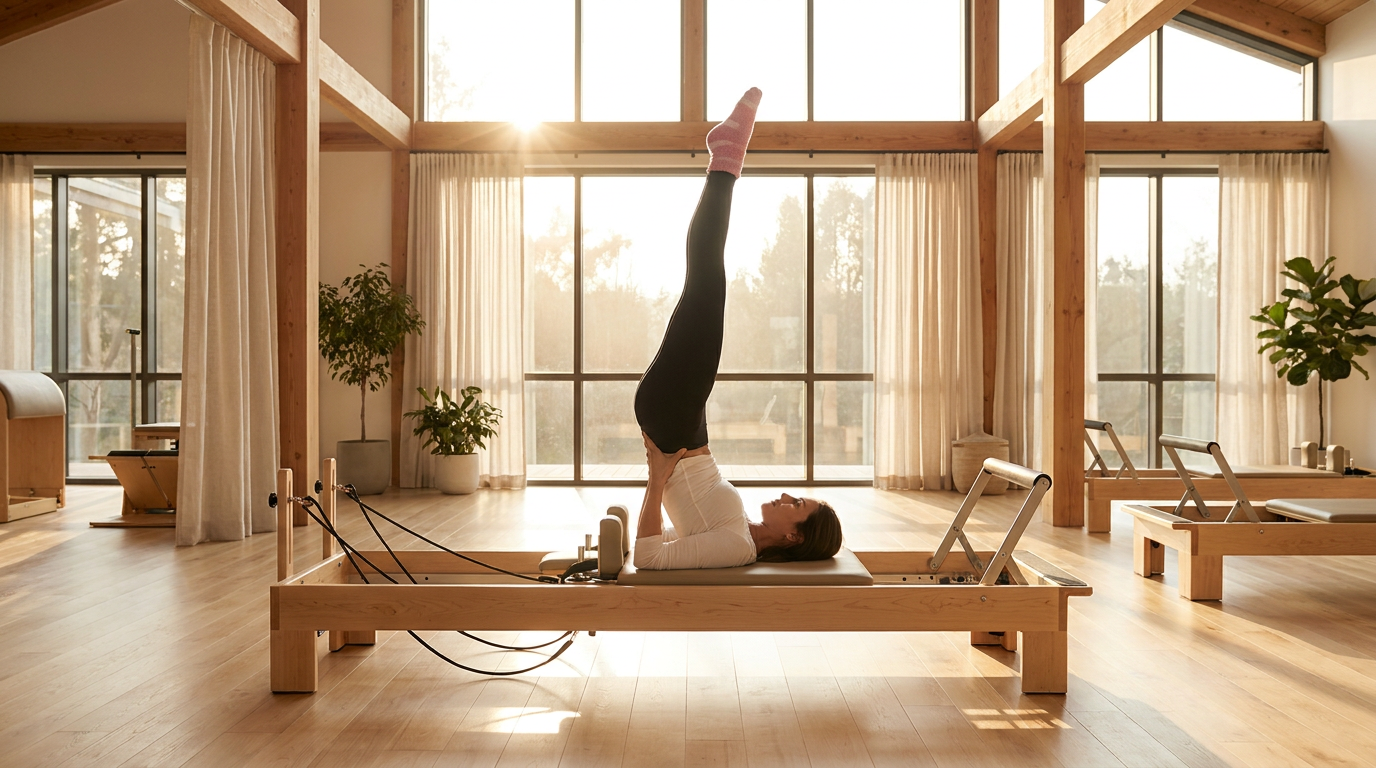
Reformer Pilates, on the other hand, utilizes a specialized machine equipped with a sliding carriage, springs, and pulleys. The springs provide variable resistance, which can either assist a beginner through a difficult range of motion or challenge an advanced athlete with heavy, unstable loads.[4][6]
Which modality is superior? According to a comprehensive review of muscle mass outcomes, the answer depends entirely on the practitioner's goal. The Reformer is mechanistically better positioned to promote progressive overload—the gradual increase of stress placed upon the body—due to its adjustable spring tensions.[4]

However, the same review notes that Mat Pilates is often more demanding on the central nervous system, as there is no machine to guide the movement trajectory or support the weight of the limbs. Both modalities reliably improve strength, flexibility, and functional performance when practiced consistently.[4][7]
Despite its myriad benefits, it is vital to understand what Pilates does not do. The scientific consensus is clear that Pilates is not an optimal tool for significant skeletal muscle hypertrophy—the raw addition of large muscle mass.[4]
While it tones and strengthens, it does not provide the heavy, progressive mechanical tension required to build large muscles in the way that traditional barbell weightlifting does. Furthermore, while a vigorous 60-minute session can burn 200 to 400 calories, it is not a primary driver of rapid weight loss without accompanying dietary changes.[4][6]
Yet, for the vast majority of the population, maximizing raw muscle size is not the primary goal. The true, enduring value of Pilates lies in its ability to build a resilient, pain-free, and highly functional body that can perform daily tasks with ease.[7]
By bridging the gap between clinical physical therapy and traditional fitness, Pilates offers a sustainable, evidence-backed pathway to lifelong mobility. It stands as a testament to the idea that sometimes, the most powerful movements are the ones executed with the greatest precision and control.[5][7]
How we got here
1920s
Joseph Pilates develops 'Contrology' to rehabilitate bedridden soldiers and internees during World War I.
1960s
The Pilates method gains immense popularity among elite ballet dancers in New York City for injury recovery.
Early 2000s
Pilates enters the mainstream fitness market, transitioning from niche dance studios to commercial gyms.
2023
Nearly 12 million Americans actively practice Pilates, driven by a post-pandemic focus on longevity and functional health.
Viewpoints in depth
Clinical Researchers & Therapists
Focuses on Pilates as a medical intervention for pain management and rehabilitation.
For physical therapists and clinical researchers, Pilates is primarily a tool for neuromuscular re-education. They value the practice for its ability to isolate and strengthen the deep stabilizing muscles of the spine and pelvis, which are often dormant in patients with chronic lower back pain. From this perspective, the aesthetic benefits of Pilates are secondary to its proven efficacy in correcting postural imbalances, rehabilitating injuries, and restoring pain-free functional movement.
Longevity & Aging Experts
Views Pilates as a critical practice for maintaining independence and preventing falls in older adults.
Gerontologists and longevity experts champion Pilates for its low-impact nature and high return on balance and mobility. Because the practice constantly challenges proprioception and dynamic stability, it directly combats the age-related decline in neuromuscular coordination. This camp emphasizes that maintaining core strength and joint mobility is one of the most effective strategies for preventing falls, which are a leading cause of catastrophic health declines in elderly populations.
Hypertrophy & Fitness Analysts
Evaluates Pilates strictly through the lens of muscle building and metabolic conditioning.
Sports scientists and hypertrophy analysts offer a more measured view of Pilates, noting its limitations in building raw muscle mass. They point out that while the Reformer offers some resistance, it cannot replicate the heavy mechanical tension of barbell strength training required for significant muscle hypertrophy. This camp argues that while Pilates is excellent for core endurance and mobility, it should be paired with traditional progressive overload training if a practitioner's primary goal is maximizing muscle size or bone density.
What we don't know
- The exact threshold of resistance required on a Reformer to trigger meaningful muscle hypertrophy in advanced athletes.
- Long-term comparative data tracking injury rates between lifelong Pilates practitioners and lifelong traditional weightlifters.
Key terms
- Core Stabilization
- The ability to control the position and movement of the central portion of the body, creating a safe foundation for the limbs to move.
- Transverse Abdominis
- The deepest layer of abdominal muscles that wraps around the torso like an internal corset, crucial for spinal support.
- Reformer
- A specialized piece of Pilates equipment featuring a sliding carriage, springs, and pulleys to provide adjustable resistance.
- Proprioception
- The nervous system's ability to sense the body's position, movement, and orientation in space.
- Hypertrophy
- The enlargement of muscle tissue from the increase in size of its cells, typically achieved through heavy resistance training.
Frequently asked
Can Pilates help me lose weight?
While a vigorous session burns 200 to 400 calories, Pilates is primarily a strength and conditioning tool. Significant weight loss requires accompanying dietary changes and cardiovascular exercise.
Do I need to be flexible to start Pilates?
Not at all. Pilates is designed to build flexibility over time. Exercises can be modified for any starting mobility level, making it highly accessible for beginners.
Is Reformer Pilates better than Mat Pilates?
Neither is strictly better; they serve different purposes. The Reformer provides adjustable spring resistance for progressive overload, while Mat Pilates forces you to rely entirely on your own body weight and internal control.
How often should I do Pilates to see results?
Clinical studies show that practicing Pilates two to three times a week yields significant improvements in core strength, posture, and balance within eight to twelve weeks.
Sources
Source coverage
7 outlets
3 viewpoints surfaced







[1]National Institutes of HealthClinical Researchers & Therapists
Effects of Pilates-Based Core Stabilization Training on Deep Stabilizing Muscles
Read on National Institutes of Health →[2]Harvard Health PublishingLongevity & Aging Experts
Pilates: A good workout option, even as we get older
Read on Harvard Health Publishing →[3]Journal of Bodywork and Movement TherapiesClinical Researchers & Therapists
The impact of Pilates on core strength and posture: A meta-analysis
Read on Journal of Bodywork and Movement Therapies →[4]ResearchGateHypertrophy & Fitness Analysts
Reformer Pilates vs Mat Pilates and Muscle Mass: Current State of Knowledge
Read on ResearchGate →[5]Better Health ChannelClinical Researchers & Therapists
Pilates - health benefits
Read on Better Health Channel →[6]WebMDLongevity & Aging Experts
Benefits of Pilates
Read on WebMD →[7]Factlen Editorial TeamLongevity & Aging Experts
Synthesis by Factlen editorial team
Read on Factlen Editorial Team →
Every angle. Every day.
Get fitness stories with full source coverage and perspective breakdowns delivered to your inbox.