
New York Knicks Celebrate First NBA Championship in 53 Years with Historic City Parade
Millions of fans lined the Canyon of Heroes to celebrate the New York Knicks' 2026 NBA title, ending a half-century drought in a victory deeply intertwined with the city's hip-hop culture.
By Factlen Editorial Team
- Diehard Knicks Supporters
- View the championship as the ultimate vindication after decades of heartbreak, loyalty, and front-office dysfunction.
- Cultural Historians
- Focus on the poetic symmetry of the 53-year cycle linking the city's basketball supremacy and the birth of its hip-hop heritage.
- Basketball Analysts
- Emphasize the strategic roster construction, defensive identity, and cultural reset within the organization that made the run possible.
What's not represented
- · Rival Eastern Conference fanbases
- · City officials managing parade logistics
Why this matters
For the first time since 1973, North America's largest media market has an NBA champion, revitalizing a historic franchise and uniting generations of New Yorkers who had never witnessed a basketball title in their lifetimes.
Key points
- The New York Knicks won the 2026 NBA Championship, their first title since 1973.
- An estimated 2.5 million fans attended the ticker-tape parade in the Canyon of Heroes.
- The celebration heavily featured New York hip-hop artists, honoring the genre's birth in 1973.
- The victory validates a multi-year rebuild focused on gritty, defensive-minded basketball.
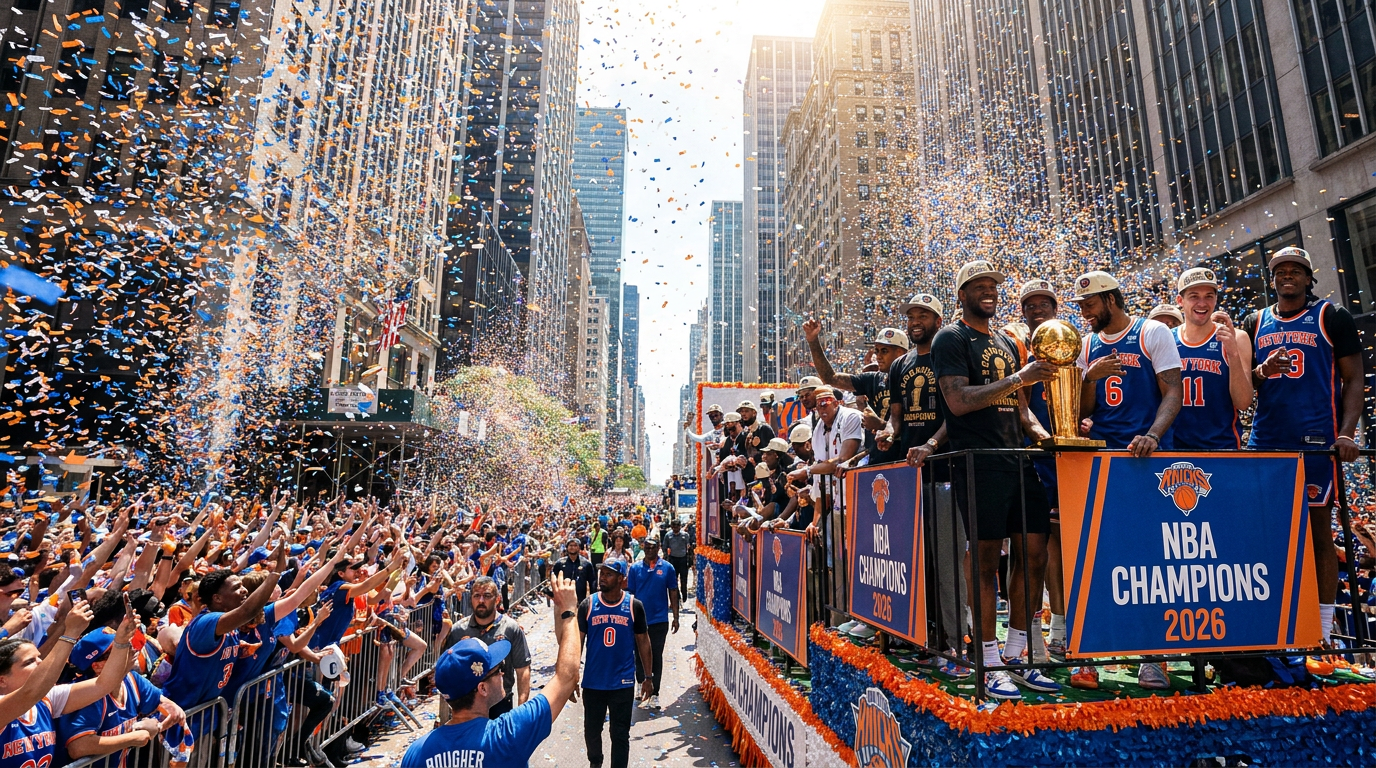
The confetti that rained down on lower Manhattan this weekend carried more than just shredded paper; it carried fifty-three years of deferred dreams, heartbreak, and unwavering loyalty. The New York Knicks, long the punchline of the NBA and a symbol of front-office dysfunction, have finally returned to the mountaintop. By securing the 2026 NBA Championship, the franchise has set off a city-wide celebration not seen in decades, transforming the streets of New York into a massive, cathartic block party. For a fanbase that has endured countless rebuilding phases and false dawns, the sight of the Larry O'Brien trophy parading down Broadway offered the ultimate vindication.[2][3]
Millions of New Yorkers packed the historic Canyon of Heroes for a ticker-tape parade that felt as much like a cultural festival as a traditional sports rally. The sheer scale of the turnout—estimated by city officials at over 2.5 million people—underscored the deep, generational yearning for basketball glory in the sport's self-proclaimed Mecca. Office workers leaned out of skyscraper windows, raining confetti onto the floats below, while families who had passed down their fandom like cherished heirlooms finally experienced the joy of a championship. The energy in the city was palpable, a collective exhale from a metropolis that takes its basketball more seriously than almost anywhere else in the world.[2][7]

The victory represents a monumental turnaround for a franchise that spent much of the 21st century mired in controversy and mediocrity. Through shrewd roster construction, a steadfast commitment to gritty, defensive-minded basketball, and the transcendent play of their core stars, the Knicks systematically dismantled the narrative of their own incompetence. The front office, often criticized in the past for chasing past-their-prime superstars, instead built a cohesive unit defined by resilience and tactical discipline. This championship was not bought with flashy free-agent signings, but earned through grueling practices, strategic drafting, and a culture that demanded accountability from the top down.[4][6]
But the story of the 2026 Knicks is inextricably linked to the cultural fabric of New York City itself, specifically the birth and evolution of hip-hop. The last time the Knicks hoisted the championship trophy was in 1973, a year that holds profound significance beyond the basketball court. That same summer, DJ Kool Herc hosted a back-to-school party in the Bronx that is widely recognized by music historians as the birth of hip-hop. For over half a century, the city's defining musical export conquered the globe, while its marquee basketball team repeatedly stumbled.[1][5]
But the story of the 2026 Knicks is inextricably linked to the cultural fabric of New York City itself, specifically the birth and evolution of hip-hop.
Fifty-three years later, those two parallel tracks converged spectacularly on the streets of Manhattan. The championship parade featured a who's who of New York rap royalty taking a victory lap alongside the players, transforming the official floats into rolling concerts that echoed from the Battery all the way up to Madison Square Garden. Legends of the genre stood shoulder-to-shoulder with the newly minted basketball champions, highlighting how deeply intertwined the sport and the music have always been in the city's parks and playgrounds. It was a celebration of New York's enduring cultural dominance, finally matched by its athletic supremacy.[1][8]

"This isn't just a sports win; it's a cultural reset for the entire city," noted one cultural critic covering the weekend's festivities. The synergy between the team's blue-collar work ethic and the city's relentless, grinding energy created a symbiotic relationship where the players fed off the crowd, and the crowd saw themselves reflected in the players. Unlike past iterations of the team that felt disconnected from the five boroughs, the 2026 roster embodied the grit and determination that New Yorkers pride themselves on, making the victory feel deeply personal for millions of residents.[5][8]
The emotional climax of the parade occurred outside the iconic Madison Square Garden, where veterans of the legendary 1973 championship squad were waiting to embrace the 2026 roster. For older fans who remembered the days of Walt Frazier and Willis Reed, it was a bridge across a half-century of heartbreak; for younger fans, it was the validation of a loyalty they had inherited but never seen rewarded in their lifetimes. Tears mingled with the confetti as generations of Knicks fans realized that the long, painful wait was finally over.[2][3][7]

Looking ahead, the Knicks are well-positioned to defend their hard-won crown, boasting a young, locked-in core and a front office that has finally earned the unconditional trust of its demanding fanbase. The challenge of repeating in a highly competitive NBA looms large, but the immediate focus remains on the present triumph. For now, the city is content to bask in the warm glow of a championship that proved, after 53 long years, that basketball still belongs to New York, and that the Mecca has finally reclaimed its throne.[4][6]
How we got here
1973
The Knicks win their last NBA title; hip-hop is born at a back-to-school party in the Bronx.
1990s
The Patrick Ewing era brings the Knicks close to a title, but yields no championships.
2000s-2010s
The franchise endures a prolonged period of dysfunction, poor management, and playoff misses.
Early 2020s
A front-office overhaul and key roster acquisitions begin a steady, culture-shifting rebuild.
June 2026
The Knicks secure the NBA Championship and hold a historic city parade.
Viewpoints in depth
Diehard Knicks Supporters
Decades of loyalty and heartbreak are finally rewarded.
For the generations of fans who pack Madison Square Garden, this championship is the ultimate catharsis. Many younger fans had never seen the team reach the NBA Finals, inheriting a fandom defined by front-office blunders and agonizing playoff exits. The 2026 victory validates their unwavering support and erases the stigma of being the league's most lucrative, yet underperforming, franchise.
Cultural Historians
The intersection of hoops and hip-hop creates a unique civic moment.
Cultural commentators emphasize that this isn't just a sports story; it's a profound civic milestone. The 53-year gap perfectly mirrors the lifespan of hip-hop, which was born in the Bronx the same year the Knicks last won. The presence of rap legends at the parade highlights how deeply intertwined the city's musical exports and its playground basketball culture have always been, making the championship a celebration of New York's broader cultural identity.
Basketball Analysts
The blueprint for rebuilding a broken franchise through culture and defense.
From a purely basketball perspective, analysts view the 2026 Knicks as a masterclass in team building. Rather than mortgaging their future for aging superstars—a strategy that failed the franchise repeatedly in the past—the front office prioritized gritty, defensive-minded players who fit a specific system. This disciplined approach proved that a strong team culture and tactical cohesion can overcome the super-team era of the NBA.
What we don't know
- Whether the Knicks can maintain this championship roster under the NBA's restrictive new salary cap rules.
- How this victory will impact the broader NBA landscape and free agency destinations in the coming years.
Key terms
- Canyon of Heroes
- A section of lower Broadway in Manhattan traditionally used for ticker-tape parades celebrating major achievements and championships.
- Larry O'Brien Trophy
- The championship trophy awarded annually by the National Basketball Association to the winner of the NBA Finals.
- Ticker-tape parade
- An urban parade event where large amounts of shredded paper are thrown from nearby office buildings onto the parade route below.
Frequently asked
When was the last time the Knicks won a championship?
Prior to 2026, the New York Knicks' last NBA Championship was won in 1973.
Why was hip-hop a major theme of the celebration?
Hip-hop was born in the Bronx in 1973, the exact same year as the Knicks' previous title, making the 53-year anniversary a shared cultural milestone for New York City.
How many people attended the championship parade?
City officials estimated that over 2.5 million fans lined the streets of lower Manhattan for the ticker-tape parade.
Sources
Source coverage
8 outlets
3 viewpoints surfaced








[1]ESPNCultural Historians
How the Knicks and hip-hop united New York
Read on ESPN →[2]The New York TimesDiehard Knicks Supporters
A 53-Year Wait Ends: Knicks Parade Floods the Canyon of Heroes
Read on The New York Times →[3]New York PostDiehard Knicks Supporters
Kings of New York: Knicks celebrate historic NBA title with epic city parade
Read on New York Post →[4]The AthleticBasketball Analysts
The anatomy of a champion: How the Knicks rebuilt a broken franchise
Read on The Athletic →[5]ComplexCultural Historians
Hip-Hop and Hoops: The cultural significance of the Knicks' 2026 Championship
Read on Complex →[6]Sports IllustratedBasketball Analysts
Jalen Brunson's masterpiece completes the Knicks' resurrection
Read on Sports Illustrated →[7]CBS SportsDiehard Knicks Supporters
2026 NBA Finals: Knicks parade draws millions as city celebrates first title since 1973
Read on CBS Sports →[8]GQCultural Historians
The Knicks are champions again, and New York City is healing
Read on GQ →
More in sports
See all 12 stories →Zone 2 Training
The Science of Zone 2 Training: What the Evidence Actually Says About the Low-Intensity Cardio Trend
6 sources

Injury
NHL Offseason Injury Report: Laine Cleared to Return, Terry Undergoes Successful Surgery
6 sources

NWSL Growth
NWSL Hijacks Men's World Cup Attention With Nationwide 'Summer of Soccer' Tour
6 sources
Standings
Mid-Season Ice Hockey Standings: Newcastle Northstars and Skycity Stampede Dominate Down Under
8 sources

Every angle. Every day.
Get sports stories with full source coverage and perspective breakdowns delivered to your inbox.