
The Tech Revolution in Beginner Motorcycles: Why 2026 is the Safest Time to Start Riding
Advanced safety features like 6-axis IMUs and cornering ABS, once exclusive to $20,000 superbikes, have become standard on sub-500cc beginner motorcycles, dramatically reducing the risk of early-rider crashes.
By Factlen Editorial Team
- Motorcycle Safety Instructors
- View electronic aids as crucial safety nets that keep novices safe while they learn fundamental riding skills.
- Entry-Level Manufacturers
- Leverage advanced technology as a competitive selling point to attract safety-conscious new riders to their brands.
- Traditionalist Riders
- Express concern that over-reliance on computer intervention prevents beginners from developing proper analog brake and throttle control.
What's not represented
- · Motorcycle Insurance Actuaries
- · Used Motorcycle Dealers
Why this matters
For decades, learning to ride a motorcycle meant accepting a high likelihood of low-speed crashes caused by locked brakes or poor throttle control. The democratization of superbike-level computer intervention in entry-level bikes means new riders now have a digital safety net that actively prevents the most common, dangerous mistakes.
Key points
- Inertial Measurement Units (IMUs) are now standard on many sub-500cc beginner motorcycles in 2026.
- An IMU measures the bike's pitch, roll, yaw, and acceleration hundreds of times per second.
- Cornering ABS allows riders to brake hard mid-turn without losing traction or running wide.
- Lean-sensitive traction control prevents the rear wheel from spinning out on wet or slippery surfaces.
- The shift to ride-by-wire electronic throttles made adding this software incredibly inexpensive.
- Safety experts agree these systems provide a crucial safety net for novices learning to ride.
Buying a first motorcycle used to mean accepting a stark compromise. New riders were routinely advised to buy barebones, underpowered machines with rudimentary brakes and no electronic aids, operating under the assumption that they would inevitably drop the bike while learning the ropes. The technology to prevent those drops existed, but it was locked behind a massive paywall.[5]
In 2026, the entry-level motorcycle market has undergone a quiet but profound revolution. Today's 300cc to 500cc motorcycles are no longer stripped-down compromises; they are rolling supercomputers. Manufacturers have realized that the riders who need safety technology the most are not professional racers on closed tracks, but novices navigating wet city streets and unpredictable traffic.[4][6]
The crown jewel of this technological migration is the Inertial Measurement Unit, or IMU. A decade ago, this technology was strictly reserved for $20,000 flagship superbikes racing in MotoGP or the World Superbike Championship. Today, it is rapidly becoming standard equipment on motorcycles that cost less than $6,000.[2]
At its core, an IMU is a small black box packed with micro-electromechanical systems (MEMS). It contains microscopic vibrating structures that measure the motorcycle's movement across six distinct axes: pitch (diving forward or squatting backward), roll (leaning left or right), and yaw (turning left or right), alongside acceleration in all three spatial directions.[2][3]

The IMU calculates the motorcycle's exact position in space hundreds of times per second. By combining this spatial data with wheel speed sensors and throttle position inputs, the bike's central computer knows exactly what the machine is doing—and, crucially, when it is about to lose grip.[3]
The most life-saving application of the IMU is Cornering ABS. Traditional straight-line ABS, which has been common for years, prevents the wheels from locking during a panic stop while the bike is perfectly upright. But motorcycles turn by leaning, which fundamentally changes the shape, size, and grip threshold of the tire's contact patch.[2]
If a rider panics and grabs a handful of front brake mid-corner on a standard motorcycle, the sudden force will overwhelm the edge of the tire. This results in either the front wheel washing out (a low-side crash) or the bike violently standing up and running wide, potentially into oncoming traffic.[6]
If a rider panics and grabs a handful of front brake mid-corner on a standard motorcycle, the sudden force will overwhelm the edge of the tire.
Cornering ABS solves this physics problem. When the IMU detects that the bike is leaned over, it modulates the brake pressure entirely differently than when the bike is upright. It allows the rider to brake hard mid-corner while maintaining the exact lean angle and trajectory, seamlessly bleeding off speed without ever exceeding the tire's available grip.[2][3]

Beyond braking, the IMU also powers lean-sensitive traction control. If a new rider applies too much throttle while exiting a wet roundabout or crossing a painted crosswalk, the rear wheel will naturally try to spin faster than the front, threatening to throw the rider in a violent high-side crash.[3]
Before the tire can fully break traction, the computer intervenes. In less than a thousandth of a second, the system retards the ignition timing or slightly closes the electronic throttle. It restores grip so smoothly and rapidly that the novice rider might only notice a small amber light flashing on their dashboard.[3]
How did this highly advanced, expensive technology get so cheap? The catalyst was actually environmental regulation. The adoption of strict Euro5 emissions standards forced motorcycle manufacturers to abandon mechanical throttle cables in favor of "ride-by-wire" electronic throttles to better control unburned fuel.[2]
Once the engine was controlled by a computer rather than a steel cable, adding traction control and IMU software became a matter of inexpensive microchips rather than heavy, costly mechanical parts. The hardware weight penalty of an IMU is practically zero, making it ideal for lightweight beginner bikes.[2][6]

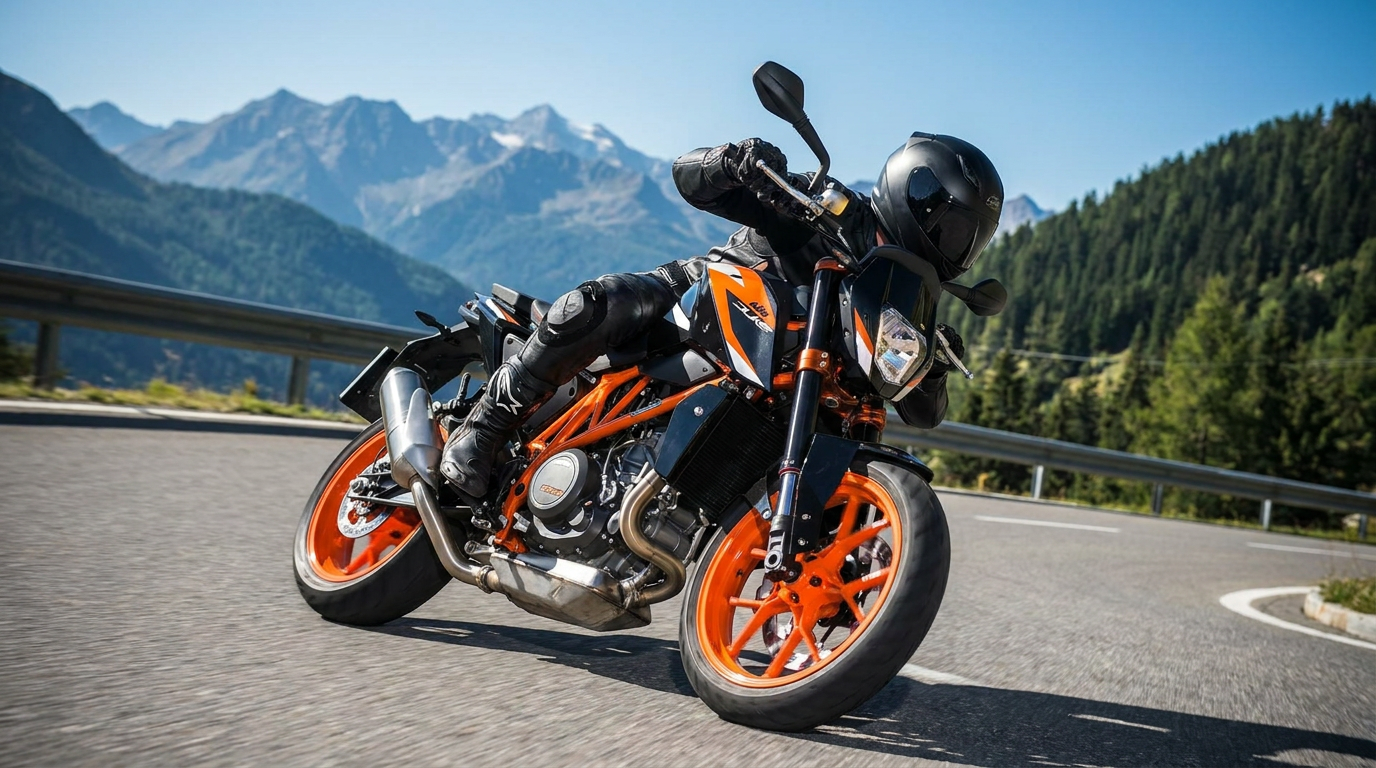
The 2026 market reflects this shift perfectly. Bikes like the KTM 390 Duke have made this technology the new baseline. The 390 Duke pairs its 6-axis IMU with a Supermoto mode and launch control—sophisticated features that were entirely unheard of in the sub-400cc class just five years ago.[1][4]
This shift has sparked a debate within the motorcycling community. Some veteran riders argue that these electronic safety nets make new riders lazy, preventing them from learning the delicate, analog skills of throttle control and brake modulation. They worry that beginners will rely on the computer to save them rather than learning to read the road surface.[6]
However, safety instructors strongly counter that an IMU does not ride the motorcycle for you; it simply raises the margin for error. By preventing the most common and punishing beginner mistakes—panic braking in a curve and whiskey-throttle on wet pavement—these systems keep new riders out of the hospital while they build their fundamental muscle memory.[5][6]

For anyone shopping for a first motorcycle in 2026, the calculus has permanently changed. While the sweet spot for learning remains the 300cc to 500cc displacement range, the presence of an IMU is now the ultimate tie-breaker. It represents the difference between a machine that merely tolerates novice mistakes and one that actively forgives them.[4][5]
How we got here
2008
The Ducati 1098R becomes the first production motorcycle to feature advanced electronic traction control.
2014
Bosch introduces Motorcycle Stability Control (MSC), bringing the first true Cornering ABS to premium flagship adventure bikes.
2019
IMU technology begins trickling down from $20,000 superbikes to middleweight commuter motorcycles.
2024
The KTM 390 Duke launches with a 6-axis IMU, bringing superbike-level safety tech to the sub-400cc beginner market.
2026
Cornering ABS and lean-sensitive traction control become the expected baseline for premium beginner motorcycles.
Viewpoints in depth
Motorcycle Safety Instructors
View electronic aids as crucial safety nets that keep novices safe while they learn fundamental riding skills.
Instructors emphasize that the first year of riding is the most statistically dangerous period for any motorcyclist. During this time, riders have not yet developed the muscle memory to perfectly modulate brake pressure during a panic situation. Safety advocates argue that an IMU acts as a digital guardian angel. It doesn't ride the bike for the novice, but it actively prevents a simple mistake—like grabbing too much brake when a car pulls out mid-corner—from turning into a hospital visit. They view the democratization of this tech as the greatest leap in rider safety since the invention of the full-face helmet.
Traditionalist Riders
Express concern that over-reliance on computer intervention prevents beginners from developing proper analog brake and throttle control.
A vocal segment of veteran riders worries about the long-term effects of learning on a computer-managed motorcycle. Their primary argument is that riders who start on IMU-equipped bikes may develop sloppy habits, relying on the traction control to sort out their heavy-handed throttle inputs rather than learning to feel the mechanical limits of grip. Traditionalists argue that starting on a barebones, analog machine forces a rider to respect the physics of motorcycling, creating a safer, more skilled rider in the long run. They fear that when these riders eventually switch to an older bike without an IMU, their lack of fundamental technique will be dangerously exposed.
Entry-Level Manufacturers
Leverage advanced technology as a competitive selling point to attract safety-conscious new riders to their brands.
For motorcycle manufacturers, the entry-level segment is fiercely competitive, as brand loyalty is often established with a rider's first purchase. By equipping their 300cc and 400cc models with 6-axis IMUs, brands like KTM, Triumph, and Yamaha are offering a premium, "big bike" experience at an accessible price point. Manufacturers note that the hardware cost of adding an IMU to a bike that already has ride-by-wire and standard ABS is minimal, but the marketing value is immense. It allows them to pitch their entry-level machines not just as toys, but as highly sophisticated, safe transportation options that appeal to both new riders and their concerned parents.
What we don't know
- Whether the widespread adoption of IMUs in beginner bikes will lead to a measurable, long-term decrease in national motorcycle fatality rates.
- How the long-term maintenance and repair costs of these electronic systems will affect the used beginner-bike market in the 2030s.
- If insurance companies will begin offering substantial premium discounts specifically for motorcycles equipped with Cornering ABS.
Key terms
- IMU (Inertial Measurement Unit)
- An electronic sensor suite that measures a motorcycle's pitch, roll, yaw, and acceleration to determine its exact position and lean angle in real-time.
- Cornering ABS
- An advanced anti-lock braking system that adjusts brake pressure based on the motorcycle's lean angle, allowing safe braking mid-corner.
- Ride-by-Wire
- An electronic throttle system where the twist grip sends a digital signal to a computer to open the engine's throttle, rather than using a physical steel cable.
- Low-Side Crash
- A type of motorcycle crash where the front or rear tire loses grip in a corner, causing the bike to slide out from under the rider.
- High-Side Crash
- A violent crash caused when a sliding rear tire suddenly regains traction, violently snapping the bike upright and ejecting the rider.
Frequently asked
What is the difference between standard ABS and Cornering ABS?
Standard ABS only works optimally when the motorcycle is perfectly upright, preventing wheel lock in a straight line. Cornering ABS uses an IMU to detect the bike's lean angle, adjusting brake pressure so you can brake mid-turn without losing traction or altering your trajectory.
Does an IMU make a beginner motorcycle heavier?
No. The IMU itself is a tiny microchip box that weighs only a few ounces. Because it utilizes the existing ABS sensors and the electronic throttle, it adds virtually no weight to the motorcycle.
Can I turn the traction control and ABS off?
Most modern motorcycles allow you to adjust the intervention levels or turn off traction control entirely for specific situations (like riding in dirt). However, street-legal bikes generally do not allow you to completely disable the front-wheel ABS for safety reasons.
Is a 300cc to 500cc bike still the best choice for a beginner?
Yes. Even with advanced electronics, a 1000cc superbike has too much power for a new rider to manage safely. The 300cc to 500cc range provides manageable power and lighter weight, making it the ideal platform for learning.
Sources
Source coverage
6 outlets
3 viewpoints surfaced





[1]KTMEntry-Level Manufacturers
2026 KTM 390 Duke Technical Specifications and Tech Features
Read on KTM →[2]VisordownTraditionalist Riders
How A Motorcycle IMU Works: The Magic Box Explained
Read on Visordown →[3]MotoiServices
Inertial Measurement Unit (IMU): The Cornerstone of Modern Motorcycle Safety
Read on MotoiServices →[4]Motorcycle GuideEntry-Level Manufacturers
Top Beginner Motorcycle Picks for 2026 by Category
Read on Motorcycle Guide →[5]BikeBoundMotorcycle Safety Instructors
Best Beginner Motorcycles of 2026: The Framework That Matters
Read on BikeBound →[6]Factlen Editorial TeamMotorcycle Safety Instructors
Synthesis by Factlen editorial team
Read on Factlen Editorial Team →



Every angle. Every day.
Get shopping stories with full source coverage and perspective breakdowns delivered to your inbox.