
The Rise of Mass Timber: How Wooden Skyscrapers Are Reshaping City Skylines
Recent updates to international building codes and advances in cross-laminated timber have unlocked a new era of sustainable, high-rise wooden architecture.
By Factlen Editorial Team
- Sustainable Architecture Advocates
- Argue that mass timber is the only viable path to decarbonize the construction industry, turning buildings from carbon emitters into carbon sinks.
- Forestry & Timber Industry
- View the boom as a massive economic opportunity that incentivizes sustainable forest management and revitalizes rural economies.
- Building Code & Safety Regulators
- Emphasize that while timber is safe, strict encapsulation rules and hybrid concrete cores remain necessary for extreme heights to ensure fire safety.
What's not represented
- · Traditional steel and concrete manufacturers
- · Urban residents living near new timber construction sites
Why this matters
Cement and steel production account for a massive share of global carbon emissions. Replacing them with engineered wood transforms buildings from carbon emitters into carbon sinks, fundamentally altering the environmental footprint of urban growth.
Key points
- New building codes have unlocked the ability to build high-rise structures using mass timber.
- Cross-laminated timber (CLT) offers a strength-to-weight ratio comparable to concrete and steel.
- Unlike concrete, which emits heavy greenhouse gases, mass timber locks carbon inside the building.
- In a fire, mass timber chars on the outside, protecting the structural core from collapsing.
- Prefabricated timber panels can reduce overall construction time by up to 30%.
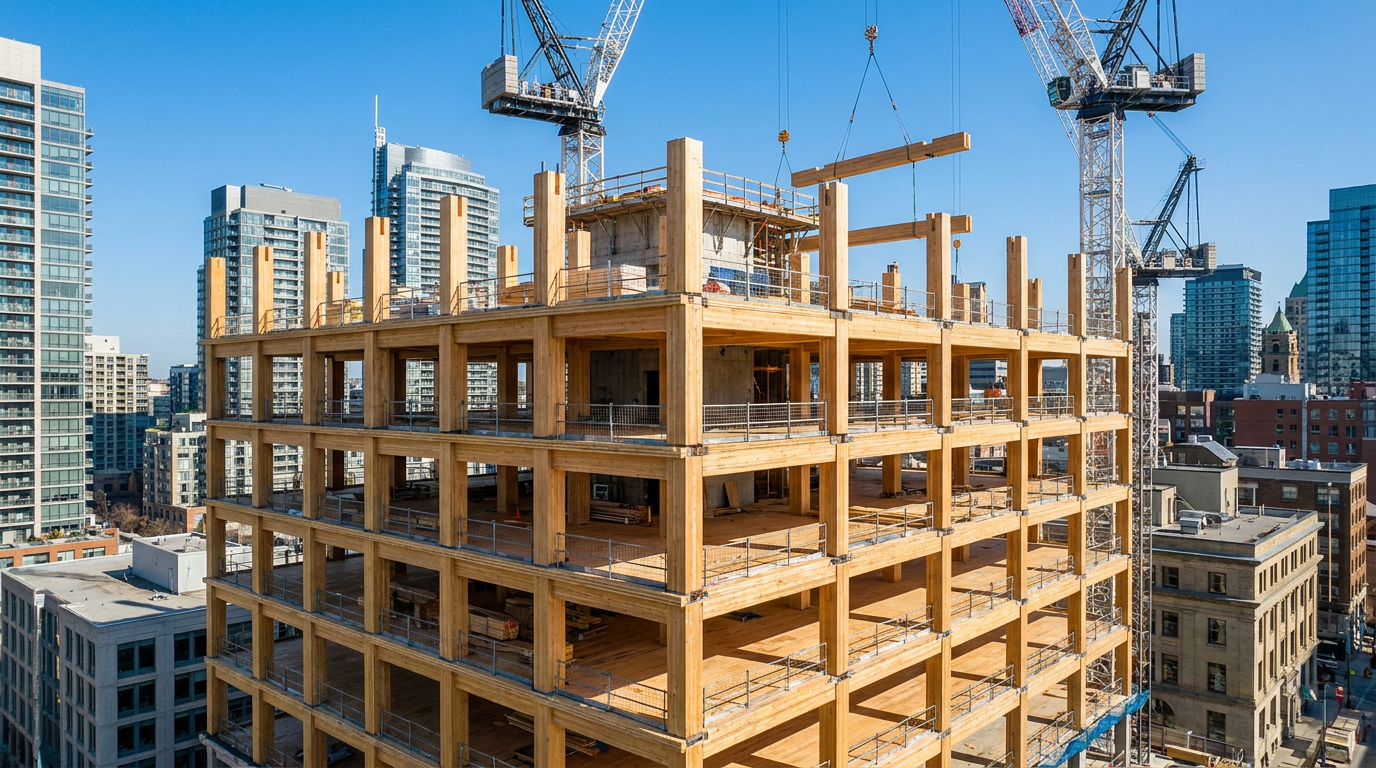
The skyline of Milwaukee is changing, but the newest addition isn't being forged from steel or poured from concrete. Construction is currently underway on the Neutral Edison, a 31-story tower that will soon claim the title of the world's tallest mass timber building.[1][4]
Reaching a planned height of 362 feet, the Edison represents a massive leap forward for wooden architecture. Once completed in 2027, it will surpass Milwaukee's own Ascent MKE—the current global record holder at 25 stories. The fact that the world's two tallest timber high-rises will sit within a ten-block radius highlights a rapid acceleration in how developers are approaching urban density.[1][4]
This vertical timber boom extends far beyond Wisconsin. In Toronto, construction is advancing on the 14-story Academic Wood Tower, set to become Canada's tallest timber structure. Meanwhile, Oakland recently welcomed a 19-story timber high-rise, and international developers in Japan have proposed conceptual wooden towers reaching up to 70 stories.[2][7]
To understand how wood can scrape the sky, it is necessary to look past traditional two-by-fours. The foundation of this architectural revolution is mass timber, a category of engineered wood products designed for heavy structural loads. The most prominent of these is Cross-Laminated Timber, or CLT.[3]

CLT is manufactured by taking solid planks of wood, stacking them in alternating perpendicular layers, and bonding them together under immense pressure with structural adhesives. This criss-crossing technique neutralizes wood's natural tendency to warp and creates massive, rigid panels with a strength-to-weight ratio that rivals traditional concrete.[3]
The urgency behind this material shift is driven by the climate crisis. The global building and construction sector is responsible for nearly 40% of all greenhouse gas emissions. Cement production alone accounts for roughly 8% of global carbon emissions, as the manufacturing process requires extreme heat and chemical reactions that release massive amounts of carbon dioxide.[2][3]

Mass timber offers a radical alternative: turning buildings into carbon sinks. As trees grow, they naturally absorb carbon dioxide from the atmosphere. When those trees are harvested and engineered into CLT panels, that carbon is locked inside the building's structure for decades or even centuries, preventing it from returning to the atmosphere.[3]
Mass timber offers a radical alternative: turning buildings into carbon sinks.
Despite the environmental benefits, the immediate question most people ask about wooden skyscrapers is about fire safety. Intuition suggests that a 30-story wooden building is a severe fire hazard, but mass timber behaves fundamentally differently than the light-frame wood used in single-family homes.[5]
When exposed to extreme heat, thick mass timber panels do not easily ignite. Instead, the outer layer of the wood burns and forms a thick layer of charcoal. This char layer acts as a natural insulator, protecting the unburned structural core inside and allowing the building to maintain its load-bearing capacity even during a prolonged fire.[5]
Regulatory bodies have spent years rigorously testing this charring effect, leading to historic updates in the International Building Code (IBC). The 2021 and 2024 IBC updates introduced new construction types—specifically Type IV-A, IV-B, and IV-C—that officially permit mass timber buildings to reach up to 18 stories under standard codes, with special performance-based permits allowing even taller structures.[5]
To ensure absolute safety at extreme heights, the strictest code (Type IV-A) requires full encapsulation. This means that while the building's skeleton is made of wood, the timber must be entirely covered by fire-resistant materials like gypsum board. Shorter timber buildings are allowed to leave more of their natural wood exposed, providing the aesthetic warmth that architects prize.[5]

Beyond sustainability and safety, mass timber is transforming the logistics of construction. Because CLT panels are precisely manufactured in off-site factories, they arrive at the construction site as a giant puzzle ready for assembly. This prefabrication drastically reduces on-site noise, requires fewer workers, and can cut overall construction time by up to 30%.[2][7]
The economic potential of this efficiency has attracted bipartisan political support. In the United States, lawmakers recently introduced the Mass Timber Federal Buildings Act, which aims to incentivize the use of engineered wood in federal construction and military projects, signaling strong governmental backing for the industry.[6]

However, the sudden demand for structural timber has raised valid questions about deforestation. Environmental advocates and forestry experts emphasize that the climate benefits of mass timber only exist if the wood is sourced from certified, sustainably managed forests. Proponents argue that a robust market for timber actually incentivizes landowners to plant more trees and maintain healthy forests rather than selling land for agricultural or commercial development.[3][6]
As the industry scales, the next hurdle is expanding manufacturing capacity. Currently, many massive timber projects rely on importing specialized panels from Europe, though North American production facilities are rapidly coming online. To reach extreme heights, developers are also perfecting hybrid systems, combining timber floors and columns with concrete elevator cores for maximum stability.[1][4]
How we got here
2009
The first modern 9-story mass timber residential building is completed.
2021
The International Building Code (IBC) is updated to allow mass timber buildings up to 18 stories.
2022
Ascent MKE is completed in Milwaukee, setting the global record at 25 stories.
2024
Further IBC updates relax encapsulation rules, allowing more exposed wood in mid-rise buildings.
2026
Construction begins on the Neutral Edison in Milwaukee, designed to reach 31 stories.
Viewpoints in depth
Sustainable Architecture Advocates
Argue that mass timber is the only viable path to decarbonize the construction industry.
Environmental architects and climate scientists view the built environment as one of the largest untapped opportunities for carbon sequestration. Because cement and steel production are inherently carbon-intensive, advocates argue that no amount of energy efficiency can offset the initial 'embodied carbon' of a traditional skyscraper. By shifting to mass timber, they believe cities can transform their skylines from massive sources of pollution into long-term carbon sinks, effectively storing decades of atmospheric carbon inside the walls of everyday apartments and offices.
Forestry & Timber Industry
View the boom as a massive economic opportunity that incentivizes sustainable forest management.
For the forestry sector, the rise of mass timber represents a revitalization of rural economies and a new incentive for sustainable land management. Industry groups argue that a high demand for structural timber makes it economically viable for landowners to maintain healthy, working forests rather than selling the land for agricultural clear-cutting or suburban sprawl. They emphasize that modern sustainable forestry mandates planting more trees than are harvested, ensuring a continuous cycle of carbon capture.
Building Code & Safety Regulators
Emphasize that while timber is safe, strict encapsulation rules remain necessary for extreme heights.
Fire safety officials and building code regulators acknowledge the structural integrity of mass timber, particularly its predictable charring behavior. However, they maintain a cautious approach to extreme verticality. Regulators insist that while the wood itself may survive a fire, the tallest structures (Type IV-A) must still rely on full encapsulation—covering the wood entirely in fire-resistant gypsum board—to ensure absolute life safety. They also advocate for hybrid systems, requiring concrete elevator cores to provide necessary lateral stability against high winds and seismic activity.
What we don't know
- How global supply chains will scale to meet the rapidly increasing demand for sustainably harvested timber.
- The long-term performance of hybrid timber-concrete systems in extreme seismic zones over multiple decades.
- Whether the cost of mass timber will achieve parity with traditional steel and concrete in all regional markets.
Key terms
- Cross-Laminated Timber (CLT)
- An engineered wood panel made by gluing layers of solid sawn lumber together in alternating directions to maximize strength.
- Mass Timber
- A category of engineered wood products used for heavy structural building components, distinct from traditional light-frame wood construction.
- Encapsulation
- The practice of covering structural mass timber with fire-resistant materials, such as gypsum board, to meet building code safety requirements.
- Embodied Carbon
- The total greenhouse gas emissions generated during the extraction, manufacturing, and transportation of building materials.
- Char Rate
- The predictable speed at which thick timber burns and forms a protective outer layer of charcoal during a fire.
Frequently asked
Does mass timber burn easily in a fire?
Unlike light-frame wood, mass timber chars on the outside when exposed to fire. This char layer insulates the interior wood, allowing the structure to maintain its load-bearing capacity.
Is mass timber strong enough for skyscrapers?
Yes. Cross-laminated timber (CLT) is engineered by gluing layers of wood perpendicularly, giving it a strength-to-weight ratio that rivals traditional concrete and steel.
Will this trend lead to deforestation?
When sourced responsibly, mass timber relies on sustainable forestry where more trees are planted than harvested. Advocates argue it creates an economic incentive to maintain healthy forests rather than clear-cutting for agriculture.
How tall can these buildings get?
The current record holder is 25 stories, but buildings up to 31 stories are under construction, and conceptual designs have proposed timber towers reaching up to 70 stories.
Sources
Source coverage
7 outlets
3 viewpoints surfaced







[1]Construction DiveBuilding Code & Safety Regulators
Construction begins on world's tallest mass timber building in Milwaukee
Read on Construction Dive →[2]The GuardianSustainable Architecture Advocates
Milwaukee plans to build world’s tallest wooden skyscraper
Read on The Guardian →[3]MIT NewsSustainable Architecture Advocates
Explainers: Mass Timber
Read on MIT News →[4]Construction BriefingBuilding Code & Safety Regulators
Construction starts on world’s tallest mass timber building
Read on Construction Briefing →[5]WoodWorksBuilding Code & Safety Regulators
Tall Mass Timber in the U.S.: How Did We Arrive Here?
Read on WoodWorks →[6]Michigan Farm NewsForestry & Timber Industry
Mass timber industry would see a boost under this bipartisan US House bill
Read on Michigan Farm News →[7]Construction CanadaBuilding Code & Safety Regulators
Canada’s tallest mass timber building to be built by 2026
Read on Construction Canada →
Every angle. Every day.
Get home stories with full source coverage and perspective breakdowns delivered to your inbox.