
The Science of Beanless Coffee: How Fermentation is Saving the Morning Brew
As climate change threatens global coffee supplies, food scientists are using precision fermentation and cellular agriculture to brew molecular coffee without the bean.
By Factlen Editorial Team
- Food Tech Innovators
- Argue that biotechnology and upcycling are the only mathematically viable ways to meet global coffee demand without destroying the planet's remaining forests.
- Traditional Coffee Advocates
- Emphasize the cultural heritage of coffee farming and warn that lab-grown alternatives could devastate the livelihoods of millions of smallholder farmers in the Global South.
- Environmental Scientists
- Focus on the empirical life-cycle data, validating the sustainability claims of beanless coffee while monitoring for unintended ecological consequences.
What's not represented
- · Specialty Coffee Roasters
- · Consumer Taste Panels
Why this matters
With climate change projected to wipe out half of all coffee-growing land by 2050, the global supply of coffee is under severe threat. Beanless coffee offers a scientifically viable way to preserve the morning ritual while drastically cutting the deforestation and water usage associated with traditional farming.
Key points
- Climate change is projected to render half of the world's coffee-growing land unproductive by 2050.
- Startups are using precision fermentation and upcycled ingredients like date pits to recreate coffee's molecular profile.
- Beanless coffee can reduce carbon emissions by over 80% and water usage by up to 94%.
- Critics warn that replacing traditional coffee could economically devastate millions of smallholder farmers in the Global South.
For billions of people, the day does not truly begin until the first cup of coffee is poured. It is a ritual so deeply ingrained in global culture that the underlying agricultural reality is rarely considered. Yet, the $100 billion coffee industry is quietly facing an existential threat known among agronomists as the "2050 problem" [3]. As global temperatures rise and weather patterns become increasingly erratic, researchers estimate that half of the land currently used to grow coffee will become unproductive by the year 2050 [1]. In Latin America, some projections suggest up to 90% of traditional coffee-growing areas could be rendered unsuitable [1]. Faced with the potential extinction of 60% of all coffee species, food scientists are racing to develop a radical alternative: brewing the perfect cup of coffee without ever planting a single coffee bean [1].[1][3]
The urgency stems not just from the threat to the coffee supply, but from the environmental toll of the crop itself. Traditional coffee cultivation is highly resource-intensive. Producing a single cup of coffee requires approximately 140 liters of water, factoring in the growth, processing, and transportation of the beans [3]. Furthermore, as demand surges in emerging markets, farmers are pushed to clear more land; an estimated 37% of global coffee production is directly linked to deforestation, particularly in biodiversity hotspots across the Amazon and Southeast Asia [3]. The industry is caught in a vicious cycle: coffee farming accelerates climate change, and climate change destroys coffee farms.[3]
Enter "beanless" or molecular coffee. Rather than trying to breed more resilient coffee trees—a process that takes years for a single harvest—a new wave of biotechnology startups is reverse-engineering the beverage from the ground up [4]. The premise is straightforward but scientifically complex: if the exact flavor, aroma, and mouthfeel of coffee can be replicated using alternative, climate-resilient ingredients, the reliance on deforestation-heavy farming can be broken [3]. This is not the chicory or barley substitutes of the past, which offered a vague approximation of coffee's bitterness. Today's food scientists are targeting the exact molecular composition of a roasted Arabica bean [2].[2][3][4]

To achieve this, researchers first had to decode the chemistry of the morning brew. A traditional cup of coffee contains dozens of distinct chemical compounds that interact to create its signature profile, with about 28 key compounds responsible for the primary sensory experience [4]. By isolating these specific molecules—which dictate everything from the fruity acidity of a light roast to the chocolatey depth of an espresso—scientists realized they could source identical compounds from other, more sustainable plants [4].[4]
The most prominent method for creating beanless coffee relies on upcycling and precision fermentation. Precision fermentation is a biotechnology technique that uses customized microbes, such as yeast or bacteria, to produce specific organic molecules during the fermentation process. Companies like Singapore-based Prefer and San Francisco-based Minus Coffee start with a base of upcycled agricultural byproducts [1]. Prefer, for instance, utilizes leftover bread, tofu whey, and spent grain from breweries, while Minus Coffee relies on date seeds, lentils, and millet [2].[1][2]
These base ingredients are fed into fermentation tanks where food-grade microbes break them down. The fermentation process unlocks the exact aroma volatiles and flavor precursors found in green coffee beans [1]. Once the fermentation is complete, the resulting biomass is dried, roasted, and ground using the exact same equipment utilized by traditional coffee roasters [1]. The roasting process triggers the Maillard reaction—the chemical browning that gives coffee its distinct roasted flavor—resulting a powder that looks, smells, and brews exactly like conventional coffee grounds [2].[1][2]
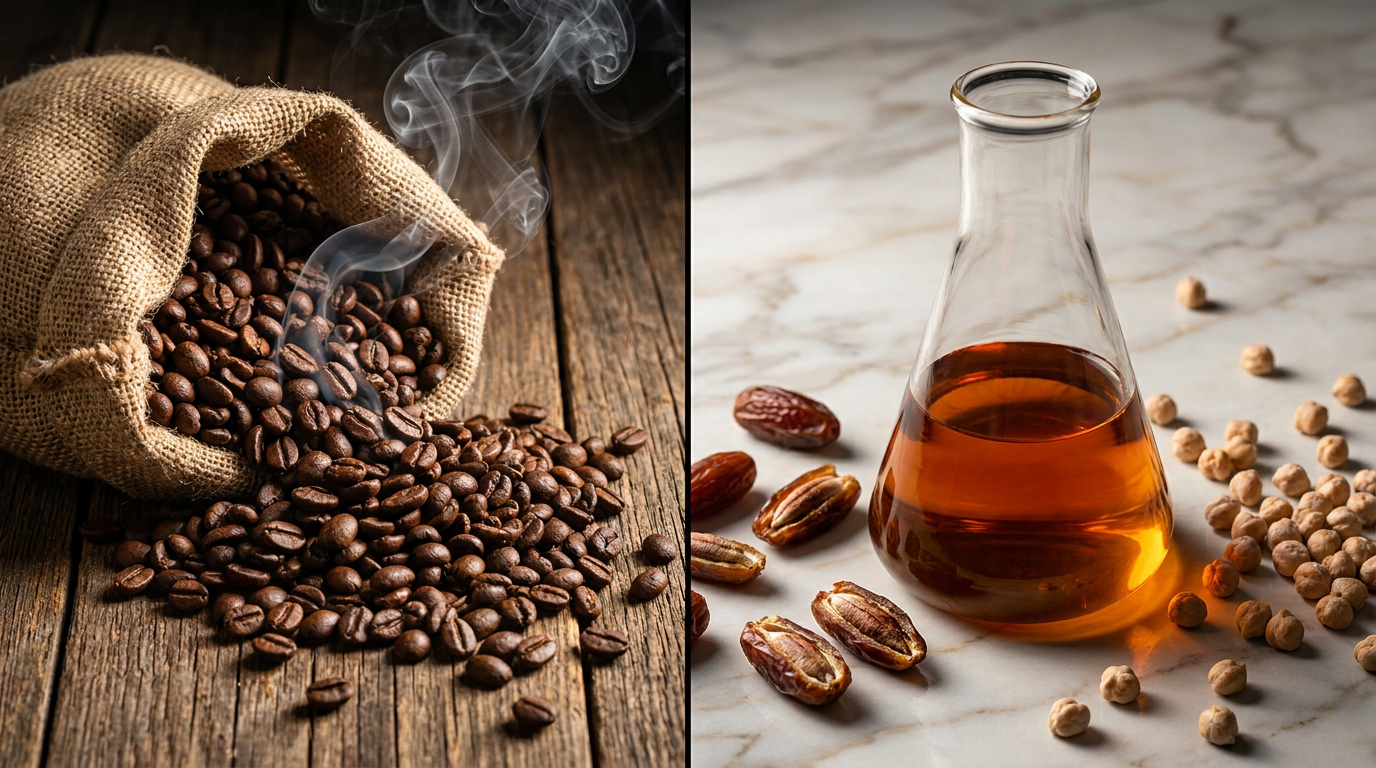
Seattle-based Atomo Coffee has taken a similar molecular approach, focusing heavily on upcycled date pits sourced from California's Coachella Valley [4]. Date palms are highly resilient desert crops that require a fraction of the water needed for coffee trees, and their pits are typically discarded as waste [4]. By blending these date pits with ramon seeds, sunflower extracts, and millet, Atomo has created a beanless espresso that is already being served in commercial cafes like New York's Bluestone Lane [4].[4]

Seattle-based Atomo Coffee has taken a similar molecular approach, focusing heavily on upcycled date pits sourced from California's Coachella Valley [4].
The environmental math behind these fermented alternatives is striking. Life cycle analyses indicate that Atomo's beanless coffee generates 83% fewer carbon emissions and requires 70% less farmland than conventional coffee [3]. Other startups report even steeper reductions, with some claiming a 94% drop in water usage [2]. Because the ingredients are sourced from annual crops or upcycled waste streams in non-tropical regions, the supply chain is virtually insulated from the deforestation pressures that plague the equator [4].[2][3][4]
While fermentation relies on alternative plants, a second, even more futuristic approach is emerging: cellular agriculture. Cellular agriculture involves growing actual agricultural products from cell cultures in a laboratory, entirely bypassing the need for soil, sunlight, or whole plants. At the VTT Technical Research Centre in Finland, biotechnologists are cultivating real coffee cells suspended in nutrient-rich bioreactors [5].[5]
This lab-grown coffee is biologically identical to the Coffea arabica plant, but it is grown in a matter of weeks rather than years [5]. The cells are harvested, dried, and roasted, producing a beverage that early testers describe as sitting somewhere between a light-roast coffee and a black tea [5]. Because the bioreactors can be located anywhere in the world—even in the middle of a snowy Finnish winter—cellular coffee drastically cuts transportation emissions and eliminates the need for pesticides [5].[5]
Despite the technological triumphs, the beanless coffee movement faces significant hurdles, the most immediate being the caffeine itself. Traditional coffee alternatives naturally lack caffeine. To provide the stimulant effect that drives most coffee consumption, companies like Atomo and Minus must add naturally derived caffeine back into their products, typically extracted from green tea leaves [2]. Ensuring this added caffeine integrates smoothly without altering the delicate flavor profile is a delicate balancing act for food chemists [4].[2][4]

Taste also remains a subjective battlefield. While molecular coffees perform exceptionally well in milk-heavy drinks like oat milk lattes or cold brews, replicating the nuanced, terroir-driven complexity of a pour-over specialty coffee is vastly more difficult [2]. The ritual of coffee is deeply emotional, and convincing purists to abandon the bean requires a product that is not just environmentally superior, but gastronomically flawless [3].[2][3]
Beyond the cup, a profound socioeconomic uncertainty looms over the transition. The global coffee trade supports an estimated 125 million people, the vast majority of whom are smallholder farmers in developing nations across Latin America, Africa, and Asia [2]. If beanless coffee captures a significant share of the market, the economic displacement in these vulnerable regions could be devastating [3]. Critics argue that while lab-grown alternatives solve an environmental problem for the Global North, they risk creating an economic crisis for the Global South [2].[2][3]

To mitigate this, some industry analysts suggest that beanless coffee will initially serve as an "extender" rather than a total replacement [1]. Much like how plant-based proteins are sometimes blended with meat to lower costs and emissions, molecular coffee can be blended with traditional beans [1]. A 50/50 blend of conventional Arabica and fermented date-pit coffee could instantly halve a roaster's carbon footprint while still supporting traditional farmers and maintaining the authentic coffee experience [4].[1][4]
Regulatory approval is the final bottleneck. While fermentation-based coffees using established food ingredients face relatively few regulatory hurdles, cell-cultured coffee falls under novel food regulations [5]. VTT's lab-grown coffee, for instance, requires extensive safety testing and approval from agencies like the FDA in the United States and the European Food Safety Authority, a process that could take several years [5].[5]
As the 2050 deadline approaches, the coffee industry is being forced to reimagine its future. Whether the morning cup of the next decade is grown on a shaded hillside in Colombia, fermented in a Singaporean steel tank, or cultivated in a Finnish bioreactor, the definition of coffee is fundamentally expanding [1]. The race is no longer just about brewing the best-tasting cup, but about engineering a cup that the planet can actually afford to sustain [3].[1][3]
How we got here
2019
Seattle-based Atomo Coffee is founded, beginning early experiments to reverse-engineer coffee from upcycled plant waste.
2021
Finland's VTT Technical Research Centre successfully produces the world's first batches of coffee grown entirely from cell cultures in a bioreactor.
2023
Singapore-based Prefer launches, utilizing precision fermentation to turn bread and tofu waste into a beanless coffee alternative.
2026
Beanless coffee begins scaling globally as an 'extender' blended into commercial ready-to-drink products to combat rising traditional bean prices.
Viewpoints in depth
Food Tech Innovators
Argue that biotechnology and upcycling are the only mathematically viable ways to meet global coffee demand without destroying the planet's remaining forests.
Proponents of molecular coffee emphasize the stark mathematics of the '2050 problem.' With global demand for coffee rising and arable land shrinking, they argue that traditional farming is on an unsustainable collision course with the climate. By utilizing precision fermentation and upcycled waste streams, these innovators believe they can decouple the morning ritual from deforestation, offering a product that is molecularly identical to coffee but requires a fraction of the resources.
Traditional Coffee Advocates
Emphasize the cultural heritage of coffee farming and warn that lab-grown alternatives could devastate the livelihoods of millions of smallholder farmers in the Global South.
For those rooted in the traditional coffee trade, the rise of beanless coffee represents a looming socioeconomic crisis. They point out that coffee cultivation supports an estimated 125 million people globally, many of whom are vulnerable smallholder farmers in developing nations. If wealthy nations shift their consumption to lab-grown or fermented alternatives produced in domestic factories, it could trigger a catastrophic loss of income for the Global South, solving an environmental issue by creating an economic one.
Environmental Scientists
Focus on the empirical life-cycle data, validating the sustainability claims of beanless coffee while monitoring for unintended ecological consequences.
Independent researchers and agronomists take a data-driven approach, scrutinizing the life-cycle analyses provided by beanless coffee startups. While they largely validate the impressive reductions in carbon emissions and water usage, they also caution that scaling up alternative ingredients—like date pits or chickpeas—must be managed carefully to avoid creating new agricultural monocultures. They advocate for a balanced transition where beanless coffee acts as a sustainable 'extender' rather than a complete replacement for the natural bean.
What we don't know
- Whether cell-cultured coffee will receive timely regulatory approval in major markets like the US and Europe.
- If beanless coffee can successfully replicate the complex, terroir-driven flavor profiles of high-end specialty coffee.
- How traditional coffee-producing nations will adapt their economies if molecular coffee captures a significant market share.
Key terms
- Precision fermentation
- A biotechnology technique that uses programmed microbes, like yeast or bacteria, to produce specific complex organic molecules.
- Cellular agriculture
- The process of growing agricultural products directly from cell cultures in a laboratory, rather than raising whole plants or animals.
- Upcycling
- The practice of taking agricultural waste or byproducts, such as date pits or spent grain, and transforming them into higher-value products.
- Maillard reaction
- A chemical reaction between amino acids and reducing sugars that gives browned food, including roasted coffee, its distinctive flavor.
Frequently asked
Does beanless coffee contain caffeine?
Yes, but it is usually added later in the process. Companies typically extract natural caffeine from sources like green tea leaves and blend it into the beanless grounds.
What does molecular coffee taste like?
Early versions excel in milk-based drinks like lattes and cold brews, offering the familiar roasted, chocolatey notes of coffee. Cell-cultured coffee is often described as tasting somewhere between a light roast and black tea.
Is lab-grown coffee available to buy right now?
Fermentation-based coffees using upcycled ingredients are currently available in select cafes and markets. Cell-cultured coffee grown in bioreactors is still awaiting regulatory approval.
Will beanless coffee put traditional farmers out of business?
It is a major concern. To mitigate economic harm, many startups are positioning their products as 'extenders' to be blended with traditional coffee, rather than total replacements.
Sources
Source coverage
6 outlets
3 viewpoints surfaced






[1]Green QueenEnvironmental Scientists
Beanless Coffee: Businesses Making Molecular, Cell-Based Coffee A Reality
Read on Green Queen →[2]GristTraditional Coffee Advocates
Can beanless coffee save your morning brew from climate change?
Read on Grist →[3]Bio-SourcedFood Tech Innovators
Meet Atomo Coffee: The Beanless Revolution
Read on Bio-Sourced →[4]Bright Green PartnersFood Tech Innovators
The Future of Coffee: Molecular, Cellular, and Climate-Resistant
Read on Bright Green Partners →[5]VTT Technical Research CentreEnvironmental Scientists
Sustainable coffee grown in Finland with cellular agriculture
Read on VTT Technical Research Centre →[6]Factlen Editorial Team
Synthesis by Factlen editorial team
Read on Factlen Editorial Team →
Every angle. Every day.
Get lifestyle stories with full source coverage and perspective breakdowns delivered to your inbox.