
How Worker Cooperatives Are Proving the Case for a Solidarity Economy
From the industrial hubs of Spain to the digital gig economy, worker-owned enterprises are demonstrating that democratic workplaces can outlast traditional corporate models.
By Factlen Editorial Team
- Economic Democracy Advocates
- Argues that worker ownership is essential to reducing inequality and empowering communities.
- Labor & Gig Worker Organizers
- Focuses on cooperatives as a tool to secure fair wages and protections against exploitative platform monopolies.
- Market & Scaling Analysts
- Highlights the practical challenges of raising capital and maintaining democratic structures as cooperatives grow.
What's not represented
- · Traditional Venture Capitalists
- · Corporate Shareholders
Why this matters
As income inequality widens and gig workers face increasing precarity, worker-owned cooperatives offer a tested blueprint for keeping wealth within communities and giving employees direct control over their livelihoods.
Key points
- Worker cooperatives operate on a 'one worker, one vote' principle, giving employees direct control over business decisions and profit distribution.
- The Mondragon Corporation in Spain demonstrates that worker-owned models can scale globally while maintaining strict limits on executive pay.
- Platform cooperatives are emerging as a worker-owned alternative to traditional gig economy apps, allowing laborers to keep a larger share of their earnings.
- During economic downturns, cooperatives often prove more resilient than traditional businesses by prioritizing job preservation over shareholder dividends.
In an era defined by widening economic anxiety, the traditional corporate structure is increasingly viewed through a lens of skepticism. In the United States, the average corporate chief executive earns roughly 339 times the salary of their median worker, a stark metric of how modern capitalism concentrates wealth at the top. Yet, quietly thriving alongside these traditional hierarchies is an alternative model rooted in a distinctly progressive economic philosophy: the worker cooperative. Rather than answering to distant shareholders demanding quarterly profit maximization, these enterprises are owned and governed entirely by the people who mop the floors, write the code, and operate the machinery. It is a structural shift that transforms labor from a disposable commodity into a governing class.[4][7]
The mechanism driving a worker cooperative is fundamentally democratic, operating on a strict "one worker, one vote" principle. In a conventional company, voting power is dictated by the number of shares an individual or institutional investor holds, meaning capital dictates direction. In a cooperative, human labor is the currency of power. When a cooperative generates a surplus—what traditional businesses call profit—that money is not extracted by outside investors. Instead, the worker-owners vote on how to allocate it, whether that means reinvesting in new equipment, building a cash reserve for economic downturns, or distributing it equitably among the staff as a dividend.[5][7]
Worker cooperatives are the cornerstone of a broader framework known as the "solidarity economy." Championed by left-leaning economists and labor organizers, the solidarity economy seeks to move beyond the zero-sum extraction of traditional capitalism. It prioritizes social welfare, community resilience, and environmental sustainability over unrestricted growth. By embedding democratic principles into the workplace, the solidarity economy argues that businesses can be a force for collective empowerment rather than individual enrichment. This is not merely a utopian theory; it is a functioning ecosystem that includes credit unions, community land trusts, and mutual aid networks, all designed to keep wealth circulating within local communities rather than being siphoned off to financial centers.[1][5]

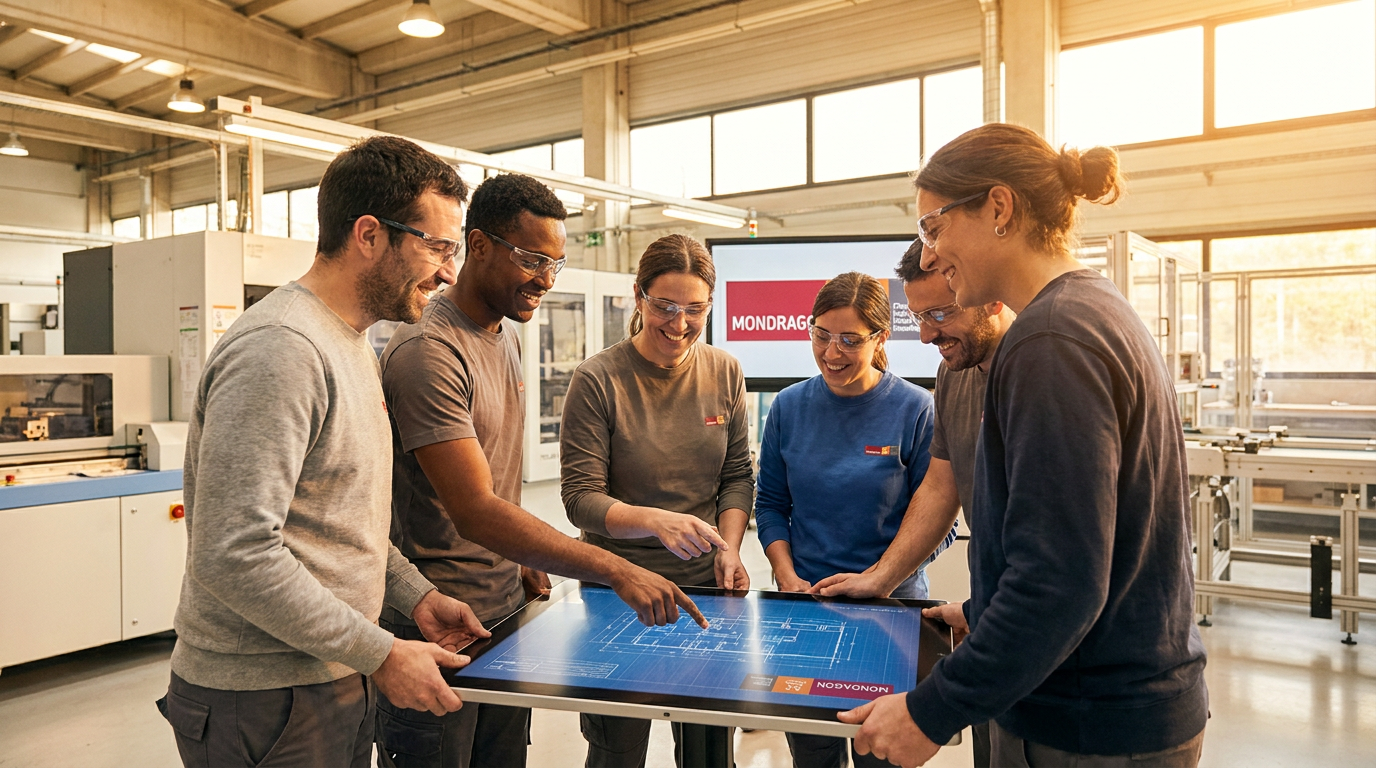
The most compelling evidence for the viability of this model lies in the Basque region of northern Spain, home to the Mondragon Corporation. Founded in 1956 by a local priest and five technical college graduates who purchased a failing paraffin heater factory, Mondragon has evolved into the largest and most successful worker cooperative in the world. Today, it is a sprawling network of over 90 distinct cooperatives operating in finance, retail, and advanced manufacturing, employing roughly 81,000 people globally. Mondragon stands as a definitive proof of concept that democratic workplaces can not only survive in a competitive global market but actively thrive and scale.[2][8]
A central pillar of Mondragon's success is its unwavering commitment to "wage solidarity." To prevent the runaway inequality seen in conventional corporations, Mondragon enforces strict internal pay ratios. The highest-paid executive within the cooperative network can earn no more than six times the salary of the lowest-paid entry-level worker. This 6:1 ratio ensures that as the company prospers, the financial gains are distributed evenly across the workforce, lifting the entire community rather than enriching a select few at the top. This policy directly challenges the orthodox economic assumption that exorbitant executive compensation is necessary to attract top talent and drive innovation.[7][8]
This democratic structure also breeds remarkable economic resilience, particularly during periods of financial crisis. When a traditional corporation faces a downturn, the standard playbook involves mass layoffs to protect shareholder dividends and maintain executive bonuses. Worker cooperatives take a radically different approach. Because the workers are the owners, they collectively absorb the shock. During recessions, cooperative members frequently vote to temporarily reduce their own hours, take collective pay cuts, or reassign workers to different, more profitable divisions within the network. The priority is always preserving livelihoods and maintaining community stability, rather than protecting profit margins.[6][7]

The data supports the efficacy of this solidarity-first approach. Studies analyzed by the National Institutes of Health and the European cooperative network CECOP indicate that democratic participation in management leads to significantly higher organizational commitment and better psychological well-being among workers. Furthermore, this shared burden of risk translates to extraordinary business longevity. Since 1986, Mondragon cooperatives have boasted a staggering 97 percent survival rate. In a global economy where roughly half of all traditional startups collapse within their first five years, the worker-owned model has proven to be an anchor of stability in turbulent markets.[2][6]
The data supports the efficacy of this solidarity-first approach.
While Mondragon represents the industrial triumph of the cooperative model, a new frontier is emerging in the digital realm: the gig economy. Over the past decade, venture-backed tech platforms have revolutionized how people access transportation, food delivery, and domestic services. However, this convenience has often come at the expense of the workers, who are frequently classified as independent contractors, denied basic labor protections, and subjected to opaque algorithmic management. Traditional gig platforms routinely extract between 20 and 50 percent of the value generated by the worker, leaving the laborers in a state of perpetual precarity while platform owners amass vast fortunes.[3][7]
In response to this exploitation, a movement of "platform cooperatives" has begun to take root. These are digital platforms that utilize the same sophisticated mobile applications and routing algorithms as Silicon Valley giants, but they are owned and governed entirely by the gig workers themselves. The Berggruen Institute and the International Labour Organization have highlighted platform cooperatives as a vital counter-mechanism to the concentrated power of tech monopolies. By reclaiming ownership of the digital infrastructure, workers can rewrite the terms of service, ensuring transparent algorithms, fair dispute resolution, and equitable distribution of the revenue they generate.[1][3]

A prime example of this digital solidarity is Up&Go, a platform cooperative launched in New York City in 2017. Designed for booking residential and commercial cleaning services, Up&Go is jointly owned by several domestic worker cooperatives, whose members are predominantly women and immigrants. In an industry historically plagued by exploitation, wage theft, and harassment, Up&Go provides a secure, worker-controlled alternative. The worker-owners collectively establish the platform's pricing structures, service policies, and safety protocols, ensuring that the technology serves their needs rather than dictating their behavior.[7]
The financial impact of this ownership model is immediate and tangible. Because there are no outside venture capitalists demanding a return on investment, the wealth generated by the platform stays with the workers. Domestic workers using Up&Go typically earn 25 percent more per hour than the local industry average wage. Furthermore, only 5 percent of the service fee is retained to maintain the platform's software and administrative overhead, compared to the massive cuts taken by traditional gig apps. Through platform cooperativism, these workers are not just securing fair wages; they are building equity in the technology that powers their livelihoods.[7]
The cooperative movement is also finding powerful allies within traditional organized labor. Historically, unions and cooperatives operated in separate spheres, but the "union co-op" model is bridging that divide. In cities like Cincinnati, initiatives partnered with the United Steelworkers are building businesses that combine the collective bargaining power of a union with the wealth-building potential of worker ownership. In this hybrid model, workers own the company and elect the board of directors, but they also form a union committee to negotiate day-to-day management issues, ensuring that democratic ideals do not get lost in the operational weeds of running a business.[7]

Despite these profound successes, the worker cooperative model faces significant structural hurdles, most notably regarding access to capital. Traditional businesses raise funds by selling equity—giving outside investors a share of ownership and voting power in exchange for cash. Because cooperatives refuse to compromise their "one worker, one vote" principle, they cannot offer venture capitalists the outsized returns and board seats they demand. This forces cooperatives to rely on debt financing, community loans, or specialized credit unions, which often limits their ability to scale rapidly or compete aggressively against heavily funded corporate rivals in capital-intensive industries.[5][6]
Furthermore, workplace democracy is inherently complex and demands significant emotional labor. Collective decision-making requires time, education, and a willingness to engage in difficult conversations—resources that are often scarce in a fast-paced business environment. As cooperatives grow and expand internationally, as Mondragon has, they face the constant tension of balancing their foundational democratic ideals with the ruthless efficiency demanded by global supply chains. Ensuring that a massive, multinational cooperative doesn't slowly devolve into a traditional corporate bureaucracy requires constant vigilance and a deep, ongoing commitment to cooperative education.[2][4]
Ultimately, advocates argue that the value of worker cooperatives extends far beyond the balance sheet. Economists like Richard Wolff view the democratization of the workplace as a necessary evolution for a truly free society. Most adults spend the majority of their waking hours in fundamentally authoritarian structures, taking orders from above with no say in the direction of their labor. By giving workers regular, meaningful experience in collective decision-making, cooperatives do more than build resilient local economies. They cultivate engaged, empowered citizens who are better equipped to participate in the broader political democracy outside the factory doors.[4][7]
How we got here
1956
The Mondragon Corporation is founded in the Basque region of Spain, starting with a single paraffin heater factory.
2009
The United Steelworkers union partners with Mondragon to launch the union co-op model in the United States, starting in Cincinnati.
2017
Up&Go, a platform cooperative owned by domestic workers, launches in New York City as a worker-controlled alternative to traditional gig apps.
2021
The Berggruen Institute publishes a major white paper advocating for platform cooperatives as a necessary policy response to the exploitation of the gig economy.
Viewpoints in depth
Economic Democracy Advocates
Argues that worker ownership is essential to reducing inequality and empowering communities.
This camp, which includes progressive economists and solidarity economy organizers, views traditional capitalism as inherently extractive. They argue that as long as outside shareholders dictate business decisions, wealth will inevitably concentrate at the top. By instituting 'one worker, one vote' policies, they believe cooperatives fundamentally rewire the economy to serve human needs, ensuring that the wealth generated by labor remains within the local community and builds long-term generational stability.
Labor & Gig Worker Organizers
Focuses on cooperatives as a tool to secure fair wages and protections against exploitative platform monopolies.
For labor advocates, the rise of the gig economy has eroded decades of hard-won worker protections. They champion 'platform cooperatives' and 'union co-ops' as practical defense mechanisms against algorithmic exploitation. From their perspective, when workers own the digital infrastructure, they can eliminate the exorbitant fees extracted by Silicon Valley middlemen, secure living wages, and establish transparent, humane working conditions without waiting for slow-moving government regulations.
Market & Scaling Analysts
Highlights the practical challenges of raising capital and maintaining democratic structures as cooperatives grow.
While acknowledging the social benefits of worker ownership, this perspective points out the structural limitations of the cooperative model in a hyper-competitive global market. Because cooperatives refuse to grant voting rights to outside investors, they are largely cut off from traditional venture capital. Analysts argue this makes it exceedingly difficult for cooperatives to scale quickly or compete in capital-intensive industries like semiconductor manufacturing or global logistics, potentially relegating them to niche markets.
What we don't know
- Whether platform cooperatives can secure enough alternative financing to effectively compete with heavily venture-backed tech monopolies on a global scale.
- How the cooperative model will adapt to the increasing automation of industrial and domestic labor over the next decade.
- If traditional labor unions will universally embrace the 'union co-op' model or view worker-ownership as a conflict of interest in collective bargaining.
Key terms
- Solidarity Economy
- An economic framework that prioritizes social welfare, equity, and environmental sustainability over unrestricted profit maximization, often utilizing cooperative business models.
- Wage Solidarity
- A policy used by cooperatives to limit income inequality by capping the pay of the highest-earning executive at a fixed ratio compared to the lowest-earning worker.
- Platform Cooperative
- A digital platform or app that is collectively owned and governed by the workers who provide the services, rather than by outside tech investors.
- Union Co-op
- A hybrid business model where a company is entirely worker-owned, but the employees also form a union to collectively bargain with the management team they elect.
Frequently asked
What is the difference between a worker cooperative and a traditional company?
In a traditional company, voting power and profits are distributed based on how many shares an investor owns. In a worker cooperative, the business is owned and governed by its employees on a "one worker, one vote" basis, and profits are shared equitably among the workforce.
How do worker cooperatives raise money if they don't have outside investors?
Because they do not sell voting shares to venture capitalists, cooperatives typically rely on debt financing, community loans, specialized credit unions, or the collective initial buy-in from their worker-members to raise capital.
What is a platform cooperative?
A platform cooperative is a digital app or website (similar to Uber or TaskRabbit) that is owned and governed by the gig workers who use it, allowing them to keep the profits and set fair labor policies rather than paying high fees to a tech monopoly.
Can worker cooperatives survive economic recessions?
Yes. Data shows they are often more resilient than traditional businesses. During downturns, worker-owners frequently vote to take collective pay cuts or reduce hours rather than laying off staff, preserving jobs and community stability.
Sources
Source coverage
8 outlets
3 viewpoints surfaced








[1]International Labour OrganizationLabor & Gig Worker Organizers
Social and Solidarity Economy and the Future of Work
Read on International Labour Organization →[2]National Institutes of HealthMarket & Scaling Analysts
Workers' Participation in Mondragon Corporation Cooperatives
Read on National Institutes of Health →[3]Berggruen InstituteLabor & Gig Worker Organizers
Policies for Cooperative Ownership in the Digital Economy
Read on Berggruen Institute →[4]Democracy at WorkEconomic Democracy Advocates
Worker Cooperatives: Widening Spheres of Democracy
Read on Democracy at Work →[5]U.S. Solidarity Economy NetworkEconomic Democracy Advocates
What is the Solidarity Economy?
Read on U.S. Solidarity Economy Network →[6]CECOPMarket & Scaling Analysts
The Resilience of the Cooperative Model
Read on CECOP →[7]Factlen Editorial TeamEconomic Democracy Advocates
Synthesis by Factlen editorial team
Read on Factlen Editorial Team →[8]Community WealthMarket & Scaling Analysts
Power & Practice: The Mondragon Principles
Read on Community Wealth →

Every angle. Every day.
Get perspectives stories with full source coverage and perspective breakdowns delivered to your inbox.