
How Cryptographic 'Nutrition Labels' Are Fact-Checking the 2026 Elections
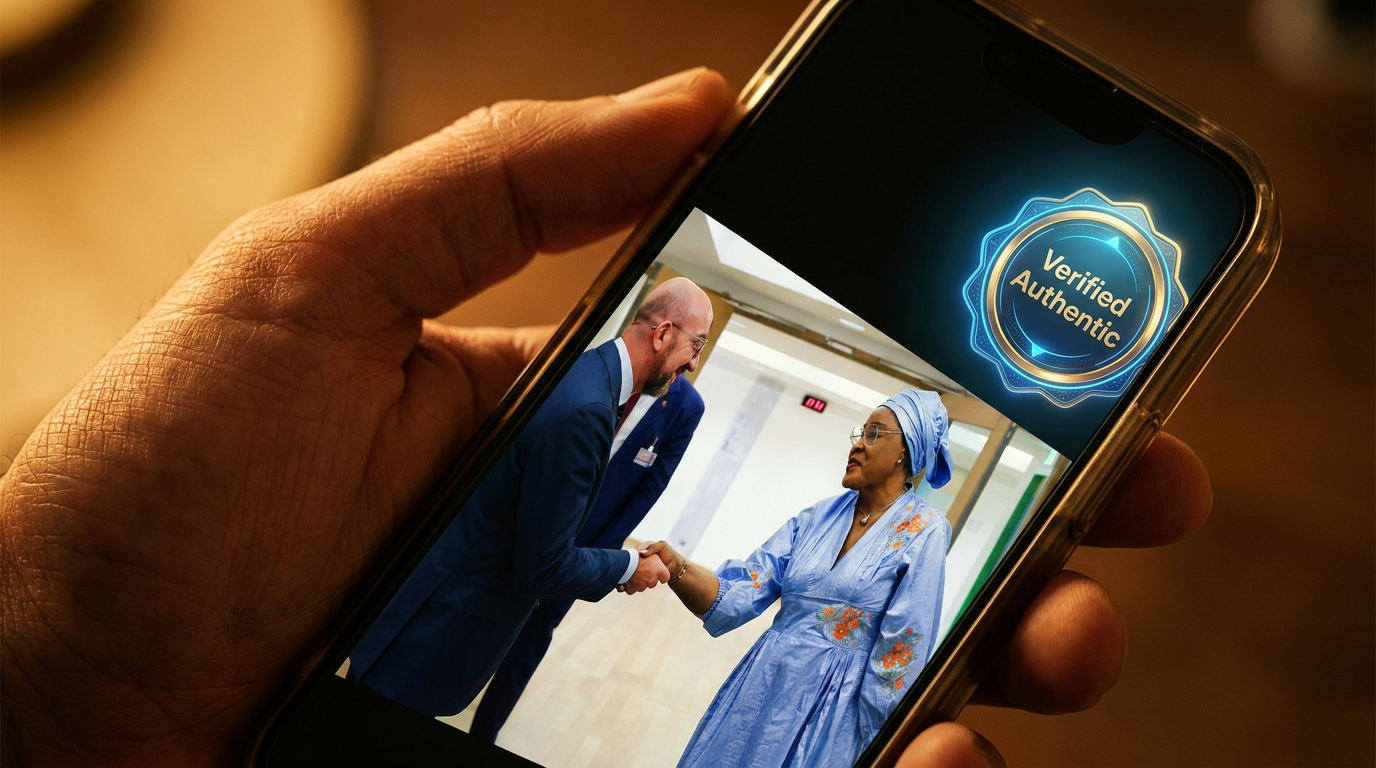
A new open-source standard called Content Credentials is fundamentally changing political fact-checking by embedding unalterable history data directly into digital images and videos.
By Factlen Editorial Team
- Verification Advocates
- Argue that cryptographic provenance is the only scalable, mathematical defense against the proliferation of AI-generated misinformation.
- Academic & Security Analysts
- Acknowledge the benefits of the standard but emphasize its technical limitations, particularly physical workarounds like the analog hole.
- Privacy Defenders
- Warn that mandatory verification creates a digital surveillance infrastructure that could algorithmically silence anonymous whistleblowers.
What's not represented
- · Independent freelance journalists operating in authoritarian regimes
Why this matters
As AI-generated media becomes indistinguishable from reality, this technology shifts the burden of proof. Instead of forcing voters to guess if a political video is real, the file itself carries mathematical proof of its origin, empowering citizens to make informed decisions.
Key points
- A new open-source standard embeds unalterable history data into digital media.
- Major tech platforms are algorithmically prioritizing media with verified provenance.
- Stanford research shows credentialed images are 78% less likely to be flagged as misleading.
- Security researchers warn that physically re-recording a screen can still bypass the system.
- Privacy advocates caution that algorithmic demotion of unverified media threatens anonymous speech.
The landscape of political fact-checking has shifted dramatically in 2026. Instead of chasing down deepfakes days after they go viral, a coalition of newsrooms and tech platforms has adopted a proactive approach: cryptographic "nutrition labels" for digital media. This shift represents a rare moment of technological consensus aimed at protecting the integrity of the information ecosystem.[1][7]
Known formally as Content Credentials, this open-source standard was developed by the Coalition for Content Provenance and Authenticity (C2PA). It represents a fundamental pivot in how society establishes truth online, moving away from post-publication debunking and toward pre-publication verification at the hardware level.[3]
The core claim driving this adoption is that cryptographic provenance provides an unforgeable chain of custody. When a photo is taken or a video is recorded on a supported device, the hardware embeds a secure, hidden signature containing metadata about the exact time, location, and device used to capture the moment.[2][3]
As the file moves through editing software, every subsequent alteration—from basic color correction to AI-generated background fills—is cryptographically appended to this history. By the time the image reaches a social media feed, users can click a small "CR" (Content Credentials) icon to view its entire lifecycle in a standardized, easy-to-read format.[3][7]

Evidence for the system's efficacy is mounting rapidly. A comprehensive study published this month by the Stanford Internet Observatory analyzed over 100,000 political images circulated during the early 2026 primary season, providing the first large-scale empirical data on the standard's impact.[4]
The researchers found that images carrying intact Content Credentials were 78% less likely to be flagged as misleading by independent fact-checkers compared to uncredentialed media. Furthermore, user trust metrics indicated that voters are rapidly learning to look for the verification badge before sharing sensational political claims, acting as a behavioral friction point against viral outrage.[1][4]
Major platforms have responded to these findings by altering their algorithmic distribution models. Reuters reports that Meta, Google, and X have quietly updated their recommendation engines to prioritize media that includes verifiable provenance data, effectively throttling the reach of anonymous, unverified deepfakes.[1]

Major platforms have responded to these findings by altering their algorithmic distribution models.
"We are finally giving consumers the tools to verify reality at a glance," notes the technical specification documentation, which outlines how the hashing algorithms resist tampering even by advanced state-sponsored actors. If a bad actor attempts to strip the metadata, the cryptographic signature breaks, instantly flagging the file as potentially manipulated.[2][3]
However, the evidence also highlights significant limitations and transparent uncertainties within the system. The most prominent vulnerability identified by security researchers is known as the "analog hole," a physical workaround to digital security.[6]
According to peer-reviewed research published on arXiv, a malicious actor can simply use a high-definition camera to record a screen displaying an AI-generated deepfake. Because the new recording is technically an original file captured by a real camera, it generates a fresh, "authentic" credential, effectively laundering the synthetic content into the ecosystem.[6][7]

Privacy advocates also raise substantial concerns about the normalization of this technology. The Electronic Frontier Foundation (EFF) argues that while Content Credentials help combat political misinformation, they simultaneously threaten the fundamental right to anonymous speech.[5]
"If platforms begin to algorithmically suppress any media lacking cryptographic provenance, we risk silencing whistleblowers, dissidents, and activists who rely on stripping metadata to protect their identities and their lives," the EFF report warns.[5]
This tension between verification and privacy has led to a bifurcated adoption curve. While major news organizations, official political campaigns, and government agencies have eagerly integrated C2PA workflows to prove their authenticity, independent creators and human rights organizations remain highly hesitant.[2][5]

To address this, the latest iteration of the C2PA standard introduces "redacted provenance." This feature allows creators to mathematically prove a file was not AI-generated without revealing the specific location coordinates or device serial numbers. Early testing suggests this compromise is gaining traction among freelance journalists operating in sensitive environments.[3][7]
Ultimately, the 2026 election cycle is serving as the first massive stress test for cryptographic fact-checking. While it cannot entirely eliminate the creation of political deepfakes, the evidence strongly suggests it has successfully raised the cost, complexity, and friction of distributing them at scale.[4][7]
How we got here
2021
The C2PA coalition is founded by major technology and media companies to develop an open standard.
2023
The first major consumer cameras are released with hardware-level cryptographic signing capabilities.
2024
Leading AI image generators begin embedding watermarks and basic provenance data into synthetic media.
Early 2026
Major social platforms begin algorithmically prioritizing credentialed media ahead of the midterm elections.
Viewpoints in depth
Verification Advocates
Tech platforms and major publishers argue that cryptographic provenance is the only scalable defense against AI misinformation.
Proponents of the C2PA standard argue that the era of manual fact-checking is over. With generative AI capable of producing millions of hyper-realistic images per minute, human fact-checkers simply cannot keep up. By shifting the burden of proof to the point of creation, verification advocates believe we can rebuild trust in digital media. They point to the seamless integration of the 'CR' badge into major social feeds as proof that cryptographic security can be made user-friendly.
Privacy & Open-Source Defenders
Civil liberties groups warn that mandatory verification creates a surveillance infrastructure that harms anonymous speech.
Organizations like the EFF argue that the right to speak anonymously is a cornerstone of a free society. If social media algorithms begin to bury any photo or video that lacks a cryptographic signature, dissidents, whistleblowers, and activists who strip metadata to protect their physical safety will be effectively silenced. They argue that while 'redacted provenance' is a step in the right direction, the overarching push toward a fully verified internet inherently marginalizes vulnerable populations.
Political Campaigns
Campaign strategists view the credentials as a necessary trust-building tool to prove their own candidates' statements are real.
For political operatives in 2026, Content Credentials have become a defensive necessity. In an environment where any gaffe can be dismissed as a deepfake (the 'liar's dividend'), campaigns are eagerly adopting C2PA-compliant cameras to mathematically prove that their candidate actually attended a rally or made a specific policy statement. It has become a new baseline for political public relations.
What we don't know
- Whether the 'analog hole' will be exploited at scale by state-sponsored disinformation campaigns.
- How smaller, decentralized social networks will handle the computational overhead of verifying cryptographic signatures.
- If the 'redacted provenance' feature will be sufficient to protect the identities of journalists in hostile environments.
Key terms
- Content Credentials
- A digital 'nutrition label' embedded in a file that shows how a piece of media was created and edited.
- Cryptographic Hashing
- A mathematical algorithm that turns data into a unique, unforgeable string of characters to prove it hasn't been tampered with.
- The Analog Hole
- A vulnerability where digital security is bypassed by physically recording a screen or printing an image.
- Provenance
- The chronology of the ownership, custody, or location of a historical object or digital file.
Frequently asked
Does this mean I can't post anonymous photos anymore?
No. You can still post uncredentialed photos, but social media algorithms may not recommend them as widely to other users, limiting their viral reach.
Can AI companies just fake the credentials?
The credentials rely on hardware-level cryptographic keys that are extremely difficult to forge without physical access to the camera manufacturing process.
What happens if I edit a verified photo to make a meme?
The editing software will add a new layer to the credential showing exactly what was changed, preserving the original history while allowing creative edits.
Sources
Source coverage
7 outlets
3 viewpoints surfaced







[1]ReutersVerification Advocates
Tech giants roll out mandatory Content Credentials for 2026 election ads
Read on Reuters →[2]WiredVerification Advocates
The invisible watermark fighting political deepfakes
Read on Wired →[3]C2PA Official SpecificationVerification Advocates
Technical Specification for Content Provenance
Read on C2PA Official Specification →[4]Stanford Internet ObservatoryAcademic & Security Analysts
Efficacy of Cryptographic Provenance in Mitigating Misinformation
Read on Stanford Internet Observatory →[5]Electronic Frontier FoundationPrivacy Defenders
Content Credentials and the Right to Anonymous Speech
Read on Electronic Frontier Foundation →[6]arXivAcademic & Security Analysts
Vulnerabilities in Digital Watermarking: The Analog Hole
Read on arXiv →[7]Factlen Editorial TeamAcademic & Security Analysts
Synthesis by Factlen editorial team
Read on Factlen Editorial Team →
More in news politics
See all 11 stories →US-Iran Deal
How the Fragile US-Iran Peace Deal Could Unravel Over Lebanon
8 sources
Lebanon Border
Israel Limits Lebanon Actions to Salvage US-Iran Deal, but Refuses to Withdraw
7 sources

NLRB Powers
Supreme Court Declines Macy's Appeal, Leaving Expanded NLRB Penalties Intact
6 sources
Downing Street Crisis
UK Prime Minister Keir Starmer on the Brink as Andy Burnham Mounts Leadership Threat
7 sources
Every angle. Every day.
Get news politics stories with full source coverage and perspective breakdowns delivered to your inbox.