
The Science of Space: How Neuroaesthetics is Rewiring Interior Design for Mental Health
Emerging research at the intersection of neuroscience and architecture reveals that interior design choices trigger measurable biological responses. By applying the principles of neuroaesthetics, designers are transforming homes and offices into active tools for stress reduction and cognitive support.
By Factlen Editorial Team
- Architects and Interior Designers
- Focuses on translating clinical neuroscience into practical, aesthetic applications that enhance the emotional experience of a home or office.
- Neuroscientists and Researchers
- Focuses on empirical data, brain imaging, and measurable biological markers to validate how spaces affect human physiology.
- Public Health Advocates
- Views evidence-based architecture as a crucial component of collective well-being and preventive care for communities.
What's not represented
- · Neurodivergent individuals who may process sensory inputs differently
- · Low-income communities lacking access to thoughtfully designed public infrastructure
Why this matters
Because humans spend roughly 90% of their lives indoors, the physical spaces we inhabit are quietly dictating our baseline stress levels, sleep quality, and focus. Understanding how to align your environment with your nervous system offers a powerful, passive way to improve your daily mental health.
Key points
- Neuroaesthetics uses brain science to understand how interior design choices physically affect our bodies and minds.
- Environments with natural light, curved shapes, and biophilic elements actively lower cortisol and increase dopamine.
- Lighting is a critical tool, as it directly regulates the body's circadian rhythms and sleep cycles.
- Evidence-based design is increasingly used in hospitals and schools to accelerate healing and improve concentration.
Have you ever walked into a room and felt an immediate, inexplicable sense of calm? For decades, interior designers attributed this phenomenon to good taste, intuition, or an elusive sense of flow. But modern science suggests something far more mechanical is at play. When you enter a thoughtfully designed space, your brain is not merely observing aesthetics; it is undergoing a measurable biological reaction. Heart rates slow, blood pressure drops, and stress hormones recede. This is the foundation of neuroaesthetics, an emerging discipline that is rapidly transforming how architects and designers approach the built environment.[1][8]
At its core, neuroaesthetics is the scientific study of how the brain responds to beauty, form, and spatial arrangement. It sits at the intersection of neuroscience, psychology, and architecture, shifting interior design from a purely subjective art form into an evidence-based health intervention. The formal study of the field began in the early 2000s when neurobiologist Semir Zeki coined the term, using brain imaging to observe how people respond to visual stimuli. Today, the discipline has moved out of the laboratory and into living rooms, offices, and hospitals, driven by a growing recognition that our surroundings actively shape our mental health.[4][8]
The urgency behind neuroaesthetics stems from a stark modern reality: humans now spend approximately 90 percent of their lives indoors. For 99.9 percent of human history, our nervous systems evolved in direct contact with nature, calibrating our biological rhythms to the sun, natural textures, and organic shapes. When we are placed in environments that mimic these natural patterns, our bodies respond with a cellular sense of recognition. Conversely, harsh lighting, cramped layouts, and synthetic materials can trigger low-grade, chronic stress responses, subtly undermining our well-being day after day.[1][6]
The biological mechanisms driving these reactions are now visible thanks to advanced functional magnetic resonance imaging. When a person experiences a space they find beautiful or harmonious, blood flow increases to the medial orbitofrontal cortex, a region of the brain associated with reward, pleasure, and emotional regulation. This activation triggers the release of dopamine and serotonin, neurotransmitters that boost mood and motivation. According to researchers, simply being in a well-designed space can produce neurological effects comparable to the joy of seeing a loved one.[3][4]

One of the most potent tools in the neuroaesthetic arsenal is lighting. Because our circadian rhythms are exquisitely sensitive to light, the bulbs and fixtures we choose dictate our hormone production. Natural daylight, or artificial lighting that mimics its progression, synchronizes our internal clocks, supporting focus in the morning and relaxation in the evening. Studies show that poor lighting disrupts these rhythms, contributing to fatigue, anxiety, and sleep disorders. In contrast, layered lighting—warm and diffuse for rest, cool and bright for focus—can actively lower cortisol levels and elevate mood.[1][5]
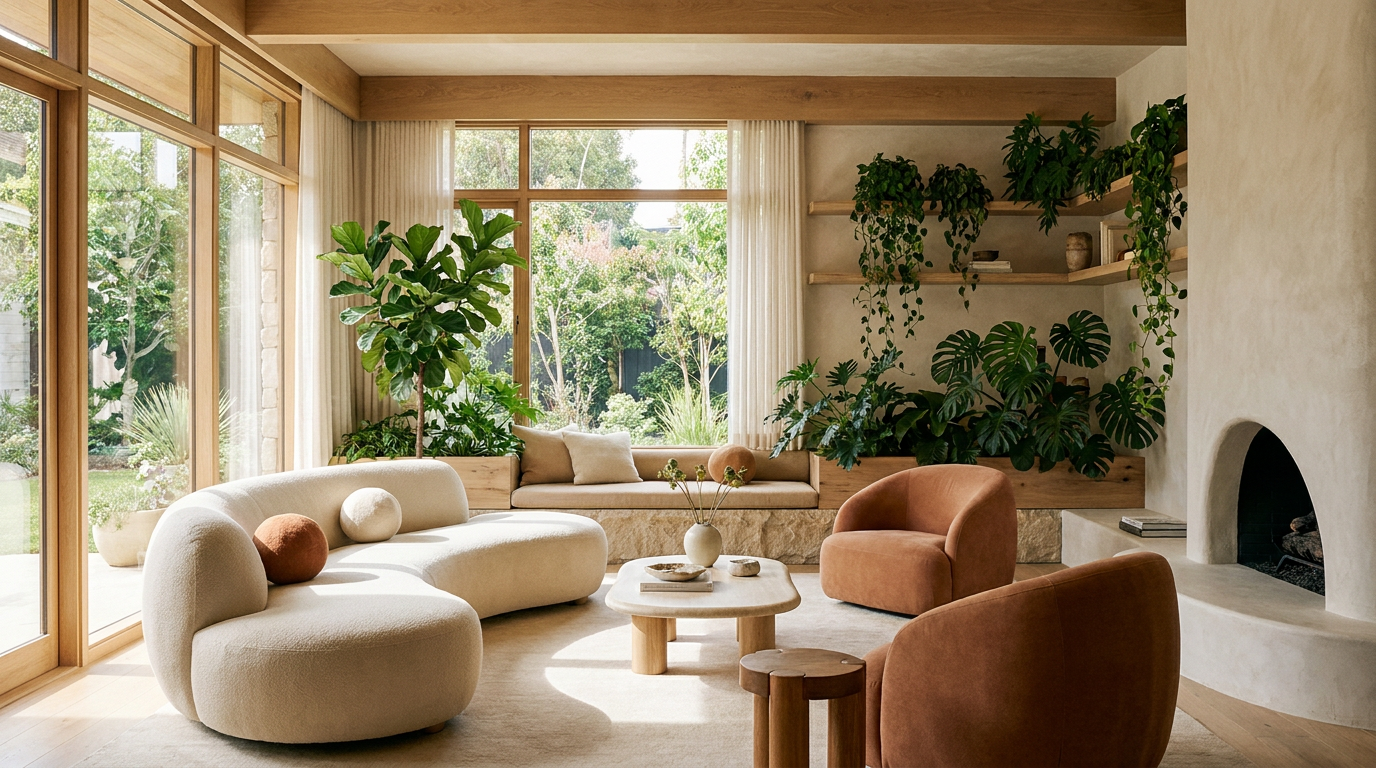
Beyond light, the physical shapes within a room profoundly influence our psychological state. The human brain exhibits a strong, hardwired preference for curved, organic silhouettes over sharp angles and rigid geometry. From an evolutionary perspective, sharp objects signal danger, subtly activating the amygdala, the brain's threat-detection center. Smooth, rounded furniture and arched doorways, however, signal safety and comfort. Designers are increasingly incorporating these curvilinear forms to create environments that feel inherently welcoming and harmonious, bypassing conscious thought to soothe the nervous system directly.[5]
This evolutionary preference extends to biophilic design, the practice of integrating natural elements into the built environment. Neuroaesthetics proves that bringing the outdoors inside is not just a stylistic trend; it is a cognitive necessity. Exposure to natural materials like wood, stone, and wool stimulates the somatosensory cortex, producing feelings of grounding and authenticity. Even visual access to greenery or artwork depicting natural scenes has been shown to lower anxiety and improve working memory, as the brain responds to nature's fractal patterns with a deep sense of restoration.[3][5]

This evolutionary preference extends to biophilic design, the practice of integrating natural elements into the built environment.
Color psychology, long a staple of design, has also been validated and refined by neuroaesthetic research. The hues that surround us do more than reflect personal taste; they act as emotional triggers. Soft blues and greens are known to lower blood pressure and promote tranquility, making them ideal for bedrooms and restorative spaces. Warmer tones, such as subtle oranges and reds, stimulate energy and social interaction. By intentionally mapping colors to the desired function of a room, designers can create emotional landscapes that actively support the activities taking place within them.[3][5]
The auditory and tactile dimensions of a space are equally critical to the neuroaesthetic experience. Unpredictable or echoing noise elevates cortisol and maintains the body in a heightened state of alertness. To combat this, designers employ acoustic panels, soft furnishings, and strategic layouts to absorb sound and create a positive acoustic environment. Tactility plays a similar grounding role; the physical sensation of touching natural, varied textures anchors the mind in the present moment, offering a subconscious counterweight to the digital screens that dominate modern life.[1][5]
The practical applications of these principles are already reshaping commercial and institutional architecture. In healthcare, the impact of evidence-based design is undeniable. Landmark studies have demonstrated that hospital patients with access to daylight and views of nature require less pain medication and recover faster than those in windowless rooms. By prioritizing natural light, calming materials, and intuitive wayfinding, modern medical facilities are utilizing architecture as an active participant in the healing process, reducing stress for both patients and healthcare workers.[3][6]
In educational and corporate settings, neuroaesthetics is proving to be a powerful catalyst for focus and productivity. Research indicates that employees working in biophilic offices report a 15 percent increase in productivity and significantly lower rates of fatigue. Similarly, classrooms designed with dynamic daylighting, warm wooden finishes, and moderate visual complexity have been shown to enhance student concentration and emotional stability. Even retail environments, like grocery stores, utilize these principles—employing specific lighting and spatial flows to energize shoppers and direct their attention.[3][7]

Yet, the most intimate frontier for neuroaesthetics is the home. In an era where residences frequently double as workspaces, the cognitive load placed on our domestic environments has never been higher. Neuroaesthetic design invites homeowners to decorate from the inside out, prioritizing how a space feels over how it photographs. This means evaluating the sensory impact of a room: the quality of morning light, the acoustics of a home office, and the tactile comfort of a living area. When a home is aligned with the nervous system, it becomes a tool for resilience.[2][8]
Crucially, implementing neuroaesthetic principles does not require a luxury budget or a complete architectural overhaul. The science emphasizes intentionality over expense. Simple interventions—such as rearranging furniture to maximize natural light, introducing a few potted plants, or swapping harsh overhead bulbs for warm, dimmable lamps—can yield measurable biological benefits. The goal is to reduce visual clutter and sensory friction, creating a balanced environment that provides enough anchors to engage the brain without tipping into chaotic overload.[2][8]
Despite its rapid adoption, the field of neuroaesthetics is still navigating areas of uncertainty. One of the primary frontiers of ongoing research is neurodivergence. Because sensory processing varies dramatically among individuals—particularly those with autism or ADHD—a lighting scheme or spatial layout that calms one person might overwhelm another. Designers and scientists are currently working to understand how to create adaptable, inclusive spaces that can be customized to meet diverse neurological needs, ensuring that the benefits of evidence-based design are accessible to everyone.[8]

Ultimately, the rise of neuroaesthetics represents a profound shift in how we value our surroundings. It dismantles the notion that interior design is a superficial pursuit, repositioning it as a fundamental component of preventive mental healthcare. By bridging the gap between art and biology, designers are gaining the tools to craft spaces that do more than shelter us. They are creating environments that actively care for us, proving that beauty, when understood through the lens of science, is a biological imperative.[2][3][8]
How we got here
1984
A landmark study by Roger Ulrich proves that hospital patients with views of nature recover faster and require less pain medication.
Early 2000s
Neurobiologist Semir Zeki formally coins the term 'neuroaesthetics' to describe the neural mechanisms of aesthetic experiences.
2015
The HEAD project publishes research demonstrating that classroom design elements like daylight and color significantly impact student learning.
2026
Neuroaesthetics transitions from a niche academic concept into a foundational, evidence-based pillar of mainstream interior design.
Viewpoints in depth
Neuroscientists' view
Emphasizes the measurable, biological impact of our surroundings on the human brain.
Researchers in this camp rely on fMRI scans and biometric data to prove that aesthetics are not subjective, but physiological. They focus on how spatial stimuli—like light, color, and shape—directly alter heart rate variability, cortisol production, and neurotransmitter release. For them, design is a medical intervention that can either support or degrade cognitive function and emotional regulation.
Interior Designers' view
Focuses on translating clinical data into beautiful, livable spaces that support daily life.
Design professionals view neuroaesthetics as a tool to validate their intuitive practices. They take the clinical findings about circadian rhythms and the amygdala's threat response and translate them into actionable choices: selecting the right color temperature for a bulb, sourcing curved furniture, or layering tactile fabrics. Their goal is to create environments that feel effortlessly comforting without looking like clinical health facilities.
Public Health Advocates' view
Views evidence-based architecture as a crucial component of collective well-being and preventive care.
This perspective argues that if our built environment dictates our stress levels, then access to good design is a public health issue. They advocate for integrating neuroaesthetic principles into hospitals, public schools, and affordable housing, rather than reserving them for luxury private residences. They point to data showing faster patient recovery times and better student focus as proof that architecture should be treated as a pillar of community health.
What we don't know
- How to perfectly standardize neuroaesthetic principles for neurodivergent individuals, whose sensory processing can vary dramatically.
- The long-term, multi-generational psychological effects of living in exclusively synthetic, non-biophilic environments.
Key terms
- Neuroaesthetics
- The scientific study of how the brain and nervous system respond to beauty, art, and spatial design.
- Biophilic Design
- An architectural approach that connects building occupants more closely to nature by incorporating natural lighting, plants, and organic materials.
- Medial Orbitofrontal Cortex
- A region of the brain associated with reward, pleasure, and emotional regulation that activates in response to beautiful environments.
- Circadian Rhythm
- The internal 24-hour biological clock that regulates sleep-wake cycles and hormone production, heavily influenced by light exposure.
- Somatosensory Cortex
- The part of the brain that processes tactile sensations, stimulated by touching natural textures like wood or stone.
Frequently asked
What exactly is neuroaesthetics?
It is the scientific study of how the brain and nervous system respond to beauty, form, and spatial environments, combining neuroscience with interior design and architecture.
Do I need a large budget to apply neuroaesthetics?
No. Simple, low-cost changes like maximizing natural light, adding indoor plants, and using warm, layered lighting can significantly improve a space's biological impact.
How does lighting affect mental health?
Natural and layered lighting synchronizes our circadian rhythms, which helps regulate sleep cycles, lower stress hormones like cortisol, and boost overall mood.
Why does the brain prefer curved furniture?
Evolutionary biology suggests that sharp angles can subconsciously signal danger and trigger the amygdala, while curved, organic shapes signal safety and comfort.
Sources
Source coverage
8 outlets
3 viewpoints surfaced








[1]Science in DesignNeuroscientists and Researchers
The Science Behind Light and Health: Neuroaesthetics
Read on Science in Design →[2]LivingetcArchitects and Interior Designers
Neuroaesthetics: Decorating from the inside out
Read on Livingetc →[3]Pearl AcademyNeuroscientists and Researchers
The Brain, Beauty, and Built Environments
Read on Pearl Academy →[4]OpulistNeuroscientists and Researchers
The Neuroscience of Beauty and Space
Read on Opulist →[5]Creative Office ResourcesArchitects and Interior Designers
Design That Feels: How Neuroaesthetics Connects Science and Intuition
Read on Creative Office Resources →[6]NeurotecturaPublic Health Advocates
What Is Neuroarchitecture?
Read on Neurotectura →[7]BaskervillArchitects and Interior Designers
Neuroarchitecture: How Design Affects the Brain
Read on Baskervill →[8]Factlen Editorial TeamPublic Health Advocates
Synthesis by Factlen editorial team
Read on Factlen Editorial Team →


Every angle. Every day.
Get lifestyle stories with full source coverage and perspective breakdowns delivered to your inbox.