
Why AI Companies Are Cleaning Apartments for Free
Robotics startups are offering free house cleaning services in exchange for first-person video data to train the next generation of humanoid home helpers.
By Factlen Editorial Team
- AI Robotics Developers
- Argue that real-world, unstructured data is the only path to achieving true autonomous home helpers.
- Consumer Early Adopters
- Value the immediate benefit of free services and the promise of future automation over ambient privacy concerns.
- Privacy Advocates
- Warn that trading intimate home footage for free chores normalizes invasive surveillance and risks data leaks.
What's not represented
- · Professional domestic workers whose labor value may be impacted by the eventual deployment of autonomous robots.
Why this matters
The biggest hurdle to getting a robotic butler isn't building the hardware—it's teaching the software how to navigate the chaotic, unpredictable environment of a real human home. By trading free services for training data, companies are rapidly accelerating the timeline for affordable, autonomous household robots.
Key points
- Startups are offering free home cleaning services in exchange for recording the process on camera.
- The video data is used to train 'embodied AI' models for future humanoid household robots.
- Real-world homes provide unpredictable clutter that cannot be easily simulated in a laboratory.
- In China, early-stage robots are already being deployed alongside human cleaners to learn on the job.
- The household robot market is projected to reach $17.4 billion in 2026 as capabilities expand.
When a New York City resident books a free deep clean through the startup Shift, the human cleaner arrives wearing a crisp uniform and a highly unusual accessory: a specialized hat rigged with cameras. As the worker scrubs countertops, vacuums rugs, and folds laundry, every movement is recorded in first-person video. This isn't a reality television stunt or an avant-garde art project. It is the latest, highly lucrative data-gathering strategy in the race to build autonomous household robots.[1][2]
For decades, robots have excelled in structured environments like factory floors and automated warehouses, where every object is predictable and perfectly aligned. But human homes are chaotic. Every apartment features a unique layout, different furniture dimensions, and unpredictable clutter. A robot trained in a sterile laboratory simulation will inevitably fail when confronted with a stray sock, an oddly shaped coffee table, or a pet running across the room.[4][6]
To bridge this gap, artificial intelligence companies need massive amounts of real-world data. Specifically, they need first-person footage of humans performing tasks in messy, uncontrolled environments. This data is fed into physical-AI models, teaching machines the nuances of spatial awareness, object manipulation, and physics. Shift, backed by the German data firm MicroAGI, calculates that the value of the video data harvested during a single cleaning session far exceeds the cost of paying a human professional to do the work.[2][6]

The economics of this data-as-subsidy model are compelling. By offering a valuable service for free, companies can bypass the immense cost of staging artificial environments. Consumers trade ambient privacy and home access for a spotless apartment, creating a scalable pipeline for the exact type of dexterous manipulation data that robotics labs desperately need. Within hours of launching its New York pilot, Shift received thousands of bookings, proving that many residents are more than willing to make the trade.[6]
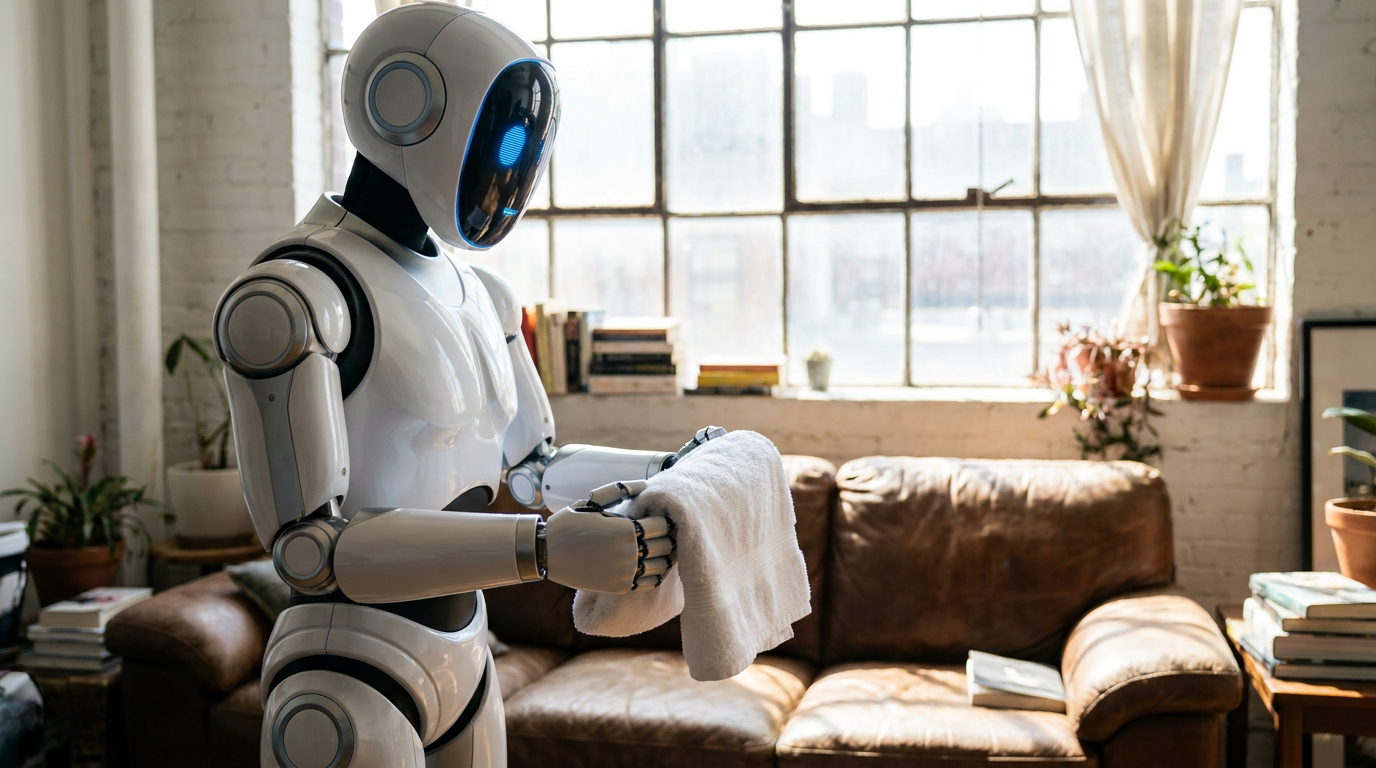
This data rush is not confined to the United States. In China, robotics pioneers are taking the concept a step further by deploying actual humanoid robots alongside human cleaners. In Shenzhen, a company called X Square Robot has partnered with a local home services platform to send its Quanta X1 Pro robot into residential apartments. While a human housekeeper tackles complex deep-cleaning tasks in the bedrooms, the 1.6-meter-tall robot navigates the living room, picking up trash, organizing surfaces, and wiping tables.[4][5]
In China, robotics pioneers are taking the concept a step further by deploying actual humanoid robots alongside human cleaners.
Putting robots to work in actual homes is proving vastly more effective than laboratory training. After each session, the Quanta robot uploads anonymized perception and operation data to a central platform to refine its model. The learning curve is steep but rapid. During its first in-home test, the machine took over ten minutes just to successfully pick up a towel. Within a week of continuous real-world exposure, it could independently wipe down a table and navigate around scattered shoes.[5]

Other Chinese firms are aggressively targeting the domestic market. GigaAI recently unveiled the SeeLight S1, a two-armed, wheeled robot designed specifically for household chores. In demonstrations, the machine can chop vegetables, fry eggs, load a washing machine, and make a bed. Rather than relying on hard-coded routines, the S1 uses embodied artificial intelligence—a digital brain wired directly into a physical body—to autonomously understand tasks and plan its movements. The company plans to deploy a fleet of 100 units for free trials in Wuhan homes by 2027, with a target retail price of around $15,000.[3][4]
Meanwhile, Silicon Valley startups are exploring alternative methods to capture human dexterity. Companies like Physical Intelligence are focusing purely on creating the "robot brain"—the underlying AI software that can be licensed to any hardware manufacturer. Others use haptic gloves worn by human workers to capture precise force-feedback and joint-movement data without needing a camera rig. This diverse array of approaches highlights a shared industry consensus: proprietary real-world training data, rather than hardware design, will be the ultimate competitive moat.[1][6]

The transition from passive smart-home devices to active, physical machines represents a monumental shift in consumer technology. For years, setting up a smart home meant installing thermostats, speakers, and lights that operated quietly in the background. The new wave of embodied AI promises machines that physically interact with the environment, offering independence for older adults, support for disabled individuals, and significant time savings for busy families. Analysts project the household robot market will reach $17.4 billion in 2026, driven by this leap in capability.[7]
Naturally, the aggressive collection of domestic data raises significant privacy questions. Inviting camera-clad workers or sensor-heavy robots into bedrooms and living rooms requires a profound level of consumer trust. Companies involved in these data-harvesting programs state that they use automated software to blur faces, personal documents, and other sensitive information before the footage is ever used for AI training. However, privacy advocates warn that technical failures could still expose intimate moments, urging robust regulatory frameworks as these services expand.[1][2]
Despite these concerns, the momentum is undeniable. As the data flywheel accelerates—more homes cleaned means better data, which leads to smarter robots, which can clean more homes—the timeline for capable robotic assistants is compressing. What was once relegated to science fiction is rapidly becoming an engineering reality, built on a foundation of free chores and first-person video.[2][6]
How we got here
Early 2020s
Robotics labs rely primarily on synthetic data and controlled laboratory environments to train physical AI.
Jan 2026
Major tech brands unveil early AI-powered humanoid robots capable of basic chores at the CES exhibition.
Mar 2026
X Square Robot launches a hybrid cleaning service in China, pairing human workers with learning robots.
May 2026
Startup Shift launches a free cleaning service in NYC specifically to harvest first-person training video.
2027 (Projected)
GigaAI plans to deploy 100 SeeLight S1 humanoid robots for free trials in Wuhan homes.
Viewpoints in depth
AI Robotics Developers
Argue that real-world, unstructured data is the only path to achieving true autonomous home helpers.
For robotics engineers, the physical world is the ultimate edge case. They argue that laboratory simulations and synthetic data can only take a physical-AI model so far. A robot might perfectly fold a shirt in a lab, but fail completely when that shirt is draped over a chair in a dimly lit bedroom. By harvesting first-person video from real homes, developers believe they can finally cross the 'sim-to-real' gap, teaching machines the generalized spatial awareness and dexterity required to be genuinely useful to consumers.
Consumer Early Adopters
Value the immediate benefit of free services and the promise of future automation over ambient privacy concerns.
Many consumers view the trade-off as a highly rational transaction. In expensive urban centers like New York, professional deep cleaning can cost hundreds of dollars. For these early adopters, allowing an anonymized camera rig into their home is a small price to pay for a premium service. Furthermore, many are enthusiastic about accelerating the development of robotic assistants, viewing their participation as a contribution to a future where humans are liberated from mundane household chores.
Privacy Advocates
Warn that trading intimate home footage for free chores normalizes invasive surveillance and risks data leaks.
Privacy watchdogs caution against the normalization of corporate cameras in private domestic spaces. While companies promise automated blurring of faces and documents, advocates point out that AI redaction is never flawless. They argue that the layout of a home, the brands of products consumed, and ambient background details constitute highly sensitive personal data. There is also concern about the long-term implications of physical-AI data brokers amassing vast libraries of interior residential footage, urging stricter regulations on how this data can be stored, shared, and monetized.
What we don't know
- How reliably automated blurring software can protect sensitive personal information captured in real-world homes.
- Whether consumers will be willing to pay the high initial retail prices (e.g., $15,000) for early-generation home robots.
- Exactly how long it will take for a fully autonomous robot to match the speed and efficiency of a human cleaner.
Key terms
- Embodied AI
- Artificial intelligence that interacts with the physical world through a robotic body, rather than just existing as software on a screen.
- Physical-AI models
- AI systems specifically designed to understand physics, spatial awareness, and object manipulation in real-world environments.
- Sim-to-real gap
- The challenge of transferring skills a robot learned in a computer simulation into the unpredictable physical world.
- Haptic gloves
- Wearable devices that capture precise hand movements and force feedback, used to teach robots complex dexterity.
Frequently asked
Why do AI companies need video of people cleaning?
Homes are chaotic, unpredictable environments. Video of humans navigating real clutter helps train robots to handle the nuances of a normal house, which cannot be easily simulated in a sterile lab.
Are the robots actually cleaning the houses right now?
In most cases, human workers wearing cameras do the cleaning to collect data. However, some companies in China are beginning to send early-stage robots to assist humans and learn simple tasks on the job.
What about privacy concerns with cameras in the home?
Companies state that they use software to automatically blur faces, documents, and other sensitive information before the footage is used for AI training, though privacy advocates remain cautious about potential technical failures.
Sources
Source coverage
7 outlets
3 viewpoints surfaced







[1]BBCPrivacy Advocates
Why an AI company cleaned my New York City apartment for free
Read on BBC →[2]The VergeConsumer Early Adopters
Shift startup offers free house cleaning in exchange for robot training videos
Read on The Verge →[3]Fast CompanyAI Robotics Developers
China is deploying the first home cleaning humanoid robot butlers
Read on Fast Company →[4]South China Morning PostAI Robotics Developers
China's robotics pioneers are rapidly expanding beyond the usual factory surroundings
Read on South China Morning Post →[5]The Straits TimesConsumer Early Adopters
A humanoid robot, Quanta X1 Pro, is being sent to homes to perform cleaning tasks and learn on the job
Read on The Straits Times →[6]SemaforAI Robotics Developers
Shift trades free home cleaning for robot training data
Read on Semafor →[7]Homes and Gardens
CES 2026: AI Humanoid Robots Can Now Wash Dishes and Do Laundry
Read on Homes and Gardens →
Every angle. Every day.
Get technology stories with full source coverage and perspective breakdowns delivered to your inbox.