
The Great Office-to-Apartment Pivot: How 90,000 Units Are Reshaping Empty Downtowns
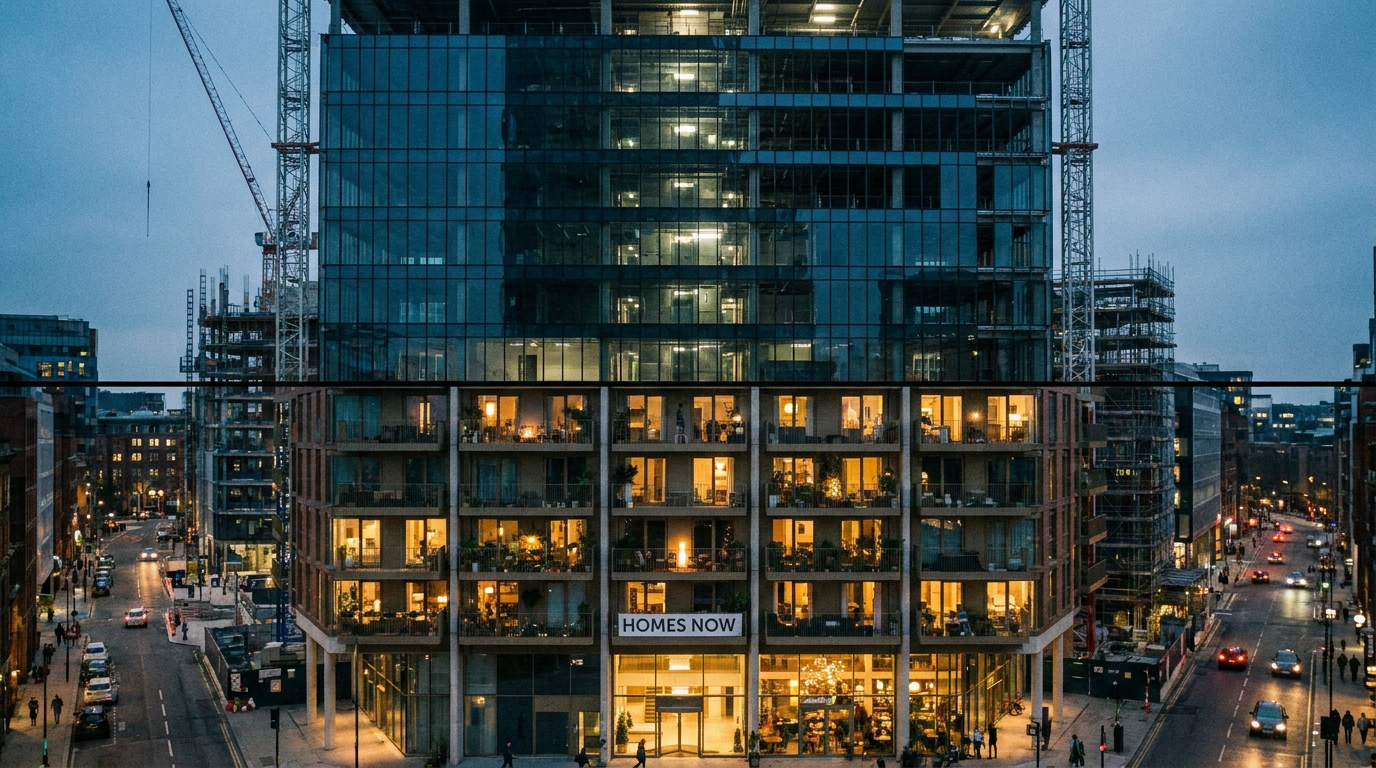
With remote work leaving millions of square feet of commercial real estate vacant, developers are converting office buildings into residential apartments at a record pace. A new wave of 2026 data reveals that adaptive reuse is moving from a niche architectural concept to a mainstream solution for the urban housing shortage.
By Factlen Editorial Team
- Urban Planners & Developers
- View conversions as a dual-purpose tool to revitalize dead downtowns and add housing stock.
- Commercial Real Estate Owners
- See conversions primarily as a financial lifeline for distressed, obsolete office assets.
- Housing Policy Skeptics
- Warn that conversions are a costly distraction that fails to deliver affordable housing without heavy subsidies.
What's not represented
- · Construction Labor Unions
- · Downtown Small Business Owners
Why this matters
The transformation of empty office towers into housing represents a once-in-a-generation shift in how American cities function. For renters, it promises an influx of new apartments in highly walkable downtowns, while for cities, it offers a concrete lifeline to save local economies hollowed out by remote work.
Key points
- The U.S. pipeline for office-to-apartment conversions reached a record 90,300 units in early 2026, up 28% from the previous year.
- Office conversions now represent 47% of all adaptive reuse projects nationwide, outpacing hotel and industrial building makeovers.
- New York City leads the country with over 16,000 planned units, followed closely by Washington D.C., Chicago, and Los Angeles.
- An estimated 1.9 billion square feet of U.S. office space is considered architecturally suitable for residential conversion.
- Despite the boom, experts warn that high conversion costs mean most resulting apartments will command market-rate or luxury rents.
The contradiction in American downtowns has become too stark to ignore: millions of square feet of office space sit empty while cities face a crippling shortage of housing. Now, a wave of data from early 2026 indicates that developers are finally bridging that gap at scale, turning the monuments of the 20th-century corporate workforce into the neighborhoods of the 21st.
According to a comprehensive tracking report by RentCafe and Yardi Matrix, there are currently 90,300 apartments in the U.S. pipeline being converted from former office buildings. This represents a 28% year-over-year increase and is nearly four times the volume recorded just four years ago in 2022.[1][6]
What was once considered a niche architectural strategy—adaptive reuse—has rapidly matured into a mainstream development tool. Office-to-residential conversions now account for 47% of all future adaptive reuse projects nationwide, easily outpacing hotel, school, and industrial building conversions.[2][6]

The primary driver of this trend is the structural shift in how Americans work. With national office vacancy rates hovering near 20% and physical occupancy in many buildings stalled at around 50% to 55%, commercial real estate owners are sitting on heavily distressed assets.[1]
"COVID-19 is to the office market what e-commerce was to retail," noted Peter Kolaczynski, director of data and research at Yardi. The resulting collapse in demand for traditional cubicle farms has forced a reckoning, pushing owners to either default, demolish, or convert their properties to survive.[1][3]
New York City is the undisputed epicenter of this transformation. The metro area currently leads the nation with 16,358 future converted units in the pipeline—a staggering 97% year-over-year increase as developers race to capitalize on the city's intense housing demand.[1][6]
The surge in Manhattan and surrounding boroughs is fueled by a combination of older, obsolete office stock, sky-high residential rents, and new policy incentives. A recent CBRE analysis highlighted that the median age of candidate buildings in Manhattan is 68 years, making these pre-war and mid-century structures prime targets for residential makeovers.[4][7]
The surge in Manhattan and surrounding boroughs is fueled by a combination of older, obsolete office stock, sky-high residential rents, and new policy incentives.
But the trend is no longer confined to coastal gateway cities. Washington, D.C. follows with nearly 8,500 units, driven by the need to house workers returning to the city's core. Chicago, Los Angeles, and Dallas round out the top five, while cities like Philadelphia, Denver, and St. Louis have more than doubled their conversion pipelines in a single year.[1][5]

Despite the enthusiasm, the evidence shows that not every empty office tower is destined to become luxury lofts. The CommercialEdge Conversion Feasibility Index estimates that while 1.9 billion square feet of U.S. office space—about 24% of total inventory—is technically suitable for conversion, the architectural hurdles remain steep.[1][2]
The feasibility of a project depends heavily on a building's physical dimensions. Modern office buildings often feature massive, deep floorplates designed for rows of desks under fluorescent lights. Converting these spaces into apartments requires carving out access to natural light and operable windows for every bedroom, which sometimes necessitates cutting a hollow "donut" core into the center of the structure.[3][5]
Plumbing and HVAC systems present another massive capital expenditure. Offices are typically built with centralized utility cores and communal bathrooms. Slicing a floor into a dozen individual apartments means trenching concrete to run new water, sewer, and ventilation lines to every single unit.[5]

Because of these structural realities, conversions are rarely cheap. A report from the Brookings Institution simulated the demographic outcomes of these projects and found that, without heavy public subsidies like the Low-Income Housing Tax Credit (LIHTC), conversions rarely produce affordable housing. They are expensive to execute and thus command market-rate or luxury rents to pencil out.[8]
Furthermore, Brookings researchers caution that office conversions alone cannot solve the national housing crisis. Even if all currently planned conversions are completed, they represent a fraction of the millions of homes needed nationwide, meaning ground-up construction remains essential.[7][8]
However, the localized impact on specific neighborhoods can be profound. By injecting thousands of new residents into central business districts that previously emptied out at 5:00 PM, cities are fostering more vibrant, 24/7 mixed-use neighborhoods that support local retail and restaurants.[4][7]
As the pipeline approaches 100,000 units, the 2026 data proves that the real estate market has crossed a threshold. The era of the single-use downtown office district is ending, replaced by a pragmatic, concrete-and-steel recycling effort that is reshaping the American city from the inside out.
How we got here
1990s - Early 2000s
The first major wave of office-to-residential conversions takes place in Lower Manhattan's Financial District.
March 2020
The COVID-19 pandemic triggers a mass shift to remote work, emptying downtown office buildings overnight.
2022 - 2023
As hybrid work becomes permanent, office vacancies soar and developers begin acquiring distressed commercial properties at steep discounts.
Early 2026
The U.S. conversion pipeline hits a record 90,300 units, marking a nearly 400% increase since 2022.
Viewpoints in depth
Urban Planners & Developers
View conversions as a dual-purpose tool to revitalize dead downtowns and add housing stock.
This camp argues that adaptive reuse is the most efficient way to save central business districts from the "urban doom loop." By replacing transient office workers with permanent residents, cities can sustain local retail, restaurants, and transit. They point to the 1.9 billion square feet of viable conversion space as a generational opportunity to rethink zoning and create 15-minute, mixed-use neighborhoods.
Commercial Real Estate Owners
See conversions primarily as a financial lifeline for distressed, obsolete office assets.
Facing a structural decline in demand due to hybrid work, owners of Class B and C office buildings are sitting on plummeting valuations and looming loan maturities. For this group, residential conversion is less about urban utopianism and more about financial survival. They advocate strongly for tax abatements and streamlined permitting, arguing that the massive capital expenditures required for plumbing and HVAC retrofits make projects unviable without municipal help.
Housing Policy Skeptics
Warn that conversions are a costly distraction that fails to deliver affordable housing without heavy subsidies.
Skeptics, including some housing advocates and policy researchers, note that the sheer cost of gutting an office building means the resulting apartments almost always command luxury rents. They argue that while conversions make downtowns nicer for high-income earners, they do not meaningfully address the severe shortage of low- and middle-income housing. This camp emphasizes that ground-up construction and broad zoning reform in residential neighborhoods yield far more units per dollar spent.
What we don't know
- How many of the 90,300 planned units will actually secure the complex financing required to break ground and reach completion.
- Whether the influx of new downtown residents will be enough to replace the daily foot traffic and retail spending previously generated by office workers.
- If future building code reforms will lower the exorbitant costs of plumbing and HVAC retrofits, making affordable housing conversions more viable.
Key terms
- Adaptive Reuse
- The process of repurposing an existing building for a use other than what it was originally designed for, such as turning a factory or office into apartments.
- Floorplate
- The total leasable square footage of a single floor in a commercial building. Deep floorplates are harder to convert because the interior spaces lack access to windows.
- Class B and C Office Space
- Older, less modern commercial buildings that lack the premium amenities of newer "Class A" buildings. These are the most common targets for residential conversion.
- Conversion Feasibility Index
- A metric used by commercial real estate analysts to evaluate whether a building's physical dimensions, location, and age make it a viable candidate for residential retrofitting.
Frequently asked
What makes an office building good for conversion?
The best candidates are older buildings with narrower floorplates, which allow natural light to reach deep into the residential units. Buildings built before the 1950s often have operable windows and U- or H-shaped designs that are ideal for apartments.
Why are office conversions so expensive?
Offices are designed with centralized utility cores, meaning developers must drill through concrete floors to run new plumbing, sewer, and HVAC lines to every individual apartment. Upgrading fire safety and egress to meet residential codes also adds significant costs.
Will this solve the housing shortage?
No. While the 90,000 units currently in the pipeline will help revitalize specific downtown neighborhoods, researchers note that the U.S. is short millions of homes, requiring a much broader approach that includes new construction.
Which cities are converting the most offices?
New York City currently leads the nation by a wide margin, followed by Washington D.C., Chicago, Los Angeles, and Dallas.
Sources
Source coverage
8 outlets
3 viewpoints surfaced








[1]Multifamily ExecutiveCommercial Real Estate Owners
Office-to-Apartment Conversions Surge as Pipeline Nears 100,000 Units
Read on Multifamily Executive →[2]ConstructConnectUrban Planners & Developers
Adaptive Reuse Surge: Office-to-Residential Projects Nearly Quadruple Since 2022
Read on ConstructConnect →[3]NAIOPCommercial Real Estate Owners
A record 90,000 apartments are now in the U.S. pipeline
Read on NAIOP →[4]GlobeStCommercial Real Estate Owners
Office-to-Residential Conversions Could Revitalize Manhattan Neighborhoods
Read on GlobeSt →[5]Yanko DesignUrban Planners & Developers
From Virtue to Volume: The 90,000 Unit Pipeline
Read on Yanko Design →[6]RentCafeUrban Planners & Developers
Adaptive Reuse Report 2026
Read on RentCafe →[7]CBRECommercial Real Estate Owners
Office Conversions and Demolitions Will Exceed New Construction in 2025
Read on CBRE →[8]Brookings InstitutionHousing Policy Skeptics
Simulating the demographic outcomes of office-to-residential conversion
Read on Brookings Institution →
Every angle. Every day.
Get real estate stories with full source coverage and perspective breakdowns delivered to your inbox.