
AI Tool Decodes 3,500-Year-Old Cuneiform Tablets by Recognizing Ancient Handwriting
A new artificial intelligence system is helping archaeologists piece together shattered Hittite clay tablets by identifying the unique handwriting styles of individual ancient scribes.
By Factlen Editorial Team
- Hittitologists & Philologists
- Scholars focused on the linguistic, cultural, and historical interpretation of the ancient Near East.
- Computational Archaeologists
- Advocates for using machine learning to process massive datasets and accelerate pattern recognition in historical artifacts.
What's not represented
- · Museum Curators and Archivists
Why this matters
By automating the painstaking process of matching ancient handwriting, this technology unlocks decades of stalled historical research. It allows scholars to reconstruct lost laws, rituals, and daily records of early human civilization without risking damage to fragile artifacts.
Key points
- Researchers have developed an AI tool called Palaeographicum to analyze 3,500-year-old Hittite cuneiform tablets.
- The system identifies the unique handwriting styles of individual scribes by analyzing the depth, angle, and spacing of wedge-shaped characters.
- By matching handwriting patterns, the AI helps piece together shattered tablet fragments that are scattered across different museums.
- The technology reduces a comparative analysis task that previously took three days of manual labor down to just five minutes.
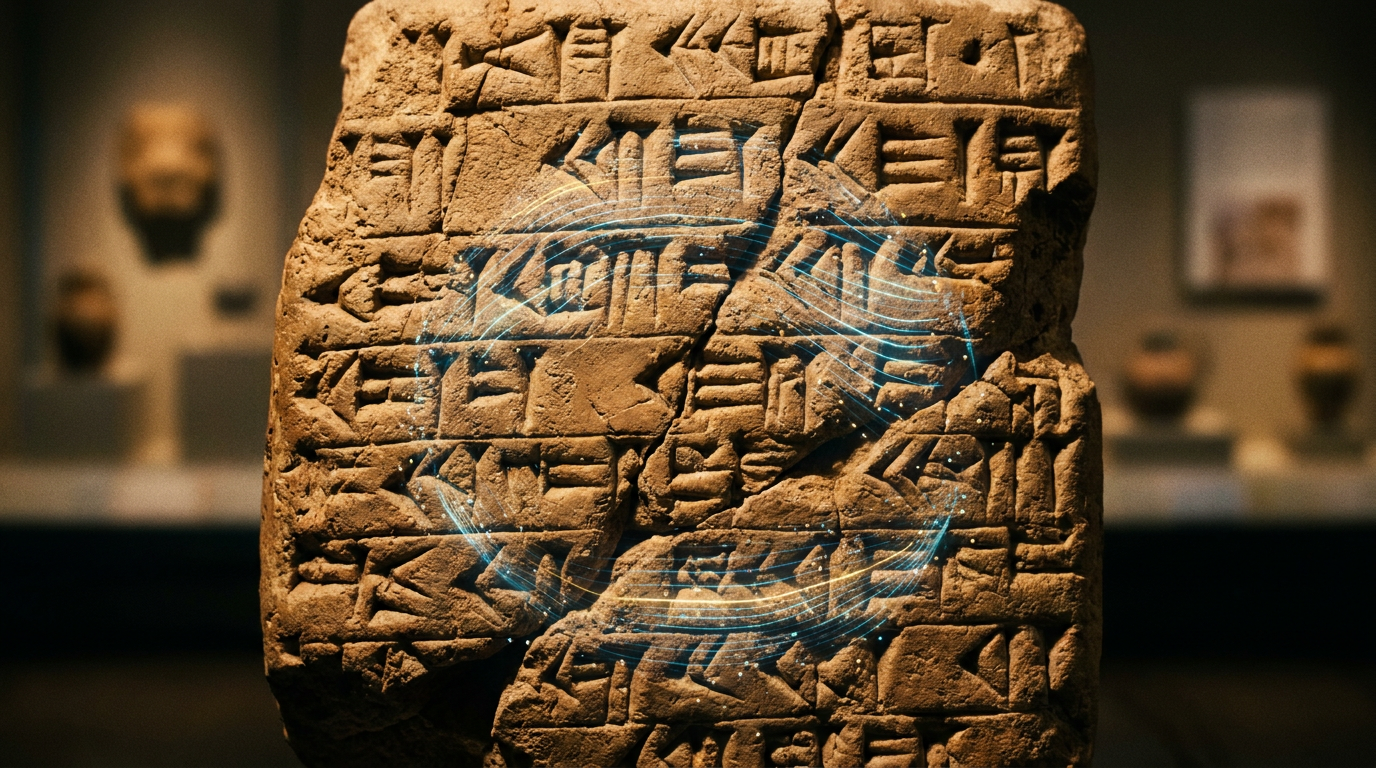
For more than three millennia before the Common Era, the advanced civilizations of the Near East recorded their laws, rituals, and daily lives on clay. Using a reed stylus, scribes pressed wedge-shaped symbols into moist clay tablets, which were then dried to create durable records of the Hittite Empire and its neighbors. Yet time has not been kind to these archives. Over thousands of years, the tablets have shattered into tens of thousands of fragments, which are now scattered across museum collections and university archives worldwide.[1][2][4]
For modern philologists, reconstructing these ancient texts is akin to solving a massive, three-dimensional jigsaw puzzle where the pieces are housed in different countries and the picture on the box has been lost. Because cuneiform is a three-dimensional medium, the legibility of the characters depends heavily on the angle of light hitting the clay. Traditionally, researchers have had to rely on slow, meticulous visual inspections to identify which fragments might belong to the same original document.[2][3][4]
That painstaking process is now undergoing a radical transformation. A research team from the University of Würzburg, the Academy of Sciences and Literature in Mainz, and the Technical University of Dortmund has unveiled an artificial intelligence system named "Palaeographicum." Designed specifically to analyze digitized images of cuneiform tablets, the tool can identify individual variations in ancient handwriting with unprecedented speed and accuracy.[3][4][5][6]
The scale of the system's database is vast. The current iteration of Palaeographicum has access to approximately 70,000 high-resolution photographs, which together document more than five million individual cuneiform characters. By isolating each symbol and comparing it against this massive dataset, the artificial intelligence groups together signs that were written in similar styles, organizing them into visual tables for scholars to review.[2][3][4]

The core premise of the technology relies on a deeply human trait: handwriting. Although cuneiform signs were impressed into clay rather than drawn with ink, the physical act of writing left behind distinct personal signatures. Some scribes dragged their styluses sharply, leaving decorative flourishes, while others consistently spaced or angled their characters in unique, identifiable ways.[2][3][4]
Recognizing these subtle, idiosyncratic quirks allows researchers to definitively link shattered fragments back together. If two disparate pieces of clay exhibit the exact same micro-variations in wedge depth and angle, they were likely inscribed by the same hand, and potentially belong to the same original tablet.[2][6]
The efficiency gains provided by the AI are staggering. According to Professor Daniel Schwemer, head of the Department of Ancient Near Eastern Studies at the University of Würzburg, comparing the handwriting across five clay tablet fragments used to require three full days of meticulous manual labor. With Palaeographicum, that same comparative analysis is completed in just five minutes.[1][4]
With Palaeographicum, that same comparative analysis is completed in just five minutes.
Beyond merely reconnecting broken pieces, the tool provides a critical mechanism for dating ancient texts. Hittite clay tablets rarely contain explicit dates, leaving researchers to rely on palaeography—the study of how handwriting styles evolve over historical periods. By tracking how the shapes of specific cuneiform signs morphed over centuries, the AI helps establish a reliable chronological timeline for undated fragments.[1][3][5]

The foundation for this breakthrough was laid over decades of digital archiving. Twenty-five years ago, researchers launched the Hethitologie-Portal Mainz, an online catalog that now houses roughly 30,000 known Hittite clay tablet fragments. This extensive digital library provided the necessary training data for the AI model, which was developed between 2018 and 2023 under the Computer-assisted Cuneiform Analysis (CuKa) project.[1][2][3]
Despite its remarkable capabilities, the system operates with transparent limitations. The research team notes that a single scribe's handwriting was rarely perfectly consistent. A scribe might write with exacting precision while drafting a formal religious text in the quiet confines of a temple, but use a much faster, messier script when recording a hasty field report or inspecting a provincial sanctuary.[1][2][4]
This contextual variance makes it difficult for the artificial intelligence to definitively track a single individual across their entire career. The algorithm must be carefully trained to distinguish between the natural evolution of one person's handwriting over time, the situational changes in their writing speed, and the genuinely different hands of separate scribes.[1][2]

To address these nuances, the development team is continuously retraining the model using newly annotated material and direct feedback from the international Hittitology community. The AI does not replace the specialized knowledge of philologists; rather, it acts as a powerful pattern-recognition engine that surfaces connections human eyes might miss, leaving the final historical interpretation to the experts.[3][4][5]
The long-term ambition for the project extends far beyond piecing together broken clay. Researchers hope that as the AI becomes more adept at tracking individual scribes, they will be able to compile a comprehensive social history of Hittite writing culture. This could involve tracing a scribe's progression from an apprentice learning the script to a master archivist shaping the empire's official records.[1][2][4]
The technology also offers significant benefits for the physical preservation of global heritage. Because the AI operates entirely on high-resolution digital images, it drastically reduces the need for researchers to physically handle the fragile, 3,500-year-old artifacts. Institutions can collaborate on reconstructions digitally, matching a fragment in Berlin with a corresponding piece in Istanbul without either object ever leaving its climate-controlled vault.[4][5]

By bridging the gap between Bronze Age clay and modern machine learning, Palaeographicum is rescuing lost voices from the silence of antiquity. The tool demonstrates how artificial intelligence, often viewed as a technology of the future, is becoming one of our most vital instruments for recovering the deeply human details of the distant past.[2][5][6]
How we got here
1990s
Researchers launch the Hethitologie-Portal Mainz to begin digitally cataloging known Hittite clay tablet fragments.
2018–2023
The Computer-assisted Cuneiform Analysis (CuKa) project develops the foundational AI model and 3D capture techniques.
2023
The TLHdig search platform is introduced, enabling digital text searches across transliterated cuneiform.
May 2026
The Palaeographicum AI tool is officially unveiled, granting researchers the ability to match individual handwriting styles.
Viewpoints in depth
Computational Archaeologists
Focus on the technological leap and the massive efficiency gains in pattern recognition.
For the developers and data scientists behind Palaeographicum, the breakthrough lies in the sheer scale of computation. Training an AI to recognize three-dimensional impressions on uneven, degraded clay surfaces requires sophisticated computer vision models. This camp emphasizes that AI excels at exactly what human eyes struggle with: holding millions of minute geometric variations in memory simultaneously. By reducing a three-day manual task to five minutes, they argue that machine learning will fundamentally unblock decades-old bottlenecks in historical translation.
Hittitologists & Philologists
Focus on the historical context, scribal culture, and the nuances of human behavior.
For the scholars who study the ancient Near East, the AI is a means to a deeply humanistic end. They caution that algorithms cannot translate the cultural context of the texts, nor can they easily account for a scribe changing their handwriting due to fatigue or the writing environment. This camp values the tool primarily for its ability to date undated fragments through palaeographic lineage and hopes it will eventually allow them to trace the individual careers, education, and social mobility of specific scribes within the Hittite Empire.
What we don't know
- Whether the AI can be trained to reliably distinguish between a single scribe changing their handwriting due to haste versus two entirely different scribes with similar styles.
- How many complete texts will ultimately be reconstructed from the 30,000 known Hittite fragments currently scattered across global collections.
Key terms
- Cuneiform
- An ancient writing system used in the Near East, characterized by wedge-shaped marks made in clay.
- Palaeography
- The study of ancient and historical handwriting, used to date documents and trace the evolution of scripts.
- Philologist
- A scholar who studies the history, structure, and development of languages and written texts.
- Hittite Empire
- A major ancient civilization based in Anatolia (modern-day Turkey) that flourished during the Late Bronze Age.
- Stylus
- A writing tool, typically made from a cut reed, used to press characters into wet clay.
Frequently asked
What is cuneiform?
Cuneiform is one of the world's oldest writing systems, created by pressing a wedge-shaped reed stylus into moist clay tablets.
Who were the Hittites?
The Hittites were an ancient Anatolian people who established a powerful empire in the Near East during the second millennium BCE.
Does the AI translate the ancient texts?
No. The Palaeographicum tool identifies and matches the physical handwriting styles of individual scribes to help piece broken fragments together, leaving the translation to human experts.
Why is it hard to read cuneiform from photographs?
Because the characters are three-dimensional impressions in clay, their legibility changes drastically depending on the angle and intensity of the lighting.
Sources
Source coverage
6 outlets
2 viewpoints surfaced






[1]University of WürzburgHittitologists & Philologists
AI reads cuneiform: A milestone for Ancient Near Eastern Studies
Read on University of Würzburg →[2]Discover MagazineComputational Archaeologists
AI Is Reconnecting Ancient Clay Tablets Faster Than Humans Can
Read on Discover Magazine →[3]Heritage DailyHittitologists & Philologists
Researchers unveil AI tool for analysing cuneiform writing
Read on Heritage Daily →[4]Daily BeirutHittitologists & Philologists
AI Deciphers 3,500-Year-Old Cuneiform Tablets Using New System
Read on Daily Beirut →[5]Mirage NewsComputational Archaeologists
AI Deciphers Cuneiform: Breakthrough in Ancient Studies
Read on Mirage News →[6]Click Petróleo e GásComputational Archaeologists
Palaeographicum System identifies ancient signs, compares writing styles, and reorganizes research on documents from the Ancient Near East
Read on Click Petróleo e Gás →
Every angle. Every day.
Get science stories with full source coverage and perspective breakdowns delivered to your inbox.