
The Science of Enhanced Rock Weathering: Can Crushed Dust Cool the Planet?
Spreading crushed silicate rocks on agricultural land accelerates a natural carbon-capture process, offering a promising method to draw down atmospheric CO2 while boosting soil health.
By Factlen Editorial Team
- Climate Scientists
- Focus on the gigaton-scale potential for permanent carbon removal and the necessity of rigorous measurement.
- Agricultural Researchers
- Emphasize the co-benefits for soil health, crop yields, and the potential to replace chemical fertilizers.
- Carbon Market Analysts
- Highlight the commercial viability, corporate investments, and the need for strict verification standards.
- Environmental Pragmatists
- Advocate for using industrial waste like steel slag to minimize the energy costs of mining and crushing new rock.
What's not represented
- · Local communities living near the mining and crushing facilities required to produce the rock dust.
Why this matters
As the world races to find scalable carbon dioxide removal techniques, enhanced rock weathering offers a rare dual-benefit: permanently locking away carbon for millennia while potentially increasing crop yields for farmers without requiring new land.
Key points
- Enhanced rock weathering (ERW) speeds up a natural carbon-capture process by spreading crushed silicate rocks on farmland.
- The rock dust reacts with CO2 and water to form bicarbonates, which safely store carbon in the ocean for millennia.
- Beyond carbon removal, the practice can improve soil health, raise pH levels, and potentially boost crop yields.
- Field trials show success, but effectiveness varies heavily based on rock type, soil acidity, and climate.
- The industry faces challenges in accurately measuring open-field carbon capture and minimizing the energy costs of crushing rock.
- Major tech companies are already purchasing ERW carbon credits, signaling rapid commercial maturation.
For millions of years, Earth has relied on a built-in thermostat to regulate its climate. When carbon dioxide builds up in the atmosphere, it dissolves into rainwater to form a mild carbonic acid. As this rain falls on mountains and exposed rock, it slowly weathers the stone, triggering a chemical reaction that binds the carbon into stable bicarbonate molecules. These molecules eventually wash into rivers and oceans, locking the carbon away for millennia. It is a highly effective system, but it operates on a geological timescale—far too slowly to counteract modern industrial emissions.[7][8]
Enter Enhanced Rock Weathering (ERW), an emerging climate technology designed to put nature's thermostat into overdrive. By taking silicate rocks—such as basalt or olivine—and crushing them into a fine powder, scientists can exponentially increase the reactive surface area of the stone. When this dust is spread across vast tracts of land, the weathering process that would normally take thousands of years can occur in less than a decade.[2][6]
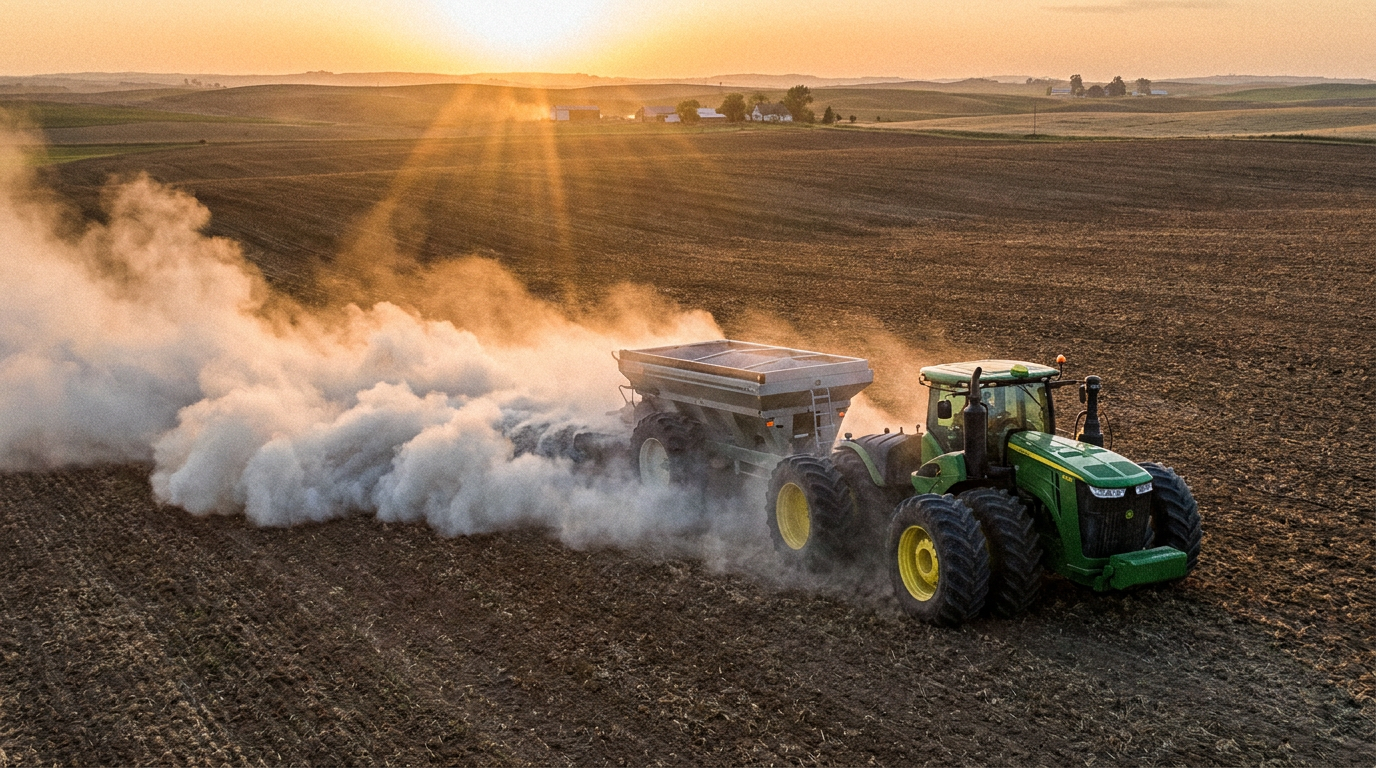
The logistical appeal of ERW lies in its compatibility with existing infrastructure. Rather than building massive, energy-intensive direct air capture facilities, ERW leverages the global agricultural footprint. Farmers already use tractors and lime spreaders to apply fertilizers and soil amendments. By simply swapping or supplementing those materials with crushed silicate rock, millions of acres of farmland can be transformed into passive carbon sinks without taking any land out of food production.[4][5]

The chemical evidence underpinning the process is robust. When the pulverized rock dust reacts with soil moisture and atmospheric carbon dioxide, it converts the greenhouse gas into dissolved bicarbonates. These compounds percolate through the soil, enter the groundwater, and eventually flow into the ocean. Once there, the carbon remains securely stored for over 1,000 years. As an added benefit, the influx of alkaline bicarbonates helps counteract ocean acidification, a secondary crisis caused by excess atmospheric CO2.[2][7]
Beyond carbon removal, ERW offers compelling agronomic co-benefits that could incentivize widespread adoption. Silicate rock dust acts as a slow-release liming agent, gradually raising the pH of overly acidic soils. As the rocks break down, they also release essential micronutrients like calcium, magnesium, potassium, and silicon. Emerging research suggests that these mineral infusions can maintain or even modestly increase crop yields, particularly in soils suffering from nutrient depletion.[3][4]
Recent field trials are beginning to validate these claims outside the laboratory. A comprehensive three-year study published in Frontiers in Climate evaluated the application of steel slag—an industrial byproduct rich in silicates—on conventional agricultural systems in the US Midwest. The researchers found that applying the slag to initially acidic soils successfully increased porewater pH and alkalinity, providing clear, measurable evidence of carbon dioxide removal.[1]

Recent field trials are beginning to validate these claims outside the laboratory.
However, the same study highlighted the profound variability of ERW in open environments. When coarse-grained crushed basalt was applied, or when amendments were added to soils that already had a neutral pH, the researchers did not observe significant changes in soil or porewater chemistry. This underscores a critical reality: ERW is not a uniform silver bullet. Its effectiveness is highly dependent on the specific type of rock used, the initial acidity of the soil, and local climatic conditions.[1][8]
This variability introduces one of the industry's most significant hurdles: Monitoring, Reporting, and Verification (MRV). Unlike a smokestack where emissions can be precisely metered, an agricultural field is an open, dynamic ecosystem. Accurately measuring exactly how much carbon has been captured—and ensuring it doesn't simply off-gas back into the atmosphere—requires complex soil sampling, hydrological modeling, and rigorous third-party auditing.[2][4]
Another major consideration is the life-cycle carbon cost of the supply chain. Mining, crushing, and transporting millions of tons of rock requires substantial energy. If the heavy machinery and transport networks rely on fossil fuels, the emissions generated could offset a significant portion of the carbon captured by the rock dust. To mitigate this, many ERW projects prioritize the use of existing industrial waste, such as mining tailings or steel slag, which eliminates the need for new extraction.[1][6]
Geographically, the potential for ERW is not evenly distributed. The chemical weathering process is heavily accelerated by heat and moisture, making the tropics and the Global South particularly well-suited for deployment. Countries with large agricultural sectors, accessible silicate resources, and hot, humid climates—such as Brazil and India—could see the fastest rates of carbon drawdown, while simultaneously providing critical soil health benefits to smallholder farmers.[4][5]

Despite the scientific and logistical complexities, the commercial market for ERW is maturing rapidly. Major corporate buyers, including Microsoft and Google, have recently locked in hundreds of thousands of tonnes of carbon removal through multi-year ERW contracts. In early 2025, the first independently verified ERW credits were issued under rigorous new MRV protocols, signaling a shift from theoretical modeling to verifiable commercial deployment.[4][8]
The ultimate scale of the technology could be staggering. Global modeling studies suggest that if deployed extensively across suitable agricultural lands, enhanced rock weathering could sequester between 0.16 and 0.30 gigatons of CO2 annually in the United States alone by 2050. Worldwide, the potential stretches into the billions of tonnes, making it one of the few carbon dioxide removal pathways capable of operating at a gigaton scale.[2][7]
While it will not replace the urgent need to decarbonize the global economy and halt fossil fuel emissions, ERW represents a pragmatic addition to the climate mitigation portfolio. By mimicking and accelerating a process that Earth has used for billions of years, scientists and farmers are unlocking a method to clean the atmosphere while simultaneously revitalizing the soil beneath our feet.[3][8]
How we got here
1990
The concept of capturing and storing carbon in the deep ocean is first formally proposed.
2016
Scientists begin heavily investigating the specific potential of silicate rocks to capture carbon at scale.
2021
Global climate models begin incorporating ERW as a viable pathway to reach gigaton-scale carbon removal.
Early 2025
The first independently verified ERW carbon credits are issued under rigorous new MRV protocols.
Viewpoints in depth
Agronomic Researchers
Focus on the immediate benefits to soil health and food security.
For agricultural scientists, the carbon capture aspect of ERW is almost a secondary benefit compared to its potential to revitalize degraded soils. By acting as a slow-release liming agent, silicate rock dust can correct soil acidity without the rapid spikes caused by traditional agricultural lime. Furthermore, the slow release of micronutrients like magnesium and potassium can reduce a farmer's reliance on synthetic chemical fertilizers, improving the overall economic resilience of farming operations, particularly in the Global South.
Carbon Market Auditors
Emphasize the critical need for strict measurement and verification to prevent greenwashing.
Market analysts and auditors warn that the open-system nature of ERW makes it uniquely vulnerable to accounting errors. Unlike a sealed industrial facility, an agricultural field is subject to heavy rain, drought, and varying microbial activity, all of which alter the rate of chemical weathering. These experts argue that until standardized, highly accurate soil and water sampling protocols are universally adopted, buyers of ERW carbon credits run the risk of paying for modeled estimates rather than guaranteed, verified carbon removal.
Life-Cycle Analysts
Highlight the hidden emissions generated by mining, crushing, and transporting the rock.
Environmental pragmatists caution that ERW is only a net-negative technology if the supply chain is carefully managed. Mining solid basalt and grinding it into a fine powder requires massive amounts of energy. If that energy comes from diesel excavators and coal-fired power grids, the emissions generated can severely undercut the climate benefits. This camp strongly advocates for utilizing existing industrial byproducts—such as steel slag or legacy mining tailings—to bypass the extraction phase entirely.
What we don't know
- Exactly how much the energy required to mine, crush, and transport the rock offsets the total carbon captured at a global scale.
- How long-term application of industrial byproducts like steel slag might affect heavy metal accumulations in agricultural soils over decades.
- Whether the cost of rigorous soil sampling and verification will remain too high for smallholder farmers to participate in carbon markets.
Key terms
- Enhanced Rock Weathering (ERW)
- A climate technology that accelerates the natural breakdown of rocks by crushing them into dust, speeding up their ability to absorb atmospheric CO2.
- Silicate Rocks
- A group of minerals, including basalt and olivine, that naturally react with carbon dioxide as they weather.
- Bicarbonate
- A stable, dissolved chemical compound formed when CO2 reacts with weathering rocks, which safely stores carbon in waterways and oceans.
- MRV (Monitoring, Reporting, and Verification)
- The rigorous scientific and auditing protocols used to prove that a specific amount of carbon was actually removed from the atmosphere.
- Ocean Alkalinity Enhancement
- The process by which alkaline bicarbonates from weathered rocks enter the ocean, helping to neutralize the harmful acidity caused by climate change.
Frequently asked
How does rock dust capture carbon?
When silicate rocks break down, they chemically react with CO2 dissolved in rainwater and soil moisture, converting the gas into stable, dissolved bicarbonates.
Does this require taking land away from farming?
No. The crushed rock is applied directly to existing agricultural fields, often using the same equipment farmers already use to spread lime or fertilizers.
What happens to the carbon after it is captured?
The dissolved bicarbonates percolate through the soil into groundwater and rivers, eventually washing into the ocean where the carbon remains locked away for over 1,000 years.
What are the downsides or risks?
The primary challenges are the energy required to mine, crush, and transport the rocks, and the difficulty of accurately measuring exactly how much carbon is captured in an open field.
Sources
Source coverage
8 outlets
4 viewpoints surfaced








[1]Frontiers in ClimateClimate Scientists
Evidence for carbon dioxide removal from enhanced weathering in a US agricultural system
Read on Frontiers in Climate →[2]Project DrawdownClimate Scientists
Enhanced Rock Weathering
Read on Project Drawdown →[3]UC Agriculture and Natural ResourcesAgricultural Researchers
Can crushed rock help farmers capture carbon?
Read on UC Agriculture and Natural Resources →[4]SenkenCarbon Market Analysts
Enhanced Rock Weathering for Carbon Removal
Read on Senken →[5]Precision DevelopmentAgricultural Researchers
Enhanced Rock Weathering for Carbon Removal
Read on Precision Development →[6]The Conservation FoundationEnvironmental Pragmatists
What is Enhanced Weathering?
Read on The Conservation Foundation →[7]PatchCarbon Market Analysts
What you need to know about enhanced rock weathering
Read on Patch →[8]Factlen Editorial TeamEnvironmental Pragmatists
Synthesis by Factlen editorial team
Read on Factlen Editorial Team →

Every angle. Every day.
Get science stories with full source coverage and perspective breakdowns delivered to your inbox.