
Iran Declares Strait of Hormuz Closed Again Over Lebanon Strikes, Testing Fragile US Ceasefire
Just days after a US-Iran agreement allowed commercial shipping to resume, Tehran announced a renewed closure of the vital oil chokepoint, citing Israeli military operations in Lebanon.
By Factlen Editorial Team
- US Administration Focus
- Prioritizes enforcing the memorandum of understanding, keeping the strait open via naval presence, and advancing the 60-day negotiation window.
- Global Energy Importers
- Focuses on the immediate resumption of safe, toll-free transit to stabilize domestic economies and replenish depleted strategic reserves.
- Iranian Leadership Focus
- Demands a complete halt to Israeli operations in Lebanon as a prerequisite for honoring the strait's reopening, using the waterway as leverage.
- Maritime Operators
- Highly risk-averse, focused on the physical dangers of sea mines and the lack of clear navigational safety, regardless of political declarations.
What's not represented
- · Omani Coastal Authorities
- · Stranded Seafarers
- · European LNG Importers
Why this matters
Roughly 20 percent of the world's seaborne oil and liquefied natural gas passes through the Strait of Hormuz. A renewed blockade threatens to reverse the recent drop in global energy prices and reignite inflation just as central banks attempt to stabilize the global economy.
Key points
- Iran declared the Strait of Hormuz closed again, citing Israeli strikes in Lebanon as a violation of the US-Iran ceasefire.
- US Central Command disputed the closure, stating that 55 merchant ships safely transited the waterway on Saturday.
- The diplomatic dispute threatens to reverse a recent drop in global oil prices and reignite inflation.
- Approximately 80 sea mines remain in the central shipping lane, forcing vessels to navigate a dangerous path near the Omani coast.
- US and Iranian delegations have arrived in Switzerland to negotiate the terms of the fragile 60-day ceasefire.
The whiplash of the weekend has left the global energy market in a state of profound uncertainty. Just hours after a handful of supertankers successfully navigated the Strait of Hormuz, Iran's military command abruptly declared the world's most critical energy corridor closed once again. The announcement on Saturday shattered the cautious optimism that had followed a landmark 14-point memorandum of understanding signed earlier in the week by United States President Donald Trump and Iranian President Masoud Pezeshkian. That interim agreement was designed to end the devastating four-month war that began in late February, lifting the American naval blockade of Iranian ports in exchange for Tehran reopening the maritime chokepoint. For a brief moment, it appeared the largest disruption to world energy supplies since the 1970s was finally drawing to a close.[2][4]
The preliminary agreement had established a 60-day window for comprehensive peace negotiations, during which commercial vessels were guaranteed toll-free transit through the Persian Gulf. The framework required the United States to cease its aerial campaign and naval interdictions, while Iran committed to halting its proxy attacks and clearing the waterway. The diplomatic breakthrough was hailed as a necessary pragmatic step to stabilize a global economy teetering on the edge of a severe inflationary crisis. Energy markets responded immediately, with traders breathing a collective sigh of relief as the prospect of normalized shipping routes became a tangible reality.[2][7]
But the fragile truce fractured almost immediately as Israeli forces launched a wave of deadly strikes against Hezbollah targets in southern Lebanon. Iran's Islamic Revolutionary Guard Corps quickly cited the military operations as a direct violation of the memorandum's first clause, which explicitly called for a halt to hostilities on all fronts. In response, Tehran warned commercial vessels not to approach the waterway, asserting that the United States had acted in bad faith by failing to restrain its ally. The sudden reversal highlights the deeply interconnected nature of the region's conflicts, where a localized military engagement in the Levant can instantly paralyze the broader geopolitical framework.[1][2][3]

The United States immediately disputed the renewed blockade, setting up a dangerous test of wills in the Persian Gulf. United States Central Command spokesperson Captain Tim Hawkins stated unequivocally that "Iran does not control the Strait of Hormuz," asserting that 55 merchant ships carrying 17 million barrels of oil had successfully transited the corridor on Saturday under American monitoring. The conflicting narratives place maritime operators in a precarious position, forced to weigh the physical protection offered by the United States Navy against the explicit threats issued by the Iranian military. With neither side willing to concede operational control of the strait, the risk of a miscalculation remains exceptionally high.[1][7]
To understand the gravity of the standoff, one must look at the sheer volume of trade that relies on this single geographic bottleneck. The Strait of Hormuz is just 34 kilometers wide at its narrowest point, yet it facilitates the transit of roughly 20 percent of the globe's seaborne crude oil and 20 percent of its liquefied natural gas. The vast majority of exports from Saudi Arabia, the United Arab Emirates, Iraq, and Qatar must pass through this corridor to reach international markets. Unlike other maritime chokepoints, there is no viable alternative route that can accommodate the tens of millions of barrels that flow through the strait every single day.[8]
Even if the diplomatic dispute over Lebanon is resolved, the physical reality of navigating the strait remains treacherous. The independent tanker owner trade body, Intertanko, reports that approximately 80 sea mines laid by Tehran during the height of the conflict still block the central traffic separation scheme. "This is like a highway where the road in the middle is closed and you are using the hard shoulder," noted Phil Belcher, Intertanko's marine director. Ships are currently forced to hug the Omani coastline to avoid the explosive hazards, a maneuver that drastically increases the risk of massive vessels running aground in shallow waters.[2][5]
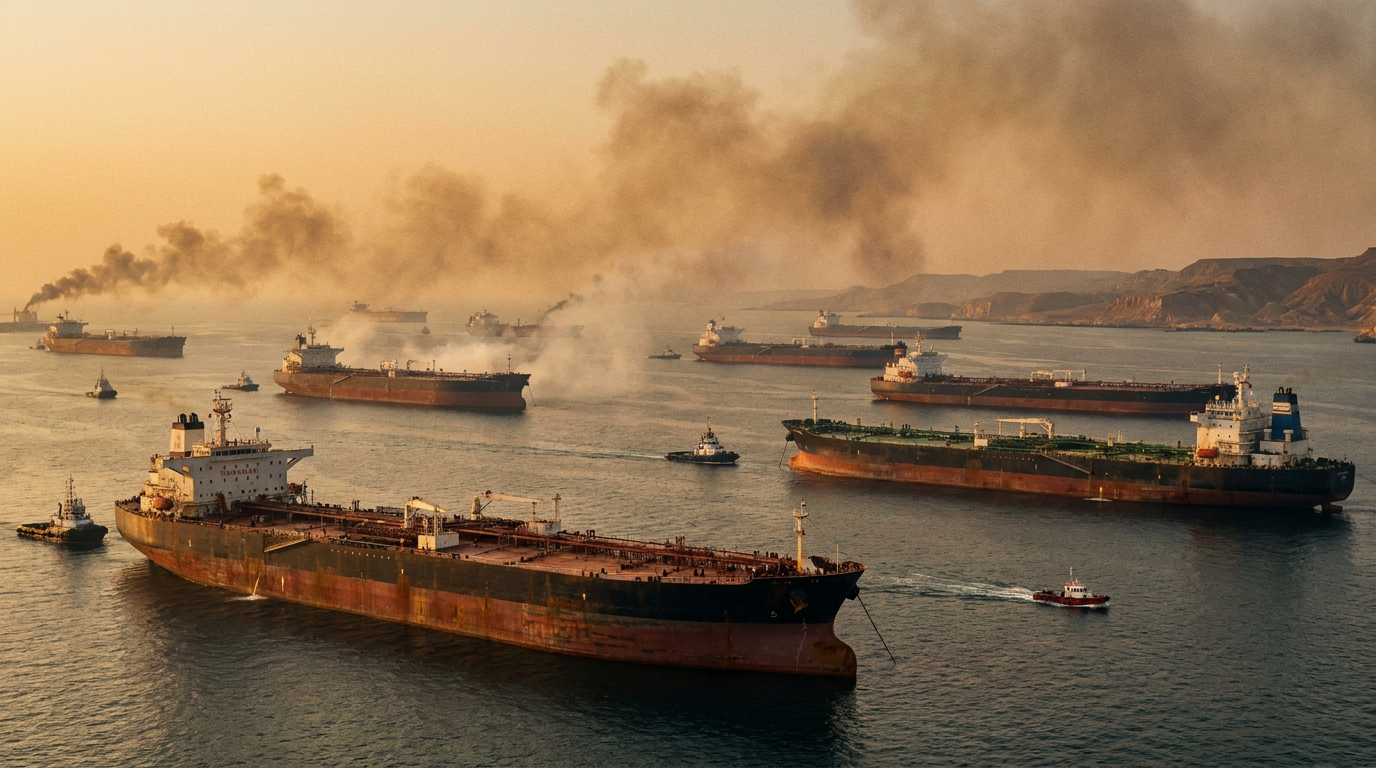
The logistical nightmare extends far beyond the immediate danger of the mines. Since the conflict began in late February, nearly 600 commercial vessels have been left anchored in the Gulf, creating a massive backlog of stranded cargo. The human toll has been equally severe, with an estimated 20,000 seafarers stuck aboard ships for months, operating under sustained security threats and severe psychological pressure. Clearing this unprecedented maritime traffic jam will require not only a lasting political settlement but also a massive, coordinated demining operation that could take months to complete.[5]

The logistical nightmare extends far beyond the immediate danger of the mines.
The brief window of open transit did allow a handful of these stranded vessels to finally escape the bottleneck. On Saturday, the Indian-flagged supertankers Desh Vaibhav, Desh Vibhor, and Sanmar Herald slipped through the strait carrying over 860,000 metric tons of crude oil, mere hours before Tehran's renewed closure declaration. Their successful voyage provided a momentary sigh of relief for the crews who had been trapped in the conflict zone, and offered a glimpse of the massive logistical effort that will be required to normalize global supply chains once the waterway is permanently secured.[4][5]
The safe passage of the Indian tankers also underscored the disproportionate economic impact the crisis has had on the Global South. India and Pakistan, both heavily reliant on Gulf energy imports, have suffered from widening trade deficits, fuel shortages, and currency devaluation since the blockade began. For these developing economies, the restoration of normal shipping patterns is not merely a matter of corporate profitability, but an urgent national security priority. The sudden spike in energy costs has forced governments to subsidize fuel prices, draining state coffers and threatening domestic political stability.[8]
Conversely, the crisis has revealed the shifting dynamics of global energy resilience among the world's superpowers. When the strait was initially blockaded, Brent crude prices surged to historic highs, threatening to reignite inflation across Western economies. Yet China, the world's largest oil importer, managed to weather the four-month blockade without crippling its manufacturing sector by drawing heavily on its immense strategic petroleum reserves. Analysts estimate that Beijing utilized a significant portion of its 1.4 billion barrel stockpile to offset the loss of Gulf crude, demonstrating a level of insulation against maritime disruptions that few other nations possess.[6][8]
This aggressive drawdown strategy effectively absorbed the shock, preventing global prices from climbing even higher during the peak of the conflict. Following the signing of the initial memorandum on Wednesday, oil prices had tumbled to a three-month low of roughly $79 to $82 per barrel, driven by expectations that Gulf producers could finally clear their export backlogs. However, the renewed closure threatens to erase those gains. If the blockade persists, countries that depleted their strategic reserves will eventually need to replenish them, creating a surge in demand that could drive prices back into the triple digits.[6]

The diplomatic focus has now shifted to Switzerland, where American and Iranian delegations—including United States Vice President JD Vance—arrived over the weekend to negotiate the finer details of the 60-day interim ceasefire. The talks were originally intended to focus on Iran's nuclear program, enriched uranium stockpiles, and the unfreezing of Iranian assets. However, the emergency in Lebanon has now been forced to the top of the agenda, transforming a bilateral negotiation into a complex regional mediation.[1][3][7]
Complicating matters further, neither Israel nor Hezbollah are signatories to the United States-Iran memorandum. Israeli Prime Minister Benjamin Netanyahu has vowed to maintain military operations in southern Lebanon until the security threat to northern Israel is eliminated, a stance that directly conflicts with Tehran's conditions for reopening the strait. American intelligence agencies have reportedly warned the administration that Israel is unlikely to halt its campaign, placing the entire framework of the broader peace deal in severe jeopardy.[1][2][3]
As negotiators scramble to salvage the agreement, the rhetoric from Washington has escalated. President Trump has threatened to impose American tolls on ships passing through the strait if a final, comprehensive deal is not reached within the 60-day window. He framed the proposed fees as necessary compensation for the United States military acting as the "Guardian Angel" of the Middle East, a proposal that has alarmed international shipping associations who fear the militarization of commercial transit costs.[7]

For now, the shipping industry remains in a state of paralysis. With hundreds of vessels still anchored in the Gulf, insurance premiums skyrocketing, and the threat of sea mines looming in the central channel, the world's most vital economic artery remains caught between a fragile diplomatic framework and the harsh reality of ongoing regional combat. Until the geopolitical disputes in the Levant are resolved and the physical hazards in the water are cleared, the global economy will remain hostage to the volatile currents of the Persian Gulf.[1][5]
How we got here
Late February 2026
The US-Israel war against Iran begins, prompting Tehran to blockade the Strait of Hormuz and the US to blockade Iranian ports.
Mid-June 2026
The US and Iran sign a 14-point memorandum of understanding to end the war, lift blockades, and reopen the strait.
June 18–19, 2026
Commercial traffic cautiously resumes through the strait, and global oil prices drop to a three-month low.
June 20, 2026
Following Israeli strikes in Lebanon, Iran declares the strait closed again, a claim immediately disputed by US Central Command.
June 21, 2026
US and Iranian delegations arrive in Switzerland to negotiate the terms of the fragile 60-day ceasefire amidst the renewed tensions.
Viewpoints in depth
Iran's Military Command
Argues that the US and Israel violated the ceasefire by continuing strikes in Lebanon, justifying the renewed closure.
Tehran views the 14-point memorandum of understanding not as an isolated maritime agreement, but as a comprehensive regional ceasefire. By their interpretation, the first clause of the MoU demands an immediate halt to all hostilities, including Israeli operations against Hezbollah in southern Lebanon. Because the United States failed to restrain its ally, the Islamic Revolutionary Guard Corps argues the US acted in bad faith, rendering the agreement void. Consequently, they maintain that closing the Strait of Hormuz is a legitimate and necessary countermeasure to force compliance and protect their regional proxies.
United States Central Command
Maintains that the strait remains open under international protection and denies Iran's operational control.
The US military fundamentally rejects Iran's authority to unilaterally close an international waterway. Central Command points to the successful transit of 55 merchant ships carrying 17 million barrels of oil on the very day Iran declared the strait closed as proof that the blockade is unenforceable. From Washington's perspective, the US Navy is actively securing freedom of navigation and fulfilling its end of the MoU by lifting the port blockades. They view Iran's declarations as political posturing designed to gain leverage in the Switzerland negotiations, rather than a reflection of the physical reality on the water.
The Shipping Industry
Views the situation as highly dangerous regardless of diplomatic declarations, focusing on physical hazards.
For maritime operators and insurers, the political back-and-forth between Washington and Tehran is secondary to the physical dangers present in the water. Organizations like Intertanko emphasize that approximately 80 sea mines remain active in the central traffic separation scheme. Even with US naval protection, commercial vessels are forced to navigate a treacherous, narrow path along the Omani coastline to avoid these explosives. Until a comprehensive demining operation is completed and the threat of arbitrary seizure is entirely removed, the industry considers the strait functionally compromised, leading to skyrocketing insurance premiums and massive logistical backlogs.
What we don't know
- Whether Israel will agree to halt its military operations in southern Lebanon to satisfy Iran's conditions for the ceasefire.
- How long it will take to safely clear the 80 sea mines from the central shipping lanes once a permanent peace is established.
- If President Trump will follow through on his threat to impose American tolls on commercial vessels transiting the strait.
Key terms
- Strait of Hormuz
- A narrow, strategically vital waterway between Iran and Oman that connects the Persian Gulf to the Gulf of Oman and the Arabian Sea.
- Memorandum of Understanding (MoU)
- The preliminary 14-point agreement signed between the US and Iran in mid-June 2026 to halt hostilities and reopen maritime trade.
- Traffic Separation Scheme
- The internationally recognized maritime routing system in the strait, which is currently blocked by sea mines laid during the conflict.
- Strategic Petroleum Reserve
- Emergency stockpiles of crude oil maintained by countries like China and the US to mitigate the economic impact of severe supply disruptions.
Frequently asked
Why did Iran announce the closure of the Strait of Hormuz again?
Iran cited ongoing Israeli military strikes against Hezbollah in southern Lebanon, which Tehran views as a direct violation of the first clause of the US-Iran ceasefire agreement.
Is the Strait of Hormuz actually closed right now?
The status is highly contested. While Iran claims the waterway is closed to commercial traffic, US Central Command asserts that dozens of ships are successfully transiting under American monitoring.
Why is the Strait of Hormuz so important to the global economy?
The 34-kilometer-wide chokepoint facilitates roughly 20 percent of the world's seaborne crude oil trade and 20 percent of global liquefied natural gas, with no viable alternative routes.
What physical dangers do ships face in the strait?
During the conflict, Iran laid approximately 80 sea mines in the central shipping lane. Vessels are currently forced to navigate a narrow, dangerous path near the Omani coast to avoid them.
Sources
Source coverage
8 outlets
4 viewpoints surfaced








[1]The Washington PostUS Administration Focus
Iran says it is closing Strait of Hormuz, testing fragile agreement with U.S.
Read on The Washington Post →[2]The GuardianIranian Leadership Focus
Iran says it is closing strait of Hormuz over Israeli strikes in Lebanon
Read on The Guardian →[3]CBS NewsUS Administration Focus
What to know about the Iran war today: Strait of Hormuz will be closed again
Read on CBS News →[4]Hindustan TimesGlobal Energy Importers
Hours before Iran's closure, three Indians supertankers safely transit Strait of Hormuz
Read on Hindustan Times →[5]BloombergMaritime Operators
Three Indian Tankers Reemerge, Pointing to Hormuz Traffic Uptick
Read on Bloomberg →[6]The New York TimesGlobal Energy Importers
While the World Scrambles for Oil, China Sits on Full Tanks
Read on The New York Times →[7]PBS NewsHourUS Administration Focus
U.S. and Iran to talk Sunday in Switzerland as Tehran says it closed Strait of Hormuz again
Read on PBS NewsHour →[8]Asia TimesGlobal Energy Importers
The US-Iran agreement is as much about restoring global energy flows
Read on Asia Times →

Every angle. Every day.
Get business stories with full source coverage and perspective breakdowns delivered to your inbox.