
How Remote Work Has Helped a Generation of Working Parents
Post-pandemic flexibility has enabled record numbers of mothers with young children to remain in the workforce, reducing the traditional 'motherhood penalty.' However, as some companies push for return-to-office mandates, the long-term sustainability of these gains remains a central debate.
By Factlen Editorial Team
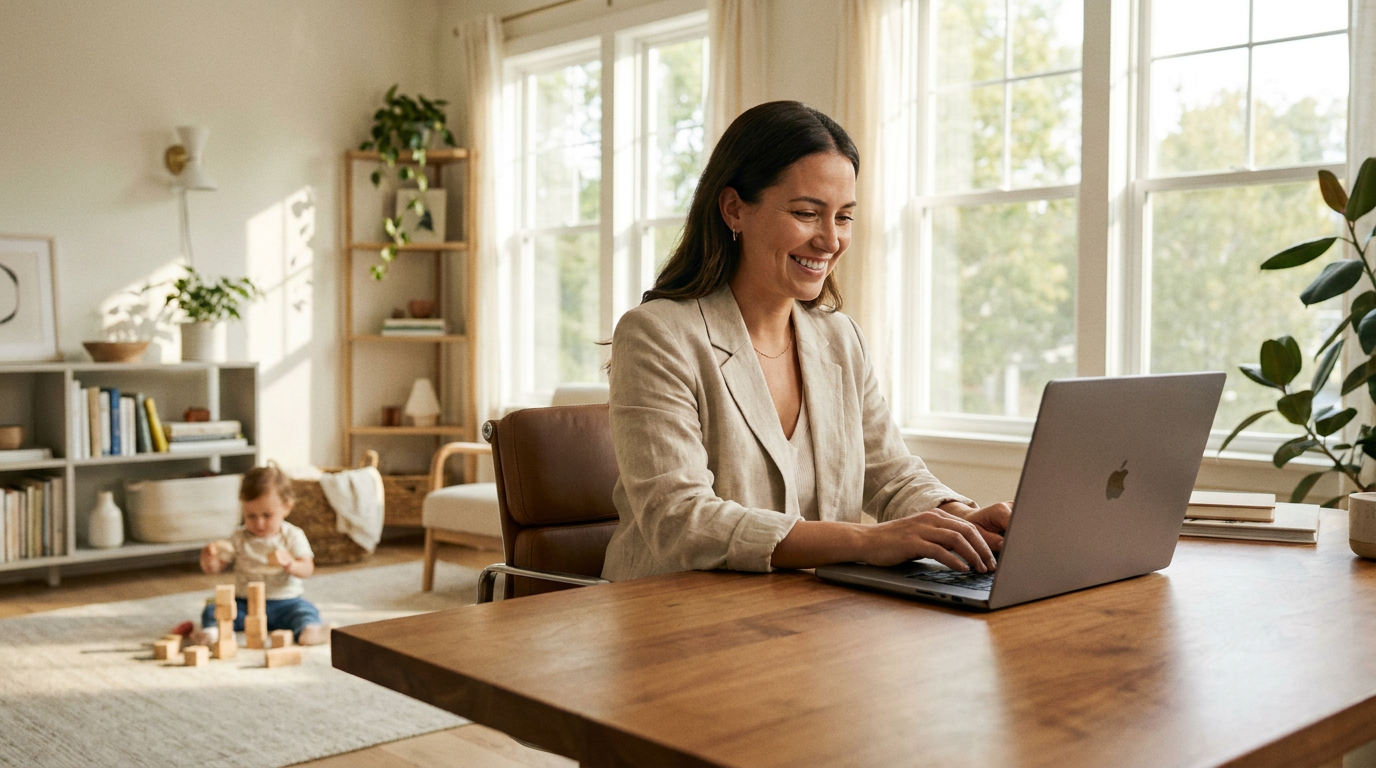
- Working Parents & Advocates
- Argue that remote work is essential infrastructure that allows mothers to maintain full-time careers without sacrificing family presence.
- Labor Economists
- Focus on the macroeconomic benefits, noting that telework reduces the motherhood penalty and keeps skilled workers in the labor force.
- Corporate Leadership
- Emphasize in-person collaboration and company culture, driving the recent push for return-to-office mandates despite retention risks.
What's not represented
- · Childcare providers struggling with fluctuating demand and rising operational costs
- · Fathers who utilize remote work to take on larger shares of domestic responsibilities
Why this matters
For millions of households, the ability to work remotely is the difference between maintaining dual-income stability and forcing one parent to sacrifice their career. Understanding this shift is crucial for professionals navigating their career paths and for companies trying to retain top talent in a competitive economy.
Key points
- Post-pandemic flexible work policies have enabled a record number of mothers with young children to remain in the labor force.
- Access to remote work significantly reduces the 'motherhood penalty,' allowing women to maintain full-time roles and avoid earnings drops.
- 76% of working mothers now report valuing flexible work arrangements more than overall compensation.
- Recent corporate return-to-office mandates are causing friction, leading some executives to report disproportionate attrition among female employees.
- While remote work eases logistical burdens like commuting, data shows it is not a viable substitute for dedicated childcare.
The modern workplace has undergone a quiet but profound transformation over the past six years, fundamentally altering the trajectory of working parents. A new openness to accommodating family needs, born out of pandemic necessity, has made it possible for a record number of mothers and fathers to balance their careers with child-rearing.[1]
For decades, the American labor market presented parents—particularly mothers of young children—with a stark binary choice: maintain a rigid full-time office schedule or step back from the workforce entirely. Today, the widespread adoption of remote and hybrid work has dismantled that binary, allowing millions of parents to remain economically active while managing household logistics.[1][4]
The economic impact of this shift is most visible in the sustained labor force participation of women. During the height of workplace flexibility, women's labor force participation reached record levels, driven largely by married mothers. Data from the Center for Economic and Policy Research indicates that mothers in jobs compatible with remote work experience significantly smaller earnings losses after childbirth compared to those in roles requiring physical presence.[3][4][6]
This phenomenon is actively reducing the so-called "motherhood penalty"—the historical decline in earnings and career progression that women often face after having children. Flexible work arrangements have enabled mothers to stay in full-time roles rather than downshifting to part-time positions, allowing them to work more weeks during the year following childbirth and rely less on extended, unpaid parental leave.[6]

The preference for telework is heavily concentrated among parents of young children. Recent data shows that 27 percent of working mothers utilize telework, compared to 20 percent of men without children. For many of these women, the ability to eliminate a daily commute and reclaim an average of 70 minutes a day translates directly into manageable childcare logistics and sustained professional engagement.[4][8]
The preference for telework is heavily concentrated among parents of young children.
As the labor market normalizes in 2026, the value placed on this flexibility has only intensified. A recent industry report found that 76 percent of working mothers now value flexible work design more than overall compensation. For this demographic, remote work is no longer viewed as a corporate perk, but rather as essential infrastructure required for survival and sustainability in a dual-income household.[5][8]
However, this hard-won equilibrium is currently facing significant headwinds. A growing number of corporate executives have initiated return-to-office mandates, citing the need for in-person collaboration and company culture. Between late 2024 and mid-2025, the percentage of Fortune 500 companies requiring full-time office attendance nearly doubled, placing immediate pressure on working parents.[2][3]
The enforcement of these mandates has triggered a measurable exodus of female talent from companies that eliminate flexibility. Surveys of corporate leadership reveal that more than half of executives reported losing a disproportionate number of women after implementing strict return-to-office policies. When flexibility contracts, the math of balancing expensive childcare and rigid commutes often forces one parent—statistically, the mother—to step back.[2][3]

In response to these rigid mandates, some working mothers are pivoting toward the freelance economy to reclaim control over their schedules. While freelancing offers the autonomy needed to manage unpredictable childcare needs, it often comes at the cost of employer-sponsored health insurance, retirement contributions, and traditional career advancement.[2]
It is also crucial to distinguish between remote work and childcare. While telework provides the logistical flexibility to handle school pickups or sick days, it does not replace the need for dedicated care. Pew Research Center data highlights that working from home does not erase the inherent difficulties of parenting; a significant percentage of remote-working parents report that their work and parenting tasks frequently overlap, creating a different kind of daily strain.[7]

Despite these ongoing tensions, the structural gains made by working parents over the last half-decade represent a permanent shift in labor expectations. The data overwhelmingly suggests that when employers provide the structural support of flexible hours and location independence, mothers not only stay in the workforce but thrive in full-time capacities.[1][4][6][8]
Ultimately, the integration of remote work into the standard corporate playbook has proven that higher rates of labor force participation for mothers are entirely possible. As companies navigate the future of work in 2026, the organizations that successfully retain top talent are increasingly those that recognize flexibility not as a pandemic-era anomaly, but as the foundation of a modern, inclusive economy.[1][4][5]
How we got here
Pre-2020
The traditional 9-to-5 office model dominates, contributing to a stalled labor force participation rate for mothers of young children.
2020-2022
The pandemic forces a massive shift to remote work, inadvertently providing working parents with unprecedented schedule flexibility.
2023-2024
Women's labor force participation reaches record highs, driven largely by married mothers utilizing hybrid and remote arrangements.
2025-2026
A wave of corporate return-to-office mandates creates new friction, forcing many working mothers to choose between flexibility and traditional employment.
Viewpoints in depth
Working Parents' View
Flexibility is a necessity, not a perk.
For many parents, particularly mothers, the ability to work remotely is the definitive factor in whether they can sustain a full-time career. Advocates argue that the traditional 9-to-5 office model was built for households with a dedicated stay-at-home parent—a demographic reality that no longer exists for the majority of families. By eliminating commutes and allowing for asynchronous work, remote arrangements provide the logistical breathing room necessary to manage childcare drop-offs, sick days, and household responsibilities without stepping off the career track.
Labor Economists' View
Remote work structurally reduces the motherhood penalty.
Economic researchers view telework as one of the most effective tools for closing the gender pay gap in recent history. Data indicates that mothers with access to flexible work are significantly less likely to downshift to part-time roles or exit the workforce entirely after childbirth. By keeping these women attached to the labor market in full-time capacities, remote work preserves their long-term earning potential, retirement savings, and progression into leadership roles, ultimately boosting overall macroeconomic stability.
Corporate Executives' View
In-person presence drives culture and long-term innovation.
Despite the clear benefits to individual families, a significant portion of corporate leadership remains concerned about the long-term impacts of a fully distributed workforce. Proponents of return-to-office mandates argue that spontaneous collaboration, mentorship of junior employees, and cohesive company culture are difficult to sustain over video calls. However, many executives are now grappling with the reality that enforcing strict in-office attendance often results in the disproportionate attrition of their top female talent.
What we don't know
- Whether the current wave of return-to-office mandates will permanently reverse the recent gains in mothers' labor force participation.
- How the shift toward freelance work among mothers seeking flexibility will impact their long-term retirement savings and career trajectories.
Key terms
- Motherhood Penalty
- The systemic decline in earnings and career progression that women historically experience after having children.
- Return-to-Office (RTO) Mandate
- A corporate policy requiring employees to return to a physical office location for a set number of days per week.
- Telework
- The practice of working from a remote location, typically a home office, using internet and communication technologies.
Frequently asked
Does remote work eliminate the need for childcare?
No. While remote work provides the flexibility to manage schedules and eliminate commutes, data shows that working from home while simultaneously caring for children creates significant stress. Dedicated childcare remains essential for full-time remote workers.
How does remote work affect the 'motherhood penalty'?
Research shows that mothers in remote-compatible jobs experience smaller earnings losses after childbirth and are more likely to remain in full-time roles compared to those in strict in-office positions.
Are companies still offering remote work in 2026?
While remote options remain higher than pre-pandemic levels, there has been a noticeable contraction as many Fortune 500 companies implement return-to-office mandates, forcing some parents to seek freelance or alternative flexible roles.
Sources
Source coverage
8 outlets
3 viewpoints surfaced








[1]The New York TimesLabor Economists
How Remote Work Has Helped a Generation of Working Parents
Read on The New York Times →[2]Business InsiderCorporate Leadership
The pandemic showed that flexible, remote work benefitted parents, particularly women
Read on Business Insider →[3]CVMomWorking Parents & Advocates
What Working Moms Lose When Flexibility Disappears
Read on CVMom →[4]The Century FoundationLabor Economists
Telework and the Post-Pandemic Labor Force
Read on The Century Foundation →[5]HRM OutlookWorking Parents & Advocates
As pandemic-era benefits fade, working moms say flexibility matters more than pay
Read on HRM Outlook →[6]Allwork.SpaceLabor Economists
Flexible Work Reduces the Motherhood Penalty
Read on Allwork.Space →[7]Pew Research CenterLabor Economists
How working parents navigate work and family life
Read on Pew Research Center →[8]Mom BloomWorking Parents & Advocates
Remote Work Trends for Mothers in 2026
Read on Mom Bloom →
Every angle. Every day.
Get business stories with full source coverage and perspective breakdowns delivered to your inbox.