
How 'Urban Quiet Parks' Are Reclaiming Silence in the World's Noisiest Cities
A growing global movement is certifying 'Urban Quiet Parks' to combat the severe health risks of city noise. These acoustic sanctuaries offer city dwellers a crucial psychological refuge without having to leave the metropolis.
By Factlen Editorial Team
- Acoustic Ecologists
- Argue that natural soundscapes are a rapidly disappearing, critical resource that must be preserved for the benefit of all life.
- Public Health Officials
- Focus on the severe medical detriments of chronic noise pollution, linking it to cardiovascular disease and cognitive impairment.
- Urban Planners & Citizens
- Seek accessible refuges for mental recovery and community well-being without having to leave the city limits.
What's not represented
- · Real estate developers building near parks
- · City transit authorities managing noise levels
Why this matters
Chronic noise pollution is linked to hypertension, heart disease, and severe mental fatigue. Access to designated quiet spaces within cities provides a scientifically backed method to lower stress hormones and recover from the constant demands of urban life.
Key points
- Quiet Parks International (QPI) is certifying 'Urban Quiet Parks' to protect natural soundscapes in major cities.
- The parks aim for background noise below 45 decibels, allowing natural sounds to dominate human-made noise.
- The WHO warns that chronic traffic noise above 53 decibels is linked to heart disease and sleep disturbance.
- Taipei, London, Stockholm, Portland, and Seattle have all successfully certified urban parks.
- The designation relies on community awareness and respect rather than strict, policed noise sanctions.
In the relentless hum of the twenty-first-century city, silence has become one of the world's most endangered resources. The modern urban soundscape is defined by a constant roar—the grind of transit systems, the drone of HVAC units, and the digital pings of a billion smartphones. For decades, urban planners treated this cacophony as the unavoidable byproduct of economic vitality. But a growing body of public health research suggests that chronic noise is not just a nuisance; it is a pervasive environmental toxin.[2][5]
In response, a global movement is rising to reclaim tranquility without requiring city dwellers to flee to the wilderness. Through the designation of "Urban Quiet Parks," a coalition of acoustic ecologists, conservationists, and urban planners is beginning to treat silence as a critical biological and psychological necessity. These certified sanctuaries offer a blueprint for how the world's densest metropolises can engineer pockets of peace amid the chaos.[5][6]
The initiative is spearheaded by Quiet Parks International (QPI), a non-profit organization founded by world-renowned acoustic ecologist Gordon Hempton and Vikram Chauhan. Hempton, often known as "The Sound Tracker," spent nearly forty years circling the globe to record the world's rarest natural soundscapes. After realizing that these pristine acoustic environments were rapidly disappearing, he formed QPI with a simple but profound mission: to save quiet for the benefit of all life.[4][5]
Initially, QPI focused its efforts on remote, untouched landscapes. The organization's first major victory was certifying the Zabalo River region in northern Ecuador as the world's first Wilderness Quiet Park. However, the founders soon realized that while preserving pristine wilderness is vital, the people who most desperately need access to quiet are those trapped in the concrete canyons of major cities. This realization birthed the Urban Quiet Park program.[4][5]

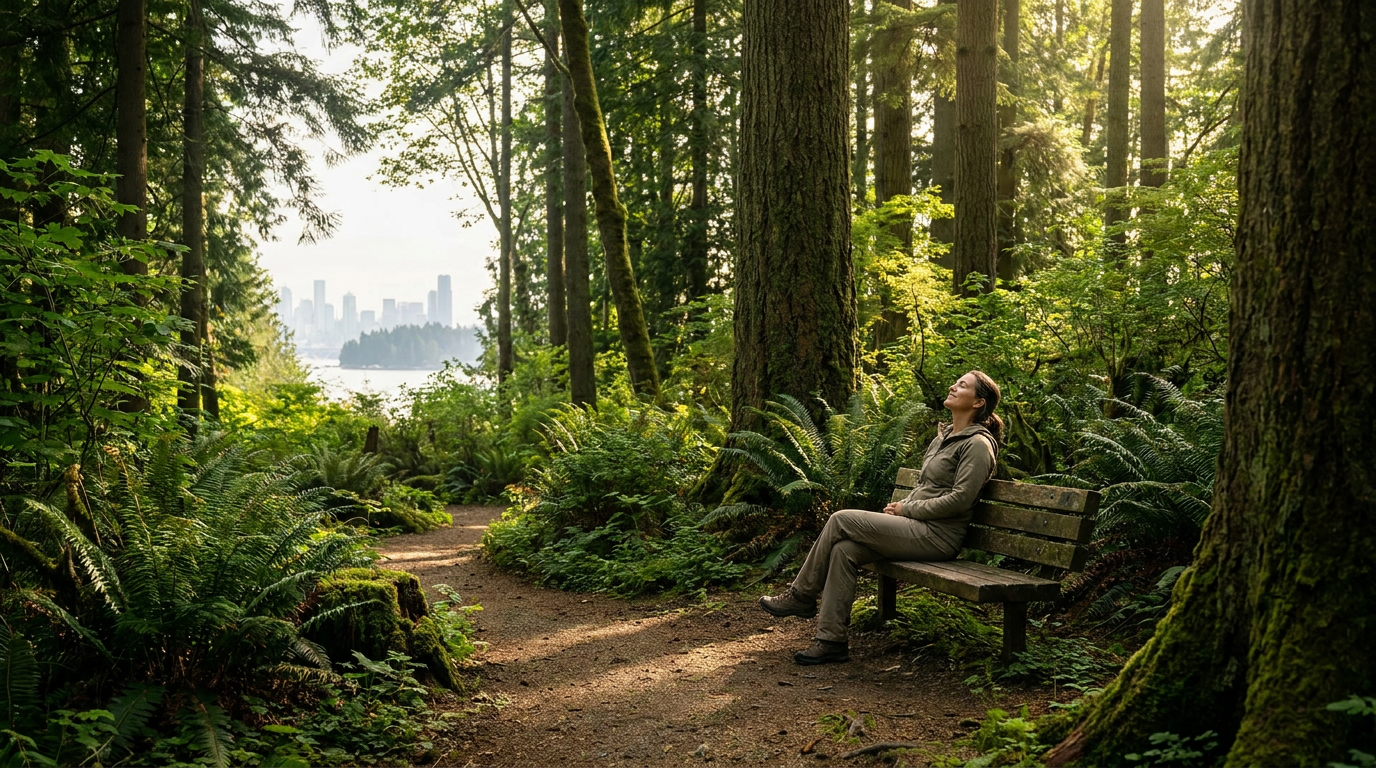
But what exactly qualifies as an Urban Quiet Park? The designation does not require a tomb-like vacuum or absolute silence. Instead, it identifies spaces where natural sounds—the rustle of autumn leaves, the call of native birds, or the trickle of a stream—are the dominant acoustic features, largely undisturbed by human-made industrial noise.[1][5]
To receive certification, a park must undergo rigorous acoustic testing. Audio engineers and trained volunteers visit the site on multiple days and at various times, recording background noise and documenting the ratio of natural to anthropogenic sounds. The general target is for the park's background noise to remain below 45 decibels.[4][5]
To put that metric into perspective, a quiet library typically measures around 40 decibels. In contrast, the World Health Organization (WHO) strongly recommends reducing average road traffic noise to below 53 decibels, noting that exposure above this threshold is consistently associated with adverse health effects. Finding a space that naturally hovers near 40 decibels within a sprawling metropolis is an increasingly rare acoustic feat.[2][3]

To put that metric into perspective, a quiet library typically measures around 40 decibels.
The health stakes driving this movement are substantial. According to the WHO, environmental noise is one of the leading environmental risks to physical and mental well-being. Chronic exposure to excessive noise activates the body's autonomic and hormonal systems, acting as a persistent environmental stressor.[2]
The medical literature links this constant acoustic stress to a cascade of ailments. Research shows that prolonged noise exposure increases the risk of ischemic heart disease, hypertension, sleep disturbance, and cognitive impairment. In the western part of Europe alone, the WHO estimates that one million healthy life years are lost annually due to traffic-related noise.[2]
Beyond mitigating physical harm, Urban Quiet Parks offer a specific psychological benefit that researchers call "soft fascination." In a typical urban environment, the brain is forced into a state of "directed attention," constantly filtering out sirens, navigating crowds, and processing traffic signals. This state is highly draining. Soft fascination occurs when the mind is gently engaged by natural patterns—like watching clouds or listening to a breeze—allowing the brain's directed attention mechanisms to rest and recover.[5]
The "Quiet Revolution" officially took root in 2020, when Yangmingshan National Park in Taipei, Taiwan, was certified as the world's first Urban Quiet Park. Located just outside the bustling capital, the park offers a sanctuary of lush forests and ice-cold springs, proving that a major Asian metropolis could successfully protect its acoustic heritage.[1][5]

Europe quickly followed suit. In 2021, London's Hampstead Heath was recognized as Europe's first Urban Quiet Park, providing nearly 800 acres of acoustic refuge just miles from Trafalgar Square. Stockholm, Sweden, has since become a global leader in the movement, certifying five separate nature reserves—including Judarskogen and Hansta—after years of evaluating the sound environment in its green spaces.[1][5]
The movement reached the United States in May 2023, when Portland's Mount Tabor Park was designated the country's first Urban Quiet Park. Spanning 176 acres on an extinct volcano, the park's towering trees help visitors find solitude even during busy summer holidays. During the evaluation process, volunteers recorded spots in the park where the noise level dropped below 35 decibels.[3]
Seattle followed in early 2024, with Seward Park earning the US's second urban designation. Set on a forested peninsula jutting into Lake Washington, the 300-acre retreat was rigorously tested by audio engineers over two years before receiving the award. Other major cities, including New York, Paris, and Brisbane, currently have parks under evaluation.[1]

Crucially, the organizers emphasize that these parks are not meant to be silent, restrictive zones. They remain vibrant community spaces. The QPI program does not come with strict rules or noise sanctions; rather, the designation is a tool to spread awareness. The hope is that by officially recognizing a space as "quiet," visitors will naturally adopt a mindset of acoustic respect, lowering their voices and turning off their speakers to preserve the shared environment.[3]
As urbanization accelerates and cities grow denser, the ability to hear a rustling leaf within city limits is shifting from a happy accident to a prized metric of a healthy metropolis. Quiet Parks International has already identified over 250 potential sites globally for future designation. By mapping and protecting these acoustic sanctuaries, the movement is ensuring that silence remains a public good, accessible to anyone who needs a moment to simply listen.[4][6]
How we got here
2019
Quiet Parks International (QPI) is founded by acoustic ecologist Gordon Hempton and Vikram Chauhan.
2020
Yangmingshan National Park in Taipei becomes the world's first certified Urban Quiet Park.
2021
London's Hampstead Heath is recognized as Europe's first Urban Quiet Park.
May 2023
Portland's Mount Tabor Park is designated as the first Urban Quiet Park in the United States.
Feb 2024
Seward Park in Seattle becomes the second US park to receive the designation.
Viewpoints in depth
The Acoustic Ecologist's View
Focuses on the intrinsic value of natural sound and the urgent need to preserve it.
For acoustic ecologists, silence is not an empty void, but a presence—the presence of nature. They point to the rapid disappearance of pristine acoustic environments and stress that saving quiet is equivalent to saving endangered species. To this camp, the ability to hear a bird call without the interference of an airplane engine is a fundamental right that is being slowly erased by industrialization.
The Public Health View
Focuses on the physiological damage of noise and the medical necessity of quiet spaces.
Public health officials view noise not merely as an annoyance, but as a pervasive environmental toxin. Citing WHO data, they emphasize that chronic noise triggers autonomic stress responses, leading directly to hypertension, ischemic heart disease, and lost years of healthy life. From this perspective, Urban Quiet Parks are not luxury amenities, but essential medical infrastructure designed to lower population-level stress hormones.
The Urban Community View
Focuses on accessibility, mental health, and shared community responsibility.
City dwellers and urban planners argue that while wilderness parks are beautiful, they are entirely inaccessible to most daily commuters. They value the psychological concept of "soft fascination" and the ability to find a 40-decibel refuge on a lunch break. Crucially, this camp emphasizes that these spaces must remain open, community-driven areas rather than heavily policed silent zones, relying on mutual respect rather than strict enforcement.
What we don't know
- How effectively cities can maintain these acoustic thresholds as urban populations and traffic density continue to grow.
- Whether the quiet park designation will eventually influence local zoning laws or traffic routing around the certified areas.
Key terms
- Urban Quiet Park
- A designated natural area in or near a city where natural sounds dominate human-made noise, typically measuring below 45 decibels.
- Soft Fascination
- A psychological state where the mind is gently engaged by natural stimuli, allowing for mental restoration without demanding focused attention.
- Acoustic Ecology
- The study of the relationship between human beings and their environment, mediated through sound.
- Lden
- A standard acoustic metric used by the WHO to measure average sound pressure over day, evening, and night periods.
Frequently asked
Does an Urban Quiet Park have to be completely silent?
No. The goal is for natural sounds like birdsong and wind to dominate human-made noise, not to create a tomb-like vacuum.
How loud is too loud for an Urban Quiet Park?
Evaluators typically look for background noise to remain below 45 decibels, which is roughly equivalent to the chatter in a quiet library.
Can anyone nominate a park for this status?
Yes, Quiet Parks International allows anyone to nominate a local park and volunteer to help measure its sound levels.
Are talking and music banned in these parks?
No. The designation relies on community awareness rather than strict noise sanctions, encouraging visitors to naturally adopt a quieter mindset.
Sources
Source coverage
6 outlets
3 viewpoints surfaced






[1]Quiet Parks InternationalAcoustic Ecologists
Urban Quiet Parks
Read on Quiet Parks International →[2]World Health OrganizationPublic Health Officials
Environmental noise in the European context
Read on World Health Organization →[3]Oregon Public BroadcastingUrban Planners & Citizens
Portland's Mount Tabor wins unique honor as first 'Urban Quiet Park' in the United States
Read on Oregon Public Broadcasting →[4]Explore MagazineAcoustic Ecologists
Quiet Parks International: Preserving the World's Quiet Places
Read on Explore Magazine →[5]Aruba TodayPublic Health Officials
The Quiet Revolution: How Urban Quiet Parks Are Reclaiming Silence
Read on Aruba Today →[6]Factlen Editorial TeamUrban Planners & Citizens
Synthesis by Factlen editorial team
Read on Factlen Editorial Team →



Every angle. Every day.
Get travel stories with full source coverage and perspective breakdowns delivered to your inbox.