
How Precision Fermentation is Creating Real Dairy Without the Cow
A rapidly maturing biotechnology is programming microbes to produce exact replicas of cow's milk proteins. The breakthrough promises to deliver the melt and stretch of real cheese while cutting greenhouse gas emissions by up to 95%.
By Factlen Editorial Team
- Food Tech Innovators
- Advocates argue that precision fermentation is the only viable way to decouple our food system from the environmental devastation of animal agriculture.
- Regulatory & Safety Bodies
- Health authorities emphasize the need for rigorous safety testing and transparent labeling, particularly regarding allergens.
- Market Analysts
- Financial observers focus on the massive growth potential of the sector, provided companies can overcome the capital-intensive hurdle of scaling bioreactor capacity.
What's not represented
- · Traditional dairy farmers facing potential long-term disruption
- · Strict vegans debating the ethics of using animal DNA sequences
Why this matters
Precision fermentation is poised to solve the biggest compromise in the alternative protein market: taste and texture. By producing real dairy proteins without the cow, this technology could drastically reduce the massive carbon and land footprint of the global dairy industry while allowing consumers to keep eating the cheese and milk they love.
Key points
- Precision fermentation uses genetically engineered microbes to produce bio-identical dairy proteins like whey and casein.
- The process requires no animals, cutting carbon emissions by up to 95% compared to traditional dairy farming.
- Recent FDA approvals in 2025 and 2026 have cleared the way for next-generation animal-free cheeses in the U.S.
- The resulting products are entirely lactose-free and cholesterol-free, though they still trigger dairy allergies.
- Major traditional dairy companies are investing heavily in the technology to create hybrid products.
Humanity has a complicated relationship with dairy. Cheese and milk are cultural staples and nutritional powerhouses, yet traditional dairy farming is a leading driver of agricultural greenhouse gas emissions and land use. For years, the food industry has attempted to bridge this gap with plant-based alternatives derived from oats, almonds, and soy.[7]
But plant-based milks and cheeses consistently fall short in one crucial area: functionality. They lack the specific proteins that give cow's milk its creamy mouthfeel and allow cheese to stretch, bubble, and melt. Now, a rapidly maturing technology called precision fermentation is solving that problem by producing real dairy proteins without the cow.[4][7]
Precision fermentation is a modern evolution of the traditional brewing process. Instead of using yeast to convert sugars into alcohol, scientists program microorganisms—such as yeast, fungi, or bacteria—to act as microscopic factories that produce specific complex molecules.[5]
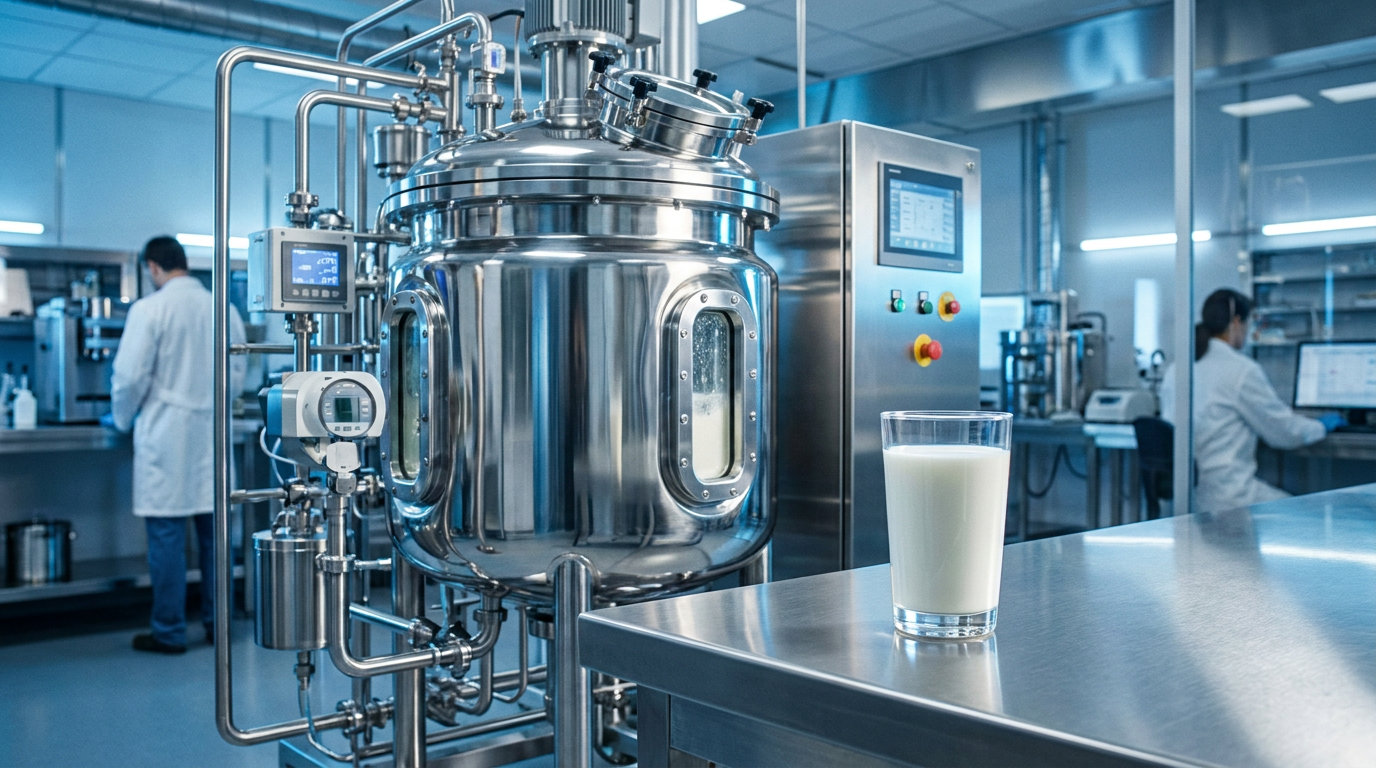
The mechanism relies on genetic engineering. Researchers take the specific DNA sequence that codes for a cow's milk protein and insert it into the genome of a microbe. These microbes are then placed in large stainless-steel fermentation tanks and fed a broth of simple plant sugars and nutrients. As the microbes grow and multiply, they naturally churn out the target dairy protein.[1][4]

Once the fermentation is complete, the liquid is filtered and purified. The microbes are entirely removed, leaving behind a pure protein isolate that is molecularly identical to the protein found in traditional cow's milk.[3]
While the application to consumer milk and cheese is new, the underlying technology is not. The food industry has quietly relied on precision fermentation since 1990 to produce chymosin, the enzyme used to curdle milk in cheese production. Today, the vast majority of commercial cheese is made using fermentation-derived chymosin rather than enzymes extracted from calf stomachs.[7]
The current frontier involves producing the macro-proteins that make up the bulk of dairy: whey and casein. Whey proteins, such as beta-lactoglobulin, are highly soluble and have been the first to reach the market in products like Strive FREEMILK and various protein nutrition bars.[3]
Casein, however, is the industry's holy grail. Casein proteins form complex structures called micelles, which are responsible for the unique melting and stretching properties of traditional cheese. Replicating casein via fermentation has proven technologically demanding, but recent breakthroughs have brought animal-free cheese to the brink of mass commercialization.[2][4]
Casein proteins form complex structures called micelles, which are responsible for the unique melting and stretching properties of traditional cheese.
In June 2026, the U.S. Food and Drug Administration (FDA) issued a "no questions" letter to Berlin-based Formo for its precision-fermented casein, confirming its Generally Recognized As Safe (GRAS) status. This regulatory green light clears the path for the ingredient to be sold to American food manufacturers, setting the stage for next-generation vegan cheeses that perform exactly like their dairy counterparts.[2]
Similar milestones are occurring across the sector. Australian startup All G recently secured FDA clearance for its precision-fermented lactoferrin, a highly valuable protein prized for its immune-boosting properties, achieving purity levels above 99.5%. Meanwhile, in Europe, the Netherlands has become the first EU country to permit public tastings of precision-fermented foods, allowing companies like Those Vegan Cowboys to test their animal-free cheeses with consumers ahead of formal Novel Foods approval.[1]

The environmental evidence supporting the shift is compelling. Companies utilizing precision fermentation report that their processes generate up to 95% fewer carbon emissions than conventional dairy farming. The technology also requires a fraction of the land and water, while entirely eliminating the methane emissions associated with cattle.[1][3]
Nutritionally, precision-fermented dairy offers distinct advantages. Because the proteins are synthesized in isolation, the final products contain zero cholesterol and are inherently lactose-free. This is a massive boon for the estimated 68% of the global population that suffers from some degree of lactose malabsorption.[3][7]
However, this molecular equivalence introduces a critical safety caveat: allergenicity. Because the fermentation-derived proteins are identical to cow's milk proteins, they will trigger the exact same immune response in individuals with dairy allergies. Regulatory bodies are working to ensure clear labeling so that consumers understand that "animal-free" does not mean "dairy-free."[5]
The technology also navigates complex labeling laws regarding genetic modification. While the microflora used in the fermentation tanks are genetically engineered, the final purified protein contains no detectable genetic material. As a result, these products often bypass mandatory bioengineered labeling requirements in the U.S., though many brands voluntarily use terms like "made with biotechnology" for transparency.[2]
Despite the scientific triumphs, the industry faces a daunting economic hurdle: scale. Building the massive, sterile bioreactors required to produce these proteins in commercial volumes is incredibly capital-intensive. Currently, precision-fermented proteins carry a price premium, though manufacturers project that economies of scale will eventually drive costs down to parity with traditional dairy.[4][6]

Interestingly, the traditional dairy industry is not treating precision fermentation as an existential threat, but rather as an investment opportunity. Major European cheese producers, including Westland Kaas, have poured millions into startups like Those Vegan Cowboys, recognizing that hybrid products—combining plant-based fats with fermentation-derived proteins—represent the future of the dairy aisle.[1]
The financial markets reflect this optimism. The global precision fermentation alternative protein market, valued at roughly $6.89 billion in 2025, is projected to surge to $78.4 billion by 2034, driven by a compound annual growth rate exceeding 31%.[6]
As regulatory barriers fall and production capacity expands, precision fermentation is poised to fundamentally alter the food system. By decoupling dairy proteins from the animal, the technology offers a rare compromise: allowing consumers to enjoy the foods they love while drastically reducing the environmental footprint of their diet.[7]
How we got here
1990
The FDA approves fermentation-derived chymosin, replacing calf stomach enzymes in commercial cheese production.
2020
Perfect Day launches the first commercial animal-free dairy ice cream in the United States.
April 2025
Vivici receives a 'no questions' letter from the FDA for its precision-fermented whey protein.
June 2026
Formo secures FDA clearance for its animal-free casein, paving the way for meltable vegan cheeses.
Viewpoints in depth
Food Tech Innovators
Advocates argue that precision fermentation is the only viable way to decouple our food system from the environmental devastation of animal agriculture.
For food technologists, the appeal of precision fermentation lies in its uncompromising functionality. Plant-based alternatives have struggled to capture mainstream consumers because they require a compromise on taste and texture. By producing the exact molecular proteins found in cow's milk, innovators believe they can seamlessly replace traditional dairy in the global supply chain, drastically cutting greenhouse gas emissions and land use without asking consumers to change their eating habits.
Regulatory & Safety Bodies
Health authorities emphasize the need for rigorous safety testing and transparent labeling, particularly regarding allergens.
Regulators are primarily concerned with ensuring that these novel foods are safe and clearly understood by the public. Because precision-fermented proteins are molecularly identical to animal dairy, they pose the exact same risk to individuals with dairy allergies. Agencies like the FDA and the UK's Food Standards Agency are working to establish labeling frameworks that prevent consumer confusion, ensuring that 'animal-free' claims do not mask the presence of real dairy allergens.
Traditional Dairy Industry
Established dairy producers view the technology as a strategic investment rather than an existential threat.
Rather than fighting the rise of animal-free proteins, many legacy dairy companies are actively investing in the space. Producers recognize that climate pressures and shifting consumer demographics will inevitably constrain traditional milk production. By partnering with precision fermentation startups, traditional cheesemakers aim to create hybrid products that blend plant-based fats with lab-grown casein, securing their market share in a resource-constrained future.
What we don't know
- It remains unclear how quickly the industry can scale up bioreactor capacity to achieve true price parity with subsidized traditional dairy.
- Consumer acceptance of 'animal-free dairy'—and how shoppers will react to the underlying genetic engineering—is still largely untested at a mass-market scale.
Key terms
- Precision Fermentation
- A biotechnology process that programs microbes to produce specific complex organic molecules, such as dairy proteins, without using animals.
- Casein
- The primary family of proteins in milk that gives cheese its unique ability to melt, stretch, and bubble when heated.
- Whey
- A highly soluble dairy protein that remains after milk has been curdled; often used in beverages and nutrition bars.
- GRAS (Generally Recognized As Safe)
- A U.S. FDA regulatory designation indicating that a food ingredient is safe for human consumption based on scientific consensus.
Frequently asked
Is precision-fermented dairy safe for people with lactose intolerance?
Yes. The fermentation process produces pure dairy proteins without the lactose sugars found in cow's milk, making the final products entirely lactose-free.
Is it safe for people with dairy allergies?
No. Because the proteins produced are molecularly identical to those from a cow, they will trigger the exact same immune response in individuals with dairy allergies.
Are these products considered genetically modified (GMO)?
The microbes used as factories are genetically engineered, but the final purified protein contains no detectable genetic material. Therefore, they often bypass mandatory bioengineered labeling laws.
Sources
Source coverage
7 outlets
3 viewpoints surfaced




[1]Green QueenFood Tech Innovators
All G Earns FDA Approval to Sell Cow-Free Lactoferrin Protein in US
Read on Green Queen →[2]FlavoristFood Tech Innovators
Animal-Free Dairy Gets a Boost: Precision Fermentation Casein Clears Major FDA Hurdle
Read on Flavorist →[3]The Food InstituteMarket Analysts
Strive Nutrition Launches Cow-Free Dairy Milk
Read on The Food Institute →[4]National Institutes of HealthRegulatory & Safety Bodies
Precision fermentation of milk proteins: Technological and societal implications
Read on National Institutes of Health →[5]UK Food Standards AgencyRegulatory & Safety Bodies
Precision fermentation and food safety
Read on UK Food Standards Agency →[6]Market InteloMarket Analysts
Precision Fermentation Alternative Protein Market Analysis
Read on Market Intelo →[7]Factlen Editorial TeamFood Tech Innovators
Synthesis by Factlen editorial team
Read on Factlen Editorial Team →
Every angle. Every day.
Get food drink stories with full source coverage and perspective breakdowns delivered to your inbox.