
The Initial SpaceX Frenzy Is Cooling Off, but a New Wave of Cash Is Waiting to Strike
Following its historic $1.8 trillion IPO, SpaceX's initial retail-driven stock surge is settling. However, an unprecedented fast-track entry into major stock indices is about to trigger a massive wave of mandatory buying from institutional tracker funds.
By Factlen Editorial Team
- Passive Index Providers
- Institutional funds that are contractually obligated to buy the stock regardless of fundamental valuation.
- Venture Capital Optimists
- Private market investors celebrating the IPO as a catalyst for future tech listings.
- Valuation Skeptics
- Fundamental analysts warning that the stock's price is detached from its underlying cash flow.
What's not represented
- · Retail Investors holding the stock
- · SpaceX Employees subject to lock-up periods
- · Competitors in the aerospace sector
Why this matters
If you have a 401(k), pension, or standard index fund, you are about to become a SpaceX investor. The sheer scale of this IPO is forcing index providers to rewrite their rules, meaning passive investors will automatically absorb billions in shares of Elon Musk's aerospace and AI giant.
Key points
- SpaceX raised $75 billion at a $1.8 trillion valuation, marking the largest IPO in history.
- Only 4% to 5% of the company's shares were floated to the public, creating extreme scarcity.
- Nasdaq's fast-entry rules will force index funds to buy the stock just 15 days after its debut.
- S&P 500 inclusion is delayed due to the massive cash burn of SpaceX's newly acquired xAI division.
- The successful listing is expected to unfreeze the IPO market for other late-stage tech unicorns.
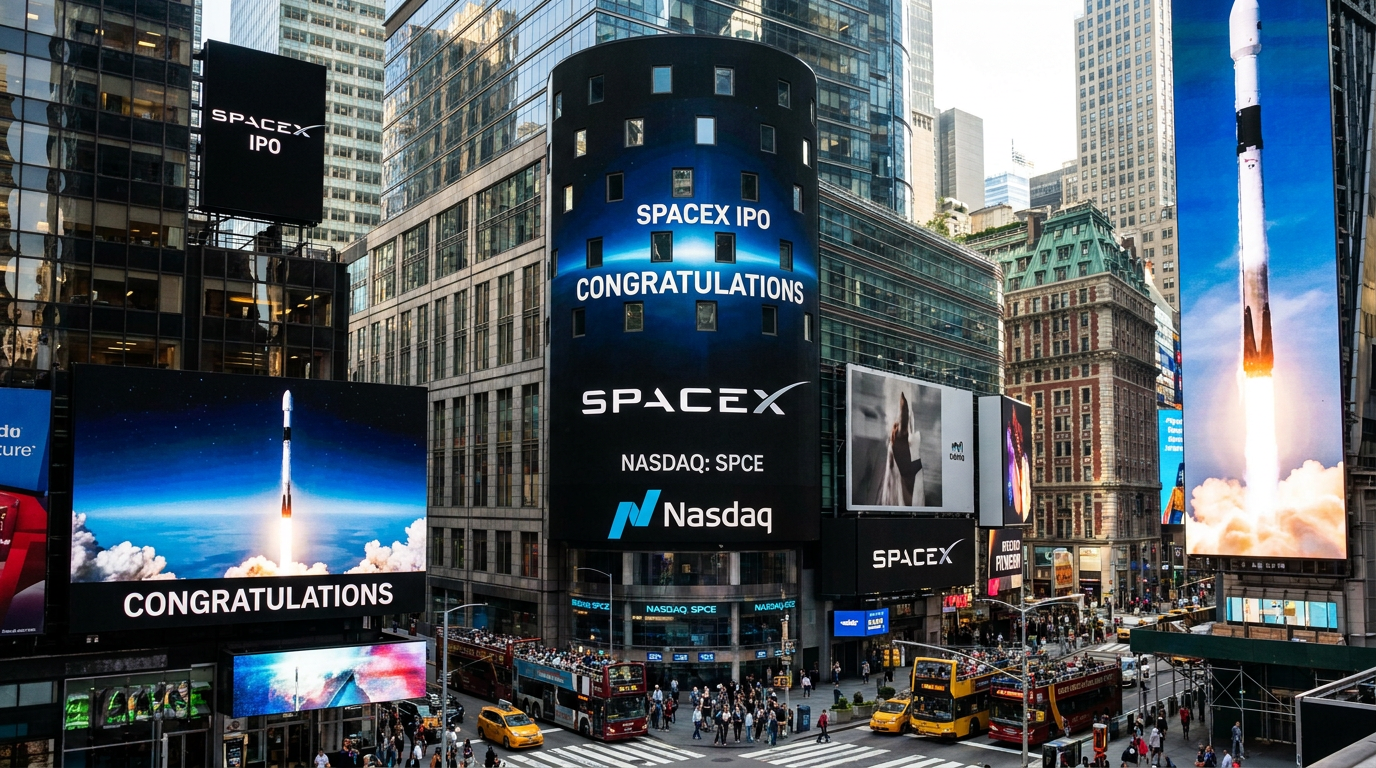
On June 12, 2026, SpaceX executed the largest Initial Public Offering in global financial history. Pricing its shares at $135, Elon Musk's aerospace and artificial intelligence conglomerate raised a staggering $75 billion, achieving a public market valuation approaching $1.8 trillion. This debut shattered the previous record held by Saudi Aramco's $29 billion listing in 2019, instantly transforming the private venture into one of the most valuable publicly traded entities on Earth.[2][5][6]
The immediate aftermath of the IPO was characterized by intense retail investor enthusiasm. Driven by the allure of Starlink's satellite internet dominance and the recent $250 billion internal acquisition of Musk's AI venture, xAI, retail buyers flooded the market. Shares surged as much as 67% to hit $225 in the opening days before cooling off to settle around $180—still a robust 33% premium over the initial offering price.[1][6][7]
However, this initial retail frenzy masks a critical structural detail regarding the company's stock: extreme scarcity. Despite the astronomical $1.8 trillion valuation, SpaceX floated only about 4% to 5% of its total equity to the public. The vast majority of shares remain locked up with Musk, early venture capital backers, and company employees.[2][3][6]
This exceptionally "low float" means that a relatively small number of shares are available for daily trading. When demand spikes in a low-float environment, price swings are heavily amplified because buyers are chasing a severely limited pool of available equity.[2][3]

The journey to this historic public valuation was paved by years of aggressive private market compounding. As recently as June 2024, internal tender offers valued SpaceX at roughly $210 billion. By late 2024, secondary sales pushed that figure toward $350 billion. The ultimate catalyst for the $1.8 trillion IPO valuation was the integration of xAI, which fundamentally shifted SpaceX from a pure aerospace company into a dual-threat space and artificial intelligence behemoth.[6][8]
As the initial retail momentum begins to stabilize, a second, much larger wave of capital is preparing to strike. This incoming cash is not driven by sentiment, news headlines, or active stock-picking, but by the rigid, automated mechanics of passive investing.[1][2][5]
Because SpaceX is now one of the largest companies in the world, major stock indices are being forced to absorb it. When a company is added to a benchmark index, any mutual fund or exchange-traded fund (ETF) that tracks that index is contractually obligated to purchase the stock to accurately reflect the index's composition.[2][5]
Because SpaceX is now one of the largest companies in the world, major stock indices are being forced to absorb it.
Historically, index inclusion is a slow, methodical process, but SpaceX's sheer scale has prompted Wall Street to rewrite the rules. Nasdaq recently introduced a "fast-entry" mechanism specifically designed for mega-cap listings. Under these revised guidelines, SpaceX is eligible for inclusion in the Nasdaq 100 index just 15 trading days after its IPO.[2][4][7]

When that 15-day threshold is crossed, passive funds tracking the Nasdaq 100 will execute mandatory buy orders. Market analysts warn that this impending wave of institutional buying will collide directly with SpaceX's 5% public float, potentially triggering a severe supply-and-demand crunch that could drive short-term volatility.[1][2][3]
The ripple effect of this inclusion extends globally. The MSCI World index is also slated to add SpaceX, where it is expected to hold a weight of approximately 0.08%. While that percentage sounds small, applied to the trillions of dollars benchmarked against MSCI indices, it translates to billions in forced buying.[2][5]
As a result of this global index inclusion, pension funds and retirement accounts worldwide will automatically gain exposure to the aerospace giant. Millions of everyday savers will become SpaceX investors by default, integrating Musk's ventures into standard 401(k) and workplace pension portfolios.[2][5]
Noticeably absent from the immediate inclusion list, however, is the S&P 500. Unlike Nasdaq, S&P Dow Jones Indices has maintained its strict inclusion criteria, which require a company to have traded publicly for at least 12 months and to demonstrate consecutive quarters of GAAP profitability.[2][6]

Profitability is currently a complex hurdle for SpaceX. While its core Starlink division boasts margins over 50% and generated a $1.2 billion profit in recent quarters, the newly acquired xAI division is operating at a massive loss. The AI segment burned an estimated $2.5 billion in the first quarter of 2026 alone, meaning S&P 500 inclusion is highly unlikely before June 2027.[3][6]
The impending wave of index buying has also not silenced Wall Street's fundamental skeptics. Analysts at Morningstar have explicitly warned that the stock is "significantly overvalued" at current levels, assigning a fair value estimate of just $63 per share. They caution that while the launch business has a strong economic moat, the cash-intensive AI segment poses a material threat to near-term value creation.[3]
Beyond SpaceX itself, the successful listing is sending shockwaves through the broader venture capital ecosystem. For years, late-stage startups have remained private longer than ever before—averaging over 12 years—creating a massive backlog of highly valued "unicorns."[4]

SpaceX's ability to seamlessly transition a $1.8 trillion valuation into the public sphere is widely viewed as the catalyst needed to thaw the frozen IPO market. Industry insiders expect this success to pave the way for other heavily capitalized AI and tech heavyweights, with companies like OpenAI and Anthropic anticipated to follow suit in the coming months.[4][7]
For now, the financial world is bracing for the imminent collision of massive institutional demand and a tightly constrained supply of shares. Whether the stock ascends further on index flows or succumbs to the gravity of its own valuation, the SpaceX IPO has permanently altered the mechanics of the public markets.[1][2][3]
How we got here
Jun 2024
Internal tender offers value SpaceX at approximately $210 billion.
Dec 2024
Secondary market sales push the private valuation of the company toward $350 billion.
May 2026
SpaceX files its S-1 registration with the SEC, revealing the internal acquisition of xAI and targeting a $1.8 trillion valuation.
Jun 12, 2026
SpaceX officially goes public, raising $75 billion in the largest IPO in history.
Late Jun 2026
Nasdaq's fast-entry mechanism is scheduled to trigger, forcing index funds to begin purchasing the stock.
Viewpoints in depth
Passive Index Providers
Index funds are forced to buy the stock regardless of its fundamental valuation.
For passive fund managers, the SpaceX IPO presents a mechanical challenge. Because their mandate is strictly to replicate an index like the Nasdaq 100 or MSCI World, they cannot exercise discretion over whether SpaceX is overvalued or if its 5% float will cause execution issues. They are contractually obligated to buy billions of dollars of the stock the moment the index providers add it, effectively acting as price-agnostic buyers in a supply-constrained market.
Valuation Skeptics
Fundamental analysts warn that the $1.8 trillion price tag ignores the massive cash burn of the company's AI ambitions.
Skeptics, led by research firms like Morningstar, argue that retail and institutional hype has detached the stock from its underlying fundamentals. While they acknowledge the profitability and monopoly-like dominance of the Starlink and launch businesses, they point to the recent $250 billion internal acquisition of xAI as a major liability. With the AI division burning billions of dollars a quarter, skeptics argue the fair value of the stock is closer to $63, warning that early public investors are absorbing the risk of Musk's most speculative ventures.
Venture Capital Optimists
Private market investors view the successful listing as a vital catalyst to unfreeze the IPO pipeline.
For the broader venture capital ecosystem, SpaceX's debut is a massive relief. Over the past five years, companies have stayed private for unprecedented durations, trapping billions in illiquid equity. VC optimists see the market's willingness to absorb a $75 billion capital raise at a $1.8 trillion valuation as proof that public appetite for mega-cap tech and AI remains voracious. They anticipate this will trigger a wave of subsequent listings from other highly valued private companies like OpenAI, Anthropic, and Stripe.
What we don't know
- How severely the 5% float will distort the stock price once the mandatory index buying begins.
- Exactly when the xAI division will achieve profitability, which is required for S&P 500 inclusion.
- Whether early venture capital backers will flood the market with shares once their lock-up periods expire.
Key terms
- Initial Public Offering (IPO)
- The process by which a private company first sells shares of its stock to the public, transitioning into a publicly traded entity.
- Free Float
- The portion of a company's shares that are freely available for trading by the public, excluding locked-up shares held by insiders or early investors.
- Index Tracker Fund
- A passive investment fund designed to replicate the performance of a specific market index, requiring the fund to buy shares of every company included in that index.
- Fast-Entry Mechanism
- A special rule used by index providers like Nasdaq that allows exceptionally large, newly public companies to be added to an index much faster than the standard waiting period.
- Tender Offer
- A private market transaction where a company or outside investors offer to buy shares directly from employees and early backers, often used to establish a valuation before an IPO.
Frequently asked
When will SpaceX be added to the S&P 500?
SpaceX is unlikely to join the S&P 500 before June 2027. The index requires companies to have traded publicly for at least 12 months and to demonstrate consecutive quarters of GAAP profitability, which is currently hindered by the cash burn of its xAI division.
Why is SpaceX's stock price expected to be volatile?
Only about 4% to 5% of SpaceX's total shares were made available to the public. This "low float" means that when massive index funds are forced to buy the stock, they are competing for a very small pool of available shares, which can cause dramatic price swings.
Do I own SpaceX stock if I have a standard retirement account?
You likely will soon. As SpaceX is added to major global indices like the MSCI World and the Nasdaq 100, any mutual fund or pension that tracks those benchmarks will automatically purchase the stock on your behalf.
How much money did SpaceX raise in its IPO?
SpaceX raised $75 billion in its initial public offering, making it the largest IPO in global financial history, far surpassing the previous $29 billion record set by Saudi Aramco.
Sources
Source coverage
8 outlets
3 viewpoints surfaced








[1]MarketWatchVenture Capital Optimists
The initial SpaceX frenzy is cooling off — but a new wave of cash is waiting to strike
Read on MarketWatch →[2]Hargreaves LansdownPassive Index Providers
SpaceX's record IPO could reshape indices
Read on Hargreaves Lansdown →[3]MorningstarValuation Skeptics
SpaceX Launches History's Largest IPO
Read on Morningstar →[4]GAM InvestmentsVenture Capital Optimists
Late‑stage private companies are driving a growing share of innovation
Read on GAM Investments →[5]Standard LifePassive Index Providers
SpaceX listing could be the largest initial public offering (IPO) in history
Read on Standard Life →[6]Investing.comVenture Capital Optimists
SpaceX filed its securities registration with the SEC
Read on Investing.com →[7]Tiger BrokersVenture Capital Optimists
The Initial SpaceX Frenzy Is Cooling Off, but a New Wave of Cash Is Waiting to Strike
Read on Tiger Brokers →[8]Los Angeles TimesVenture Capital Optimists
SpaceX tender offer said to value company at $210 billion
Read on Los Angeles Times →
Every angle. Every day.
Get finance stories with full source coverage and perspective breakdowns delivered to your inbox.