
The Science of Pilates: How a Century-Old Method is Rewiring Modern Biomechanics
Clinical research and sports science are validating the profound biomechanical and neurophysiological benefits of Pilates, proving it is far more than just a fitness trend.
By Factlen Editorial Team
- Sports Science Researchers
- Focuses on the biomechanical data, ultrasound imaging, and empirical evidence of deep core muscle activation.
- Clinical Rehabilitation Specialists
- Views Pilates primarily as a non-pharmacological therapeutic intervention for chronic pain, injury recovery, and mental health.
- Classical Pilates Practitioners
- Emphasizes Joseph Pilates' original 'Contrology' philosophy, focusing on the mind-body connection, breath, and holistic movement.
What's not represented
- · High-intensity strength athletes who may view low-impact modalities as insufficient for maximal force production.
- · Public health officials focused on the accessibility and cost barriers of equipment-based Reformer Pilates.
Why this matters
Understanding the biomechanics of Pilates transforms it from a fitness trend into a vital tool for longevity. By targeting the deep stabilizing muscles that support the spine, this century-old method offers a proven, non-pharmacological defense against chronic back pain and age-related mobility loss.
Key points
- Pilates targets deep stabilizing muscles, specifically the transverse abdominis and multifidus, rather than superficial muscles.
- Clinical ultrasound imaging confirms that Pilates significantly increases the thickness and anticipatory firing rate of core muscles.
- Systematic reviews validate Pilates as a highly effective, non-pharmacological treatment for chronic low back pain.
- The method was originally developed by Joseph Pilates during World War I to rehabilitate injured soldiers using bed springs.
- Beyond physical strength, Pilates has proven neurophysiological benefits, including reducing anxiety and the fear of movement.
In 2026, Pilates is ubiquitous. From boutique reformer studios in suburban strip malls to the training facilities of professional sports teams, the century-old exercise method has experienced a massive resurgence. Yet, despite its reputation as a trendy, aesthetic-focused workout, Pilates is fundamentally a rigorous system of biomechanics. It is not merely about stretching or achieving a certain physique; it is a highly engineered approach to human movement that targets the body's deepest stabilizing structures. As modern sports science and rehabilitative medicine continue to study the method, clinical evidence is increasingly validating what its creator intuited over a hundred years ago.[7]
The paradox of Pilates is that it often looks effortless to the untrained eye, yet it demands an intense, exhausting level of internal muscular control. Unlike traditional weightlifting, which typically focuses on moving heavy loads through a single plane of motion using large, superficial muscles, Pilates emphasizes the precise coordination of deep stabilizers. The method requires practitioners to maintain a neutral spine and a stable pelvis while moving their limbs, creating a unique neuromuscular challenge. This focus on core stability has made it a subject of intense interest among physical therapists, biomechanists, and orthopedic researchers looking for non-pharmacological interventions for musculoskeletal disorders.[7]
To understand the science of Pilates, one must first understand its origins, which are rooted in rehabilitation and survival. Joseph Hubertus Pilates was born in Germany in 1883. As a child, he suffered from a litany of ailments, including asthma, rickets, and rheumatic fever. Determined to overcome his physical frailties, he dedicated his youth to studying anatomy, bodybuilding, wrestling, and gymnastics. He observed the fluid, efficient movements of animals—particularly cats—and began to synthesize Eastern practices like yoga with Western physical culture, seeking a holistic approach to physical vitality.[6]

The crucible for his method arrived during World War I. Living in England when the war broke out, Joseph Pilates was interned as an enemy alien on the Isle of Man. Surrounded by fellow internees suffering from the physical and mental toll of confinement, he began teaching his unique system of mat exercises to maintain their health. When he was assigned to work as an orderly in the camp's hospital, he faced the challenge of rehabilitating bedridden, injured soldiers. By attaching springs to the hospital beds, he created a system of variable resistance that allowed patients to exercise their muscles without bearing weight on injured joints—the rudimentary prototype for the modern Pilates Reformer.[6]
After the war, Joseph Pilates briefly returned to Germany before emigrating to the United States in 1926. On the voyage, he met his future wife, Clara, and together they opened the first Pilates studio on Eighth Avenue in New York City. The studio happened to share a building with several dance rehearsal spaces, and the method quickly caught the attention of the city's elite dance community. Legendary choreographers like George Balanchine and Martha Graham began sending their injured dancers to the studio for rehabilitation, cementing the method's long-standing association with the grace and flexibility of ballet.[6]
Joseph Pilates did not originally call his method Pilates. He named it Contrology, defining it as the complete coordination of body, mind, and spirit. He believed that modern lifestyles, characterized by poor posture and inefficient breathing, were detrimental to human health. Contrology was built on six foundational principles: centering, concentration, control, precision, breath, and flow. Rather than mindlessly repeating reps to the point of failure, practitioners were instructed to perform fewer repetitions with absolute biomechanical perfection. The mind was required to actively guide the body, forging a strong neuromuscular connection that modern science now recognizes as proprioception.[6][7]

Today, the clinical efficacy of Contrology is being mapped by rehabilitative ultrasound imaging and electromyography. When researchers study the biomechanics of Pilates, they focus heavily on the local muscle system—the deep, stabilizing muscles that attach directly to the spine and pelvis. In traditional fitness, many people equate the core with the rectus abdominis, the superficial muscle responsible for the visible six-pack. However, Pilates bypasses these superficial movers to target the transverse abdominis, the deepest abdominal layer that wraps around the torso like a corset, and the lumbar multifidus, a series of small muscles that stabilize the individual vertebrae.[1]
Today, the clinical efficacy of Contrology is being mapped by rehabilitative ultrasound imaging and electromyography.
A 2025 study published by the National Institutes of Health utilized rehabilitative ultrasound imaging to measure the effects of Pilates-based core stabilization on these deep muscles. The researchers found that healthy adults who participated in a structured Pilates program demonstrated significant increases in the thickness of both the transverse abdominis and the internal obliques. Furthermore, the exercises improved the contraction timing of these muscles, meaning the nervous system became faster and more efficient at firing the stabilizers in anticipation of movement. This anticipatory core engagement is the exact mechanism that protects the spine during heavy lifting or sudden athletic movements.[1]
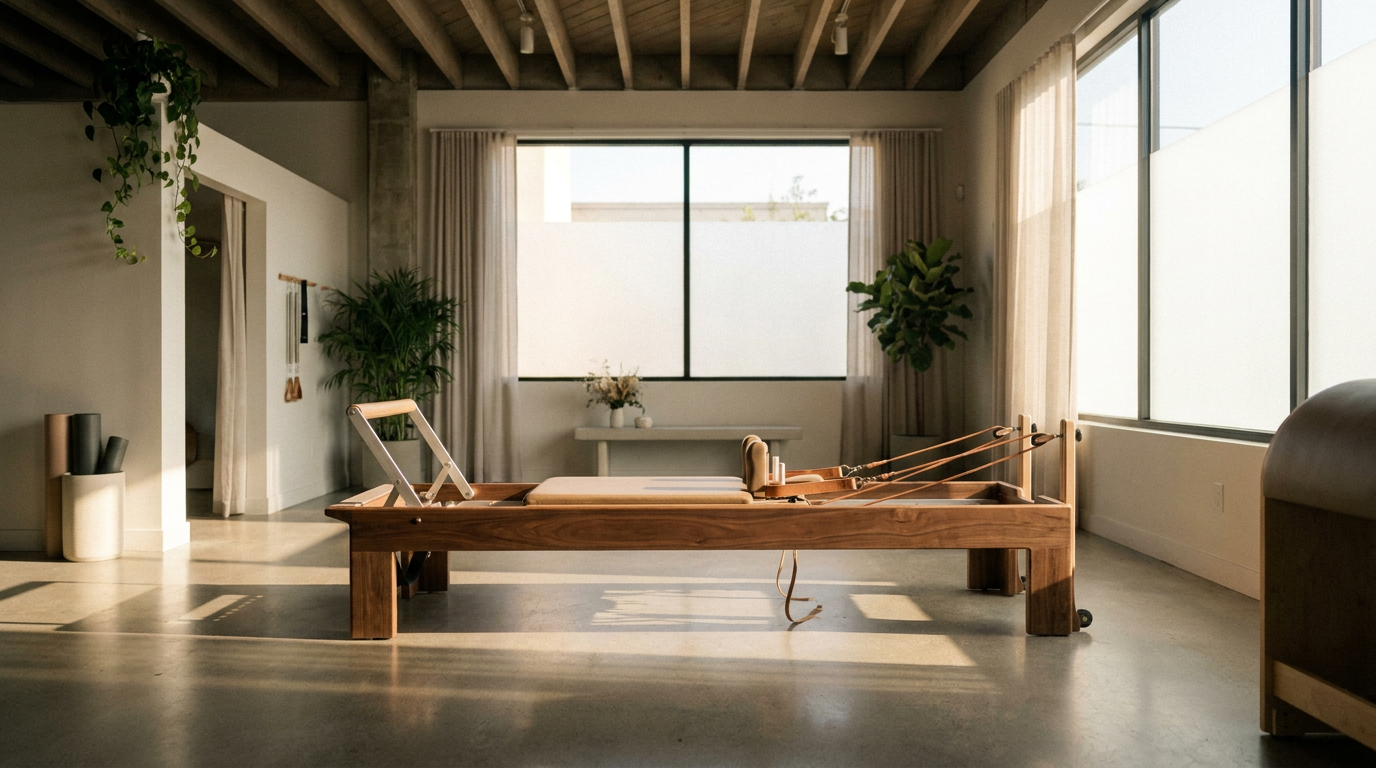
The use of apparatuses like the Reformer amplifies this neuromuscular adaptation. The Reformer consists of a sliding carriage attached to springs of varying tensions. Because the surface is unstable, the central nervous system must constantly recruit deep stabilizing muscles to maintain balance while the limbs push and pull against the resistance. This co-contraction of the core muscles while the extremities are in motion is what makes Pilates uniquely effective for rehabilitating musculoskeletal disorders. It teaches the body to separate limb movement from spinal movement, a concept known as lumbopelvic dissociation.[1]
Nowhere is the clinical impact of this biomechanical training more evident than in the treatment of chronic low back pain. This condition is one of the leading causes of disability worldwide, often stemming from muscular imbalances, poor posture, and a failure of the deep core muscles to adequately support the lumbar spine. When the transverse abdominis and multifidus are weak or delayed in their firing, the burden of supporting the torso falls on the passive structures of the spine—the ligaments and intervertebral discs—leading to pain and injury.[2]
Systematic reviews and meta-analyses have consistently shown that Pilates is a highly effective, non-pharmacological intervention for chronic low back pain. By specifically targeting the deep stabilizers, Pilates restores the muscular corset that unloads the lumbar spine. A comprehensive meta-analysis of randomized controlled trials found that patients practicing Pilates experienced significant reductions in pain scales and major improvements in functional disability, as measured by the Oswestry Disability Index. For many patients, restoring the motor control of the lumbar spine through Pilates provides more sustainable relief than traditional medical interventions.[2]

Beyond the mechanical stabilization of the spine, recent research has uncovered the profound neurophysiological effects of the practice. A 2025 study published in Rheumatology Live examined the impact of Reformer Pilates on women suffering from chronic musculoskeletal pain. The researchers discovered that the benefits extended far beyond muscle thickness. Participants experienced a significant reduction in fear of movement, known clinically as kinesiophobia, and an altered perception of pain. By providing a safe, controlled environment where patients could move without triggering their pain pathways, Pilates helped rewire the brain's relationship with physical exertion.[2][4]
This mind-body unity is a critical component of the method's success. Because Pilates requires intense concentration on breath and precise alignment, it functions as a form of active meditation. Systematic reviews of the therapeutic effects of Pilates have documented moderate to large effects on mental health outcomes, including significant decreases in anxiety, depression, and somatic stress. The deep, diaphragmatic breathing patterns required during the exercises stimulate the parasympathetic nervous system, lowering cortisol levels and promoting a state of physiological calm even while the muscles are working near their threshold.[3]

While its rehabilitative credentials are well-established, Pilates has also become a staple in elite athletic conditioning. Strength and conditioning coaches across professional sports now integrate Pilates to complement high-impact, high-intensity training. Heavy barbell lifting builds absolute strength and bone density, but it can also lead to muscular stiffness and asymmetrical imbalances. Pilates serves as the perfect counterbalance, improving joint mobility, dynamic balance, and unilateral strength. A strong, highly responsive core allows athletes to transfer power more efficiently from their lower body to their upper body, enhancing overall performance while drastically reducing the risk of soft-tissue injuries.[5]
Ultimately, the enduring legacy of Joseph Pilates lies in his profound understanding of human anatomy long before the advent of modern diagnostic imaging. He famously claimed that his method was fifty years ahead of its time, a bold assertion that sports science has proven entirely accurate. By prioritizing the deep stabilizers over superficial aesthetics, and by insisting that the mind must actively govern the body, he created a system of movement that is as medically sound as it is physically challenging. Today, whether used to rehabilitate a herniated disc, calm an anxious mind, or add inches to an athlete's vertical leap, Pilates stands as a masterclass in biomechanical engineering.[7]
How we got here
1883
Joseph Hubertus Pilates is born in Germany, suffering from childhood illnesses that inspire his lifelong study of anatomy and physical culture.
1914
Interned on the Isle of Man during WWI, Pilates develops his mat exercises and uses hospital bed springs to rehabilitate injured soldiers.
1926
Joseph and Clara Pilates emigrate to the United States and open the first Pilates studio in New York City, attracting elite dancers.
1945
Pilates publishes 'Return to Life Through Contrology,' detailing his philosophy and the original 34 mat exercises.
2025
Major systematic reviews in sports science and rheumatology validate Pilates as a highly effective clinical intervention for chronic pain and core stability.
Viewpoints in depth
Sports Science Researchers
Focuses on the biomechanical data, ultrasound imaging, and empirical evidence of deep core muscle activation.
For biomechanists and sports scientists, Pilates is viewed through the lens of motor control and neuromuscular efficiency. This camp relies on tools like electromyography (EMG) and rehabilitative ultrasound imaging to quantify exactly how the method alters muscle architecture. They emphasize that the true value of Pilates lies in its ability to increase the thickness of the transverse abdominis and multifidus, while simultaneously improving the central nervous system's anticipatory firing rates. To this group, Pilates is less about holistic wellness and more about optimizing the mechanical levers of the human body to prevent injury and maximize force transfer.
Clinical Rehabilitation Specialists
Views Pilates primarily as a non-pharmacological therapeutic intervention for chronic pain, injury recovery, and mental health.
Physical therapists, rheumatologists, and pain specialists approach Pilates as a highly effective clinical intervention. This camp focuses heavily on the method's success in treating chronic low back pain (CLBP) and musculoskeletal disorders. They highlight the neurophysiological benefits of the practice, noting that the controlled, low-impact environment helps patients overcome 'kinesiophobia' (the fear of movement) and alters their perception of pain. For these specialists, the mind-body connection in Pilates is not just a spiritual concept, but a measurable neurological mechanism that down-regulates the sympathetic nervous system and reduces systemic inflammation.
Classical Pilates Practitioners
Emphasizes Joseph Pilates' original 'Contrology' philosophy, focusing on the mind-body connection, breath, and holistic movement.
Traditionalists and classical instructors advocate for preserving the method exactly as Joseph Pilates designed it. This camp argues that 'Contrology' is a complete lifestyle and philosophy, not just a set of physical exercises. They emphasize the six core principles—centering, concentration, control, precision, breath, and flow—and believe that the apparatuses (like the Reformer and Cadillac) are essential tools for teaching the body how to organize itself. To classical practitioners, the modern scientific validation of Pilates is welcome, but secondary to the holistic, mind-body integration that 'Uncle Joe' envisioned a century ago.
What we don't know
- While Pilates improves muscular endurance and stability, its specific impact on increasing bone mineral density compared to heavy resistance training remains under-researched.
- The exact long-term retention rate of neurophysiological benefits, such as reduced fear of movement, after a patient stops practicing Pilates is still being studied.
Key terms
- Contrology
- Joseph Pilates' original name for his method, emphasizing the mind's active control over the body's movements and alignment.
- Transverse Abdominis (TrA)
- The deepest layer of abdominal muscle that wraps around the torso like a corset, crucial for spinal stability.
- Multifidus
- A series of small, deep muscles attached directly to the spinal column that provide stability to individual vertebrae.
- Lumbopelvic Dissociation
- The biomechanical ability to move the arms and legs freely without compensatory movement in the spine or pelvis.
- Proprioception
- The nervous system's ability to sense the body's position, movement, and alignment in space.
Frequently asked
Is Pilates better than traditional weightlifting?
They serve different purposes and are highly complementary. Weightlifting builds absolute strength and bone density using superficial muscles, while Pilates targets deep stabilizing muscles to improve alignment, balance, and joint health.
Can Pilates help with chronic lower back pain?
Yes. Systematic reviews show that Pilates is a highly effective intervention for lower back pain because it strengthens the transverse abdominis and multifidus, which act as a muscular corset to support the lumbar spine.
What is the difference between Mat and Reformer Pilates?
Mat Pilates uses body weight and gravity for resistance, while Reformer Pilates uses a sliding carriage and springs. The springs provide variable resistance and proprioceptive feedback, which can help isolate specific stabilizing muscles.
Who was Joseph Pilates?
Joseph Pilates was a German physical trainer who developed his exercise method, originally called 'Contrology,' while interned in England during World War I. He later opened his first studio in New York City in 1926.
Sources
Source coverage
7 outlets
3 viewpoints surfaced






[1]NIH BiomechanicsSports Science Researchers
Effects of Pilates-based core stabilization training on deep stabilizing muscles
Read on NIH Biomechanics →Efficacy of Pilates on Pain, Functional Disorders and Quality of Life in Patients with Chronic Low Back Pain: A Systematic Review
Read on NIH Rheumatology →[3]ResearchGateSports Science Researchers
Therapeutic and Functional Effects of Pilates: Evidence from Current Literature
Read on ResearchGate →[4]Rheumatology LiveClinical Rehabilitation Specialists
Reformer Pilates Improved Mental, Physical Health in Chronic Neck, Back Pain
Read on Rheumatology Live →[5]Women's HealthClinical Rehabilitation Specialists
The Health Benefits of Pilates, According To Science
Read on Women's Health →[6]Pilates AnytimeClassical Pilates Practitioners
The History of Joseph Pilates and Contrology
Read on Pilates Anytime →[7]Factlen Editorial TeamClassical Pilates Practitioners
Synthesis by Factlen editorial team
Read on Factlen Editorial Team →
Every angle. Every day.
Get fitness stories with full source coverage and perspective breakdowns delivered to your inbox.