
East New York Community Land Trust Makes History With First Commercial Property Purchase
The East New York Community Land Trust is set to become the first in New York City history to purchase a commercial property off the private market. The $2.3 million acquisition will transform a vacant warehouse into an affordable hub for local businesses and nonprofits.
By Factlen Editorial Team
- Community Organizers
- Advocates view land ownership as the ultimate tool for neighborhood stabilization and empowerment.
- Urban Policy Experts
- Policy experts highlight the CLT model's proven resilience against market volatility.
- City Officials
- Municipal leaders see community land trusts as essential partners in achieving citywide affordability goals.
- Commercial Real Estate
- Industry observers monitor the shift as non-profits successfully compete for commercial assets in a tight market.
What's not represented
- · Private commercial developers
- · Displaced local business owners
Why this matters
As urban gentrification accelerates, legacy businesses and long-time residents are frequently priced out of their own neighborhoods. This historic purchase proves that community-led organizations can successfully compete in the private real estate market to secure permanent, affordable commercial space, offering a scalable blueprint for neighborhood stabilization.
Key points
- The East New York Community Land Trust is purchasing a $2.3 million vacant warehouse, marking NYC's first commercial property acquisition by a land trust.
- The building will become the East Brooklyn Liberation Center, providing permanently affordable space for local businesses and community nonprofits.
- Community land trusts separate land ownership from building ownership, effectively removing properties from the speculative real estate market.
- The milestone aligns with the city's broader housing plan, which relies on community partnerships to preserve and create affordable neighborhood spaces.
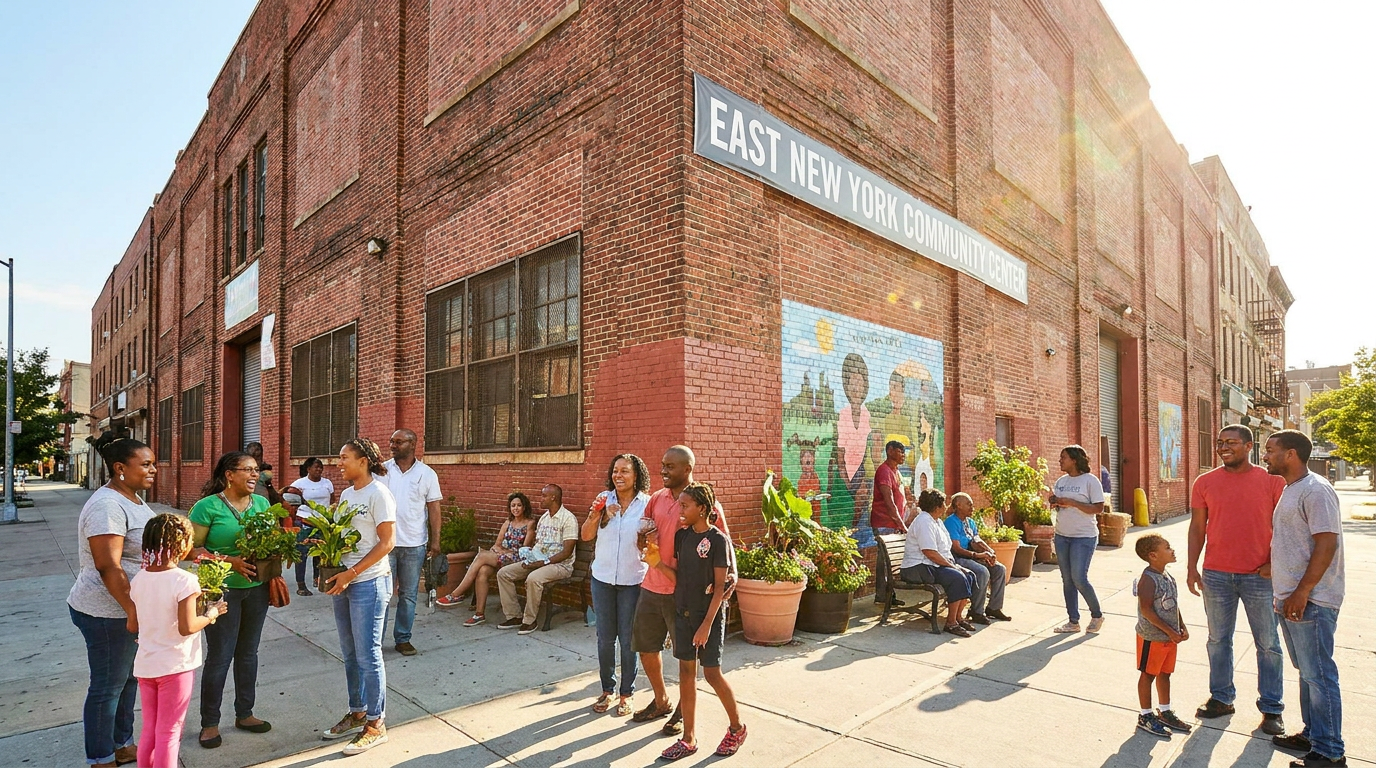
In a landmark moment for neighborhood-led development and urban revitalization, the East New York Community Land Trust (ENYCLT) is set to become the first organization of its kind in New York City history to purchase a commercial property directly off the private market. The grassroots organization is currently finalizing the acquisition of a vacant, two-story brick warehouse for $2.3 million. Once the extensive renovations are complete, the building will be transformed into the "East Brooklyn Liberation Center." This new facility will serve as a permanent headquarters for the nonprofit while simultaneously offering deeply affordable office, retail, and gathering space to other local businesses and community organizations that are increasingly being priced out of the area.[1][3][4][5]
This historic milestone represents a significant evolution in the community land trust model, which has traditionally focused almost exclusively on residential housing and affordable homeownership. By securing commercial space, the trust aims to anchor local economic activity and prevent the displacement of legacy businesses that form the cultural backbone of the neighborhood. East New York and neighboring Brownsville have long been at the epicenter of Brooklyn's affordability crisis. With median household incomes sitting far below the citywide average, these predominantly Black and Hispanic neighborhoods have faced compounding pressures from speculative real estate investment, predatory lending, and encroaching gentrification from the western parts of the borough. "Removing land from the speculative market is building power in the neighborhood," said Boris Santos, president of the ENYCLT, emphasizing that community ownership is the most effective and permanent bulwark against displacement.[1][5][6][8]
To understand the significance of this purchase, it is essential to understand how the community land trust mechanism fundamentally alters the real estate equation. The CLT model works by legally separating the ownership of the underlying land from the physical structures built upon it. The nonprofit trust, governed by a board of community residents and stakeholders, retains ownership of the land in perpetuity. Meanwhile, the buildings are sold or leased at heavily restricted, below-market rates to community members, cooperatives, or local enterprises. This structural separation ensures that any public, private, or philanthropic investment in the property remains permanently locked into the community. Rather than being absorbed by private landlords as property values inevitably rise, the wealth generated by the land's appreciation is utilized to keep rents affordable for the next generation of tenants and business owners.[6][7][8]

The ambitious commercial acquisition builds directly upon the ENYCLT's previous, highly publicized successes in the residential sector, proving that their organizational capacity has matured significantly. In 2024, the organization made headlines across the city when it became the first New York City community land trust to purchase a 20-unit multifamily apartment building directly off the private market. Rather than maintaining the status quo of a traditional landlord-tenant relationship, the organization is currently in the complex process of converting that building into a shared-equity housing cooperative. This innovative structure allows long-time renters to become partial owners of their building, empowering them to build generational wealth while legally capping the resale value of their shares to ensure the units remain affordable for all future buyers.[1][2][6]
The East Brooklyn Liberation Center will expand this exact philosophy of permanent affordability and democratic control into the commercial sector. Organizers envision the newly acquired $2.3 million space as a vibrant, multi-purpose hub for cooperative economics. By offering below-market, rent-protected leases, the center will provide a stable foundation for local entrepreneurs, artists, and vital social service providers who might otherwise be forced to close their doors. In neighborhoods where rapidly changing retail corridors often price out the very businesses that sustained the community during decades of municipal neglect, securing a permanent commercial foothold ensures that the local economy serves the residents first. The space is slated to host financial literacy workshops, small business incubators, and community organizing meetings, cementing its role as a neighborhood anchor.[2][5][8]

The East Brooklyn Liberation Center will expand this exact philosophy of permanent affordability and democratic control into the commercial sector.
This achievement places New York City alongside a growing vanguard of progressive urban centers—such as Oakland, Denver, and St. Paul—where community land trusts have successfully transferred commercial and mixed-use properties from speculative markets into local, democratic stewardship. The movement has garnered increasing, vocal support from municipal leaders who recognize the limitations of traditional top-down development. The current mayoral administration's comprehensive housing plan, which targets the ambitious creation and preservation of 200,000 affordable units over the next decade, explicitly includes commitments to partner with and fund CLTs. City officials increasingly view these trusts not as fringe experiments, but as vital, institutional partners in stabilizing neighborhoods that have historically suffered from the devastating impacts of redlining, predatory lending, and chronic municipal underinvestment.[1][5][6][7]
Despite these policy tailwinds, competing in the open commercial real estate market remains a daunting, uphill battle for nonprofit organizations. Cash-heavy private developers and institutional investors often move with significantly more speed, possess deeper capital reserves, and can easily outbid community organizations in a bidding war. This dynamic makes the ENYCLT's successful $2.3 million acquisition a rare, hard-fought victory that required immense coordination. To overcome these systemic hurdles, the ENYCLT relied on a broad, highly organized coalition of supporters. This included strategic backing from the NYC Community Land Initiative, as well as crucial financing partnerships with several local credit unions that are specifically chartered to advocate for neighborhood wealth-building, equitable lending practices, and the financial enfranchisement of low-income communities.[4][5][8]

As the East Brooklyn Liberation Center prepares for its next phase of architectural design and physical development, it stands as a concrete, highly visible proof of concept for the entire city. The project demonstrates unequivocally that with the right mix of grassroots organizing, strategic financing, and municipal support, communities can successfully reclaim their commercial corridors from the speculative market. For advocates across New York's five boroughs and beyond, the ENYCLT's victory offers a scalable, replicable blueprint. It proves that neighborhood revitalization does not have to equal displacement, and that the economic benefits of a recovering, thriving city can be permanently secured for the working-class people who have always called those neighborhoods home.[3][8]
How we got here
2024
The East New York Community Land Trust purchases a 20-unit multifamily building to convert into a shared-equity cooperative.
May 2026
The ENYCLT announces plans to acquire a vacant warehouse to create the East Brooklyn Liberation Center.
June 2026
The $2.3 million commercial property acquisition is finalized, marking a historic first for New York City.
2027 (Projected)
The East Brooklyn Liberation Center is expected to officially open its doors to local businesses and nonprofits.
Viewpoints in depth
Community Organizers
Advocates view land ownership as the ultimate tool for neighborhood stabilization and empowerment.
For grassroots organizers, the speculative real estate market is the primary driver of displacement in working-class neighborhoods. By taking land off the private market and placing it into a community-controlled trust, organizers argue they are building permanent neighborhood power. They emphasize that without owning the physical spaces where businesses and residents operate, communities will always be vulnerable to the whims of absentee landlords and rising rents.
City Administration
Municipal leaders see community land trusts as essential partners in achieving citywide affordability goals.
City officials recognize that traditional top-down affordable housing initiatives often fall short in rapidly gentrifying areas. By partnering with CLTs, the administration can leverage grassroots networks to identify at-risk properties and ensure that public subsidies result in permanent affordability. The mayor's housing plan explicitly relies on these public-private-community partnerships to meet its ambitious target of 200,000 new or preserved affordable units.
Urban Planners
Policy experts highlight the CLT model's proven resilience against market volatility.
Urban planners and economists point to decades of data showing that properties held in community land trusts suffer significantly lower foreclosure rates during economic downturns compared to traditional private ownership. By applying this model to commercial real estate, experts believe cities can create resilient economic corridors that protect legacy businesses from being priced out during boom periods, while shielding them from eviction during recessions.
What we don't know
- It remains to be seen how quickly the East Brooklyn Liberation Center can complete its extensive renovations and officially open to the public.
- It is unclear if other New York City community land trusts will be able to secure the necessary capital to replicate this commercial purchasing success in the near future.
Key terms
- Community Land Trust (CLT)
- A nonprofit organization that acquires and holds land in perpetuity to provide permanently affordable housing and commercial space for the local community.
- Shared-Equity Cooperative
- A housing model where residents own a share of the building and agree to limit the resale value of their share to keep the housing affordable for future buyers.
- Speculative Market
- The buying and selling of real estate with the expectation that property values will rise, often leading to rapid price increases and displacement.
- Redlining
- A discriminatory historical practice where banks and government agencies denied loans and investment to specific neighborhoods, typically based on race.
Frequently asked
What is the East Brooklyn Liberation Center?
It is a planned community hub in a formerly vacant warehouse that will provide permanently affordable office and retail space for local businesses and nonprofits.
How does a Community Land Trust keep prices affordable?
By retaining ownership of the underlying land, the trust removes the property from the speculative real estate market, allowing the buildings on the land to be leased or sold at restricted, below-market rates.
Why is this purchase historic?
While CLTs in New York City have previously purchased residential buildings, this is the first time a CLT has successfully bought a commercial property directly off the private market.
Who funded the $2.3 million purchase?
The acquisition was supported by a coalition of community organizations, local credit unions, and city funding aimed at neighborhood wealth-building.
Sources
Source coverage
8 outlets
4 viewpoints surfaced








[1]Next CityCommunity Organizers
A Community Land Trust Is Purchasing Commercial Property in NYC for the First Time
Read on Next City →[2]BrownstonerCommercial Real Estate
Community Land Trust Plans 'Liberation Center' in East New York Warehouse
Read on Brownstoner →[3]The CityCommunity Organizers
East New York Organizers Notch Historic Commercial Property Buy
Read on The City →[4]Commercial ObserverCommercial Real Estate
Nonprofit Acquires East New York Warehouse for $2.3M in Landmark CLT Deal
Read on Commercial Observer →[5]New Economy ProjectCommunity Organizers
NYC's Growing Community Land Trust Movement Hits a New Milestone
Read on New Economy Project →[6]Lincoln Institute of Land PolicyUrban Policy Experts
The Rise of Commercial Community Land Trusts in Urban Centers
Read on Lincoln Institute of Land Policy →[7]NYC Department of Housing Preservation and DevelopmentCity Officials
Community Land Trusts and Neighborhood Wealth Building
Read on NYC Department of Housing Preservation and Development →[8]Factlen Editorial TeamUrban Policy Experts
Synthesis by Factlen editorial team
Read on Factlen Editorial Team →
Every angle. Every day.
Get community stories with full source coverage and perspective breakdowns delivered to your inbox.