
The Rise of Over-the-Counter CGMs: How Glucose Tracking Became 2026's Biggest Wellness Trend
Once reserved for diabetes management, continuous glucose monitors are now available without a prescription, offering healthy adults real-time data on how food, sleep, and stress affect their metabolism.
By Factlen Editorial Team
- Longevity & Biohacking Advocates
- View CGMs as essential tools for proactive health, allowing individuals to optimize their diet and prevent metabolic dysfunction before it starts.
- Public Health & Pediatric Specialists
- Focus on the technology's potential to combat the rising crisis of prediabetes, particularly in children and high-risk populations.
- Data-Pragmatism Skeptics
- Warn that healthy individuals may over-analyze normal biological fluctuations, leading to unnecessary anxiety and restrictive eating.
What's not represented
- · Low-Income Patients Priced Out of Wellness Tech
- · Eating Disorder Recovery Specialists
Why this matters
By making real-time metabolic data accessible without a prescription, OTC CGMs allow anyone to identify the specific foods and habits that cause their afternoon energy crashes, brain fog, and long-term inflammation.
Key points
- Over-the-counter CGMs like Dexcom Stelo and Abbott Lingo are now widely used by healthy adults for metabolic optimization.
- The FDA recently expanded clearance for the Dexcom Stelo to children as young as two to combat pediatric prediabetes.
- CGMs measure interstitial fluid, not direct blood, resulting in a 5-to-15-minute lag in readings.
- Users often discover that traditional 'healthy' foods like oatmeal or black coffee can trigger unexpected glucose or cortisol spikes.
- Experts recommend healthy adults use CGMs for 14-to-30-day educational experiments rather than permanent monitoring to avoid data fatigue.
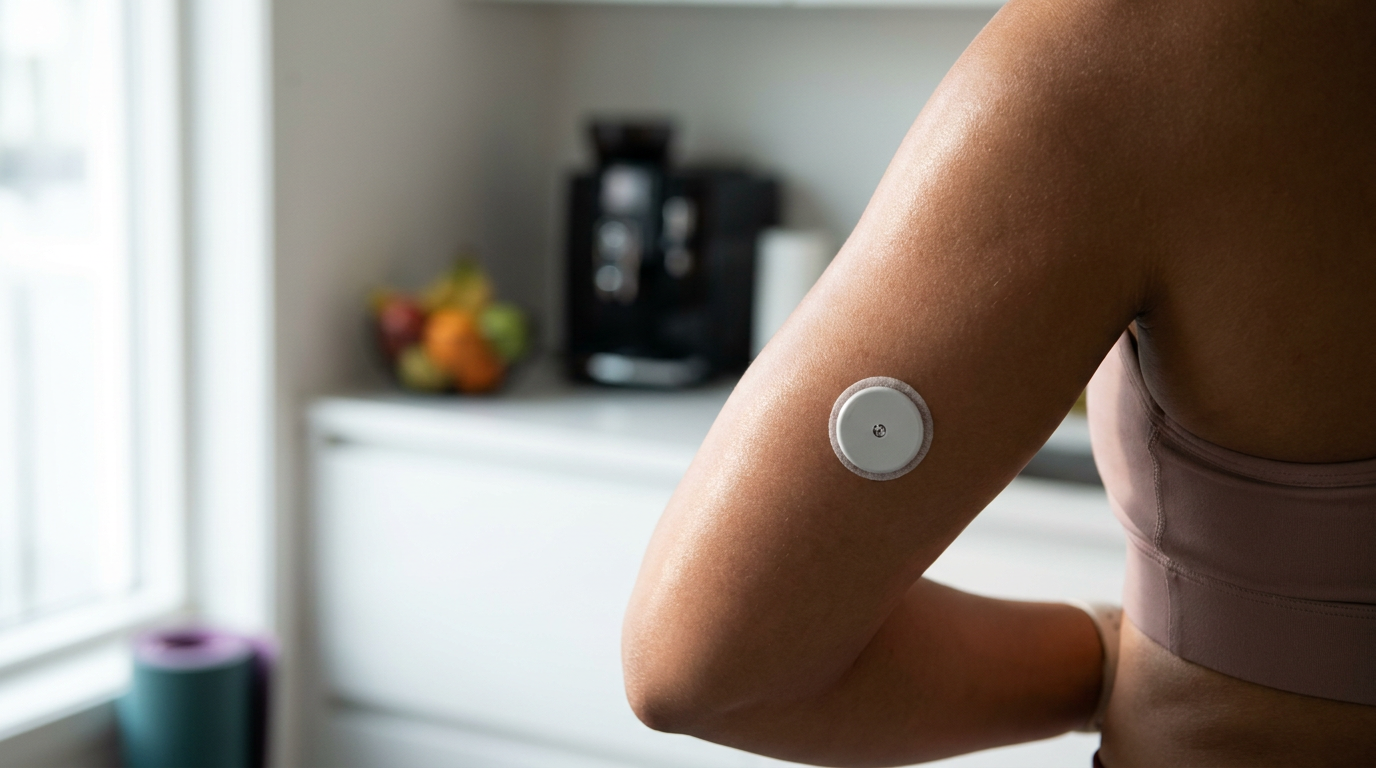
For decades, the continuous glucose monitor (CGM) was strictly a medical necessity, a prescription-only lifeline for people managing diabetes. But in 2026, the small white patch worn on the back of the upper arm has transformed into the ultimate status symbol in the wellness and longevity community.[6]
The paradigm shift began when the FDA cleared the first over-the-counter (OTC) sensors—Dexcom's Stelo and Abbott's Lingo—for adults without diabetes. Now, the market is expanding rapidly. In June 2026, the FDA expanded the clearance of the Dexcom Stelo to children as young as two years old, aiming to combat a rising tide of pediatric prediabetes by giving parents real-time data on how diet and exercise affect their children's metabolic health.[1][4]
However, the primary audience driving the explosion of these OTC devices remains healthy adults looking to optimize their daily cognitive and physical performance. Technology companies are racing to integrate this new data stream; platforms like Ultrahuman now combine Abbott Lingo's glucose readings with smart ring data to correlate blood sugar spikes directly with sleep quality, heart rate variability, and stress recovery.[2]
The appeal of the CGM lies in what traditional medicine often misses. Standard metabolic blood panels rely on fasting glucose and Hemoglobin A1c (HbA1c). While these are excellent tools for diagnosing established disease, they are backward-looking averages. Longevity physicians note that these traditional tests can miss up to 50 percent of meaningful glucose dysregulation—the daily spikes and crashes that drive systemic inflammation and accelerate aging long before a patient crosses the clinical threshold into prediabetes.[3]
A CGM changes the equation from a single annual snapshot to a continuous, 24/7 live stream. The sensor does not actually measure blood; instead, a tiny filament sits just below the skin and measures interstitial glucose—the sugar concentration in the fluid between cells. This interstitial reading tracks closely with blood glucose, though it operates with a biological lag time of roughly five to fifteen minutes.[4][5]

By streaming this data to a smartphone every few minutes, users can visualize their "glycemic variability." This refers to the dramatic peaks and valleys in glucose that dictate daily energy levels. For many new users, the first two weeks of wearing a sensor are filled with startling discoveries about foods they previously considered perfectly healthy.[5][6]
For many new users, the first two weeks of wearing a sensor are filled with startling discoveries about foods they previously considered perfectly healthy.
One of the most common revelations in the biohacking community is the "oatmeal trap." A standard bowl of oatmeal, long touted as a heart-healthy breakfast, can send a healthy adult's glucose soaring to 160 mg/dL within fifteen minutes. This sharp spike is inevitably followed by a steep crash, which physically manifests as mid-morning brain fog and lethargy.[5]

Even zero-calorie habits are being reevaluated under the lens of continuous data. The "coffee and cortisol paradox" has shown many users that drinking black coffee immediately upon waking can trigger a cortisol spike, which in turn signals the liver to dump stored glucose into the bloodstream. The data-driven solution adopted by many is simply delaying caffeine intake for 60 to 90 minutes after waking to allow natural cortisol rhythms to stabilize.[5][6]
The hardware itself has become highly accessible and commoditized. The Dexcom Stelo offers a 15-day wear time and integrates directly with wearables like the Oura Ring, while the Abbott Lingo provides a 14-day sensor at a slightly lower price point. Both boast impressive Mean Absolute Relative Difference (MARD) scores—the clinical standard for CGM accuracy—hovering around 8.3 to 8.7 percent, meaning the readings are highly reliable for wellness tracking.[4][5]
However, the raw data is only as useful as the behavior it drives. The most effective intervention users discover is remarkably low-tech: walking. Data consistently shows that a brisk 20-minute walk immediately following a carbohydrate-heavy meal can reduce postprandial insulin levels by nearly 30 percent, blunting the glucose spike by using the circulating sugar as immediate muscle fuel.[3]
Despite the widespread enthusiasm, a growing chorus of skeptics warns against "data fatigue." Metabolically healthy individuals with normal A1c levels and active lifestyles already possess highly functioning glucose regulation systems. For these users, obsessing over every minor fluctuation can lead to unnecessary anxiety or overly restrictive eating habits, attempting to flatline a system that is designed to fluctuate naturally.[4][6]

Furthermore, the technology has physical quirks that require context. Biohackers frequently encounter "compression lows"—false alarms triggered at 3:00 AM simply because the user slept on their arm, pushing the interstitial fluid away from the sensor and artificially dropping the reading.[5]
The consensus among longevity experts is that a CGM should be used as an educational tool rather than a permanent fixture for healthy adults. A 14-to-30-day experiment is usually sufficient to map out personal "spike foods," understand the impact of sleep on insulin resistance, and establish better daily habits.[6]
How we got here
March 2024
The FDA clears the Dexcom Stelo as the first over-the-counter CGM for adults without diabetes.
Summer 2025
Abbott launches the Lingo, expanding the consumer market for affordable, non-prescription glucose tracking.
Early 2026
Wearable platforms like Ultrahuman begin integrating OTC CGM data with smart rings for holistic metabolic scoring.
June 2026
The FDA expands Stelo clearance to children aged two and older to combat rising rates of pediatric prediabetes.
Viewpoints in depth
Longevity & Biohacking Advocates
This camp views real-time glucose data as the ultimate tool for personalized preventative medicine.
Advocates argue that the traditional medical system is too reactive, waiting until a patient's A1c crosses into prediabetic territory before intervening. By using a CGM, healthy individuals can map their unique metabolic responses to specific foods, sleep deprivation, and stress. They emphasize that flattening the glucose curve reduces systemic inflammation, preserves insulin sensitivity, and ultimately slows the biological aging process.
Public Health & Pediatric Specialists
Medical professionals focused on using OTC accessibility to combat the silent crisis of prediabetes.
With nearly one in three U.S. adolescents now showing signs of prediabetes, pediatric specialists view the recent FDA clearance of OTC CGMs for children as a vital intervention tool. Because pediatric prediabetes is asymptomatic and progresses rapidly, doctors argue that giving parents real-time biofeedback allows for immediate dietary corrections before permanent damage is done to a child's insulin-producing cells.
Data-Pragmatism Skeptics
Critics who warn that constant monitoring in healthy people can lead to anxiety and disordered eating.
Skeptics point out that a healthy human body is designed to experience glucose fluctuations; a spike after eating a banana is a normal physiological response, not a medical emergency. They warn that the gamification of glucose scores can lead to "data fatigue" and orthorexia, where users become overly restrictive with their diets in an attempt to achieve a perfectly flat glucose line that isn't biologically necessary.
What we don't know
- Whether micromanaging glucose spikes in already-healthy adults translates to a statistically significant increase in overall lifespan.
- The long-term psychological impact of continuous dietary biofeedback on eating disorder rates among the general public.
- How next-generation non-invasive optical sensors (like those rumored for smartwatches) will disrupt the current patch-based hardware market.
Key terms
- Interstitial fluid
- The fluid found in the spaces around cells, which CGMs use to estimate blood sugar levels.
- Glycemic variability
- The degree to which a person's blood sugar fluctuates between high peaks and low crashes throughout the day.
- Postprandial peak
- The highest point your blood sugar reaches after eating a meal.
- MARD score
- Mean Absolute Relative Difference; the standard clinical metric used to grade how accurate a continuous glucose monitor is.
- HbA1c
- A standard blood test that measures your average blood sugar levels over the past three months.
Frequently asked
Do I need a prescription to buy a CGM in 2026?
No. The FDA cleared devices like the Dexcom Stelo and Abbott Lingo for over-the-counter sale to adults (and recently children) who do not use insulin.
Does a CGM measure my actual blood?
No. It measures interstitial fluid—the fluid between your cells. This reading closely mirrors blood glucose but has a 5-to-15-minute delay.
How long does a single sensor last?
Most over-the-counter sensors last between 14 and 15 days before they need to be replaced.
What is a compression low?
A false low-glucose reading that occurs when you sleep on the sensor, temporarily pushing the interstitial fluid away from the filament.
Sources
Source coverage
6 outlets
3 viewpoints surfaced






[1]MedPage TodayPublic Health & Pediatric Specialists
FDA Clears First OTC Continuous Glucose Monitor for Kids
Read on MedPage Today →[2]Athletech NewsLongevity & Biohacking Advocates
Ultrahuman Adds OTC Glucose Tracking Through Abbott Lingo Partnership
Read on Athletech News →[3]Pravida MedicalLongevity & Biohacking Advocates
What a Month of CGM Data Actually Reveals — And What It Means for Longevity
Read on Pravida Medical →[4]AskVoraData-Pragmatism Skeptics
The 2026 Consumer CGM Landscape
Read on AskVora →[5]PeakLifestyleHQLongevity & Biohacking Advocates
Best non-diabetic CGM 2026: Don't Waste Your Money
Read on PeakLifestyleHQ →[6]Factlen Editorial TeamData-Pragmatism Skeptics
Synthesis by Factlen editorial team
Read on Factlen Editorial Team →


Every angle. Every day.
Get health stories with full source coverage and perspective breakdowns delivered to your inbox.