
Community-Owned Grocery Stores Outpace Traditional Chains in 2026 Growth
Cooperative grocery markets are experiencing a surge in popularity, growing at more than double the rate of conventional supermarkets while prioritizing local farmers and community reinvestment.
By Factlen Editorial Team
- Cooperative Advocates
- Argue that democratic ownership and local supply chains create more resilient and equitable food systems.
- Public Policy Planners
- View grocery access as essential civic infrastructure requiring municipal support and hybrid public-cooperative models.
- Conventional Retailers
- Maintain that massive, consolidated supply chains are the only way to achieve the scale necessary to keep base prices low.
What's not represented
- · Corporate Grocery Executives
- · Agricultural Supply Chain Logistics Managers
Why this matters
As corporate consolidation and inflation drive up food prices, community-owned models offer a proven alternative that keeps dollars in the local economy, supports regional farmers, and gives residents democratic control over their food supply.
Key points
- Community-owned grocery stores achieved a 6.2% sales growth in 2026, doubling the 2.9% average of conventional supermarkets.
- Cooperative markets source from an average of 187 local suppliers, compared to just 41 for traditional grocery chains.
- Certified organic products make up 38% of co-op sales, significantly outpacing the 3% average at conventional stores.
- Municipalities are increasingly exploring hybrid public-cooperative models to combat food apartheid in underserved urban neighborhoods.
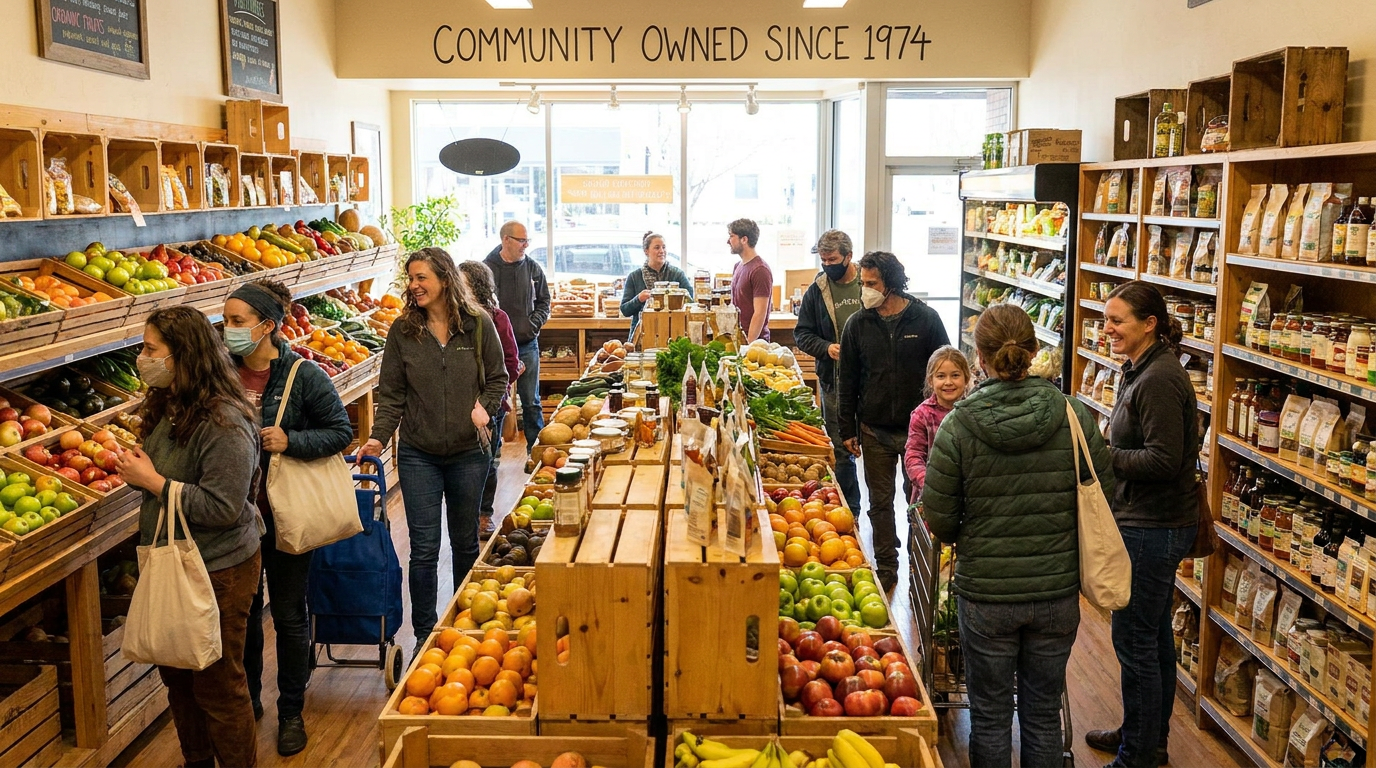
While national headlines have been dominated by massive corporate grocery mergers and debates over supermarket inflation, a quieter retail revolution has been gaining unprecedented momentum. Community-owned grocery stores—cooperatives funded, governed, and shopped by local residents—are currently experiencing a surge in popularity and profitability. Rather than extracting wealth for distant shareholders, these neighborhood-scale markets are proving that democratic ownership can successfully compete in the notoriously low-margin grocery sector. According to new industry data released in mid-2026, the cooperative model is not just surviving; it is actively outpacing traditional corporate chains in year-over-year growth.[3][4]
The numbers reveal a stark divergence in retail performance. A comprehensive 2026 impact report tracking 244 cooperative grocery stores across the United States found that the sector achieved a collective sales growth of 6.2% over the past year. This expansion rate is more than double the 2.9% growth benchmark recorded for the average conventional U.S. grocery store over the same period. Driven by a network that now serves over 1.3 million member-owners, these community markets generated a combined $2.8 billion in annual sales, signaling a robust consumer shift toward alternative food economies.[3][6]
The mechanics of a food cooperative fundamentally alter the traditional retail relationship. Instead of a centralized corporation dictating store operations, a co-op is capitalized by the community itself. Households typically purchase a one-time equity share—often ranging from $100 to $300—which grants them a democratic vote in board elections and a say in store policies. Because the primary mandate is community benefit rather than maximized quarterly profit, surplus revenue is either reinvested directly into store improvements, distributed to staff as living wages, or returned to member-owners as annual patronage dividends.[4][7]

This localized mandate drastically reshapes the supply chain. While conventional supermarkets rely on highly consolidated, national distribution networks, community-owned stores actively cultivate regional food systems. The average cooperative grocer purchases from 187 distinct local farmers and producers, compared to an average of just 41 local suppliers for a traditional supermarket. Consequently, nearly a quarter of all revenue generated at a typical co-op comes directly from locally sourced products, keeping agricultural dollars circulating within the immediate geographic region rather than being siphoned off to multinational conglomerates.[3]
Beyond local sourcing, community-owned markets have established themselves as dominant players in the organic and ethically sourced food sectors. Certified organic products account for 38% of total sales at cooperative grocers, a figure that dwarfs the 3% organic sales average seen at conventional grocery chains. Furthermore, co-ops dedicate a significantly larger portion of their shelf space to Fair Trade Certified goods and products manufactured by other cooperative businesses. This purchasing power allows communities to collectively enforce their environmental and labor values through everyday grocery spending.[3][4]
Beyond local sourcing, community-owned markets have established themselves as dominant players in the organic and ethically sourced food sectors.
Economic analysts point to the 'local multiplier effect' as a primary driver of the cooperative model's broader civic value. Research indicates that for every dollar spent at a community-owned market, a substantially higher percentage remains in the local economy through wages, local purchasing, and community donations. Last year alone, U.S. food cooperatives collectively donated over $20 million to local neighborhood groups and food banks, while simultaneously generating tens of millions in sales for minority-owned and historically marginalized businesses through inclusive trade initiatives.[4][7]

The cooperative model is also emerging as a vital tool for combating urban food apartheid, stepping in where traditional corporate chains refuse to operate. In Philadelphia, established community-owned markets like Mariposa Food Co-op and Weaver's Way have proven that neighborhood-directed grocery stores can thrive in diverse urban environments. These stores prioritize culturally relevant inventory and implement tiered pricing or solidarity programs to ensure that fresh, high-quality food remains accessible to lower-income residents, proving that community ownership does not have to mean exclusivity.[2]
Innovation in the sector is expanding beyond traditional retail. In Southwest Philadelphia, a new initiative called The Community Grocer is pioneering a hybrid model that blends retail with direct health interventions. Operating out of a community-owned space, the market is partnering with the University of Pennsylvania to study the impact of healthy food access on postpartum recovery in new mothers. By utilizing the grocery store as a hub for job training, nutritional workshops, and public health research, these initiatives transform a simple point of sale into vital civic infrastructure.[2]
The success of independent cooperatives has caught the attention of municipal policymakers, sparking proposals for publicly supported grocery networks. In New York City, advocates and urban planners have recently outlined comprehensive strategies to develop a city-backed solidarity economy. Proposals include converting vacant commercial spaces into community-owned food districts and utilizing public subsidies to underwrite rent and utilities. By absorbing overhead costs, these hybrid public-cooperative models aim to offer groceries at wholesale prices while maintaining living-wage union jobs for store employees.[1][5]

Despite their operational success, launching a new community-owned grocery store remains a formidable challenge. The pre-development phase requires years of grassroots organizing, feasibility studies, and complex fundraising. Communities must painstakingly aggregate hundreds of individual household equity investments, secure specialized grants, and navigate commercial real estate markets that heavily favor corporate tenants. Volunteer steering committees often spend half a decade or more working to open a single location, balancing democratic governance with the rigorous demands of commercial construction and retail management.[7]
Yet, the accelerating growth of the sector suggests that consumers are increasingly willing to support these efforts. Industry observers note a growing public fatigue with the conventional supermarket experience, which has been increasingly characterized by automated self-checkouts, opaque pricing algorithms, and shrinkflation. In contrast, community-owned stores offer high-touch customer service, transparent sourcing, and a tangible sense of neighborhood pride. Shoppers are recognizing that their grocery budget can serve as a direct investment in their own community's resilience.[5][7]
As the 2026 retail landscape continues to evolve, the cooperative grocery sector stands as a compelling counter-narrative to corporate consolidation. With dozens of new community-owned markets currently in the development pipeline across the country, the model is poised for continued expansion. By proving that a grocery store can successfully balance financial viability with environmental stewardship and local economic empowerment, these community hubs are redefining what it means to truly nourish a neighborhood.[3][4]
How we got here
2008
St. Paul, Kansas opens a municipally-owned grocer after two decades without a local store, pioneering alternative ownership models.
2024
National Co+op Grocers reports an initial post-pandemic surge in cooperative market growth as consumers seek local supply chains.
2025
Advocates in New York City publish comprehensive proposals for city-backed community food districts to combat food insecurity.
May 2026
Industry data reveals community-owned grocers are growing at 6.2%, more than double the rate of conventional supermarkets.
Viewpoints in depth
Cooperative Advocates
Focus on the local economic multiplier and democratic control of food systems.
Proponents of the cooperative model argue that food is a fundamental human right and its distribution should not be solely dictated by corporate profit margins. By keeping ownership local, they assert that communities can enforce their own values regarding environmental sustainability, fair labor practices, and regional agricultural support. They point to the massive discrepancy in local sourcing—187 suppliers for co-ops versus 41 for conventional stores—as proof that democratic ownership actively builds regional economic resilience.
Conventional Retailers
Focus on scale, efficiency, and lower base prices for the average consumer.
Representatives of the traditional grocery sector maintain that massive, consolidated supply chains are the only realistic way to achieve the economies of scale necessary to keep absolute food costs down. While acknowledging the appeal of local sourcing, they argue that the cooperative model often results in higher baseline prices that can exclude budget-conscious shoppers. From this perspective, corporate efficiency and national distribution networks remain the most effective tools for feeding a massive population affordably.
Public Policy Planners
Focus on food security as essential civic infrastructure requiring municipal intervention.
Urban planners and food security advocates argue that relying entirely on either corporate chains or grassroots community fundraising is insufficient to solve systemic food apartheid. They advocate for hybrid models where municipalities subsidize the heavy overhead costs—such as rent and utilities—of cooperative markets in underserved areas. By treating grocery access as a public utility rather than a purely private enterprise, they believe cities can guarantee fresh food access while supporting living-wage jobs.
What we don't know
- Whether the accelerated growth rate of community co-ops will stabilize or continue to compound as more stores open in late 2026.
- How conventional corporate grocers might adapt their local sourcing strategies in response to losing market share to cooperatives.
- If municipal proposals for fully city-subsidized grocery stores will secure the long-term political and financial backing required to launch.
Key terms
- Food Co-op
- A grocery store owned and democratically controlled by the people who shop there, operating for community benefit rather than corporate profit.
- Patronage Dividend
- A portion of a cooperative's surplus revenue that is returned to member-owners at the end of the year, based on how much they spent at the store.
- Local Multiplier Effect
- An economic phenomenon where money spent at an independent local business continues to circulate within the community, generating additional local wealth.
- Food Apartheid
- A term preferred by advocates over 'food desert' to describe the systemic and intentional lack of access to healthy, affordable food in marginalized neighborhoods.
- Solidarity Economy
- An economic framework prioritizing social profitability, mutual aid, and democratic ownership over pure financial extraction.
Frequently asked
What is a community-owned grocery store?
It is a retail market owned and democratically governed by local residents who purchase equity shares, rather than by a distant corporation or private investors.
Do I have to be a member to shop at a food co-op?
No. While members receive certain benefits like patronage dividends or voting rights, almost all community-owned grocery stores are open to the general public.
Why are co-ops growing faster than regular grocery stores?
Consumers are increasingly drawn to their transparent local sourcing, high-quality organic offerings, and the assurance that their money stays within the local economy.
How much does it cost to join a food co-op?
Equity shares typically range from $100 to $300 per household, which is a one-time investment rather than an annual fee, though some offer tiered or subsidized options for lower-income residents.
Sources
Source coverage
7 outlets
3 viewpoints surfaced







[1]ForbesPublic Policy Planners
The Case For Public And Community-Owned Grocery Stores
Read on Forbes →[2]GenerocityPublic Policy Planners
Community-owned grocery stores pioneer new models in Philadelphia
Read on Generocity →[3]National Co+op GrocersCooperative Advocates
2026 Food Co-op Impact Report
Read on National Co+op Grocers →[4]NCBA CLUSACooperative Advocates
Food Co-ops Credit Community Ownership & Local Focus with Success
Read on NCBA CLUSA →[5]Civil EatsPublic Policy Planners
Can City-Owned and Cooperative Grocery Stores Solve Food Apartheid?
Read on Civil Eats →[6]RetailStatConventional Retailers
U.S. Grocery Store Sales Benchmarks 2025-2026
Read on RetailStat →[7]Next CityCooperative Advocates
How Urban Food Co-ops Are Redefining Neighborhood Resilience
Read on Next City →
Every angle. Every day.
Get community stories with full source coverage and perspective breakdowns delivered to your inbox.