
How a 2,000-Mile Wildlife Corridor is Stitching North America Back Together
A binational effort to reconnect North America's fractured wilderness has successfully built over 200 wildlife crossings, drastically reducing vehicle collisions and saving isolated grizzly populations from genetic collapse.
By Factlen Editorial Team
- Conservation Biologists
- Focus on healing genetic isolation and ensuring species can migrate to adapt to environmental changes.
- Transportation Engineers
- Prioritize driver safety, cost-efficiency, and designing infrastructure that effectively alters animal behavior.
- Indigenous Nations
- Advocate for holistic landscape stewardship and the protection of traditional territories on a massive scale.
- Local Communities
- Value coexistence, the economic benefits of eco-tourism, and the reduction of dangerous road hazards.
What's not represented
- · Commercial freight operators navigating the mitigated highways
- · Private landowners adjacent to the wildlife corridors
Why this matters
As human development expands, wildlife-vehicle collisions cost billions of dollars and threaten the survival of keystone species. The success of this 2,000-mile corridor proves that strategic infrastructure can virtually eliminate these accidents, saving human lives, taxpayer money, and entire ecosystems.
Key points
- The Yellowstone to Yukon initiative is reconnecting 2,000 miles of fragmented wildlife habitat.
- Over 200 wildlife crossings have been built to help animals safely navigate highways.
- Banff National Park's crossings have reduced wildlife-vehicle collisions by 80 percent.
- DNA evidence proves the crossings are successfully curing genetic isolation in bear populations.
- The gap between isolated grizzly populations has shrunk from 150 miles to just 45 miles.
- The North American model is now inspiring similar infrastructure projects worldwide.
The North American continent was once a seamless tapestry of migration routes. Today, a web of highways and human development has fractured that landscape, turning pristine habitats into isolated islands. For decades, this fragmentation threatened the survival of wide-ranging species like grizzly bears, wolverines, and caribou. But across the spine of the Rocky Mountains, an ambitious, binational effort is successfully stitching the wilderness back together.[1][7]
The Yellowstone to Yukon (Y2Y) Conservation Initiative is arguably the most successful large-scale ecological connectivity project on Earth. Spanning five U.S. states, two Canadian provinces, and more than 75 Indigenous territories, the 2,000-mile corridor aims to link public lands from Wyoming to the Arctic Circle. The goal is not just to protect isolated parks, but to ensure animals can safely travel between them.[1][2]
To understand why this matters, one must understand the mechanism of genetic isolation. When a busy highway bisects a habitat, it does more than cause fatal vehicle collisions; it acts as an invisible wall. If a grizzly bear population on one side of a highway cannot safely cross to mate with bears on the other side, their gene pool shrinks. Over time, this inbreeding makes the isolated population highly vulnerable to disease and environmental changes.[3][7]
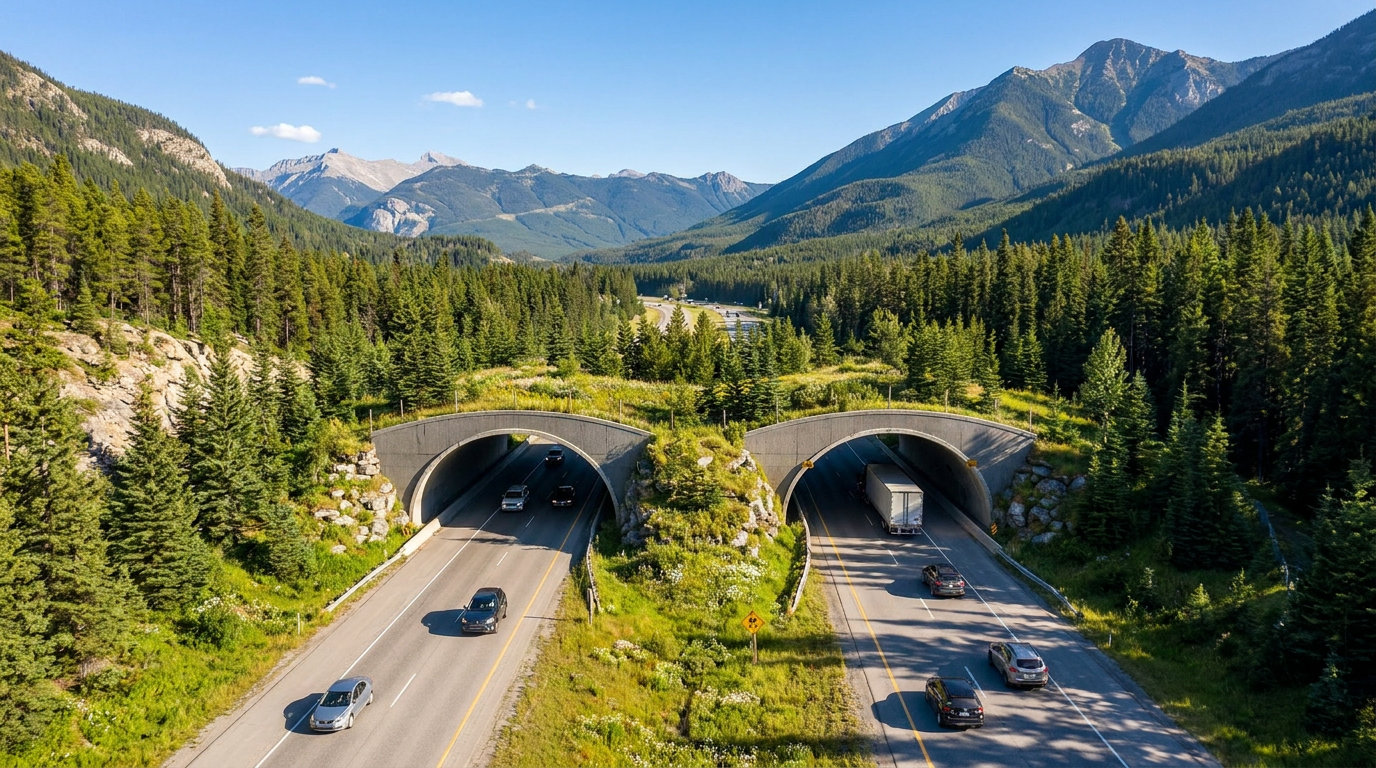
The primary solution to this modern crisis is the wildlife crossing structure—a feat of transportation ecology that includes both vegetated overpasses and subterranean underpasses. By physically bridging the gap over or under high-speed asphalt, these structures allow animals to follow their ancient seasonal migration routes without risking their lives.[2][6]

The flagship laboratory for this concept is Canada’s Banff National Park. When the Trans-Canada Highway was expanded in the 1980s and 90s, biologists and engineers collaborated to build an unprecedented network of crossings. Today, Banff boasts six massive overpasses and 38 underpasses, flanked by 82 kilometers of highway fencing designed to funnel animals toward the safe routes.[2][3]
The evidence of success in Banff is overwhelming. Long-term monitoring reveals that these structures have reduced wildlife-vehicle collisions by 80 percent overall, and by an astonishing 96 percent for ungulates like elk and deer. Since 1996, researchers have recorded more than 200,000 safe crossings by at least 11 species of large mammals.[2][3]
But the most crucial evidence comes from DNA. To prove that the crossings were solving genetic isolation, researchers strung barbed wire across the structures to snag tufts of hair from passing bears. Genetic analysis of the hair confirmed that bears were not just crossing the highway—they were successfully breeding with populations on the other side. The structures had effectively cured the genetic bottleneck.[3][7]
To prove that the crossings were solving genetic isolation, researchers strung barbed wire across the structures to snag tufts of hair from passing bears.
Building on Banff’s success, the broader Y2Y region has seen an explosion of infrastructure. As of early 2026, there are now 204 wildlife crossing structures spanning busy roads across the Yellowstone to Yukon corridor. Each new bridge or tunnel acts as a vital valve, opening up thousands of square miles of previously inaccessible habitat.[1][7]

The cumulative impact of these connections is measurable. In 1993, grizzly bear populations in the lower 48 states were separated by 150 miles of hostile, fragmented terrain. Today, thanks to targeted land conservation and crossing structures, that gap has shrunk to just 45 miles. Biologists now believe that fully reconnecting these southern populations is an achievable milestone within the decade.[1][7]
The current frontier of this effort is Highway 3, a treacherous stretch of road that straddles the British Columbia-Alberta border. Known as a "death trap" for young grizzlies, the highway currently blocks the north-south movement of wildlife, separating two distinct bear populations.[4][6]
To solve this, the "Reconnecting the Rockies" project is actively deploying new infrastructure along the Highway 3 corridor. By identifying collision hotspots, engineers and conservationists are strategically placing new underpasses and fencing. These homegrown solutions are designed to ensure that animals can navigate the complex landscape of private lands, railways, and roads.[4][6]

Infrastructure alone is not enough; the land leading up to the crossings must also be protected. In 2025, conservationists celebrated a massive victory when 112,000 acres of land were conserved through a key purchase in southeast B.C.’s Elk Valley. This ensures that the approaches to the highway crossings remain wild and free from commercial development.[1][7]
Indigenous leadership is also driving the initiative's northern expansion. In the Yukon, the Ross River Dena Council has proposed an Indigenous Protected and Conserved Area spanning 15,000 square miles. This massive tract of boreal forest and rugged peaks serves as a critical stronghold for the northern end of the Y2Y corridor, ensuring that vast stretches of the continent remain permanently connected.[1][7]

Beyond the ecological triumphs, wildlife crossings make undeniable economic sense. While a single overpass can cost millions to construct, the expense is quickly offset by the reduction in vehicle collisions. When factoring in property damage, medical costs, and emergency response, wildlife-vehicle collisions cost North Americans billions annually. By drastically cutting these accidents, the crossings effectively pay for themselves.[3][6]
The success of the Yellowstone to Yukon initiative has transformed North America into a global exporter of road ecology. Delegations from around the world now study the Rockies' infrastructure, applying the lessons to tiger underpasses in India, crab bridges on Christmas Island, and the massive Wallis Annenberg crossing in California. By proving that human infrastructure and wild migrations can coexist, the Y2Y project has offered a hopeful blueprint for a connected planet.[3][5][7]
How we got here
1993
The Yellowstone to Yukon Conservation Initiative is founded to connect habitats across 2,000 miles.
1996
Banff National Park completes its first two wildlife overpasses over the Trans-Canada Highway.
2014
Banff's network expands to 44 crossing structures, becoming the most extensive in the world.
2025
The Y2Y region surpasses 200 completed wildlife crossings, shrinking the grizzly isolation gap to 45 miles.
Viewpoints in depth
Conservation Biologists
Focused on healing genetic isolation and ensuring species can migrate to adapt to environmental changes.
For biologists, the true measure of success isn't just fewer dead animals on the road—it's genetic flow. When highways carve up a landscape, they create 'island populations' that suffer from inbreeding and become highly susceptible to disease. By using DNA hair-snagging techniques, researchers have proven that wildlife crossings allow animals to breed across previously impassable barriers, effectively curing the genetic bottlenecks that threatened species like the grizzly bear.
Transportation Engineers
Prioritize driver safety, cost-efficiency, and designing infrastructure that effectively alters animal behavior.
Engineers view the crossings as a highly efficient solution to a costly public safety crisis. Wildlife-vehicle collisions result in billions of dollars in property damage, medical bills, and emergency response costs annually. By combining overpasses, underpasses, and miles of funneling fences, transportation departments can virtually eliminate these accidents. While the upfront construction costs are high, the infrastructure pays for itself over time by drastically reducing the financial toll of highway collisions.
Indigenous Nations
Advocate for holistic landscape stewardship and the protection of traditional territories on a massive scale.
Indigenous communities are leading the push to protect the vast, unbroken landscapes that anchor the northern end of the corridor. Initiatives like the Ross River Dena Council's proposed 15,000-square-mile protected area in the Yukon demonstrate a commitment to holistic stewardship. For these nations, connectivity isn't just about highway infrastructure; it's about preserving the ecological integrity of traditional homelands and ensuring that the natural rhythms of the continent remain intact for future generations.
What we don't know
- How rapidly shifting climate zones will force animals to alter their historical migration routes.
- Whether funding will be sustained to complete the remaining infrastructure bottlenecks on Highway 3.
Key terms
- Wildlife Corridor
- A continuous link of habitat that connects two or more larger areas, allowing animals to migrate safely.
- Genetic Isolation
- A lack of interbreeding between populations, which shrinks the gene pool and increases vulnerability to disease.
- Transportation Ecology
- The scientific study of how roads and transport infrastructure interact with the natural environment.
- Ungulate
- A hoofed mammal, such as an elk, deer, or moose, which frequently migrates across large distances.
- Overpass
- A vegetated, bridge-like structure designed specifically to allow wildlife to cross safely over a busy roadway.
Frequently asked
Do animals actually know to use the crossings?
Yes. While it takes time for species to adapt, camera traps show animals memorizing the safe routes and returning repeatedly. Mothers also teach their young to use the structures.
Are overpasses or underpasses better?
It depends on the species. Grizzlies, elk, and deer prefer wide, open overpasses with clear sightlines, while black bears and cougars prefer the enclosed, shadowy environment of underpasses.
How much do these structures cost?
Early overpasses cost around $1.5 million, though modern, larger structures can cost significantly more. However, they pay for themselves over time by preventing highly expensive vehicle collisions.
Sources
Source coverage
7 outlets
4 viewpoints surfaced







[1]Yellowstone to Yukon Conservation InitiativeConservation Biologists
Y2Y's 2025 Impact Report: Reconnecting Fragmented Landscapes
Read on Yellowstone to Yukon Conservation Initiative →[2]Canadian GeographicTransportation Engineers
Animal crossing: Reconnecting North America's most important wildlife corridor
Read on Canadian Geographic →[3]MongabayConservation Biologists
How Banff’s wildlife crossings inspired a global movement
Read on Mongabay →[4]CBC NewsLocal Communities
This B.C. valley has become a death trap for young grizzly bears
Read on CBC News →[5]Conservation CorridorConservation Biologists
Global Wildlife Corridor Examples
Read on Conservation Corridor →[6]Miistakis InstituteTransportation Engineers
Reconnecting the Rockies: Highway 3 Progress
Read on Miistakis Institute →[7]Factlen Editorial TeamIndigenous Nations
Synthesis by Factlen editorial team
Read on Factlen Editorial Team →
Every angle. Every day.
Get world stories with full source coverage and perspective breakdowns delivered to your inbox.