
Is the Strait of Hormuz Open? How Conflicting Claims Are Rattling Global Markets
Iran claims it has closed the world's most critical oil chokepoint, while the U.S. military and satellite data show commercial vessels are still passing through. The resulting ambiguity is driving up insurance premiums and testing the resilience of global energy supply chains.
By Factlen Editorial Team
- Iranian Authorities
- Asserts sovereign right to control the strait and claims the waterway is closed to nations it deems hostile.
- U.S. & Allied Militaries
- Maintains that the strait is an international waterway and insists that commercial traffic is continuing to flow freely.
- Maritime Insurers & Shippers
- Focuses purely on the physical and financial risk to vessels, reacting to threats by raising premiums regardless of political rhetoric.
- Neutral Energy Importers
- Prioritizes uninterrupted energy supply and quietly continues transits, leveraging diplomatic ties to avoid harassment.
What's not represented
- · Crews and captains navigating the high-risk waters
- · European natural gas consumers reliant on Qatari LNG
Why this matters
Roughly 20% of the world's global oil consumption passes through the Strait of Hormuz. Even the perception of a closure drives up global energy prices, which directly impacts inflation, gasoline costs, and the broader global economy.
Key points
- Iran claims it has closed the Strait of Hormuz to hostile traffic, asserting IRGC control.
- U.S. military and satellite data confirm commercial ships are still passing through the waterway.
- The ambiguity is causing maritime insurance 'war risk premiums' to surge.
- Roughly 20% of the world's daily oil consumption relies on the strait.
- A genuine closure would severely disrupt global supply chains for oil, LNG, and petrochemicals.
A high-stakes war of words is unfolding over the Strait of Hormuz, creating a fog of uncertainty that threatens to destabilize global energy markets. Over the past 48 hours, Iranian authorities have repeatedly asserted that the Islamic Revolutionary Guard Corps (IRGC) has closed the waterway to "hostile" traffic, claiming full operational control over the maritime chokepoint. Yet, simultaneous reports from the United States military and independent satellite tracking firms paint a starkly different picture, insisting that international shipping lanes remain open and that commercial vessels are continuing to transit the area without physical interception.[2][4]
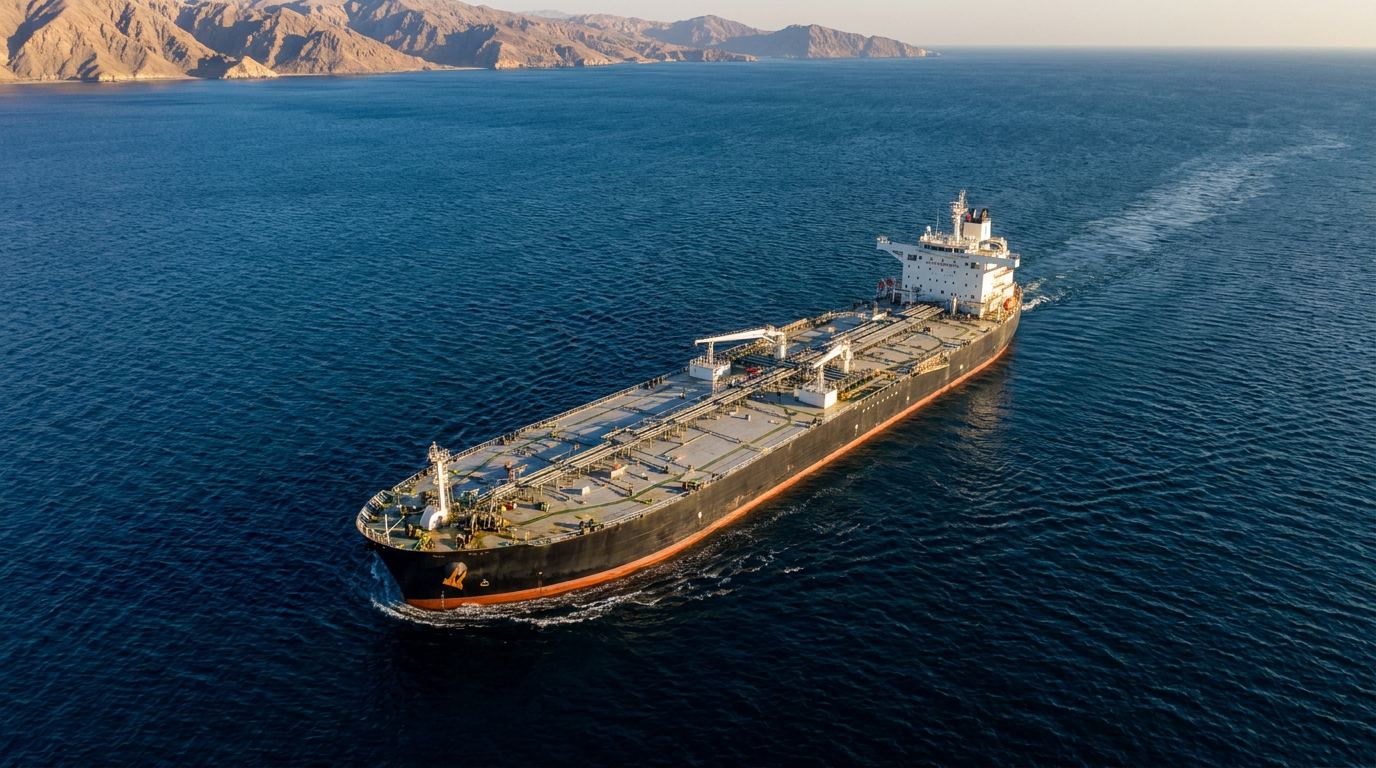
The contradiction between official statements and physical reality has left the global shipping industry in a precarious position. The U.S. Fifth Fleet, based in nearby Bahrain, issued a statement confirming that while regional tensions are elevated, maritime traffic is still flowing through the strait. This assessment is corroborated by maritime tracking data, which recently showed three fully laden, India-linked supertankers reemerging in the Gulf of Oman after successfully navigating the passage. These transits suggest that, at least for certain neutral or allied nations, the waterway remains functional despite the fiery rhetoric.[1][2]
To understand why this ambiguity is so dangerous, one must look at the physical geography of the Strait of Hormuz. Located between Oman and Iran, the strait connects the Persian Gulf to the Gulf of Oman and the Arabian Sea. While the waterway is 21 miles wide at its narrowest point, the actual shipping lanes capable of accommodating massive supertankers are incredibly constrained. The inbound and outbound lanes are each only two miles wide, separated by a two-mile buffer zone. This geographic reality means that any disruption, whether a physical blockade or merely the threat of one, can instantly bottleneck global trade.[6][7]

Legally, the strait operates under the principle of "transit passage" as defined by the United Nations Convention on the Law of the Sea (UNCLOS). This framework guarantees the right of continuous and expeditious transit for all ships, including military vessels, through international straits. Iran, however, has historically argued that because it has not ratified UNCLOS, it is only bound by earlier treaties that allow it to restrict passage to nations it deems hostile. This fundamental legal disagreement forms the bedrock of the current standoff, allowing Tehran to claim it is legally securing its waters while Washington argues Iran is violating international law.[4][6]
In practice, a "closure" of the Strait of Hormuz rarely looks like a physical wall of warships. Instead, it manifests as a spectrum of harassment: aggressive maneuvers by fast-attack craft, unannounced boardings, GPS spoofing, or the seizure of specific vessels under the guise of environmental or legal violations. By claiming the strait is closed while allowing certain vessels to pass, Iran effectively weaponizes ambiguity. This strategy allows Tehran to project power and influence global markets without necessarily triggering a direct military confrontation with the United States or its allies.[3][4]
The economic stakes of this chokepoint cannot be overstated. According to the U.S. Energy Information Administration, approximately 21 million barrels of oil flow through the Strait of Hormuz every single day. This represents roughly 20% of total global petroleum consumption. Unlike other maritime chokepoints, such as the Suez Canal or the Strait of Malacca, there are very few viable pipeline alternatives to bypass Hormuz. If the strait were to be genuinely and completely shut down, the global market would instantly lose a fifth of its oil supply, a shock that analysts warn could send crude prices spiraling to unprecedented highs.[6][7]

The economic stakes of this chokepoint cannot be overstated.
Even without a physical blockade, the mere threat of closure is already exacting a heavy toll on the global economy through the insurance market. Maritime insurers assess risk on a voyage-by-voyage basis, and the waters around the Middle East are designated as high-risk areas. Following the recent conflicting claims, "war risk" insurance premiums for vessels transiting the Gulf have surged dramatically. These premiums, which are calculated as a percentage of the vessel's total hull value, can add hundreds of thousands of dollars to the cost of a single journey.[3][5]
This insurance dynamic is often the true mechanism by which a strait is "closed." If insurers decide the risk of a vessel being seized or attacked is too high, they may refuse to underwrite the voyage entirely, or they may price the premiums so high that the journey becomes economically unviable for the shipping company. In this scenario, it is not military warships that stop the flow of oil, but rather actuaries in London and New York. Currently, insurers are closely monitoring the situation, balancing the U.S. assurances of safety against the Iranian threats of interception.[5]
The impact extends far beyond crude oil. The Strait of Hormuz is also the primary export route for liquefied natural gas (LNG) from Qatar, one of the world's largest producers. A disruption here would severely impact natural gas markets, particularly in Europe and Asia, which rely heavily on Qatari shipments to power their electrical grids and heat homes. Furthermore, the Gulf is a major hub for petrochemical exports, meaning a prolonged crisis could disrupt the supply chains for everything from plastics to fertilizers, driving up costs across multiple sectors of the global economy.[6][7]
The situation is further complicated by the diverse nationalities of the vessels, their owners, and their cargo. A single tanker might be owned by a Greek company, flagged in Panama, insured in the UK, crewed by Indian and Filipino sailors, and carrying Saudi oil destined for China. This complex web of international interests makes any aggressive action in the strait a deeply multilateral issue. When Iran targets a specific vessel, it must carefully calculate the diplomatic fallout across half a dozen nations, which often restrains the scale of their maritime operations.[3][6]
The recent successful transit of the three Indian supertankers highlights a crucial nuance in the current crisis: the role of neutral or allied buyers. India and China are massive consumers of Middle Eastern oil and maintain complex, pragmatic diplomatic relations with both Tehran and Washington. Vessels linked to these nations often navigate the strait with less friction, as Iran has little strategic interest in antagonizing its primary economic lifelines. This creates a two-tiered system of maritime security, where ships linked to Western nations face severe risks, while others pass relatively unhindered.[1][4]

For the United States, maintaining the free flow of commerce through Hormuz has been a cornerstone of its Middle East policy for decades. The U.S. Navy frequently conducts freedom of navigation transits and provides escorts for certain flagged vessels. However, providing a dedicated military escort for every single commercial ship is logistically impossible given the sheer volume of traffic. The U.S. strategy relies heavily on deterrence—maintaining a visible presence to discourage Iranian aggression while relying on intelligence and surveillance to anticipate specific threats.[2][6]
As the standoff continues, energy markets remain in a state of hyper-vigilance. Brent crude, the international benchmark, has experienced significant intraday volatility, spiking on Iranian statements and retreating slightly when satellite data confirms ongoing traffic. Traders are attempting to price in a "risk premium"—an additional cost added to the price of oil to account for the possibility of a sudden supply shock. However, accurately quantifying this premium is nearly impossible when the facts on the water are so fiercely contested.[3][5]
Ultimately, the current situation in the Strait of Hormuz demonstrates how modern geopolitical conflicts are increasingly fought in the gray zone between peace and outright war. By creating a narrative of closure without fully executing one, Iran maximizes its leverage over global markets while minimizing the risk of a devastating military retaliation. Until a clear, verifiable consensus emerges on the safety of the waterway, the global economy will remain hostage to the conflicting claims echoing across the narrow waters of the Gulf.[2][4][5]

How we got here
Past 48 Hours
Iranian authorities issue statements claiming the IRGC has closed the Strait of Hormuz to hostile traffic.
Following Hours
The U.S. Fifth Fleet releases a statement confirming that maritime traffic continues to flow.
Current Status
Satellite data reveals India-linked supertankers successfully navigating the strait, contradicting claims of a total blockade.
Viewpoints in depth
Iranian Authorities' View
Framing the strait as sovereign waters subject to Iranian security dictates.
Iranian officials and state-aligned media argue that Tehran has the legal and moral authority to police the Strait of Hormuz. By refusing to recognize the UNCLOS framework of 'transit passage,' Iran treats the waterway as its own territorial domain, asserting the right to deny entry to military or commercial vessels from nations it considers hostile. This perspective views the presence of U.S. and allied forces not as protectors of free trade, but as foreign occupiers destabilizing the region.
U.S. & Allied Militaries' View
Defending the principle of freedom of navigation in international waters.
The United States and its allies operate under the mandate that the Strait of Hormuz is an international waterway essential to the global economy. From this viewpoint, Iranian claims of closure or attempts to harass commercial shipping are illegal acts of aggression that violate international law. The U.S. Fifth Fleet views its role as a necessary deterrent, providing a security umbrella that prevents Tehran from holding the global energy market hostage.
Maritime Insurers' View
Calculating the financial risk of transit regardless of political rhetoric.
For the syndicates in London and New York that insure global shipping, political claims matter less than statistical risk. Insurers view the strait through the lens of liability: what is the probability of a vessel being seized, damaged, or delayed? When rhetoric heats up, insurers respond by drastically increasing war risk premiums. From their perspective, a strait doesn't need to be physically blocked to be 'closed'—it only needs to become too expensive to insure.
Neutral Energy Importers' View
Navigating the geopolitical divide to secure essential energy supplies.
Nations like India and China, which rely heavily on Middle Eastern crude, take a highly pragmatic approach to the conflict. They maintain diplomatic and economic ties with both Iran and the West, allowing their vessels to often pass through the strait with less scrutiny. From this perspective, the goal is not to win a legal argument over maritime law, but to ensure that the oil keeps flowing to power their domestic economies, often requiring quiet diplomacy behind the scenes.
What we don't know
- Whether Iran plans to escalate from verbal claims to physical interceptions of Western-linked vessels.
- The exact threshold at which maritime insurers will refuse to cover voyages through the Gulf entirely.
- How long the current state of ambiguity can persist before it permanently alters global shipping routes.
Key terms
- Chokepoint
- A narrow, strategically significant geographic feature, such as a strait or canal, that maritime traffic is forced to pass through.
- Transit Passage
- A concept in international maritime law that allows all ships the freedom of navigation through straits used for international navigation.
- VLCC
- Very Large Crude Carrier; massive supertankers capable of carrying up to 2 million barrels of oil in a single voyage.
- War Risk Premium
- An extra insurance fee levied on ships entering conflict zones, calculated as a percentage of the vessel's total value.
Frequently asked
Is the Strait of Hormuz actually closed right now?
No. Despite Iranian claims of closure, U.S. military reports and satellite tracking data show that commercial vessels, including supertankers, are still successfully transiting the waterway.
Why can't ships just go around the strait?
The Strait of Hormuz is the only sea passage from the Persian Gulf to the open ocean. While a few pipelines exist to bypass it, they do not have the capacity to handle the 21 million barrels of oil that move through the strait daily.
How does this affect gas prices?
When the flow of oil is threatened, global crude prices rise due to a 'risk premium.' Because crude oil is the primary input for gasoline, sustained higher crude prices eventually lead to higher prices at the pump for consumers.
What is a war risk premium?
It is an additional insurance cost charged to vessels traveling through designated high-risk areas. When tensions rise in the Gulf, insurers drastically increase these premiums, making shipping much more expensive.
Sources
Source coverage
7 outlets
4 viewpoints surfaced







[1]BloombergNeutral Energy Importers
Three Indian Tankers Reemerge, Pointing to Hormuz Traffic Uptick
Read on Bloomberg →[2]NPRU.S. & Allied Militaries
Iran claims Hormuz closure, U.S. says ships still passing
Read on NPR →[3]ReutersMaritime Insurers & Shippers
Oil markets on edge as Hormuz transit claims clash
Read on Reuters →[4]Al JazeeraIranian Authorities
IRGC asserts control over Strait of Hormuz maritime traffic
Read on Al Jazeera →[5]Financial TimesMaritime Insurers & Shippers
War risk insurance premiums surge for Gulf shipping amid closure fears
Read on Financial Times →[6]S&P Global
Strait of Hormuz: The world's most critical oil chokepoint
Read on S&P Global →[7]U.S. Energy Information Administration
World Oil Transit Chokepoints
Read on U.S. Energy Information Administration →
Every angle. Every day.
Get business stories with full source coverage and perspective breakdowns delivered to your inbox.