
Observational Data Confirms Critical Slowdown of Atlantic Ocean Currents
A landmark synthesis of deep-ocean sensor data provides the most definitive evidence yet that the Atlantic Meridional Overturning Circulation (AMOC) is losing stability, threatening abrupt shifts in global weather patterns.
By Factlen Editorial Team
- Earth System Scientists
- Focus on the observational data and statistical early-warning signals, arguing the tipping point is closer than previously modeled.
- Climate Modelers
- Emphasize the complexity of global models and caution against extrapolating near-term collapse dates from localized statistical variance.
- Policy Analysts
- Highlight the urgent need to incorporate non-linear tipping point risks into global climate adaptation and infrastructure planning.
What's not represented
- · Global South agricultural planners
- · Coastal infrastructure developers
Why this matters
The AMOC regulates the climate of the Northern Hemisphere and dictates tropical rainfall patterns. A collapse would plunge Europe into deep freezes, disrupt the monsoon systems that feed billions in the Global South, and accelerate sea-level rise along the US East Coast.
Key points
- New observational data confirms the Atlantic Meridional Overturning Circulation is losing stability.
- The slowdown is primarily driven by fresh meltwater from the Greenland ice sheet diluting the ocean.
- A full collapse would plunge Europe into deep freezes and disrupt tropical monsoon systems.
- While the slowdown is documented, the exact timeline for a potential collapse remains debated.
- Scientists warn that global adaptation policies are unprepared for abrupt, non-linear climate shifts.
A new synthesis of deep-ocean sensor data has provided the most definitive evidence to date that the Atlantic Meridional Overturning Circulation (AMOC) is losing stability. The findings, published this week in the journal Nature, shift the conversation about an ocean current collapse from a theoretical future risk to an actively unfolding crisis.[1][3]
For decades, climate models have suggested that the AMOC—a massive system of ocean currents that includes the Gulf Stream—would gradually weaken as global temperatures rise. However, the newly released observational data indicates the system is approaching a critical tipping point much faster than anticipated by early models.[1][5]
The AMOC functions as a global conveyor belt. It pulls warm, salty surface water from the tropics up toward the North Atlantic. There, the water cools, becomes denser, and sinks, flowing back southward along the ocean floor.[2][4]

This mechanism is the engine of the Northern Hemisphere's climate. It keeps Europe unusually mild for its latitude and dictates the position of the tropical rain belts that sustain agriculture for billions of people in South America, Africa, and Asia.[3][4]
The primary evidence for the slowdown comes from the RAPID array, a network of sensors moored across the Atlantic, combined with new satellite measurements of sea surface salinity and temperature. These instruments have tracked a 15 to 20 percent reduction in the current's flow rate since the mid-20th century.[1][2]
Furthermore, the data reveals a persistent "cold blob" in the subpolar North Atlantic—a region that is cooling while the rest of the globe warms. Oceanographers identify this anomaly as the classic fingerprint of a weakening AMOC, as less tropical heat is transported northward.[1][4]
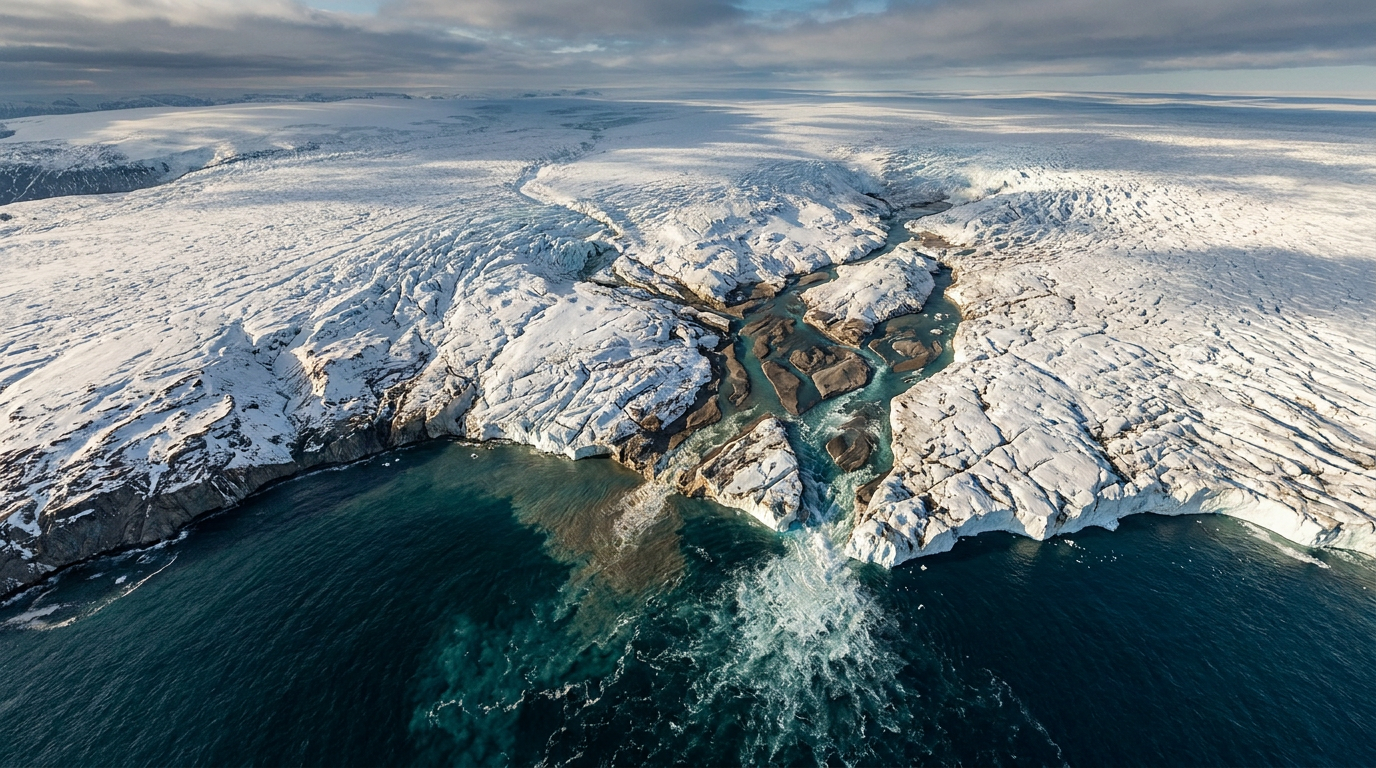
The driving force behind this destabilization is the rapid melting of the Greenland ice sheet. As billions of tons of fresh meltwater pour into the North Atlantic annually, it dilutes the salty surface water.[2][3]
The driving force behind this destabilization is the rapid melting of the Greenland ice sheet.
Because fresh water is less dense than salt water, it struggles to sink. This creates a bottleneck in the conveyor belt, slowing the entire global circulation system and causing heat to back up in the tropical Atlantic.[1][4]

While the fact of the slowdown is now robustly documented, the timeline for a potential total collapse remains the subject of intense scientific debate. The uncertainty stems from the sheer complexity of modeling non-linear tipping points in the Earth's climate system.[4][5]
Some researchers, analyzing early-warning signals in the statistical variance of ocean temperatures, argue a collapse could occur as early as the 2050s if greenhouse gas emissions are not drastically reduced. They point to paleoclimate records showing the AMOC has collapsed abruptly in the deep past.[1][4]
Conversely, many traditional climate modelers caution that these statistical extrapolations may overstate the immediate risk. They point out that complex Earth system models generally project a full collapse is unlikely before the year 2100, though they concede those models have historically underestimated the pace of ice melt.[2][5]
Despite the uncertainty in timing, the consequences of an AMOC collapse are universally recognized as catastrophic. It would not simply mean a colder Europe; it would fundamentally rewire the global climate system in ways human civilization has never experienced.[3][4]
In the Northern Hemisphere, average temperatures could plummet by several degrees within a decade. This abrupt cooling would severely disrupt agriculture, energy grids, and infrastructure across Europe and parts of North America.[3][5]
Simultaneously, the tropical monsoon systems would likely shift southward. This would induce devastating, permanent droughts in the Sahel region of Africa and the Amazon basin, while causing unprecedented flooding in other parts of the Southern Hemisphere.[1][4]

Furthermore, the slowdown of the current means less water is pulled away from the US East Coast. Oceanographers project this dynamic could result in an additional localized sea-level rise of up to 20 inches, compounding the baseline effects of global ice melt.[2][3]
How we got here
2004
The RAPID array is deployed across the Atlantic to continuously monitor the strength of the AMOC.
2021
The IPCC reports that the AMOC is very likely to weaken over the 21st century, but a collapse is unlikely before 2100.
2023
A controversial statistical study suggests the AMOC could cross a tipping point between 2025 and 2095.
June 2026
New synthesis of observational data confirms the system is losing stability faster than traditional models predicted.
Viewpoints in depth
Earth System Scientists
Researchers focused on observational data and statistical early-warning signals.
This camp argues that traditional climate models are too conservative and often fail to capture the complex, non-linear dynamics of tipping points. By analyzing the statistical variance and 'loss of resilience' in sea surface temperatures, these scientists contend that the AMOC is already exhibiting the classic mathematical precursors to a collapse. They emphasize that the influx of Greenland meltwater is occurring faster than models anticipated, meaning the threshold for a shutdown could be crossed within decades, not centuries.
Climate Modelers
Scientists who build and analyze complex, long-term Earth system models.
While agreeing that the AMOC is weakening, this camp cautions against extrapolating near-term collapse dates from localized statistical anomalies. They argue that the Earth's climate system contains numerous stabilizing feedbacks that simple statistical models miss. According to their high-resolution simulations, while a significant slowdown is locked in, a full cessation of the current remains highly unlikely before the year 2100. They stress the need for more deep-ocean data before declaring an imminent tipping point.
Policy Analysts
Experts focused on the societal and economic implications of climate shifts.
For policy experts, the debate over the exact year of a collapse is secondary to the fact that the risk is no longer zero. They argue that global adaptation strategies—from agricultural planning in the Global South to coastal defense on the US East Coast—are dangerously reliant on assumptions of gradual, linear warming. This camp advocates for immediate 'stress testing' of global food and energy systems against the scenario of an abrupt AMOC shift, treating it as a catastrophic national security risk.
What we don't know
- The exact year or decade the AMOC might cross the critical tipping point.
- Whether a partial collapse would stabilize, or inevitably trigger a total shutdown.
- The precise localized impacts on specific agricultural regions in the Global South.
Key terms
- AMOC
- The Atlantic Meridional Overturning Circulation, a major system of ocean currents that acts as a global conveyor belt for heat.
- Tipping Point
- A critical threshold in the climate system that, when crossed, leads to large, accelerating, and often irreversible changes.
- Salinity Anomaly
- A deviation from the normal salt concentration in the ocean, often caused by an influx of fresh meltwater.
- Sverdrup
- A unit of measure for ocean currents, equal to one million cubic meters of water flowing per second.
Frequently asked
What is the AMOC?
The Atlantic Meridional Overturning Circulation (AMOC) is a massive system of ocean currents that transports warm water from the tropics to the North Atlantic, regulating global climate.
Why is the AMOC slowing down?
Rapid melting of the Greenland ice sheet is pouring fresh water into the North Atlantic. Because fresh water is less dense than salt water, it prevents the surface water from sinking, which creates a bottleneck in the current.
When could the AMOC collapse?
The exact timeline is highly uncertain. Some statistical models suggest a collapse could occur as early as the 2050s, while traditional climate models project it is unlikely before 2100.
How would a collapse affect the United States?
A weakened AMOC pulls less water away from the US East Coast, which could result in an additional 20 inches of localized sea-level rise, compounding the effects of global warming.
Sources
Source coverage
5 outlets
3 viewpoints surfaced





[1]NatureEarth System Scientists
Observational constraints on the stability of the Atlantic Meridional Overturning Circulation
Read on Nature →[2]NOAAClimate Modelers
Global Ocean Monitoring and Observing: 2026 AMOC Status Report
Read on NOAA →[3]The Washington PostPolicy Analysts
Vital Atlantic ocean current shows signs of imminent tipping point, new data warns
Read on The Washington Post →[4]Potsdam Institute for Climate Impact ResearchEarth System Scientists
Tipping elements in the Earth's climate system: The AMOC bottleneck
Read on Potsdam Institute for Climate Impact Research →[5]Factlen Editorial TeamPolicy Analysts
Synthesis by Factlen editorial team
Read on Factlen Editorial Team →

More in science
See all 7 stories →Quantum Physics
The Physics of the Higgs Field: How the Universe Got Its Mass
6 sources
Urban Ecology
How 13-Centimeter Holes in London Fences Are Reversing Urban Biodiversity Loss
8 sources

Dark Oxygen
The Discovery of 'Dark Oxygen' is Rewriting the Rules of Life on Earth
6 sources
Superconductors
Nanoscale Substrate Sculpting Unlocks Higher Temperatures and Magnetic Tolerance in Superconductors
7 sources

Every angle. Every day.
Get science stories with full source coverage and perspective breakdowns delivered to your inbox.