
How AI is Finally Reading the 'Unreadable' Herculaneum Scrolls
Two millennia after Mount Vesuvius carbonized an entire Roman library, a global coalition of computer scientists and papyrologists is using machine learning and X-ray tomography to virtually unroll the fragile texts.
By Factlen Editorial Team
- Computer Scientists & AI Researchers
- Focuses on the technical achievement of training machine learning models to detect microscopic variations in 3D X-ray data.
- Papyrologists & Classicists
- Values the translation, historical context, and philosophical significance of the newly recovered Epicurean texts.
- Digital Heritage Preservationists
- Emphasizes the importance of non-destructive scanning and the potential to unlock 'invisible libraries' worldwide.
What's not represented
- · Traditional Field Archaeologists
- · Italian Cultural Heritage Regulators
Why this matters
More than 99 percent of ancient Greek and Roman literature has been lost to time. By proving that carbonized scrolls can be read without opening them, this technology unlocks the only surviving library from antiquity, potentially recovering lost masterpieces of classical philosophy, science, and drama.
Key points
- The Herculaneum scrolls were carbonized by the eruption of Mount Vesuvius in 79 AD.
- Physical attempts to open the scrolls destroy them, leaving hundreds unread.
- Researchers are using 3D X-ray micro-CT scans to digitally map the scrolls' internal layers.
- Machine learning models detect microscopic physical signatures left by the invisible carbon ink.
- The Vesuvius Challenge has already decoded a lost philosophical treatise on pleasure.
- The technology could eventually uncover lost works from the ancient world.
In the autumn of 79 AD, Mount Vesuvius erupted, burying the Roman resort town of Herculaneum under a devastating pyroclastic surge. Unlike nearby Pompeii, which was slowly buried under falling ash, Herculaneum was hit by a 500-degree Celsius wave of volcanic gas and mud.[1]
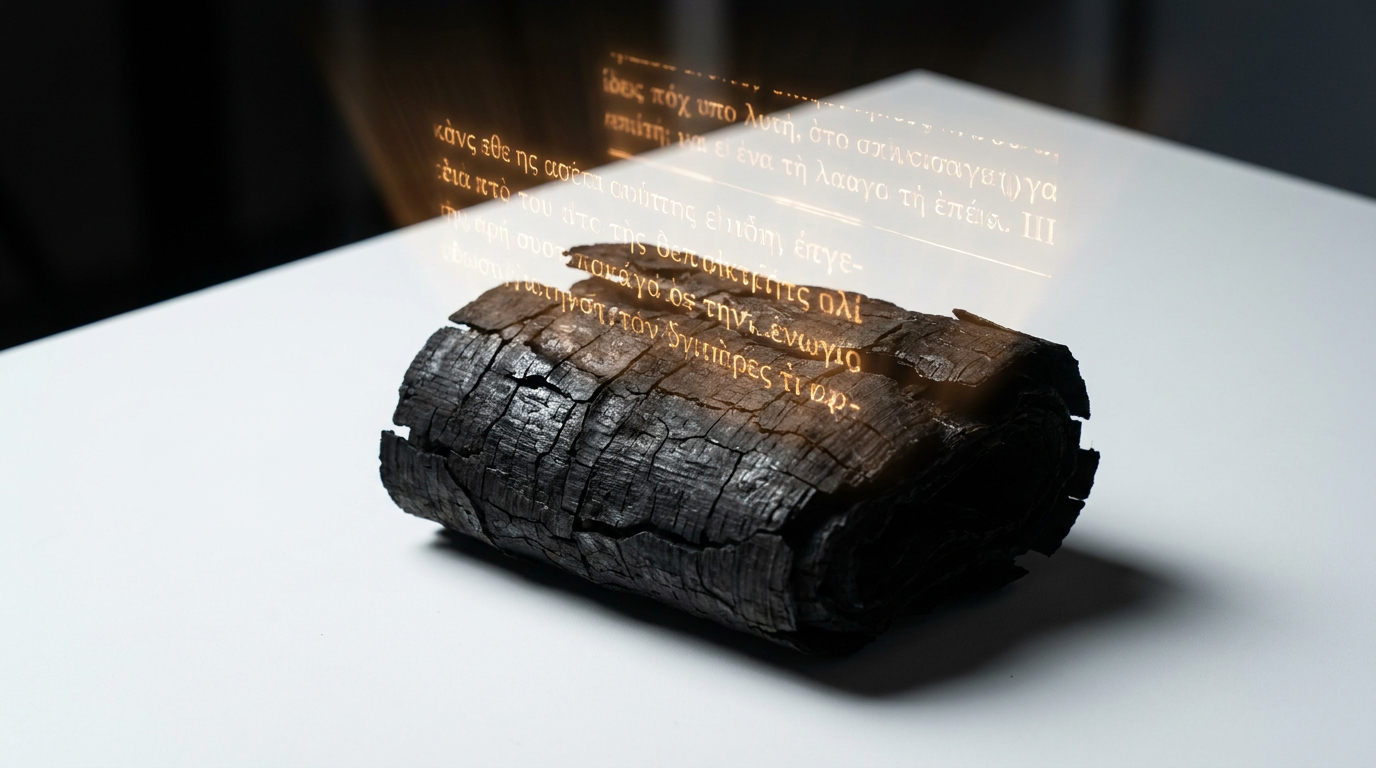
This intense, oxygen-deprived heat instantly carbonized organic material, preserving wooden beams, food, and most importantly, an entire library. Discovered by well-diggers in the 1750s, the Villa of the Papyri yielded hundreds of tightly rolled papyrus scrolls.[1][3]
For more than two and a half centuries, these scrolls represented one of archaeology's most tantalizing and frustrating mysteries. They physically survived, but they resembled brittle lumps of charcoal.[2]
Early attempts to physically unroll them were disastrous. When researchers tried to pry the layers apart, the carbonized papyrus would shatter and crumble into dust, destroying the very history they sought to uncover.[2][4]
Today, a global coalition of computer scientists, physicists, and classicists is finally reading the unreadable. Through a combination of high-resolution particle accelerators and advanced machine learning, the "Vesuvius Challenge" is successfully extracting lost ancient literature without ever opening the physical artifacts.[1][7]
The breakthrough relies on a technique called "virtual unwrapping," pioneered by Dr. Brent Seales, a computer scientist at the University of Kentucky. The process begins by taking the charred scrolls to facilities like the Diamond Light Source in the UK, where powerful X-ray computed tomography (micro-CT) scans create massive, three-dimensional digital models of the scrolls' internal structures.[4][6]

But scanning the scrolls was only half the battle. The scribes of Herculaneum used carbon-based ink. Because the ink and the carbonized papyrus have the exact same density, the text is completely invisible on a standard X-ray.[3]
To solve this, Seales and his team hypothesized that the ink, even if invisible, might leave microscopic physical signatures on the papyrus—subtle changes in texture or thickness where the liquid once soaked into the plant fibers.[3][6]
In March 2023, Seales partnered with technology entrepreneurs Nat Friedman and Daniel Gross to launch the Vesuvius Challenge, offering a $1 million prize pool to anyone who could build an artificial intelligence model capable of detecting these microscopic ink signatures.[1][6]
The organizers released terabytes of 3D X-ray data and open-source virtual unwrapping software, inviting citizen scientists and machine learning experts worldwide to tackle the bottleneck. The first major milestone fell in October 2023, when Luke Farritor, a 21-year-old computer science student at the University of Nebraska-Lincoln, trained a neural network that successfully detected the ancient Greek word "porphyras," meaning purple.[1][3][5][6]
The pace of discovery rapidly accelerated. In February 2024, the $700,000 Grand Prize was awarded to a trio of student researchers—Farritor, Youssef Nader, and Julian Schilliger—who managed to decode 15 columns of text containing more than 2,000 characters.[1][6]

Papyrologists translating the Grand Prize submission revealed it to be a previously unknown philosophical treatise. The text, likely written by the Epicurean philosopher Philodemus, discusses the nature of pleasure, specifically examining how the scarcity or abundance of food and music affects human enjoyment.[5][6]
The momentum has continued into recent years. In early 2025, the Vesuvius Challenge team successfully generated the first internal images of a scroll held at Oxford's Bodleian Libraries, identifying the Greek word "diatrope," meaning disgust.[4]
Because AI models are prone to "hallucinating" data, the evidence-gathering process is rigorously transparent. The competition requires independent teams using entirely different machine learning architectures—such as TimeSformer and ResNet models—to process the same digital segments.[7]
When multiple, distinct neural networks independently highlight the exact same geometric patterns of Greek letters, papyrologists can be highly confident that the AI is detecting genuine physical ink rather than generating digital artifacts.[7]

The implications for classical history are staggering. Scholars estimate that more than 99 percent of ancient Greek and Roman literature has been lost to time. The Villa of the Papyri is the only intact library to survive from antiquity, and its unread scrolls could contain lost plays by Sophocles, missing dialogues of Aristotle, or early texts that reshape our understanding of the ancient world.[1][7]
Furthermore, archaeologists believe that the roughly 800 scrolls recovered so far may only represent a fraction of the villa's collection. There is widespread speculation that a larger, primary library remains buried in the unexcavated lower levels of the complex.[1][7]
As the Vesuvius Challenge moves toward its next goal of fully automating the segmentation and unwrapping pipeline, the focus is shifting from proving the concept to scaling it. If the software can be refined to read entire scrolls in days rather than months, the "invisible library" of Herculaneum will finally be open to the world.[1][6][7]
How we got here
79 AD
Mount Vesuvius erupts, carbonizing the library at the Villa of the Papyri.
1750s
Well-diggers discover the buried villa and recover hundreds of charred scrolls.
March 2023
The Vesuvius Challenge launches, releasing 3D scans and offering a $1 million prize pool.
October 2023
A 21-year-old student uses AI to detect the first word, 'porphyras' (purple).
February 2024
The Grand Prize is awarded for decoding 15 columns of a lost philosophical text.
Viewpoints in depth
Computer Scientists & AI Researchers
Focuses on the technical achievement of training machine learning models to detect microscopic variations in 3D X-ray data.
For the computer science community, the Herculaneum scrolls represent a massive data problem. The primary bottleneck is 'segmentation'—the painstaking process of tracing the crumpled, overlapping layers of papyrus within a 3D digital mesh. Researchers emphasize that the success of the Vesuvius Challenge proves the viability of crowdsourced, open-source machine learning competitions to solve highly specific, multi-disciplinary technical hurdles.
Papyrologists & Classicists
Values the translation, historical context, and philosophical significance of the newly recovered Epicurean texts.
Classicists view the technological breakthroughs as a means to an end: the recovery of lost human knowledge. Because 99 percent of ancient literature is gone, the prospect of reading an intact Roman library is considered the holy grail of classical archaeology. Papyrologists are currently focused on translating the newly discovered texts of Philodemus, noting that these primary sources offer unprecedented insight into the daily intellectual debates of the ancient Mediterranean.
Digital Heritage Preservationists
Emphasizes the importance of non-destructive scanning and the potential to unlock 'invisible libraries' worldwide.
Preservationists argue that virtual unwrapping fundamentally changes how museums and archives handle fragile artifacts. By proving that information can be extracted without physical intervention, this camp advocates for the scanning of other 'invisible libraries'—such as water-damaged manuscripts, sealed medieval documents, and degraded parchment—ensuring that cultural heritage is preserved digitally before it physically decays.
What we don't know
- Whether the unexcavated lower levels of the Villa of the Papyri contain a larger, primary library of Latin texts.
- How quickly the segmentation pipeline can be fully automated to read the remaining 800 scrolls.
- Which specific lost works of classical antiquity might be hidden within the unread scrolls.
Key terms
- Virtual Unwrapping
- A computational technique that uses 3D X-ray scans to digitally flatten and read layered, fragile objects without physically opening them.
- Micro-CT Scan
- High-resolution X-ray computed tomography that creates a 3D model of an object's internal structure.
- Carbonized Papyrus
- Ancient paper made from the papyrus plant that has been scorched into charcoal by intense volcanic heat.
- Machine Learning Segmentation
- The process of training an AI model to identify and trace the extremely thin, crumpled layers of papyrus within a 3D scan.
- Epicureanism
- An ancient Greek philosophical system founded by Epicurus, emphasizing that the goal of a happy life is the pursuit of intellectual and modest pleasures.
Frequently asked
Why couldn't researchers just unroll the scrolls by hand?
The intense heat of the volcanic eruption turned the scrolls into brittle lumps of charcoal. Physical attempts to unroll them over the past 250 years caused them to shatter and crumble into dust.
How does the AI know what the letters are if the ink is invisible?
The ancient scribes used carbon-based ink, which has the same density as the carbonized papyrus. However, the AI is trained to detect microscopic physical changes in the papyrus surface—such as subtle texturing or thickness—caused by the ink's application.
Could the AI be hallucinating the text?
To prevent hallucinations, the competition requires multiple independent teams using different machine learning architectures to process the same scans. When different models independently produce the exact same Greek characters, papyrologists can verify the results.
What have they read so far?
Decoded passages include a philosophical treatise on pleasure, food, and music, believed to be written by the Epicurean philosopher Philodemus, as well as isolated words like "purple" and "disgust."
Sources
Source coverage
7 outlets
3 viewpoints surfaced







[1]Vesuvius ChallengeComputer Scientists & AI Researchers
Resurrect an ancient library from the ashes of a volcano
Read on Vesuvius Challenge →[2]Smithsonian MagazinePapyrologists & Classicists
How Artificial Intelligence Is Making 2,000-Year-Old Scrolls Readable Again
Read on Smithsonian Magazine →[3]National GeographicPapyrologists & Classicists
AI just deciphered part of an 'unreadable' ancient scroll. Here's what it says.
Read on National Geographic →[4]The GuardianDigital Heritage Preservationists
Researchers read word 'disgust' in ancient scroll burned at Pompeii
Read on The Guardian →[5]University of Nebraska-LincolnComputer Scientists & AI Researchers
Husker Undergrad Decodes Ancient Scroll, Wins Global Competition
Read on University of Nebraska-Lincoln →[6]National Endowment for the HumanitiesDigital Heritage Preservationists
NEH-Supported Researchers Use AI to Decode Ancient Herculaneum Scroll
Read on National Endowment for the Humanities →[7]Factlen Editorial TeamDigital Heritage Preservationists
Synthesis by Factlen editorial team
Read on Factlen Editorial Team →

More in science
See all 5 stories →

Every angle. Every day.
Get science stories with full source coverage and perspective breakdowns delivered to your inbox.