
Startup Katalyst Space Prepares Daring Rescue Mission to Save NASA's Sinking Swift Observatory
Arizona-based startup Katalyst Space is set to launch a robotic spacecraft built in just 250 days to intercept and boost the orbit of a 21-year-old NASA telescope before it burns up in Earth's atmosphere.
By Factlen Editorial Team
- Commercial Space Industry
- Views the mission as a watershed moment that will validate the business model of in-orbit servicing and end the throwaway era of satellites.
- Scientific Community
- Values the mission primarily as a lifeline for a critical, irreplaceable astrophysics asset that acts as a first responder for cosmic events.
- Defense and Strategic Sector
- Sees the rapid 250-day development and docking capabilities as a strategic demonstration of how the U.S. can quickly respond to threats or failures in orbit.
What's not represented
- · Traditional aerospace prime contractors whose long development cycles are being challenged by this rapid startup model.
- · Taxpayer watchdog groups evaluating the cost-benefit of spending $30 million to save a 21-year-old asset.
Why this matters
The mission could validate a new era of commercial satellite servicing, proving that aging multi-million-dollar space assets can be rescued and upgraded rather than abandoned. If successful, it establishes a lucrative new market for space startups and extends the life of critical scientific instruments at a fraction of their replacement cost.
Key points
- NASA's Swift Observatory is rapidly losing altitude due to atmospheric drag and intense solar activity.
- Arizona startup Katalyst Space built the LINK rescue spacecraft in just 250 days under a $30 million NASA contract.
- The mission marks the first time a commercial robot will attempt to dock with an unprepared government satellite.
- LINK is scheduled to launch on June 27 via an air-dropped Pegasus XL rocket from the Marshall Islands.
- Katalyst recently raised $12 million to develop a larger servicing spacecraft for geostationary orbit.
For more than two decades, NASA’s Neil Gehrels Swift Observatory has served as the astrophysics community’s cosmic first responder. Launched in 2004, the $500 million space telescope is designed to detect gamma-ray bursts—the most violent explosions in the universe—and instantly alert other observatories to swing their lenses toward the blast.[1][6]
But the venerable telescope is currently facing its own existential threat. Swift carries no onboard propulsion system, and after 21 years of brushing against the tenuous outer edges of Earth's atmosphere, its orbit is steadily decaying.[1][2]
The situation has grown dire in recent months. A period of intense solar activity has puffed the Earth's atmosphere outward, thickening the drag on the spacecraft and pulling it downward faster than NASA had anticipated. Without intervention, the observatory is doomed to burn up in the atmosphere by late 2026.[1][2]
Rather than let a world-class scientific asset perish, NASA is attempting something it has never done before: catching a falling telescope. In September 2025, the space agency awarded a $30 million contract to Katalyst Space Technologies, a startup based in Flagstaff, Arizona, to mount a daring robotic rescue mission.[2][4]

The mission, dubbed Swift Boost, is designed to prove that the United States can rapidly respond to crises in orbit. Katalyst was given an extraordinarily compressed timeline, taking its robotic servicing spacecraft, named LINK, from concept to a flight-ready vehicle in just 250 days.[1][5][6]
"Frankly, I have to be honest: No one thought it was going to be possible," Shawn Domagal-Goldman, division director for astrophysics at NASA Headquarters, told reporters. "No one thought we would get as far as we've already gotten today."[1][2]
The 880-pound LINK spacecraft is scheduled to launch on June 27, 2026. The launch logistics are as unique as the mission itself. LINK will ride aboard a Northrop Grumman Pegasus XL rocket—the final flight for the historic launch vehicle.[2][3]
Instead of launching from a traditional pad, the Pegasus XL will be carried into the sky beneath the belly of a modified aircraft called Stargazer. Taking off from Kwajalein Atoll in the Marshall Islands, the plane will drop the rocket at an altitude of 40,000 feet, where it will ignite its motors and carry LINK into low Earth orbit.[2][3]

Instead of launching from a traditional pad, the Pegasus XL will be carried into the sky beneath the belly of a modified aircraft called Stargazer.
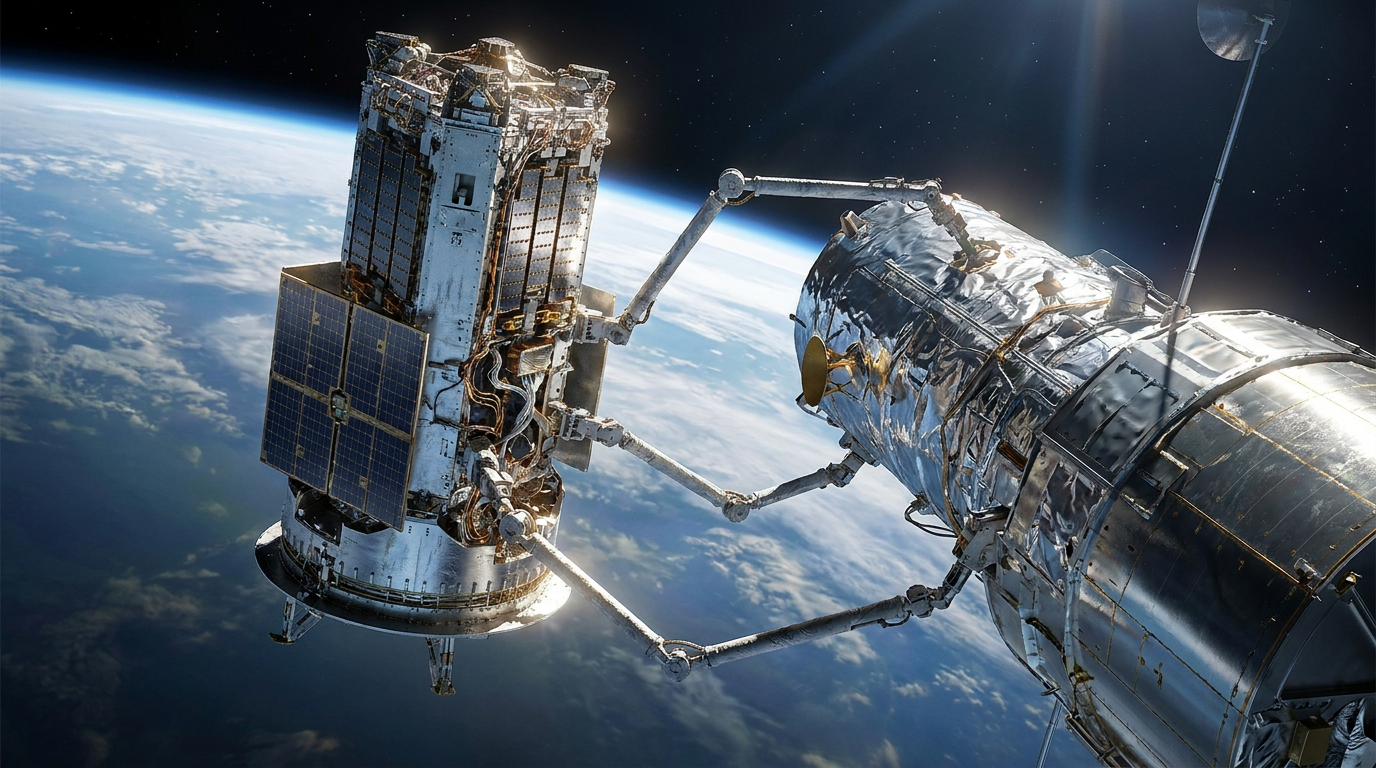
Once in space, the true test begins. LINK will use electric propulsion and complex proximity-operation software to hunt down the Swift Observatory. The challenge is immense because Swift is an "unprepared" satellite—it was built long before the era of in-orbit servicing and features no docking rings, grappling fixtures, or cooperative navigation aids.[1][2]
To capture its target, LINK is equipped with multiple rendezvous sensors and three robotic arms. It must carefully match the telescope's orientation, reach out, and physically grip the fragile observatory without damaging its sensitive instruments or solar panels.[1][2]
If the capture is successful, LINK will act as a space tug. Over the course of several months, the spacecraft will fire its reaction-control thrusters to gradually raise Swift’s altitude, pushing it back into a safe, sustainable orbit that will add years to its operational life.[1][2]
The stakes extend far beyond the survival of a single telescope. For Katalyst Space, the mission is a high-profile audition for a burgeoning new sector of the space economy. Historically, the aerospace industry has relied on a "throwaway model," where multi-million-dollar satellites are simply abandoned when they run out of fuel or suffer minor component failures.[2]
"Over the last decade or so, we've gotten very good at launching things into space," said Robert Lamontagne, Katalyst's vice president for strategic partnerships. "Katalyst is here really to kind of demark the end of that throwaway model, and the start of a new model."[2]

A successful rescue would prove that commercial startups can safely and affordably service government assets, opening the door to a lucrative market for satellite life-extension, refueling, and repair. This capability is highly sought after not just by civil agencies like NASA, but by the U.S. Space Force, which views orbital servicing as a critical national security advantage.[4][5]
Katalyst is already capitalizing on the momentum. Just days before the scheduled launch, the company announced it had raised $12 million in new funding led by Geodesic Capital. The capital injection will fund the development of NEXUS, a larger, next-generation servicing spacecraft designed for the much higher geostationary orbit.[4]
Scheduled to debut on an Ariane 6 rocket in 2027, NEXUS will boast double the power and mass of the LINK vehicle. Unlike LINK's single-target mission, NEXUS is being designed to service multiple satellites in a single trip, a capability that Katalyst CEO Ghonhee Lee says will make the business margins "quite spectacular."[4]

The NEXUS roadmap includes a planned rendezvous with a U.S. Space Force satellite called Rooster, followed by commercial life-extension contracts. The density of high-value communications and defense satellites in geostationary orbit makes it the ultimate proving ground for commercial space tugs.[2][4]
But before Katalyst can conquer geostationary orbit, it must succeed in low Earth orbit. The Swift Boost mission represents a convergence of rapid commercial innovation and urgent scientific need, executed on a timeline that traditional aerospace contractors would have considered impossible.[1][5]
As the Stargazer aircraft prepares to take flight over the Pacific, the astrophysics community is holding its breath. If LINK can thread the needle and catch the falling observatory, it will preserve a vital window into the universe's most violent events—and permanently change how humanity manages its infrastructure in the stars.[1][2]
How we got here
Nov 2004
NASA launches the Neil Gehrels Swift Observatory to study gamma-ray bursts.
Aug 2025
Katalyst Space is awarded a NASA Phase III SBIR contract to develop a rescue mission concept.
Sep 2025
NASA officially awards Katalyst a $30 million contract to execute the Swift Boost mission.
Apr 2026
Katalyst engineers complete thermal vacuum testing of the LINK spacecraft at NASA's Goddard Space Flight Center.
Jun 27, 2026
Scheduled launch of the LINK spacecraft aboard a Pegasus XL rocket.
Viewpoints in depth
Commercial Space Advocates
Argue that the mission proves nimble startups can solve urgent problems faster and cheaper than traditional aerospace primes.
This camp views the 250-day development cycle as a watershed moment for government procurement. By utilizing a Small Business Innovation Research (SBIR) contract, NASA bypassed the decade-long development cycles typical of legacy contractors. Advocates believe that if Katalyst succeeds, it will permanently shift the industry away from disposable satellites and toward a dynamic ecosystem of in-orbit repair, refueling, and life-extension services.
Astrophysics Community
Focused on the preservation of a unique scientific asset that acts as a first responder for cosmic events.
For astronomers, the business implications are secondary to the data. Swift’s ability to rapidly pivot and locate gamma-ray bursts cannot currently be matched by other instruments. The scientific community emphasizes that losing Swift would create a blind spot in our observation of the universe's most violent explosions, making this $30 million rescue a massive bargain compared to the half-billion-dollar cost of building a replacement.
Defense and Strategic Sector
Views the rapid development and docking capabilities as a strategic demonstration of orbital security.
Military and intelligence analysts are closely watching the mission's rendezvous and proximity operations (RPOD). The ability to quickly launch a spacecraft that can autonomously hunt down and dock with an unprepared satellite is a highly sought-after capability for the U.S. Space Force. This camp sees the commercial rescue as a dual-use demonstration, proving the U.S. can rapidly inspect, protect, or maneuver critical national security assets in orbit.
What we don't know
- Whether the unprecedented autonomous docking with an unprepared, spinning satellite will succeed without damaging the fragile telescope.
- Exactly how many years of operational life the reboost will add to the Swift Observatory.
- How the economics of satellite servicing will scale once larger fleets of commercial space tugs are deployed to higher orbits.
Key terms
- Gamma-ray burst
- The most powerful explosions in the universe, often caused by collapsing stars, which the Swift Observatory was built to detect.
- Atmospheric drag
- The friction caused by the Earth's upper atmosphere, which gradually slows down satellites in low Earth orbit and causes them to lose altitude.
- Rendezvous and Proximity Operations (RPOD)
- The complex orbital maneuvers required for two spacecraft to safely approach, fly in formation, and interact with one another.
- Geostationary orbit (GEO)
- A high-altitude orbit where satellites match the Earth's rotation, appearing stationary over a single point on the ground.
Frequently asked
Why is the Swift Observatory falling?
Swift does not have its own propulsion system. Over 21 years, friction from the Earth's upper atmosphere has slowly degraded its orbit, a process recently accelerated by intense solar storms.
How will the LINK spacecraft catch the telescope?
LINK will use electric propulsion to match Swift's orbit, then use sensors and three robotic arms to grapple the telescope, which was never designed to be docked with.
What happens if the mission fails?
If the rescue is unsuccessful, the $500 million Swift Observatory will continue to lose altitude and eventually burn up in the Earth's atmosphere by late 2026.
Sources
Source coverage
6 outlets
3 viewpoints surfaced






[1]ForbesCommercial Space Industry
Inside One Startup’s Race To Rescue NASA’s Sinking Space Telescope
Read on Forbes →[2]Space.comScientific Community
'No one thought it was going to be possible.' A space telescope is falling out of space. This is NASA's daring plan to save it.
Read on Space.com →[3]EngadgetCommercial Space Industry
NASA and Katalyst Space prepare to launch rescue mission for Swift observatory
Read on Engadget →[4]Payload SpaceDefense and Strategic Sector
Katalyst Raises $12M to Extend Satellite Servicing to GEO
Read on Payload Space →[5]Katalyst SpaceCommercial Space Industry
First-of-its-kind mission would extend Swift Observatory's life by years
Read on Katalyst Space →[6]NASAScientific Community
Swift Boost Mission
Read on NASA →



Every angle. Every day.
Get business stories with full source coverage and perspective breakdowns delivered to your inbox.