
SpaceX's Historic IPO Triggers a Massive Wave of Index Fund Buying
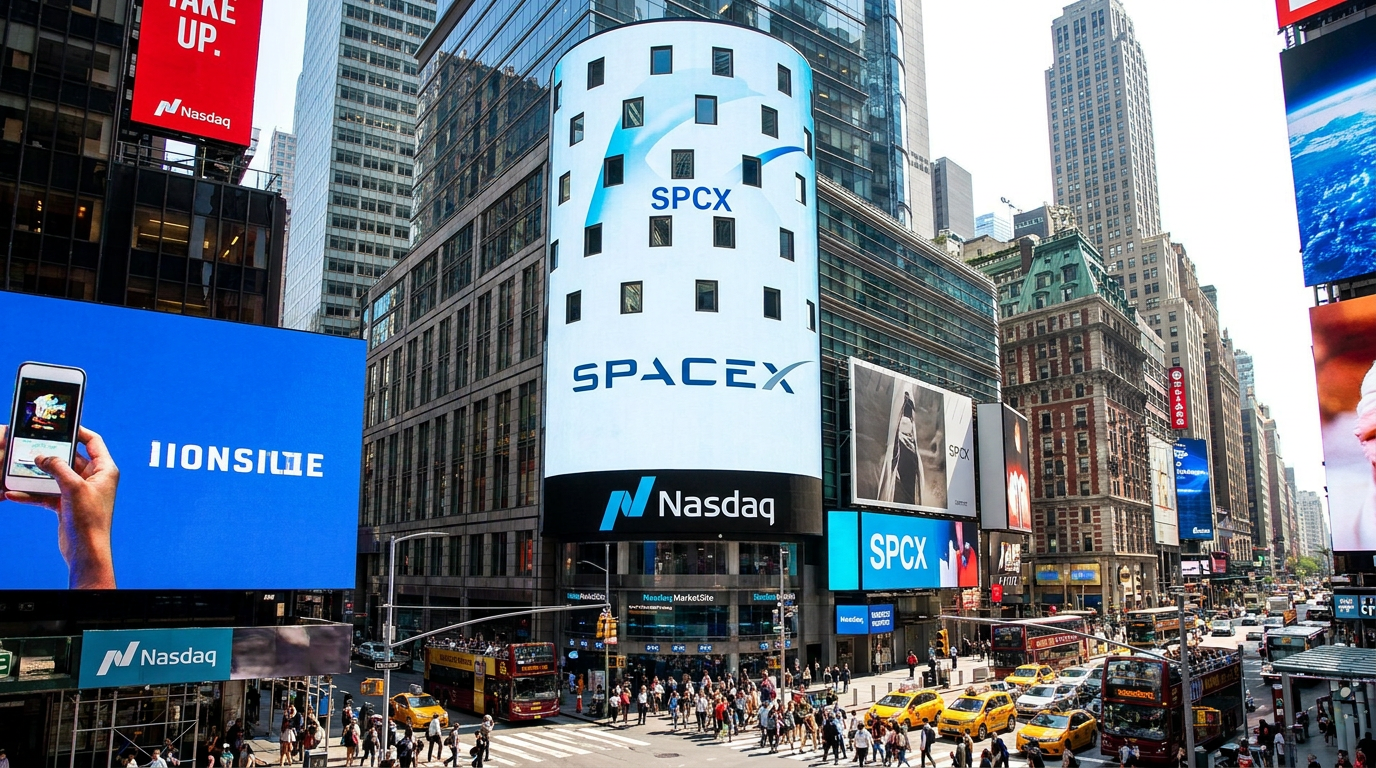
Following its record-breaking $75 billion public debut, SpaceX is forcing major stock indexes to rewrite their rules, triggering a mechanical wave of buying from passive retirement funds.
By Factlen Editorial Team
- Passive Investors
- Concerned with how mechanical index inclusion forces them to buy high-valuation, low-float equities.
- Index Rule Makers
- Focus on balancing benchmark stability with the need to accurately reflect the modern market's largest companies.
- Growth Bulls
- Argue that SpaceX's near-monopoly in space launch and its AI expansion justify its historic valuation.
- Market Purists
- Support the S&P 500's refusal to waive profitability rules, warning against the risks of IPO volatility.
What's not represented
- · Active Fund Managers
- · Retail Short Sellers
Why this matters
Millions of everyday investors will soon own a piece of SpaceX through their 401(k)s and passive index funds, fundamentally altering the risk and return profile of standard retirement portfolios.
Key points
- SpaceX raised $75 billion in the largest IPO in history, debuting at a $1.75 trillion valuation.
- Nasdaq and FTSE Russell rewrote their eligibility rules to allow the company fast entry into major indexes.
- Passive funds tracking the Nasdaq-100 and Russell 1000 will be forced to buy billions in SpaceX stock by early July.
- The S&P 500 rejected a fast-track proposal, delaying SpaceX's inclusion until at least mid-2027.
- Only about 4% of SpaceX shares were made available to the public, creating a low-float dynamic.
On June 12, SpaceX executed the largest initial public offering in history, raising a staggering $75 billion and debuting at a $1.75 trillion valuation that instantly reshaped the global equity landscape. The retail frenzy was immediate and intense, sending shares surging 67% in the opening days of trading before momentum cooled, leaving the stock at a more sustainable 33% premium over its $135 offering price. But while the initial wave of retail enthusiasm may be settling down, Wall Street is now bracing for a second, far more powerful catalyst. A massive, mechanical influx of capital is waiting to strike as passive index funds—the bedrock of modern retirement accounts—prepare to absorb the aerospace giant. This impending wave of forced buying has little to do with traditional stock picking or fundamental analysis; rather, it is driven entirely by the rigid, automated rules that govern the world's largest stock market benchmarks.[1][5][6]
Index inclusion is not optional for passive investment vehicles—it is a strict, non-negotiable mandate. When a company is officially added to a major benchmark like the Nasdaq-100 or the Russell 1000, every exchange-traded fund and mutual fund tracking that specific index must systematically purchase the stock to match its designated weight. For a company of SpaceX's unprecedented size, this creates a unique and highly complex logistical challenge for the broader market. Despite its $1.75 trillion valuation, the aerospace giant only floated roughly 4% of its total shares to the public during the IPO. The vast majority of the equity remains tightly locked up with Chief Executive Officer Elon Musk, early employees, and long-term private backers. This extremely low 'free float' means that a tidal wave of passive capital will soon be chasing a very limited supply of available shares, creating the perfect conditions for heightened price volatility as index managers scramble to fulfill their mandates.[5][6]

Under traditional index methodologies, this tiny free float would have immediately disqualified SpaceX from gaining entry into most major market benchmarks. However, recognizing the sheer scale and market importance of the listing, several prominent index providers scrambled to rewrite their rulebooks in the weeks leading up to the IPO. Nasdaq and FTSE Russell both implemented significant updates to their eligibility requirements to accommodate the historic offering. Nasdaq notably removed its long-standing 10% float requirement and instituted a new 'fast-entry' rule specifically designed for mega-cap IPOs, allowing companies of SpaceX's caliber to join the prestigious Nasdaq-100 index after just 15 trading days. These rapid regulatory adjustments highlight the growing tension between maintaining strict benchmark standards and ensuring that major indexes accurately reflect the current reality of the global economy, where massive tech conglomerates often choose to remain private for much longer than in previous decades.[2][3][4]
As a direct result of these rule changes, funds tracking the Nasdaq-100—most notably the massive Invesco QQQ Trust—will be structurally forced to buy billions of dollars of SpaceX stock by early July. To fund these concentrated purchases without injecting new capital, index managers will have to systematically sell off fractions of established, highly profitable tech giants like Apple, Microsoft, and Nvidia to make room in their portfolios. The Center for Research in Security Prices (CRSP) went even further in its accommodations, tweaking its internal policies to allow newly public companies to join its indexes after a mere five trading days. Because of this rapid inclusion timeline, Vanguard's immensely popular Total Stock Market ETF (VTI) is already beginning to mechanically absorb the stock, initiating a steady drip of passive buying that will only accelerate as other major benchmarks hit their respective inclusion dates throughout the summer.[2][3][4]

Yet, amidst this wave of rapid accommodations, the most famous and widely tracked benchmark in global finance has firmly refused to bend its rules. S&P Dow Jones Indices, the committee that manages the S&P 500, formally rejected a high-profile proposal to fast-track mega-cap IPOs, opting instead to prioritize long-term benchmark stability over immediate market reflection. The S&P 500 will rigidly maintain its strict 12-month 'seasoning' period and its non-negotiable requirement for four consecutive quarters of positive GAAP profitability. This profitability metric is a significant hurdle for SpaceX, which recently reported a $4.3 billion quarterly loss. That deficit was heavily driven by the company's massive ongoing research and development spending, as well as its newly announced $60 billion all-equity acquisition of the artificial intelligence coding startup Cursor. Consequently, SpaceX will not see S&P 500 inclusion until mid-2027 at the absolute earliest, delaying the largest pool of passive capital from entering the fray.[1][4]
Yet, amidst this wave of rapid accommodations, the most famous and widely tracked benchmark in global finance has firmly refused to bend its rules.
For everyday retail investors and retirement savers, this regulatory divergence creates a starkly bifurcated landscape that fundamentally alters the composition of their portfolios. Those holding 401(k) accounts that are heavily weighted toward Nasdaq-100 trackers or broad total-market index funds will soon own a direct piece of Musk's sprawling space and artificial intelligence venture, regardless of whether they actively chose to invest in the company. Conversely, investors who rely strictly on S&P 500 trackers, such as the SPDR S&P 500 ETF Trust (SPY) or Vanguard's VOO, will be forced to sit on the sidelines for at least another year. While these S&P 500 investors may miss out on any early post-IPO momentum or index-driven price surges, they will also remain completely insulated from the stock's current volatility and the sky-high valuation multiples that have made some traditional value investors deeply uncomfortable.[2][4][6]

That historic valuation remains a fierce point of contention across Wall Street trading desks. At $1.75 trillion, SpaceX is vastly more expensive relative to its current earnings profile than almost any established constituent in the S&P 500. Skeptics and market purists argue that passive index funds are essentially being forced to pay for decades of future growth upfront, absorbing a level of speculative risk that index investing was originally designed to avoid. Bulls, however, point to the company's expanding and seemingly impenetrable economic moat. Beyond its near-monopoly on commercial orbital launch and the rapidly scaling global reach of its Starlink satellite internet network, the $60 billion Cursor acquisition signals a massive, well-funded pivot into agentic artificial intelligence. Supporters argue that SpaceX is no longer just an aerospace manufacturer, but a foundational infrastructure layer for both the physical space economy and the next generation of automated software development.[1][6]
As the critical July rebalancing dates approach, the sheer mechanics of passive investing will dictate SpaceX's next major market move, temporarily overshadowing traditional fundamental analysis. The synchronized wave of buying from Nasdaq and Russell trackers will test the liquidity of the stock's narrow 4% public float, potentially triggering sharp price movements that active managers will scramble to navigate. Ultimately, the true test for the company will extend far beyond this summer's index inclusion frenzy. SpaceX must prove that its underlying business fundamentals—spanning reusable rockets, global broadband, and cutting-edge AI—can rapidly grow into its historic $1.75 trillion price tag before the S&P 500 finally opens its doors next year. Until then, the world's largest public company will remain a fascinating case study in how modern market mechanics and passive capital flows can shape the trajectory of a mega-cap stock.[2][4]
How we got here
June 12, 2026
SpaceX executes the largest IPO in history, raising $75 billion.
June 17, 2026
Nasdaq confirms SpaceX will be eligible for the Nasdaq-100 after 15 trading days.
June 18, 2026
CRSP allows SpaceX entry into Vanguard's Total Stock Market ETF after just five days.
Early July 2026
Anticipated date for massive mechanical buying from Nasdaq-100 and Russell 1000 tracker funds.
Mid-2027
The earliest possible window for SpaceX to join the S&P 500.
Viewpoints in depth
Index Rule Makers
Balancing benchmark stability with the need to reflect the modern market.
Index providers like Nasdaq and FTSE Russell argue that benchmarks must evolve to capture the reality of the market. When a $1.75 trillion company goes public, excluding it because of legacy float requirements makes the index less representative of the actual economy. However, S&P Dow Jones Indices maintains that strict profitability and seasoning rules protect passive investors from the inherent volatility of newly listed mega-caps.
Passive Investors
Navigating the mechanical realities of forced buying.
For managers of passive ETFs and superannuation funds, index inclusion is a rigid mandate, not a choice. They are structurally required to buy SpaceX shares at whatever valuation the market dictates, often forcing them to sell fractions of established, highly profitable tech giants to make room. This dynamic transforms passive vehicles into forced buyers of a low-float, high-premium asset.
Growth Bulls
Valuation is justified by an expanding, impenetrable moat.
Optimists argue that traditional valuation metrics fail to capture SpaceX's near-monopoly in orbital launch and the compounding revenue of Starlink. Furthermore, the company's recent $60 billion acquisition of AI coding platform Cursor signals a massive expansion into agentic artificial intelligence, positioning SpaceX as a foundational infrastructure layer for both the space economy and the next generation of software.
What we don't know
- How the massive wave of forced index buying will impact SpaceX's stock price given its exceptionally low public float.
- Whether SpaceX can achieve the four consecutive quarters of GAAP profitability required for S&P 500 inclusion by 2027.
Key terms
- Free Float
- The portion of a company's shares that are available for trading by the general public, excluding locked-in shares held by insiders.
- Index Rebalancing
- The periodic process where an index provider adjusts the weights of its constituent stocks to reflect current market capitalizations.
- Seasoning Period
- A required length of time a company must trade publicly before it is eligible to be included in a specific stock index.
- GAAP Profitability
- Earnings calculated according to Generally Accepted Accounting Principles, a strict standard required for S&P 500 inclusion.
Frequently asked
Why isn't SpaceX in the S&P 500 yet?
The S&P 500 requires a company to be public for 12 months and report four consecutive quarters of GAAP profitability, rules the index committee refused to waive.
Will my 401(k) buy SpaceX stock?
If your retirement account holds Nasdaq-100, Russell 1000, or Total Stock Market index funds, it will likely begin acquiring SpaceX shares by July.
How much of SpaceX is actually available to trade?
Only about 4% of the company's shares were made available to the public during the IPO, creating a 'low float' that can drive price volatility.
Sources
Source coverage
6 outlets
4 viewpoints surfaced






[1]MarketWatchGrowth Bulls
The initial SpaceX frenzy is cooling off — but a new wave of cash is waiting to strike
Read on MarketWatch →[2]ForbesIndex Rule Makers
SpaceX Could Join Nasdaq-100 Within Weeks, But S&P 500 Inclusion Remains Far Off
Read on Forbes →[3]The Motley FoolIndex Rule Makers
How Index Providers Are Changing the Rules for the SpaceX IPO
Read on The Motley Fool →[4]SpotGammaMarket Purists
Why Index Rules Are Changing — and Why the S&P 500 Said No
Read on SpotGamma →[5]Hargreaves LansdownPassive Investors
SpaceX IPO: when will index tracker funds invest?
Read on Hargreaves Lansdown →[6]MorningstarPassive Investors
The big picture for Aussie investors: How SpaceX enters your superannuation
Read on Morningstar →

Every angle. Every day.
Get finance stories with full source coverage and perspective breakdowns delivered to your inbox.