
The Factory Floor Revolution: How Vision-Language-Action Models Are Powering 2026's Humanoid Workforce
Humanoid robots have moved out of the lab and onto live production lines at major automakers like BMW, Hyundai, and Tesla. Driven by new Vision-Language-Action (VLA) models, these machines are learning to perform complex, dynamic manufacturing tasks autonomously.
By Factlen Editorial Team
- Humanoid Developers
- Focused on scaling bipedal hardware and achieving end-to-end autonomy.
- Automotive Manufacturers
- Focused on integrating flexible automation into existing, human-centric assembly lines.
- Broader Automation Industry
- Focused on the underlying AI models and alternative physical AI form factors.
What's not represented
- · Labor Unions & Factory Workers
- · Occupational Safety Regulators (OSHA)
Why this matters
The deployment of autonomous humanoids at scale promises to solve chronic industrial labor shortages and reduce workplace injuries. By fundamentally altering the economics of physical labor, this shift will lower manufacturing costs and reshape the global supply chain.
Key points
- Humanoid robots have transitioned from research labs to live production lines at major automakers like BMW, Hyundai, and Tesla.
- Tesla has deployed over 1,000 Optimus Gen 3 units at its Fremont factory, marking the largest humanoid deployment in history.
- The breakthrough enabling this shift is the Vision-Language-Action (VLA) model, which maps visual data directly to physical movements.
- VLA models eliminate the need for rigid, hardcoded programming, allowing robots to adapt to unpredictable factory environments in real time.
- Manufacturers are targeting a commercial price of $20,000 to $30,000 per unit, making humanoids a cost-effective alternative to redesigning factories.
- Safety certifications and long-term reliability over 24/7 shifts remain the primary hurdles before widespread third-party adoption.
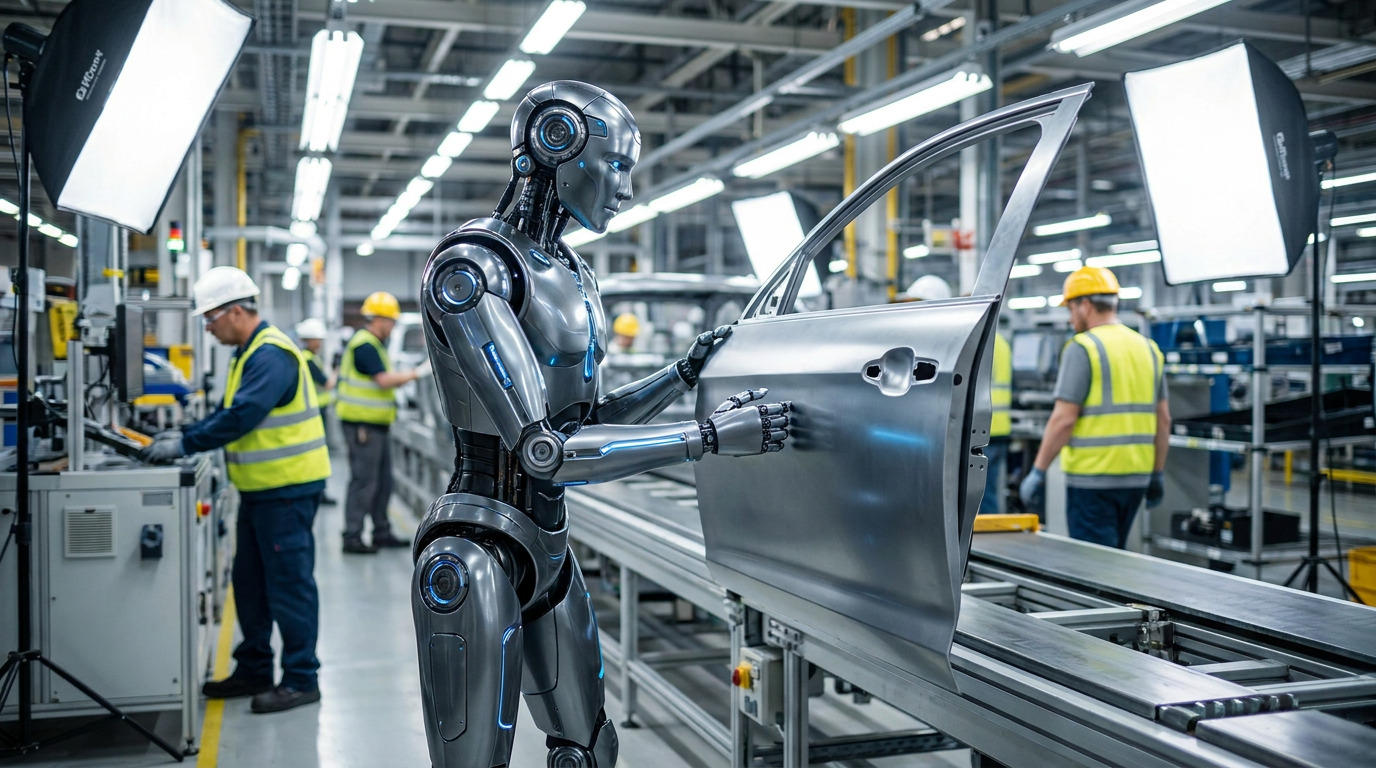
For decades, humanoid robots were confined to research laboratories and carefully choreographed demonstration videos. They performed backflips, danced to popular music, and occasionally stumbled over obstacles, serving more as engineering curiosities than practical tools. But in the first half of 2026, the robotics industry crossed an irreversible threshold. Humanoid machines have officially moved out of the lab and onto live, high-volume manufacturing floors. Across the United States and Europe, bipedal robots are now working alongside human employees, handling sheet metal, routing cables, and inspecting automotive parts. This transition marks the beginning of a new era in industrial automation, driven not just by stronger motors or better batteries, but by a fundamental breakthrough in artificial intelligence.[1][7]
The scale of these early deployments is unprecedented. At Tesla's Fremont factory in California, over 1,000 Optimus Gen 3 robots are currently operating on the live production line. According to company confirmations in early 2026, these units are not sequestered in demonstration cells; they are actively building the electric vehicles that Tesla ships to customers. They sort battery cells, handle parts between stations, and perform kitting operations. This represents the largest single deployment of humanoid robots in manufacturing history, serving as a massive data-collection engine to refine the robots' capabilities.[4][5]
Meanwhile, in Spartanburg, South Carolina, BMW has integrated Figure AI's humanoid robots into its sprawling automotive plant. Following a commercial agreement signed in 2024, Figure 01 and its successor, Figure 02, have been tasked with inserting sheet metal parts into fixtures and transporting materials across the body shop. These are repetitive, ergonomically challenging jobs that have historically led to human strain and injury. By deploying humanoids, BMW aims to maintain high production rates while shifting human workers to more complex, cognitive tasks.[3][7]
Not to be outdone, Boston Dynamics—long considered the pioneer of bipedal robotics—unveiled the fully electric, production-ready version of its Atlas robot in January 2026. Retiring its famous hydraulic predecessor, the new enterprise-grade Atlas is designed specifically for industrial environments. All of the company's 2026 deployments are already fully committed, with fleets shipping to Hyundai's Robotics Metaplant Application Center and Google DeepMind. The electric Atlas features 56 degrees of freedom and a 110-pound payload capacity, allowing it to lift heavy automotive components and autonomously swap its own batteries to work continuous shifts.[1][2]

What catalyzed this sudden leap from prototype to production? The hardware—actuators, sensors, and battery density—has been steadily improving for years, but the true bottleneck was always the software. Until recently, robots required explicit, hardcoded programming for every specific movement. If a part was shifted by a single centimeter, or the lighting changed, a traditional robot would fail to complete its objective. The breakthrough that unlocked the 2026 factory deployments is the widespread commercial adoption of Vision-Language-Action (VLA) models, which finally bridge the gap between perception and physical execution.[6][7]
A Vision-Language-Action model is a unified artificial intelligence architecture that allows a robot to understand its environment, process natural language instructions, and translate both into physical movement. Instead of relying on rigid code, a VLA model maps pixels directly to actions. When a factory manager tells a robot to pick up a misplaced bracket and put it in a blue bin, the robot's cameras capture the scene, the language model interprets the command, and the action decoder generates the precise motor torques required to execute the task.[6][8]
This end-to-end autonomy represents a paradigm shift in robotics. In 2024, VLA models were primarily research artifacts that were too slow and computationally heavy for real-world use. But by early 2026, inference optimization allowed quantized VLA models to run at 10 to 25 hertz on consumer-grade graphics processing units. This means the robot's computational core can process visual data and adjust its physical grip dozens of times per second, enabling the real-time, fluid manipulation required to handle unpredictable factory environments.[6]
This end-to-end autonomy represents a paradigm shift in robotics.
To train these VLA models, robotics companies rely on massive data collection campaigns. The process often begins with teleoperation, where human operators wear virtual reality headsets and haptic gloves to remotely control the robot through a task. As the human successfully inserts a piece of sheet metal or routes a wire, the robot records the visual feed, the force feedback, and the corresponding joint movements. This high-fidelity, force-aware data is then fed into the neural network, teaching the robot how to perform the task autonomously through imitation learning.[3][7][8]

Simulation also plays a critical role in accelerating this learning curve. Platforms like NVIDIA's Isaac Sim allow companies to train their VLA models in physically accurate virtual factories. A robot can practice picking up a battery cell millions of times in simulation, encountering thousands of variations in lighting, orientation, and friction. Once the model masters the task virtually, the neural network weights are transferred to the physical robot on the factory floor—a process known as sim-to-real transfer.[3][8]
The physical design of these new humanoids has also evolved to match their advanced software. The industry has decisively shifted away from hydraulic systems, which were prone to fluid leaks and required extensive maintenance. The 2026 generation relies entirely on custom electric actuators, utilizing technologies like planetary roller screws to match the force density of hydraulics while operating quietly and cleanly. This makes them safe and suitable for deployment alongside human workers in standard manufacturing facilities.[2][5]
Dexterous manipulation remains one of the hardest challenges in robotics, but significant strides have been made. Tesla's Optimus Gen 3 features tactile hands with 22 degrees of freedom, equipped with sensors that can detect minute changes in pressure. Figure's robots utilize similarly advanced hands capable of sensing forces as light as three grams. This tactile feedback is essential for tasks that require a delicate touch, such as seating electrical connectors or handling fragile components without crushing them.[5][7]
The economic implications of this technological leap are profound. Traditional industrial automation requires redesigning the entire factory floor—installing safety cages, custom conveyors, and specialized robotic arms. Humanoid robots, by contrast, are designed to operate in spaces built for humans. They can walk up stairs, navigate narrow aisles, and use the same tools as their human counterparts. This flexibility drastically lowers the integration cost for manufacturers, allowing them to deploy automation without halting production to rebuild their facilities.[2][4]

Cost curves are also falling rapidly. While early prototypes cost millions of dollars to develop, the target commercial price for mass-produced humanoids like Tesla's Optimus is between $20,000 and $30,000 per unit. At that price point, the return on investment for a manufacturer operating multiple shifts becomes highly compelling. To meet this anticipated demand, companies are investing heavily in dedicated manufacturing infrastructure. Figure AI has opened BotQ, a facility designed to produce 12,000 humanoids annually, while Tesla is constructing a massive expansion at Giga Texas with a long-term aspirational target of producing millions of units.[1][5][7]
Despite the rapid progress, significant uncertainties remain. Operating a robot for a tightly controlled demonstration is vastly different from running it for a 24/7 industrial shift. Reliability, battery degradation, and the ability to gracefully recover from unexpected errors are still active areas of engineering. Furthermore, regulatory frameworks for deploying autonomous, mobile robots in shared human workspaces are still being drafted. Safety certifications from agencies like OSHA will be critical hurdles before these machines can be sold broadly to third-party enterprises.[4][6]
The labor impact of this transition is the subject of intense debate. Manufacturers argue that humanoids are essential to address chronic labor shortages, particularly for physically punishing roles that suffer from high turnover. By automating the dull, dirty, and dangerous jobs, companies claim they can onshore production and create new, higher-paying roles in robot maintenance and fleet management. However, labor advocates warn that the rapid deployment of general-purpose robots could displace workers faster than they can be retrained, necessitating proactive workforce transition strategies.[3][7]

As 2026 unfolds, the trajectory is clear: the humanoid robot has transitioned from a science fiction concept to a commercial industrial product. With VLA models providing the cognitive architecture and scaled manufacturing driving down costs, these machines are poised to become a standard fixture on the global factory floor. The companies that successfully navigate the remaining reliability and regulatory challenges will not just sell robots; they will fundamentally redefine the economics of physical labor.[1][5][6]
How we got here
July 2013
Boston Dynamics unveils the first hydraulic Atlas robot, primarily designed for disaster response research.
August 2021
Tesla announces the Optimus program, signaling a major shift toward mass-manufactured, general-purpose humanoids.
January 2024
Figure AI signs a landmark commercial agreement to deploy its humanoid robots at BMW's Spartanburg facility.
January 2026
Boston Dynamics reveals its production-ready electric Atlas, while Tesla confirms over 1,000 Optimus units are operating at its Fremont plant.
Mid-2026
VLA models achieve widespread commercial adoption, enabling robots to perform real-time autonomous manipulation on factory floors.
Viewpoints in depth
Humanoid Developers
Companies building humanoids view them as the ultimate solution to scaling industrial output.
Firms like Tesla, Figure AI, and Boston Dynamics argue that general-purpose bipedal robots are the only logical way to automate environments originally built for humans. By leveraging VLA models, they believe they can bypass the rigid, brittle programming of traditional robotics, creating fleets that learn and adapt continuously. Their primary focus is driving down unit costs through mass manufacturing and achieving sufficient reliability to operate 24/7 without human intervention.
Automotive Manufacturers
Automotive giants see humanoids as a flexible, low-capex path to modernizing legacy factories.
For companies like BMW, Hyundai, and Mercedes-Benz, the appeal of humanoid robots lies in their drop-in compatibility. Instead of spending billions to redesign a factory floor with safety cages and fixed robotic arms, they can deploy humanoids into existing workstations. Automakers view these machines as a way to handle ergonomically punishing tasks—like heavy lifting and awkward insertions—thereby reducing workplace injuries and allowing human employees to focus on quality control and complex assembly.
Broader Automation Industry
Traditional robotics firms emphasize the software breakthrough over the bipedal form factor.
Veterans of the industrial automation space argue that the true revolution of 2026 is not the humanoid shape, but the Vision-Language-Action models powering them. Companies developing collaborative arms and mobile robots point out that VLA models can be deployed on wheeled or fixed platforms just as effectively, often with higher stability and lower maintenance costs. To this camp, the 'brain' mapping pixels to actions is the real product, while the bipedal body is just one of many possible vessels.
What we don't know
- How quickly regulatory bodies like OSHA will establish safety certification frameworks for autonomous humanoids in shared workspaces.
- The long-term maintenance costs and battery degradation rates of these robots when operating continuously over multi-year deployments.
- The exact timeline for when these companies will begin fulfilling orders for third-party enterprise customers at scale.
Key terms
- Vision-Language-Action (VLA) model
- An AI architecture that allows a robot to simultaneously process visual input, understand natural language commands, and translate them directly into physical movements.
- Teleoperation
- A training method where a human operator remotely controls a robot using VR and haptic feedback, generating data that the robot uses to learn the task.
- Degrees of Freedom (DoF)
- The number of independent joints or moving parts a robot has, which determines its flexibility and range of motion.
- Sim-to-real transfer
- The process of training an AI model in a virtual, simulated environment and then successfully deploying that learned behavior onto a physical robot.
- Quantization
- A technique used to compress AI models so they can run faster and more efficiently on local computer chips without losing significant accuracy.
Frequently asked
Are humanoid robots fully autonomous in these factories?
Yes, the latest generation uses Vision-Language-Action (VLA) models to process visual data and execute tasks autonomously, though they are initially trained using human teleoperation.
Why build robots in a human shape instead of traditional arms?
Humanoid robots can drop into existing factory floors designed for human workers, navigating stairs and narrow aisles without requiring expensive facility redesigns.
How much do these industrial humanoid robots cost?
While early prototypes were highly expensive, manufacturers are targeting a commercial price point between $20,000 and $30,000 per unit as mass production scales up.
What specific tasks are they performing today?
Current deployments focus on repetitive, ergonomically challenging tasks like sheet metal insertion, battery cell sorting, cable routing, and material transport.
Sources
Source coverage
8 outlets
3 viewpoints surfaced








[1]RoboZapsAutomotive Manufacturers
Boston Dynamics Unveils New Atlas Robot to Revolutionize Industry
Read on RoboZaps →[2]Boston DynamicsHumanoid Developers
Meet the new industrial revolution: Electric Atlas
Read on Boston Dynamics →[3]Humanoids DailyAutomotive Manufacturers
Figure Humanoids Begin Work on BMW Production Line in South Carolina
Read on Humanoids Daily →[4]OptimusK BlogHumanoid Developers
Tesla Optimus Production Timeline: 2025, 2026 & Beyond
Read on OptimusK Blog →[5]iFactoryHumanoid Developers
Tesla Optimus Gen 3 at Fremont: 1,000+ Units, Mass Production
Read on iFactory →[6]Robotics CenterBroader Automation Industry
From research curiosity to production infrastructure: VLA Models in 2026
Read on Robotics Center →[7]EVS IntHumanoid Developers
The top 8 humanoid robot companies to watch in 2026
Read on EVS Int →[8]Universal RobotsBroader Automation Industry
Teradyne Robotics unveils wide range of production-ready physical AI applications
Read on Universal Robots →

More in ai
See all 6 stories →Local AI
How Local LLMs Are Moving AI from the Cloud to Your Laptop
8 sources

On-Device AI
The Local AI Revolution: How to Run Powerful LLMs on Your Own Laptop
8 sources

Local AI
The 2026 Guide to Running AI Locally: Why Millions Are Taking Their Prompts Offline
7 sources

Medical AI
AI Reasoning Model Outperforms Human Physicians in Complex Diagnostic Tests
7 sources
Every angle. Every day.
Get ai stories with full source coverage and perspective breakdowns delivered to your inbox.