
How to Run AI Locally: The Rise of Private, On-Device LLMs
A new generation of highly compressed models and user-friendly tools is allowing everyday users to run powerful artificial intelligence entirely on their own laptops and smartphones.
By Factlen Editorial Team
- Privacy Advocates
- Argue that local AI is essential for protecting personal data from corporate surveillance.
- Open-Source Developers
- Focus on the democratization of artificial intelligence and community-driven innovation.
- Enterprise IT Leaders
- Prioritize cost reduction, regulatory compliance, and predictable performance.
What's not represented
- · Cloud AI Providers
- · Hardware Manufacturers
Why this matters
Running AI on your own hardware eliminates subscription fees, protects your private data from corporate servers, and allows powerful tools to work entirely offline. It transforms artificial intelligence from a metered web service into a permanent, private utility on your personal computer.
Key points
- Local AI allows users to run powerful language models directly on their own hardware without internet access.
- The shift to on-device inference eliminates recurring cloud API costs and network latency.
- Quantization techniques have compressed massive models to fit within standard consumer laptop memory.
- Tools like Ollama and LM Studio have reduced complex installation processes to a single click.
- Apple and Google are integrating local AI directly into their operating systems to protect user privacy.
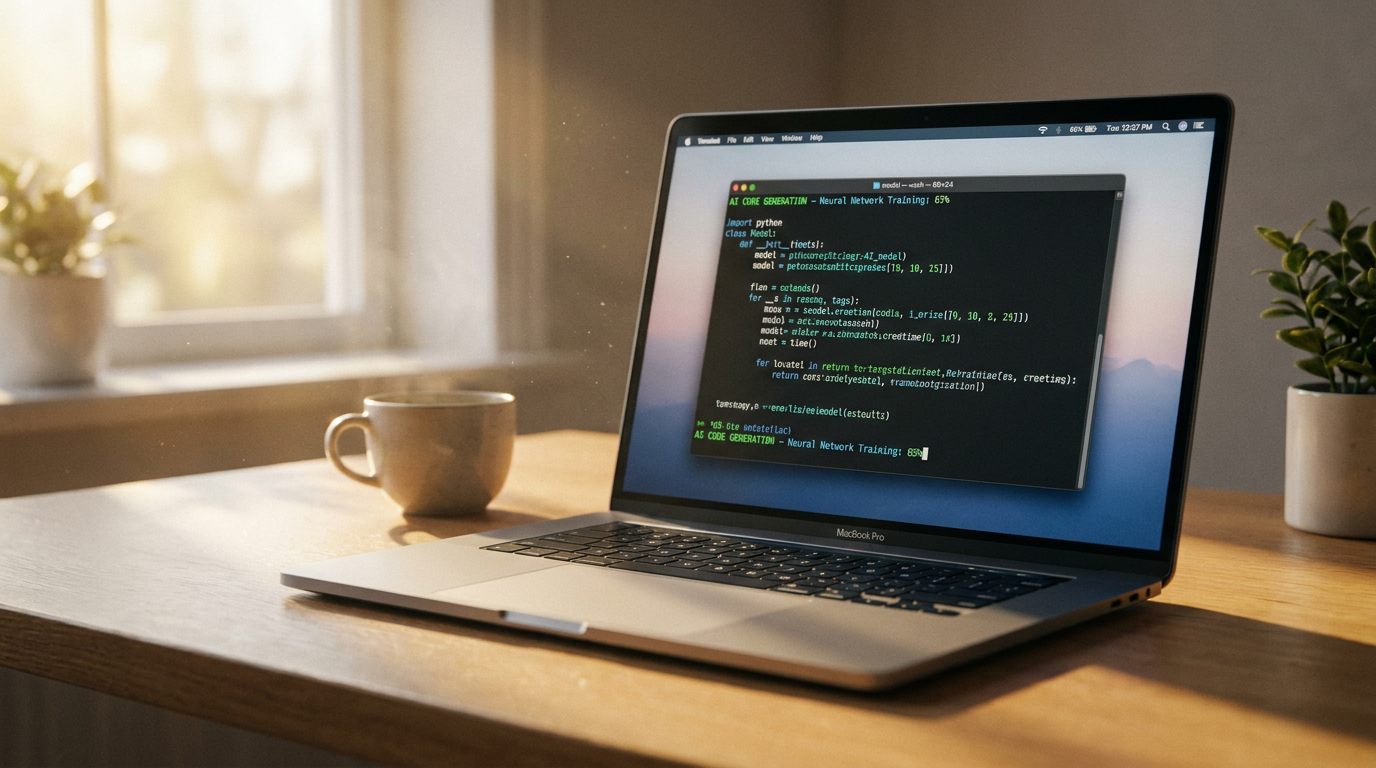
For the past three years, interacting with artificial intelligence meant sending your thoughts, code, and questions to a distant server. You typed a prompt, waited for the cloud to process it, and hoped your internet connection held up. The entire paradigm was built on the assumption that AI models were simply too massive and computationally demanding to run anywhere but inside a billion-dollar data center. But in 2026, a quiet revolution has completely inverted that model. Powerful language models are no longer confined to remote server farms; they are running directly on the laptops, smartphones, and workstations sitting on our desks, fundamentally changing who controls the intelligence engine.[1]
This shift toward 'local AI' or 'on-device inference' has crossed a critical threshold in the tech industry. According to recent industry data, 55% of enterprise AI inference now happens on-premises, representing a massive leap from just 12% in 2023. The appeal of this transition is simple but profound: running an AI model locally means zero recurring subscription fees, zero network latency, and absolute data privacy. Organizations and individuals alike are realizing that they do not need to rent intelligence by the query when they can own the infrastructure outright.[2]
The primary driving force behind this rapid migration is data sovereignty. When an artificial intelligence model runs entirely on your own hardware, your prompts, documents, and outputs never leave your machine. There are no API calls to intercept over the network, no third-party data processing agreements to negotiate, and no lingering risk of a corporation using your private conversations to train its next generation of models. For heavily regulated industries like healthcare, finance, and defense, this localized architecture instantly solves complex compliance hurdles, allowing them to deploy AI without violating strict data residency laws.[2][3]

Beyond the obvious privacy benefits, local AI fundamentally changes the user experience by completely eliminating network latency. Cloud-based APIs typically add 200 to 800 milliseconds of delay before the first word of a response appears on the screen. By processing the request locally on the device's own silicon, that delay drops to near zero. This makes real-time applications—like voice assistants, live code completion, and augmented reality overlays—feel instantaneous and fluid, transforming the interaction from a sluggish web query into a seamless conversational experience.[3]
Running models locally also severs the tether to the internet, unlocking entirely new use cases. Cloud-based AI is effectively useless on an airplane, in a remote field location, or during a widespread network outage. On-device models, however, are fully self-contained and always available. A software developer can generate complex code while entirely offline, and a field worker can query massive technical manuals in a cellular dead zone. This shift transforms artificial intelligence from a fragile web service into a reliable, always-available utility that works wherever the user goes.[3]
Making this offline reality possible required a major breakthrough in how AI models are packaged and deployed. Large language models are notoriously memory-hungry, but a mathematical technique called 'quantization' has completely changed the hardware requirements. By compressing the mathematical weights of a neural network from high-precision floating-point formats down to 4-bit or 8-bit integers, developers can shrink a massive model to a fraction of its original file size. Crucially, this dramatic reduction in memory footprint comes with only a minimal loss in the model's actual reasoning capability.[1]

This aggressive compression means that highly capable, frontier-level models can now fit comfortably into the memory of standard consumer hardware. Google's recently released Gemma 4, for instance, offers a highly capable 12-billion parameter model that runs smoothly in just 16 gigabytes of RAM. Similarly, Meta's open-source Llama 3 and Llama 4 families have been heavily optimized by the community to punch well above their weight class, delivering performance that rivals major cloud providers directly on everyday laptops and desktop computers.[2][5]
This aggressive compression means that highly capable, frontier-level models can now fit comfortably into the memory of standard consumer hardware.
Hardware manufacturers have met this software efficiency halfway, designing chips specifically for local AI workloads. Apple's transition to Apple Silicon—spanning the M1 through M4 chips—introduced a 'unified memory' architecture, allowing the CPU and GPU to share a massive pool of high-speed RAM. This gives Mac users an outsized advantage for running large models without needing expensive, specialized graphics cards. On the PC side, NVIDIA's consumer GPUs, particularly those equipped with 16GB to 24GB of VRAM, have become the gold standard for high-speed local inference.[2][6]
But the true catalyst for the local AI boom has been the dramatic simplification of software tooling. Just a few years ago, running a model locally required navigating complex Python environments, managing fragile driver dependencies, and compiling code from scratch. Today, tools like Ollama have reduced the entire setup process to a single terminal command. By simply typing a command like `ollama run llama3`, a user can download, install, and start chatting with a world-class language model in under five minutes, completely removing the technical barrier to entry.[2][4][5]

Ollama operates as a lightweight, developer-first engine that runs quietly in the background, exposing an OpenAI-compatible API to the rest of the system. This architectural choice is brilliant: it means that any application, plugin, or script built to talk to ChatGPT can be effortlessly redirected to talk to a local Ollama instance with zero code changes. As a result, Ollama has become the invisible backbone powering hundreds of local AI applications, coding assistants, and automation scripts across the developer ecosystem.[2][4]
For users who prefer a visual interface over the command line, applications like LM Studio have democratized access even further. LM Studio functions much like a desktop app store for artificial intelligence: users can browse a visual library of models, download them with a single click, and chat with them in a familiar, user-friendly window. The software automatically detects the user's hardware capabilities and optimizes the model settings under the hood, making local AI accessible to non-programmers, writers, and researchers.[4]
The ecosystem of available models has exploded to match this accessible tooling. While general-purpose models like Llama and Mistral handle everyday reasoning and writing tasks, specialized models are increasingly dominating niche workflows. Qwen2.5-Coder and DeepSeek Coder V2, for example, have emerged as incredibly powerful local coding assistants. These highly tuned models allow software engineers to generate, debug, and refactor complex codebases entirely offline, offering a level of privacy and speed that cloud-based coding assistants simply cannot match in enterprise environments.[5][6]

This local-first philosophy is now being baked directly into the core of our operating systems. Apple's deep integration of Foundation Models into iOS and macOS allows the operating system to handle text generation, image understanding, and tool calling natively. If a user's request is small enough, it runs instantly on the device's neural engine; if it requires more heavy lifting, it securely routes to Apple's Private Cloud Compute. Android has followed a similar architectural path with its AICore and highly efficient Gemini Nano models.[7][8]
This OS-level integration introduces a completely new paradigm for digital privacy. As industry experts note, when an AI assistant can access your private emails, calendar events, and live screen context, privacy is no longer just about where the computation happens—it is about how the operating system bounds the AI's authority. By keeping the primary inference engine local, Apple and Google are attempting to build a secure, verifiable perimeter around the user's most intimate data, ensuring that context is never needlessly broadcast to the web.[7][8]
Ultimately, we are entering an era where artificial intelligence is treated less like a distant search engine and more like a core component of our personal computing infrastructure. By moving inference to the edge, developers and everyday users are reclaiming ownership of their data, eliminating recurring subscription costs, and building systems that are faster, more private, and infinitely more resilient. The future of AI is not just in the cloud; it is running quietly and securely on the device in your hands.[1]
How we got here
2023
Local AI remains a niche hobby requiring complex Python environments and massive hardware.
2024
Tools like Ollama and LM Studio launch, simplifying installation to a single click or command.
2025
Apple and Google begin integrating small local models directly into iOS and Android operating systems.
2026
Over half of enterprise AI inference shifts to on-premises, driven by privacy needs and highly capable models.
Viewpoints in depth
Privacy Advocates
Argue that local AI is essential for protecting personal data from corporate surveillance.
Privacy advocates emphasize data sovereignty. They argue that as AI becomes more deeply integrated into daily life—reading our emails, summarizing our meetings, and analyzing our photos—sending that context to cloud providers is an unacceptable risk. Local AI ensures that sensitive information never leaves the device, fundamentally changing the power dynamic between users and tech conglomerates.
Open-Source Developers
Focus on the democratization of artificial intelligence and community-driven innovation.
This camp believes that artificial intelligence is too important to be controlled by a few massive tech companies. By building accessible tools like Ollama and LM Studio, and by openly sharing model weights, open-source developers are empowering individuals to own and run their own intelligence engines. They view local AI as a safeguard against vendor lock-in and censorship.
Enterprise IT Leaders
Prioritize cost reduction, regulatory compliance, and predictable performance.
For enterprise leaders, cloud AI APIs represent an unpredictable, metered expense that complicates regulatory compliance. Local AI offers a fixed hardware cost and guarantees that sensitive corporate data remains within the company firewall. By shifting inference on-premises, they can deploy AI across their organizations without running afoul of strict data residency laws like HIPAA or the EU AI Act.
What we don't know
- Whether local hardware advancements can keep pace with the rapidly growing size of frontier AI models.
- How cloud providers will adjust their pricing models to compete with the rise of free, localized inference.
Key terms
- Local LLM
- A large language model that runs entirely on a user's own hardware rather than on a remote cloud server.
- Quantization
- A compression technique that reduces the memory footprint of an AI model, allowing massive models to run on consumer laptops.
- VRAM
- Video RAM, the dedicated memory on a graphics card used to load and run AI models quickly.
- GGUF
- A file format optimized for running language models efficiently on everyday CPUs and Apple Silicon.
Frequently asked
Do I need an expensive graphics card to run local AI?
Not necessarily. While dedicated GPUs offer the fastest speeds, modern Apple Silicon (M1-M4) and standard CPUs can run quantized models efficiently.
Is my data safe when using local AI tools?
Yes. Because the model runs entirely on your device, your prompts and documents never leave your machine or get sent to a third-party server.
Can local models code as well as cloud models?
Yes. Specialized local models like Qwen2.5-Coder and DeepSeek Coder V2 offer coding capabilities that rival major cloud providers, entirely offline.
Sources
Source coverage
8 outlets
3 viewpoints surfaced








[1]Factlen Editorial TeamEnterprise IT Leaders
Synthesis by Factlen editorial team
Read on Factlen Editorial Team →[2]TechsyEnterprise IT Leaders
Run LLMs Locally 2026: The 5-Minute Setup for Any GPU
Read on Techsy →[3]AIMagicXPrivacy Advocates
On-Device AI Is Having Its Moment
Read on AIMagicX →[4]Prompt QuorumOpen-Source Developers
Ollama vs LM Studio 2026: CLI vs GUI — Speed, API, Privacy & Setup Compared
Read on Prompt Quorum →[5]PinggyOpen-Source Developers
Top 5 Local LLM Tools in 2026
Read on Pinggy →[6]WhatLLMOpen-Source Developers
Best Local LLMs and Hardware Guide 2026
Read on WhatLLM →[7]RunAnywherePrivacy Advocates
On-device LLM Platform Features in 2026
Read on RunAnywhere →[8]CallstackPrivacy Advocates
Apple Foundation Models and React Native in 2026
Read on Callstack →


Every angle. Every day.
Get ai stories with full source coverage and perspective breakdowns delivered to your inbox.