
2026 Rivian R2 vs. Tesla Model Y: The Definitive Electric SUV Comparison
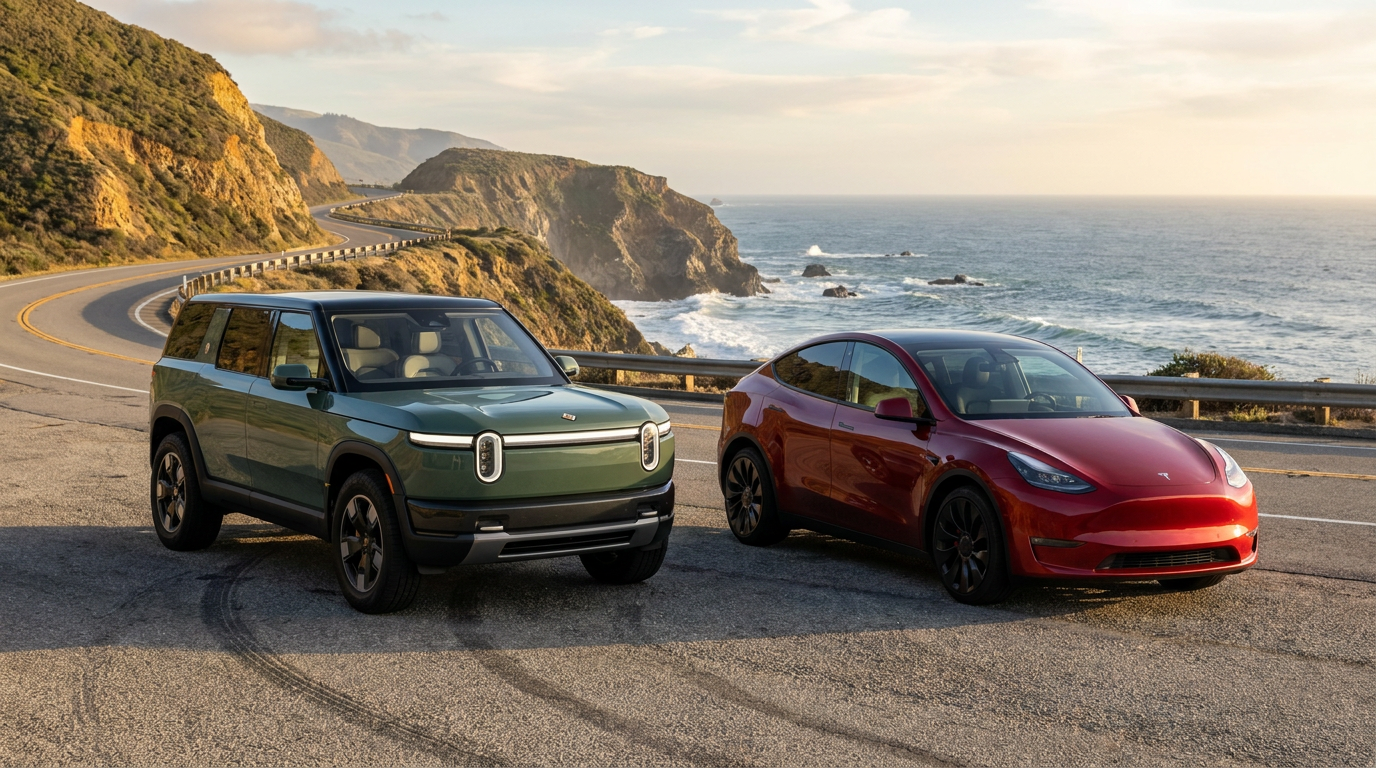
Rivian's highly anticipated R2 arrives to challenge the newly refreshed Tesla Model Y 'Juniper,' offering a rugged, boxy alternative to the world's best-selling aerodynamic crossover.
By Factlen Editorial Team
- Efficiency & Value Buyers
- Focus on the lowest cost of entry, maximum highway range, and proven charging speeds.
- Adventure & Utility Seekers
- Prioritize off-road capability, boxy aesthetics, and maximum cargo volume.
- Tech & Spec Analysts
- Evaluate the vehicles purely on dimensional data, horsepower-per-dollar, and software features.
What's not represented
- · Long-term Reliability Analysts
- · Traditional Dealership Advocates
Why this matters
The midsize electric SUV segment is the most fiercely contested battleground in the automotive industry. Choosing between the Model Y and the R2 dictates not just how much you spend, but whether your daily driver is optimized for highway efficiency or weekend wilderness adventures.
Key points
- The 2026 Tesla Model Y holds a significant entry-level price advantage, starting around $39,990.
- Rivian's R2 Performance trim launches at $57,990, aligning closely with the Model Y Performance.
- The Model Y excels in aerodynamic efficiency, offering up to 357 miles of range.
- The Rivian R2 dominates in utility, featuring 9.6 inches of ground clearance and 90.1 cubic feet of cargo space.
- Both vehicles utilize native NACS ports, granting seamless access to the Tesla Supercharger network.
The midsize electric SUV market has a new heavyweight title fight. For years, the Tesla Model Y has dominated global sales, serving as the default choice for buyers seeking a practical, high-tech EV. But in 2026, the landscape shifts dramatically with the arrival of the Rivian R2. Designed to distill Rivian’s rugged, outdoor-focused brand into a smaller, more accessible package, the R2 is launching directly into the crosshairs of Tesla’s newly refreshed 'Juniper' Model Y.[3][4]
This is not merely a competition of brand loyalty; it is a clash of fundamental automotive philosophies. Tesla has doubled down on aerodynamic efficiency, on-road driving dynamics, and minimalist tech. Rivian, conversely, has prioritized boxy utility, genuine off-road geometry, and a more traditional, luxurious cabin. For buyers navigating the 2026 EV market, choosing between the two requires a careful side-by-side analysis of trade-offs, pricing, and daily utility.[2][3]
The case for the Tesla Model Y begins at the bottom line. In 2026, Tesla holds a massive advantage in entry-level affordability. The base rear-wheel-drive Model Y starts around $39,990, making it immediately accessible to mainstream crossover buyers. The evidence against the Rivian R2 in this category is simple availability: while Rivian plans to release Standard and Premium trims priced around $45,000, those models will not arrive until 2027. For a buyer shopping strictly under $50,000 today, the Model Y is the undisputed winner by default.[3][6]

However, at the top of the lineup, the pricing gap vanishes, setting up a true head-to-head comparison. The launch-edition Rivian R2 Performance trim hits the market at $57,990. This lines up almost exactly with the 2026 Tesla Model Y Performance, which commands roughly $57,490 to $59,630 depending on options. At this $58,000 price point, buyers are forced to choose between Tesla’s blistering street performance and Rivian’s go-anywhere capability.[1][3][4]
Beyond price, the Model Y’s strongest argument is its relentless optimization for the road. Tesla’s teardrop silhouette is designed to slip through the air, maximizing every kilowatt-hour of battery life. The 2026 'Juniper' refresh enhances this with frequency selective dampers that smooth out the ride, and double-laminated glass that dramatically reduces cabin noise. It is engineered to be the ultimate highway cruiser and suburban commuter.[1]
The empirical evidence heavily favors the Model Y in efficiency and straight-line speed. The Premium RWD trim can achieve an EPA-estimated 357 miles of range, edging out the R2’s maximum estimates. In the Performance trim, the Model Y utilizes a 510-horsepower dual-motor setup to sprint from 0 to 60 mph in just 3.3 seconds. It also charges slightly faster, capable of pulling 250 kW from a DC fast charger, compared to the R2’s 230 kW maximum.[1][6]
The primary argument against the Tesla Model Y is that its aerodynamic efficiency requires a compromise in utility and distinctiveness. The sloped roofline cuts into rear cargo height, and its 6.0 inches of ground clearance makes it strictly a pavement-and-gravel vehicle. Inside, the hyper-minimalist cabin lacks a dedicated driver’s gauge cluster, forcing the driver to look at the central 15.4-inch screen for speed and range—a persistent pain point for traditionalists.[1][2][6]
The primary argument against the Tesla Model Y is that its aerodynamic efficiency requires a compromise in utility and distinctiveness.
Conversely, the case for the Rivian R2 centers entirely on versatility and character. The R2 rejects the aerodynamic jellybean shape in favor of a classic, upright SUV profile. It is designed for buyers who want an electric vehicle that can comfortably handle rutted forest service roads, deep snow, and weekend camping trips without scraping its underbelly. It also features a more conventional, luxurious interior with open-pore wood and a dedicated 12.3-inch digital gauge cluster behind the steering wheel.[2][4][6]
The dimensional data proves the R2’s utility dominance. It boasts 9.6 inches of ground clearance—60 percent more than the Model Y—along with a 25-degree approach angle and 32-inch tires. Despite being slightly shorter in overall length, the R2’s boxy shape yields 90.1 cubic feet of total cargo volume with the seats folded, crushing the Model Y’s 76 cubic feet. The R2 also features a larger 5.2-cubic-foot front trunk and a power-rolling rear window that allows for hauling long items like surfboards.[2][5][7]

The evidence against the R2 is rooted in physics. The boxy design and heavy-duty suspension make the R2 roughly 370 pounds heavier than the Model Y. While Rivian’s engineering is impressive—the R2 Performance still manages 330 miles of range and a 3.6-second 0-60 mph time via its 656-horsepower setup—it requires a larger battery to achieve those numbers, making it inherently less efficient than the Tesla.[2][4][5]
Historically, comparing any EV to a Tesla required a massive asterisk regarding charging infrastructure. In 2026, that asterisk is gone. The Rivian R2 is equipped with a native NACS port right from the factory. This means R2 owners can pull up to any compatible Tesla Supercharger and plug in without fumbling for an adapter, effectively neutralizing Tesla’s biggest historical moat.[3][6]

Ultimately, the Tesla Model Y fits well when a buyer prioritizes maximum highway range, immediate affordability, and sports-sedan handling. It fits perfectly for the suburban family that commutes daily, takes long interstate road trips, and has no intention of driving over anything rougher than a dirt driveway. Its lower starting price in 2026 makes it the undisputed value champion.[1][3]
Conversely, the Tesla does not fit when a buyer needs genuine off-road capability, regularly hauls bulky, square-shaped cargo, or simply cannot adjust to the stark, screen-only minimalist interior. It is also not the right fit for buyers who want to stand out in a parking lot, as the Model Y remains one of the most ubiquitous vehicles on the road.[2][6]
On the other side of the aisle, the Rivian R2 fits well when a buyer wants the rugged aesthetic and trail capability of a traditional SUV, paired with modern EV performance. It fits perfectly for outdoor enthusiasts who need high ground clearance, massive interior cargo volume, and clever utility features like the roll-down rear window. It also appeals strongly to buyers who prefer a luxurious cabin with a dedicated driver display.[2][4]

However, the R2 does not fit if the buyer’s budget is strictly capped under $50,000 in 2026, as the more affordable trims are delayed until 2027. It also does not fit the hyper-commuter who wants the absolute lowest energy consumption per mile, as pushing a tall, boxy, 9.6-inch-clearance vehicle through the air will always require more electricity than a sleek teardrop crossover.[2][3]
How we got here
March 2024
Rivian officially unveils the R2, promising a smaller, more affordable alternative to its flagship R1S.
Late 2025
Tesla introduces the heavily updated 'Juniper' refresh for the Model Y, featuring improved suspension and a quieter cabin.
Spring 2026
The first Rivian R2 Performance models begin delivering to customers, going head-to-head with the Model Y.
2027
Rivian plans to release the lower-priced Standard and Premium trims of the R2 to compete with Tesla's entry-level models.
Viewpoints in depth
Efficiency & Aerodynamics Advocates
Prioritize maximum range, low drag coefficients, and on-road performance.
This camp views the Tesla Model Y as the undisputed champion of electric vehicle engineering. They point to the Model Y's sleek, teardrop shape and lighter curb weight as the ultimate expression of EV efficiency. For these buyers, the fact that the Model Y Premium RWD can squeeze 357 miles of range out of its battery pack while maintaining sports-car-like acceleration proves that aerodynamic design should not be compromised for a traditional SUV aesthetic.
Outdoor & Utility Enthusiasts
Value ground clearance, cargo flexibility, and off-road capability over pure highway range.
For this group, an SUV must actually be a utility vehicle. They argue that the Rivian R2's 9.6 inches of ground clearance, 32-inch tires, and 25-degree approach angle make it a genuine adventure vehicle, whereas the Model Y is essentially a tall hatchback. They are willing to trade a slight drop in aerodynamic efficiency for the R2's massive 90.1 cubic feet of cargo space, power-rolling rear window, and the ability to comfortably navigate rutted trails and campsites.
What we don't know
- The exact real-world highway range degradation for the Rivian R2 when fully loaded with outdoor gear.
- How Rivian's long-term reliability and service network will compare to Tesla's established infrastructure as the R2 scales to mass production.
Key terms
- NACS
- North American Charging Standard, the charging plug design originally developed by Tesla that has now been adopted by most major automakers, including Rivian.
- Frunk
- A front trunk; an enclosed storage compartment located under the hood of an electric vehicle where an internal combustion engine would traditionally sit.
- MPGe
- Miles Per Gallon Equivalent, a metric used by the EPA to compare the energy efficiency of electric vehicles to traditional gas-powered cars.
Frequently asked
Does the Rivian R2 have access to Tesla Superchargers?
Yes. The 2026 Rivian R2 comes equipped with a native NACS (North American Charging Standard) port, allowing it to plug directly into Tesla Superchargers without needing an adapter.
Which vehicle is faster from 0 to 60 mph?
The Tesla Model Y Performance is slightly quicker, hitting 60 mph in 3.3 seconds, compared to the Rivian R2 Performance's 3.6 seconds.
When will the cheaper Rivian R2 models be available?
While the $57,990 R2 Performance trim launches in 2026, the more affordable Premium and Standard trims (starting around $45,000) are slated to arrive in 2027.
Sources
Source coverage
7 outlets
3 viewpoints surfaced







[1]Car and DriverEfficiency & Value Buyers
2026 Tesla Model Y Review, Pricing, and Specs
Read on Car and Driver →[2]ElectrekTech & Spec Analysts
Rivian R2 vs. Tesla Model Y: A dimension-by-dimension breakdown
Read on Electrek →[3]Road EthosTech & Spec Analysts
Rivian R2 Vs. Tesla Model Y: An Honest Comparison For 2026 Buyers
Read on Road Ethos →[4]Top GearAdventure & Utility Seekers
Rivian R2 (US) review
Read on Top Gear →[5]CarBuzzAdventure & Utility Seekers
Here's Every Way The Rivian R2 Is Ready To Beat The Model Y
Read on CarBuzz →[6]EdmundsEfficiency & Value Buyers
2026 Rivian R2 Review
Read on Edmunds →[7]Rivian OfficialAdventure & Utility Seekers
R2: Extra elevated, inside and out
Read on Rivian Official →
More in automotive
See all 5 stories →
Every angle. Every day.
Get automotive stories with full source coverage and perspective breakdowns delivered to your inbox.