
The Math Breaking Fossil Fuels: How Wright’s Law Made Solar and Batteries Unbeatable
Decades of data confirm that solar power and battery storage follow a predictable, exponential curve of cost decline. As battery prices plummeted another 45% last year, the economic case for fossil fuels has largely collapsed.
By Factlen Editorial Team
- Energy Economists
- Argues that the energy transition is now an unstoppable economic force driven by the compounding math of industrial learning curves.
- Grid Operators & Planners
- Focuses on the physical realities of the transition, emphasizing that cheap panels are useless without massive investments in transmission lines and storage.
- Clean Tech Analysts
- Highlights the rapid technological shifts, such as LFP battery chemistry, that are actively solving the intermittency problem faster than predicted.
What's not represented
- · Local communities facing land-use conflicts for mega-solar projects
- · Mining communities supplying raw materials for batteries
Why this matters
Understanding the economic math behind renewable energy reveals that the transition away from fossil fuels is no longer reliant on government subsidies or climate policy. It is now an unstoppable market force that will fundamentally lower the cost of global energy.
Key points
- Solar power and battery storage follow Wright's Law, meaning costs drop predictably as production scales.
- Solar module prices have plummeted by 99.6% since 1976, making it the cheapest electricity in history.
- Utility-scale battery costs dropped an astonishing 45% in 2025, solving the grid's intermittency problem.
- Over 90% of newly installed renewable energy capacity globally is now cheaper than fossil fuel alternatives.
- While hardware costs continue to fall, grid bottlenecks and balance-of-system costs remain key challenges.
The global transition away from fossil fuels is often framed as a political struggle, driven by climate treaties, government mandates, and environmental activism. But the underlying data reveals a much more pragmatic reality: the transition is now primarily an economic inevitability driven by a mathematical principle known as Wright's Law.[7]
First observed in 1936 by aeronautical engineer Theodore Wright, the law states that for certain manufactured goods, every doubling of cumulative production results in a consistent percentage decline in cost. Wright originally noticed this phenomenon while studying the manufacturing of airplanes, realizing that experience directly fed innovation.[2]
While the prices of coal and natural gas fluctuate based on extraction costs, finite supply, and geopolitics, solar panels and batteries are fundamentally different. They are manufactured technologies. The more we build, the better we get at building them, creating a virtuous cycle of falling prices and rising demand.[2][7]
The evidence that solar power has followed a strict, exponential learning curve for decades is exceptionally strong, making it the cheapest electricity in history. According to historical data compiled by Our World in Data, solar photovoltaic (PV) modules have maintained a "learning rate" of approximately 20%.[2]

This means that every time the world's total installed solar capacity doubles, the cost of the hardware drops by a fifth. Because the growth in deployment has been exponential, the price drops have been equally dramatic.[2][5]
The cumulative effect of this compounding math is staggering. In 1976, solar modules cost over $100 per watt, adjusted for inflation, restricting their use mostly to niche applications like satellites. By the end of 2025, that price had plummeted by more than 99.6%, making solar the cheapest form of bulk electricity generation in most of the world.[2][5]
The International Energy Agency (IEA) confirmed the real-world impact of this cost collapse in its 2026 reports, noting that solar PV was the single largest contributor to global energy supply growth in 2025.[1][3]
It marked the first time on record that a renewable source led global primary energy supply growth. The world added an unprecedented 600 terawatt-hours of solar generation in a single year, directly contributing to a measurable decline in global coal-fired electricity generation.[3]
It marked the first time on record that a renewable source led global primary energy supply growth.
For years, however, the primary argument against renewable energy was its intermittency: the sun sets, and the wind stops blowing. The proposed solution—utility-scale battery storage—was long considered too expensive for widespread grid use, leaving systems reliant on natural gas peaker plants.[7]
Recent data provides robust evidence that battery storage is now following the exact same exponential curve as solar, effectively solving the grid's intermittency problem. The IEA reports that battery storage was the fastest-growing power sector technology in 2025.[3][6]
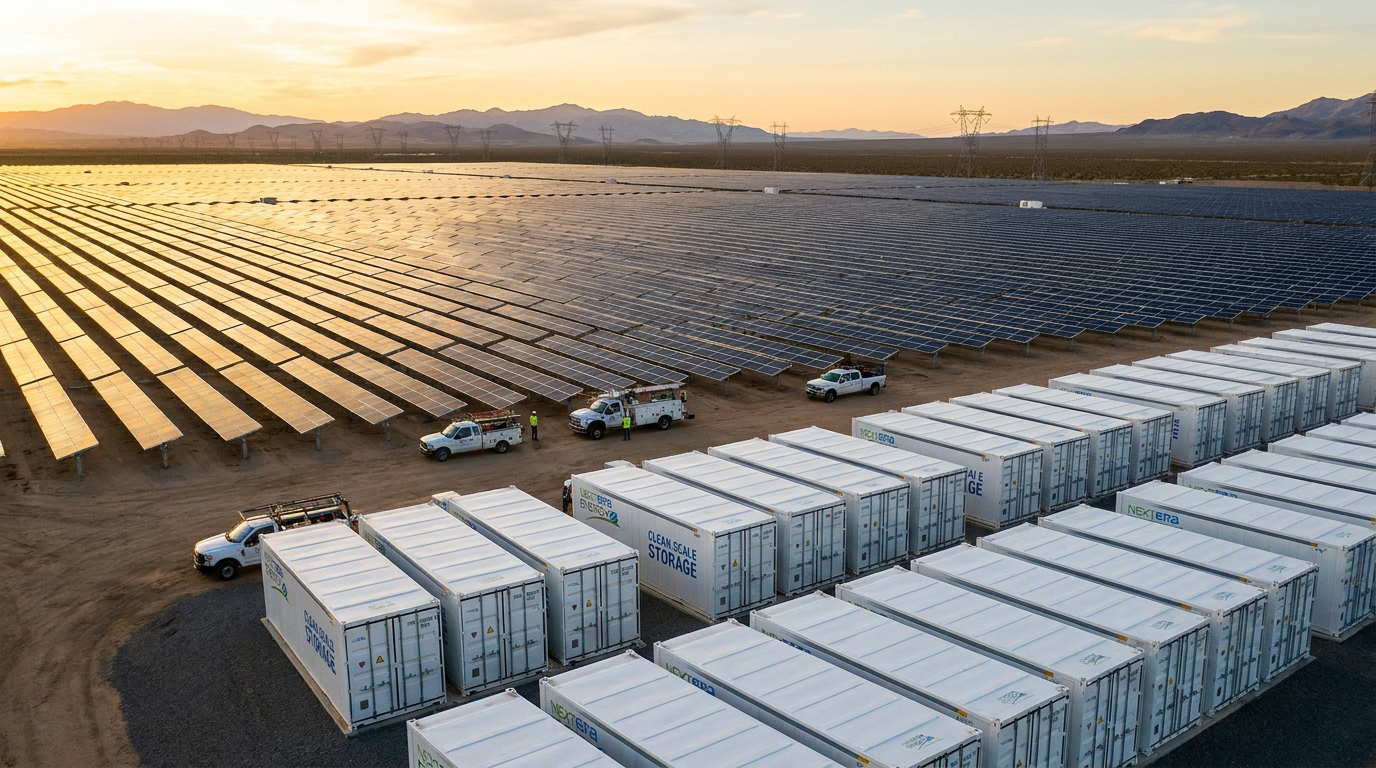
The world added roughly 110 gigawatts (GW) of new battery capacity in a single year. To put that scale into perspective, that single-year addition of battery storage exceeded the largest-ever annual capacity additions for natural gas.[3]

This explosion in deployment is directly tied to plummeting costs. According to energy think tank Ember and the IEA, utility-scale battery costs dropped by 20% in 2024 and plunged an astonishing 45% in 2025.[1][3]
The shift was largely driven by the mass adoption of Lithium Iron Phosphate (LFP) chemistries. By eliminating the need for expensive and ethically fraught metals like cobalt and nickel, LFP batteries became more than 40% cheaper than alternative chemistries, quickly growing to account for over 90% of global battery energy storage systems.[1]
Because of these twin learning curves, the market has already tipped, making new fossil fuel generation economically unviable in most regions. Data from the Rocky Mountain Institute (RMI) shows that by 2024, more than 90% of newly installed renewable energy capacity globally was cheaper than the fossil fuel alternative on a levelized cost basis.[4]

With natural gas prices facing volatility and renewable costs continuing their downward march, the combination of "solar-plus-storage" is now routinely beating gas peaker plants on price. Analysts note that this combination is enabling a paradigm shift from "daytime solar" to "anytime solar."[4][6]
Yet, an objective review of the evidence must also acknowledge the limits of Wright's Law. While the core hardware of the energy transition is undeniably getting cheaper, it is a mistake to assume that total project costs will fall to zero.[7]
The data suggests that "balance-of-system" costs—which include land acquisition, specialized labor, local permitting, and grid interconnection—do not follow Wright's Law. As the cost of solar panels and battery cells approaches a floor, these soft costs will inevitably make up the vast majority of a project's price tag.[7]

Furthermore, the IEA warns that physical grid bottlenecks remain a severe vulnerability. Generating cheap electricity is only useful if there are sufficient high-voltage transmission lines to carry it from remote solar farms to urban centers, and grid infrastructure is notoriously slow to build.[1][4]
Despite these friction points, the macroeconomic trend is locked in. The data from 2025 and 2026 confirms that the energy transition is no longer reliant on subsidies or goodwill. It is being propelled by the relentless, compounding force of industrial learning, fundamentally rewriting the economics of global power.[2][7]
How we got here
1936
Theodore Wright observes that airplane costs fall consistently as production scales, establishing Wright's Law.
1976
Solar photovoltaic modules cost over $100 per watt, restricting their use mostly to satellites.
2010
Lithium-ion battery packs cost over $1,200 per kilowatt-hour, making grid storage economically unviable.
2024
Over 90% of newly installed global renewable capacity becomes cheaper than fossil fuel alternatives.
2025
Battery storage becomes the fastest-growing power sector technology, adding roughly 110 GW globally.
Viewpoints in depth
The Economic Inevitability View
Focuses on how Wright's Law makes the decline of fossil fuels a mathematical certainty.
Energy economists and data analysts argue that the transition is no longer dependent on climate policy or carbon taxes. Because solar panels and batteries are manufactured technologies rather than extracted fuels, they benefit from 'learning by doing.' Every time global manufacturing capacity doubles, efficiencies are found, supply chains are optimized, and costs drop by a predictable percentage. This camp points to the 99.6% drop in solar costs as proof that fossil fuels, which do not follow learning curves, simply cannot compete in the long run.
The Infrastructure Reality View
Emphasizes that cheap hardware does not automatically equal a cheap or reliable power grid.
Grid operators and infrastructure planners caution against irrational exuberance. While they acknowledge the plummeting costs of solar modules and battery cells, they point out that 'balance-of-system' costs—such as land, labor, permitting, and high-voltage transmission lines—are not getting cheaper. This perspective argues that the next phase of the energy transition will be bottlenecked not by the cost of generation, but by the physical and regulatory challenges of building enough wires to move the power to where it is needed.
What we don't know
- Exactly when balance-of-system costs (labor, land, permitting) will completely stall the overall price decline of utility-scale projects.
- Whether the global supply chain can sustain the exponential growth required to fully replace fossil fuels by 2050 without hitting critical material shortages.
Key terms
- Wright's Law
- An economic principle stating that for certain technologies, every doubling of cumulative production leads to a consistent percentage decline in cost.
- Learning Rate
- The specific percentage by which a technology's cost drops for every doubling of its installed capacity.
- LFP (Lithium Iron Phosphate)
- A cheaper, cobalt-free battery chemistry that now dominates the global utility storage market.
- Balance-of-System Costs
- The expenses of a solar or battery project excluding the core hardware, such as land, labor, permitting, and grid connection.
Frequently asked
Why don't fossil fuels get cheaper the same way?
Fossil fuel plants rely on extracting a physical commodity whose price fluctuates based on supply and geopolitics. Renewables are manufactured technologies with zero fuel costs, benefiting continuously from manufacturing improvements.
What happens when the sun isn't shining?
The rapid deployment of battery storage—which saw a 45% cost drop in 2025—is increasingly shifting solar power from a daytime-only resource to an around-the-clock energy supply.
Will solar prices eventually stop falling?
While the core modules continue to get cheaper, 'soft costs' like labor, permitting, and land do not follow Wright's Law and will eventually make up the bulk of the price.
Sources
Source coverage
7 outlets
3 viewpoints surfaced







[1]IEAGrid Operators & Planners
Electricity 2026: Flexibility and Battery Storage
Read on IEA →[2]Our World in DataEnergy Economists
Why did renewables become so cheap so fast?
Read on Our World in Data →[3]CleanTechnicaClean Tech Analysts
IEA Global Report: Solar PV and Battery Storage Lead Global Energy Growth
Read on CleanTechnica →[4]RMIEnergy Economists
Affordability: Globally, Renewables' Cost Advantage Grew Last Year
Read on RMI →[5]Visual CapitalistEnergy Economists
Chart: The Plummeting Cost of Renewable Energy
Read on Visual Capitalist →[6]SolarQuarterGrid Operators & Planners
IEA Reports Record 108 GW Of Global Battery Storage Additions In 2025
Read on SolarQuarter →[7]Factlen Editorial TeamClean Tech Analysts
Synthesis by Factlen editorial team
Read on Factlen Editorial Team →
Every angle. Every day.
Get data analysis stories with full source coverage and perspective breakdowns delivered to your inbox.