
U.S. and Iranian Delegations Open High-Stakes Ceasefire Negotiations in Switzerland
Vice President JD Vance and U.S. envoys have arrived in Switzerland for direct talks with Iranian officials, mediated by Qatar and Pakistan, aimed at halting the 114-day conflict. The negotiations mark a critical juncture in the Middle East crisis, with Lebanon's stability and regional security topping the agenda.
By Factlen Editorial Team
- U.S. Administration
- Focused on securing a diplomatic victory and de-escalating the conflict to stabilize the region.
- Iranian Negotiators
- Seeking economic relief and an end to military strikes while maintaining regional leverage.
- Israeli Leadership
- Opposed to any agreement that fails to permanently dismantle Iran's military and proxy capabilities.
- European & Global Observers
- Emphasizing the urgent need for a ceasefire to protect global trade and prevent a wider war.
What's not represented
- · Lebanese civilians directly affected by the border conflict
- · International shipping companies impacted by the Red Sea crisis
Why this matters
A successful agreement could end a 114-day conflict that has destabilized the Middle East, disrupted global shipping, and drawn the U.S. military into direct confrontation. Failure to secure a ceasefire risks a wider regional war that could severely impact global energy markets and draw in neighboring nations.
Key points
- Vice President JD Vance and envoys Jared Kushner and Steve Witkoff are leading the U.S. delegation in Switzerland.
- The talks aim to secure a ceasefire in the 114-day conflict involving the U.S., Israel, and Iran.
- Qatar and Pakistan are serving as primary mediators for the bilateral negotiations.
- The immediate focus of the summit is stabilizing the situation in Lebanon and preventing further regional escalation.
- Israel is not directly participating in the talks, leading to friction between Washington and Jerusalem.
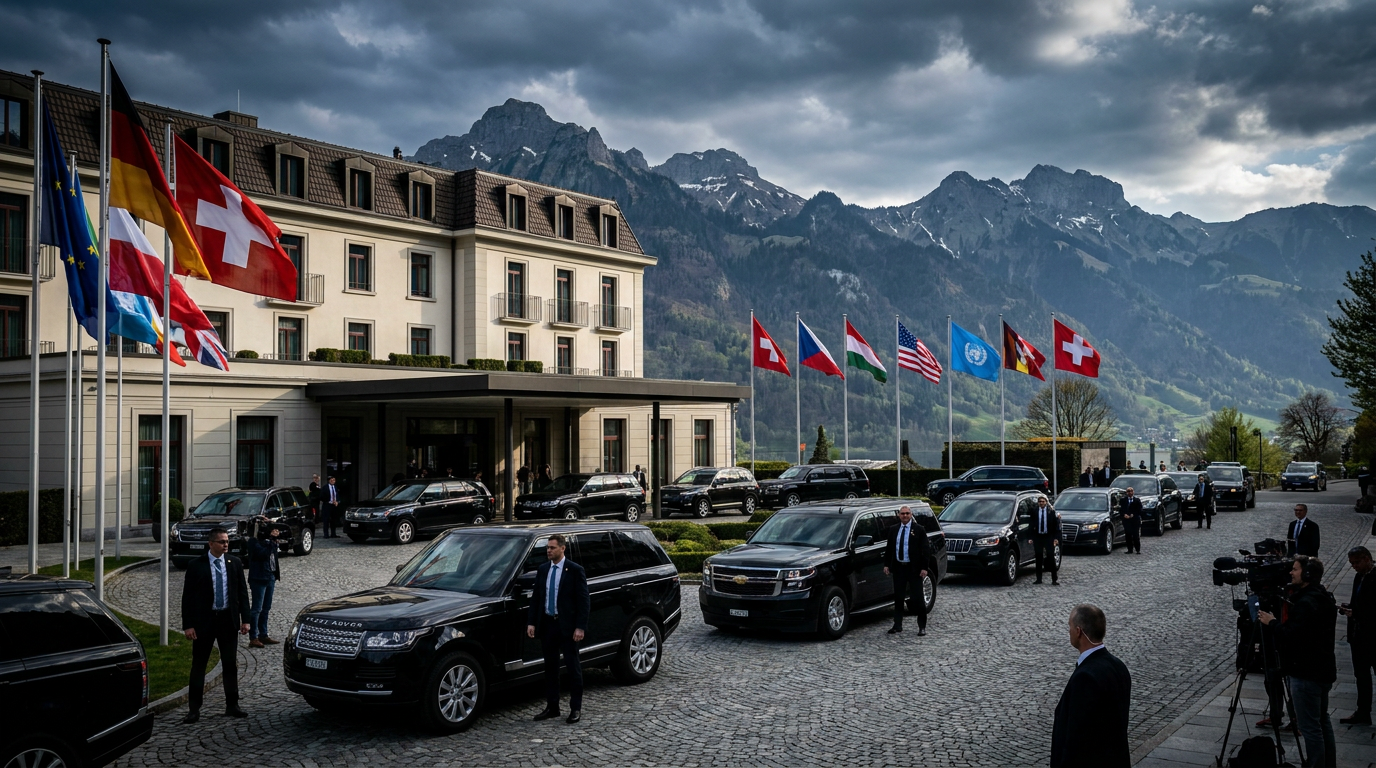
High-level U.S. and Iranian delegations have converged on the Bürgenstock resort in Switzerland for a critical round of negotiations aimed at halting the 114-day conflict in the Middle East. Vice President JD Vance arrived on Sunday to lead the American contingent, joining special envoys Jared Kushner and Steve Witkoff. The talks represent the most significant direct diplomatic engagement between Washington and Tehran since the outbreak of hostilities, signaling a potential pivot from military confrontation to a negotiated settlement.[1][2]
The summit is being heavily mediated by international partners, with Qatar and Pakistan playing central roles in bridging the communication gap between the two adversaries. Pakistani officials confirmed they have dispatched a specialized delegation to assist in the back-channel logistics, while Qatari diplomats continue their long-standing role as primary interlocutors for Tehran. The presence of Vice President Vance underscores the administration's urgency in securing a diplomatic victory and de-escalating a war that has strained U.S. military resources.[2][3]
While the overarching goal is a comprehensive ceasefire, the immediate focus of the Swiss talks is the deteriorating situation in Lebanon. Iranian state media and regional outlets indicate that stabilizing the Lebanese border and preventing a full-scale ground invasion by Israeli forces are top priorities for Tehran's negotiators. The U.S. delegation is reportedly seeking guarantees that Iran will curtail its military support for regional proxy groups in exchange for a cessation of direct U.S. strikes and potential sanctions relief.[3][7]

Notably absent from the negotiating table in Switzerland is Israel, a dynamic that has generated significant political friction. The preliminary framework for a U.S.-Iran deal has been met with fierce resistance from Israeli Prime Minister Benjamin Netanyahu, who views any accommodation with Tehran as an existential threat. Analysts suggest that the U.S. decision to proceed with direct bilateral talks, effectively sidelining Jerusalem's immediate input, marks a stark divergence in the strategic priorities of the two long-standing allies.[4][6]
Notably absent from the negotiating table in Switzerland is Israel, a dynamic that has generated significant political friction.
For the U.S. administration, the negotiations carry immense domestic political weight. Deploying Kushner and Witkoff—both key architects of the administration's broader Middle East strategy—alongside the Vice President highlights a concerted effort to bypass traditional State Department channels in favor of trusted loyalists. The administration is eager to frame a potential ceasefire as a triumph of its diplomatic doctrine, though critics argue the very necessity of the talks stems from earlier escalatory policies.[1][4]
The economic backdrop to the Bürgenstock summit is equally pressing. The 114-day conflict has introduced severe volatility into global energy markets, with Brent crude prices fluctuating wildly in response to military strikes near critical maritime chokepoints like the Strait of Hormuz. A durable ceasefire would likely stabilize oil prices and ease the soaring insurance premiums currently burdening international shipping companies operating in the Persian Gulf and the Red Sea.[5]

From Tehran's perspective, the negotiations offer a crucial off-ramp from a war of attrition that has battered its already fragile economy. Iranian diplomats are expected to push hard for the unfreezing of international assets and the lifting of recent U.S. sanctions as preconditions for any long-term security guarantees. However, hardline factions within Iran's political establishment remain deeply skeptical of American promises, demanding verifiable enforcement mechanisms before agreeing to scale back their regional military posture.[5][7]
The talks are scheduled to continue through the week, with working groups breaking off to address specific technical issues, including prisoner exchanges and maritime security protocols. While a final, comprehensive treaty is unlikely to emerge from this single round of meetings, both sides are aiming for a preliminary memorandum of understanding that would formalize a temporary cessation of hostilities. The success or failure of these initial dialogues will likely determine the trajectory of the Middle East for the remainder of the year.[2][5]
How we got here
Day 1
The current phase of the U.S.-Israel-Iran conflict officially begins following a major regional escalation.
Day 45
U.S. forces increase direct military interventions to protect international shipping lanes.
Day 90
Preliminary back-channel communications between Washington and Tehran are established via Qatari mediators.
Day 114
High-level U.S. and Iranian delegations arrive in Switzerland for direct ceasefire negotiations.
Viewpoints in depth
The U.S. Administration
Seeking a swift diplomatic resolution to end military entanglement and claim a foreign policy victory.
The White House views these direct talks as a necessary maneuver to extract the United States from an escalating 114-day conflict that threatens broader regional stability. By deploying high-level loyalists like Vice President JD Vance and Jared Kushner, the administration is attempting to bypass bureaucratic hurdles and secure a rapid ceasefire. They argue that a negotiated settlement, backed by the threat of overwhelming military force, is the only viable path to halting Iranian proxy attacks and stabilizing global energy markets.
The Israeli Government
Deeply skeptical of the talks, viewing any U.S. accommodation with Iran as a strategic betrayal.
Prime Minister Benjamin Netanyahu and his coalition view the bilateral U.S.-Iran negotiations with profound alarm. From Jerusalem's perspective, any deal that leaves Iran's nuclear infrastructure and proxy networks intact is unacceptable. Israeli officials have expressed frustration at being sidelined during the Bürgenstock summit, arguing that Washington is prioritizing a short-term political win over the long-term security requirements of its closest Middle Eastern ally.
The Iranian Establishment
Seeking sanctions relief and an end to direct military strikes while preserving regional influence.
Tehran approaches the negotiations out of economic necessity and a desire to prevent a full-scale U.S. or Israeli ground offensive against its allies in Lebanon. Iranian diplomats are focused on securing tangible economic concessions, particularly the lifting of recent sanctions, in exchange for tactical de-escalation. However, the Iranian leadership remains fundamentally distrustful of Washington, insisting that any agreement must include ironclad guarantees that the U.S. will not unilaterally withdraw from the terms in the future.
What we don't know
- Whether Iran is willing to permanently curtail its support for regional proxy groups in exchange for sanctions relief.
- How the Israeli government will respond militarily if the U.S. and Iran reach a preliminary agreement that Jerusalem opposes.
- The specific economic concessions the U.S. is prepared to offer Tehran to secure a cessation of hostilities.
Key terms
- Bilateral talks
- Negotiations involving exactly two parties—in this case, the United States and Iran—often requiring mediators when diplomatic relations are severed.
- Proxy groups
- Armed organizations funded and trained by a larger state power to fight on its behalf without direct state-to-state confrontation.
- Sanctions relief
- The reduction or removal of economic penalties imposed by one country on another, often used as a bargaining chip in diplomatic negotiations.
Frequently asked
Why are the talks happening in Switzerland?
Switzerland has a long history of diplomatic neutrality and frequently hosts high-stakes negotiations between nations that do not have formal diplomatic relations.
Is Israel participating in these negotiations?
No, Israeli officials are not present at the Bürgenstock summit. The talks are strictly bilateral between the U.S. and Iran, mediated by third parties.
What is the role of Qatar and Pakistan?
Because the U.S. and Iran do not have direct diplomatic ties, Qatar and Pakistan are acting as intermediaries, passing messages and helping to structure the framework of the talks.
Sources
Source coverage
7 outlets
4 viewpoints surfaced







[1]Fox NewsU.S. Administration
JD Vance arrives in Switzerland to join Kushner and Witkoff for new round of Iran negotiations
Read on Fox News →[2]The New York TimesU.S. Administration
Mideast Live Updates: New Round of U.S.-Iran Talks Set to Start in Switzerland
Read on The New York Times →[3]Al JazeeraIranian Negotiators
Iran war day 114: US, Iranian delegations in Switzerland for key talks
Read on Al Jazeera →[4]The GuardianEuropean & Global Observers
Trump may survive the humiliation of the Iran deal. Netanyahu will not
Read on The Guardian →[5]ReutersEuropean & Global Observers
U.S., Iran open direct talks in Switzerland to halt regional conflict
Read on Reuters →[6]The Times of IsraelIsraeli Leadership
Israel sidelined as US and Iran resume direct ceasefire negotiations in Europe
Read on The Times of Israel →[7]IRNAIranian Negotiators
Iranian delegation arrives in Switzerland for talks on regional security
Read on IRNA →
More in news politics
See all 5 stories →Peace Negotiations
US and Iranian Delegations Open High-Stakes Peace Talks in Switzerland
8 sources
Labour Leadership
Keir Starmer Expected to Resign as UK Prime Minister Amid Labour Mutiny
6 sources
Misinformation Defense
Fact-Checking the 'Cognitive Vaccine': Does Prebunking Actually Stop Misinformation?
6 sources

Every angle. Every day.
Get news politics stories with full source coverage and perspective breakdowns delivered to your inbox.