
The Evidence Behind Smart Rings: How Accurate is Sleep Tracking?
Peer-reviewed studies confirm smart rings accurately track total sleep time and recovery metrics, though exact sleep staging remains an estimate.
By Factlen Editorial Team
- Clinical Researchers
- Scientists focused on the accuracy of consumer wearables compared to medical-grade equipment.
- Wearable Tech Analysts
- Reviewers and technologists evaluating the user experience, hardware, and ecosystem integration.
- Consumer Health Advocates
- Focus on how everyday users can practically apply biometric data to improve their well-being.
What's not represented
- · Medical Device Regulators
- · Sleep Apnea Patients
Why this matters
Millions of consumers rely on smart rings to dictate their daily routines and gauge their health. Understanding the scientific accuracy of these devices ensures you make informed purchasing decisions and don't misinterpret your own biometric data.
Key points
- Smart rings demonstrate over 94% accuracy in detecting whether a user is asleep or awake compared to clinical polysomnography.
- Consumer wearables struggle to perfectly classify specific sleep stages, with an average accuracy of around 76% for distinguishing light, deep, and REM sleep.
- The Oura Ring Generation 3 currently holds the most peer-reviewed scientific validation among consumer smart rings.
- Smart rings excel at measuring Heart Rate Variability (HRV), providing highly accurate data for daily recovery and stress monitoring.
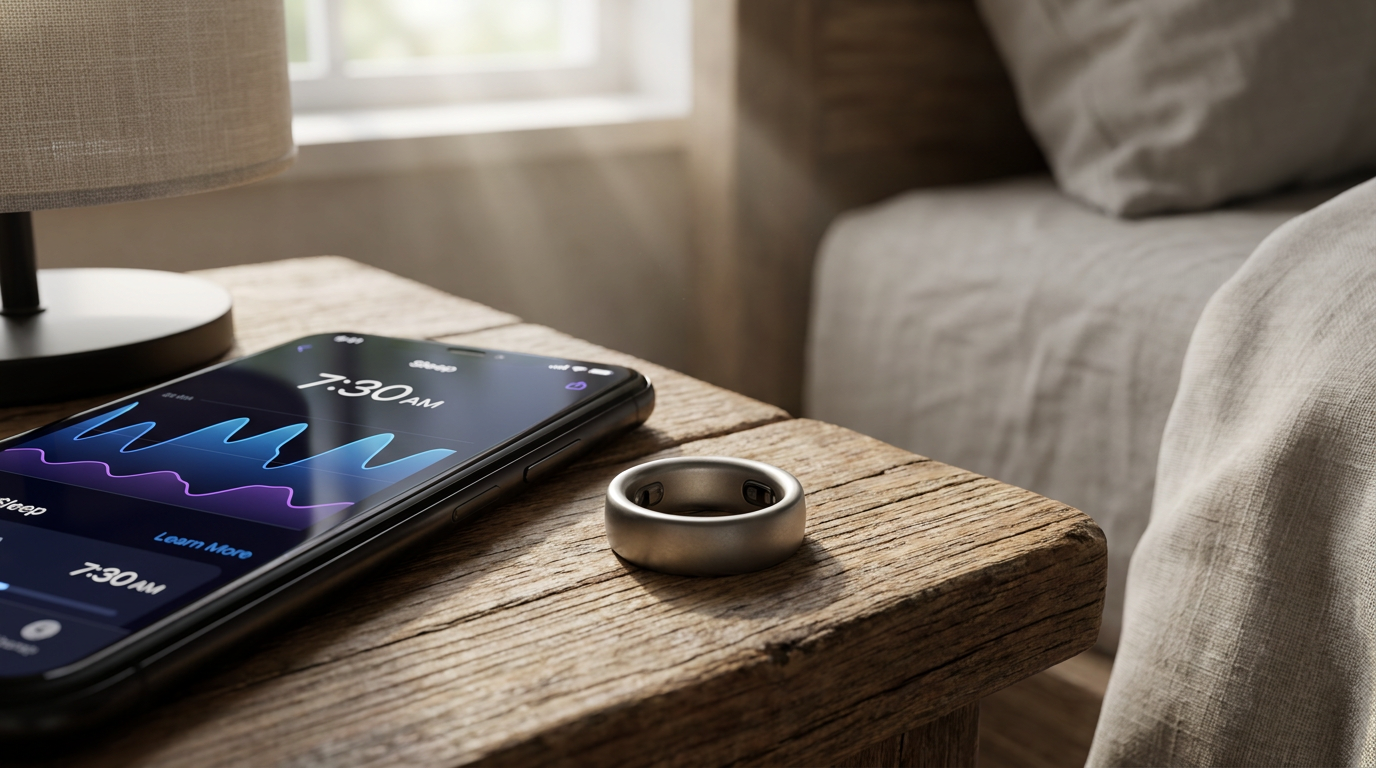
The era of bulky, wrist-worn sleep trackers is quietly giving way to a more discreet form factor: the smart ring. Devices like the Oura Ring Generation 3 and the newly released Samsung Galaxy Ring promise clinical-grade sleep insights from a titanium band no thicker than a wedding ring. But as millions of consumers rely on these devices to dictate their bedtime routines and gauge their daily readiness, a critical question remains: does the scientific evidence actually support the marketing claims?[6]
To understand the accuracy of smart rings, one must first understand how they measure sleep. Unlike clinical sleep studies—which use electrodes to monitor brain waves, eye movements, and muscle activity—smart rings rely on a combination of photoplethysmography (PPG) sensors, 3D accelerometers, and negative temperature coefficient (NTC) thermistors. By measuring heart rate, heart rate variability (HRV), movement, and skin temperature, proprietary algorithms attempt to reverse-engineer your sleep architecture from the outside in.[3][6]
The gold standard for sleep measurement is ambulatory polysomnography (PSG). When researchers validate consumer wearables, they test them head-to-head against PSG equipment. The consensus across recent peer-reviewed literature is clear: smart rings are exceptionally good at telling whether you are asleep or awake, but they struggle with the nuances of specific sleep stages.[1][2]
For total sleep time and sleep-wake detection, the evidence is robust. A 2024 multi-night validation study of 96 participants published in the journal Sleep Medicine found that the Oura Ring Generation 3 demonstrated a 94.4% to 94.5% sensitivity for detecting sleep. The device showed no significant difference from clinical PSG in estimating total sleep time, time in bed, and sleep onset latency.[1]

A separate 2024 study conducted by researchers at Brigham and Women's Hospital and published in MDPI Sensors echoed these findings. The study evaluated the Oura Ring, Fitbit Sense, and Apple Watch against PSG, finding that all devices exhibited over 95% sensitivity for identifying sleep. For consumers simply looking to track how many hours they spend asleep, the current generation of smart rings is highly reliable.[2]
However, the data becomes murkier when evaluating sleep staging—the division of sleep into light, deep (N3), and rapid eye movement (REM) phases. Because smart rings cannot measure brain waves (EEG), they must infer sleep stages from autonomic nervous system activity. This proxy measurement is inherently imprecise.[6]
The Brigham and Women's Hospital study found that the Oura Ring was the most accurate of the tested consumer devices for four-stage sleep classification, achieving an accuracy of 76.3%. While this outperformed wrist-worn competitors, an error rate of nearly 24% means that the exact minutes of deep or REM sleep reported on your smartphone each morning should be viewed as an estimate rather than a clinical fact.[2]
The Japanese validation study further quantified these limitations, noting that while overall sleep staging accuracy ranged from 75.5% for light sleep to 90.6% for REM sleep, the Oura Ring consistently underestimated REM sleep by an average of 4.1 to 5.6 minutes per night. It also occasionally misclassified light sleep as deep sleep.[1]

It also occasionally misclassified light sleep as deep sleep.
While the Oura Ring Generation 3 benefits from extensive third-party validation, newer entrants like the Samsung Galaxy Ring are still building their clinical evidence base. Priced at $399 without a recurring subscription, the Galaxy Ring has been praised by tech reviewers for its lightweight design and seamless integration into the Android ecosystem.[4]
Yet, early independent data analysis suggests Samsung's sleep staging algorithm may lag behind Oura's. Independent testing by data scientists comparing the Galaxy Ring against reference devices indicates that while it performs adequately for total sleep time, it tends to overestimate both REM and deep sleep, occasionally misclassifying light sleep periods. Samsung has integrated snore detection and blood oxygen monitoring, but its core staging algorithms require further peer-reviewed validation to match Oura's proven track record.[3][5]
Beyond sleep staging, the most scientifically validated metric provided by smart rings is Heart Rate Variability (HRV). HRV—specifically the root mean square of successive differences (RMSSD)—is a well-established indicator of parasympathetic nervous system activity and physical recovery. Because the finger has a high density of blood vessels close to the skin, ring-based PPG sensors can capture highly accurate HRV readings, often surpassing the reliability of looser-fitting wristwatches.[4][6]
This physiological accuracy is why many athletes and health enthusiasts use smart rings not for the precise minute-count of REM sleep, but for the overarching trends in their HRV and resting heart rate. A sudden drop in HRV or a spike in overnight skin temperature is a scientifically sound indicator of impending illness, overtraining, or excessive stress.[4][6]

The form factor itself also plays a crucial role in data quality. Wrist-worn trackers are notoriously prone to "motion artifact"—sensor errors caused by the device shifting on the wrist during the night. Smart rings fit snugly on the finger, reducing signal loss. Furthermore, many users find rings significantly more comfortable to wear to bed than bulky smartwatches, leading to higher compliance and more consistent longitudinal data.[3][4]
Despite their advancements, experts caution against over-relying on smart rings for medical purposes. These devices cannot diagnose sleep apnea, insomnia, or restless leg syndrome. If a user feels chronically fatigued despite their smart ring reporting a "Good" sleep score, clinical evaluation is always the recommended next step.[2][6]
Ultimately, the scientific consensus supports the use of smart rings as powerful tools for behavioral change. While they may misjudge the exact boundary between light and deep sleep, their ability to accurately track total sleep time, monitor recovery through HRV, and highlight long-term lifestyle trends makes them a highly validated addition to the consumer health toolkit.[1][2][6]
Viewpoints in depth
Clinical Sleep Researchers
Scientists focused on the accuracy of consumer wearables compared to medical-grade equipment.
Clinical researchers emphasize that while smart rings are excellent at detecting whether a user is asleep or awake, they cannot replace polysomnography for diagnosing sleep disorders. Because rings rely on autonomic nervous system proxies—like heart rate and temperature—rather than brain waves, their ability to perfectly distinguish between light and deep sleep remains mathematically limited. They view these devices as useful screening tools rather than diagnostic instruments.
Wearable Tech Analysts
Reviewers and technologists evaluating the user experience, hardware, and ecosystem integration.
Tech analysts prioritize form factor, battery life, and software ecosystems. They argue that the best sleep tracker is the one a user will actually wear every night. From this perspective, the lightweight, unobtrusive nature of smart rings makes them vastly superior to bulky smartwatches, even if the sleep staging algorithms occasionally misclassify a sleep cycle. They also highlight the growing competition between subscription models (Oura) and one-time purchases (Samsung).
Data-Driven Biohackers
Consumers who use raw biometric data to optimize their daily performance and recovery.
Biohackers and quantified-self enthusiasts focus heavily on Heart Rate Variability (HRV) and resting heart rate trends rather than absolute sleep stage minutes. They value smart rings for their ability to provide a consistent baseline of physiological stress. For this camp, the exact accuracy of REM sleep tracking is secondary to the ring's ability to accurately flag a drop in HRV, which signals under-recovery or impending illness.
What we don't know
- How the Samsung Galaxy Ring's sleep staging algorithms will perform in large-scale, independent peer-reviewed clinical trials.
- Whether future firmware updates can significantly bridge the 24% accuracy gap in sleep stage classification without the use of EEG brain wave sensors.
- The long-term psychological impact of 'orthosomnia'—the unhealthy obsession with achieving perfect sleep scores based on wearable data.
Key terms
- Polysomnography (PSG)
- A comprehensive clinical sleep study that measures brain waves, oxygen levels, heart rate, and breathing to diagnose sleep disorders.
- Photoplethysmography (PPG)
- An optical sensor technology used in wearables to measure heart rate and blood flow by illuminating the skin and measuring changes in light absorption.
- Heart Rate Variability (HRV)
- The fluctuation in the time intervals between adjacent heartbeats, used as a key indicator of physical recovery and nervous system balance.
- REM Sleep
- Rapid Eye Movement sleep, a phase associated with dreaming, memory consolidation, and emotional processing.
Frequently asked
Are smart rings as accurate as clinical sleep studies?
No. While smart rings are highly accurate (over 94%) at determining if you are asleep or awake, they are less accurate (around 76%) at distinguishing between specific sleep stages like deep and light sleep.
Can a smart ring diagnose sleep apnea?
No. Smart rings are consumer wellness devices and cannot diagnose medical conditions like sleep apnea, though features like blood oxygen monitoring can flag potential breathing irregularities.
Which smart ring has the most scientific validation?
Currently, the Oura Ring Generation 3 has the most peer-reviewed validation data backing its algorithms, though competitors like Samsung are rapidly developing their own clinical evidence.
Why do smart rings track HRV?
Heart Rate Variability (HRV) is a scientifically validated metric for assessing physical recovery and stress. Rings track it overnight to help users understand if their body is rested or fatigued.
Sources
Source coverage
6 outlets
3 viewpoints surfaced






[1]Sleep Medicine (Journal)Clinical Researchers
Validity and reliability of the Oura Ring Generation 3 with Oura sleep staging algorithm 2.0 when compared to multi-night ambulatory polysomnography
Read on Sleep Medicine (Journal) →[2]MDPI SensorsClinical Researchers
Validation of Oura Ring Generation 3, Fitbit Sense, and Apple Watch against Polysomnography
Read on MDPI Sensors →[3]CNETWearable Tech Analysts
Best Sleep Trackers for 2026
Read on CNET →[4]Runner's WorldWearable Tech Analysts
Samsung Galaxy Ring review: I trained for an ultra with it
Read on Runner's World →[5]The Quantified ScientistWearable Tech Analysts
Samsung Galaxy Ring Scientific Test
Read on The Quantified Scientist →[6]Factlen Editorial TeamConsumer Health Advocates
Synthesis by Factlen editorial team
Read on Factlen Editorial Team →
More in shopping
See all 8 stories →Laptop Hardware
How to Choose a Laptop in 2026: ARM, x86, and the Rise of the NPU
9 sources
Display Tech
OLED vs. Mini-LED: The 2026 Gaming Monitor Trade-Off
6 sources
Consumer Deals
Amazon Sets Prime Day 2026 for Mid-July as Rival Retailers Launch Competing Summer Sales
7 sources

TV Displays
OLED vs. Mini-LED: The 2026 TV Buyer's Trade-Off Guide
7 sources
Every angle. Every day.
Get shopping stories with full source coverage and perspective breakdowns delivered to your inbox.