
Amazon Sets Prime Day 2026 for Mid-July as Rival Retailers Launch Competing Summer Sales
Amazon has officially slated its 2026 Prime Day event for July 14 and 15, triggering a wave of competing "Black Friday in July" promotions from Walmart, Target, and Best Buy. Consumer advocates note that this year's summer sales heavily feature AI-driven price matching and deeper discounts on household essentials.
By Factlen Editorial Team
- E-commerce Retailers
- View the summer sales events as critical opportunities to drive loyalty program sign-ups and clear mid-year inventory.
- Consumer Advocates
- Focus on equipping shoppers with tools to verify real discounts, avoid impulse buys, and bypass artificial price inflation.
- Retail Analysts
- Analyze the sales volume as a macroeconomic indicator of consumer health and supply chain efficiency.
What's not represented
- · Small business owners competing with mega-retailer discounts
- · Warehouse logistics workers managing the mid-summer volume surge
Why this matters
For consumers managing household budgets, the mid-summer retail showdown offers the year's best opportunity to secure steep discounts on electronics, back-to-school supplies, and everyday staples outside of the traditional winter holiday shopping season.
Key points
- Amazon will host its 12th annual Prime Day on July 14 and 15, 2026.
- Target and Walmart have announced competing week-long sales events starting July 7 and July 8, respectively.
- Retailers are shifting focus to heavily discount household essentials and groceries to attract inflation-weary shoppers.
- Consumer advocates urge shoppers to use AI price-tracking tools to verify discounts and avoid artificial price anchoring.
- The overlapping sales events are expected to generate over $14.5 billion in US e-commerce spending.
The summer retail calendar is officially set. Amazon announced that its 12th annual Prime Day will take place on Tuesday, July 14, and Wednesday, July 15, 2026, promising millions of deals globally across its e-commerce platform. The 48-hour event, which began in 2015 as a 20th-anniversary celebration, has morphed into a cornerstone of the global retail industry, effectively creating a second Black Friday in the middle of the summer.[1]
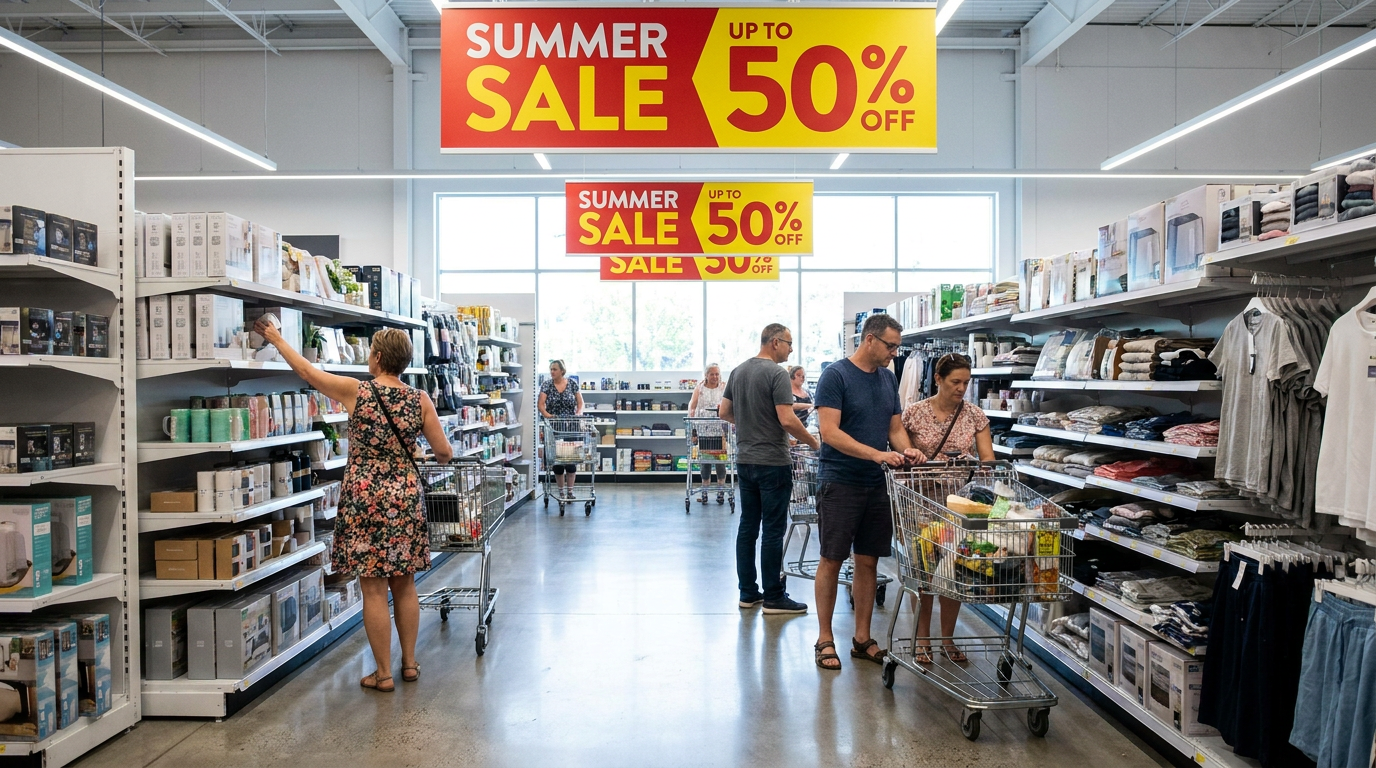
The announcement immediately triggered a cascade of counter-programming from major brick-and-mortar competitors eager to capture a slice of the mid-year consumer spending surge. Target revealed that its "Target Circle Week" will run from July 7 through July 13, offering daily deals exclusively to members of its free-to-join loyalty program. Meanwhile, Walmart announced "Walmart+ Week" starting July 8, heavily emphasizing discounts on groceries, gas, and back-to-school essentials alongside traditional electronics.[3][6][7]

This year's sales landscape reflects a distinct shift in consumer priorities. While previous Prime Days were dominated by heavy discounts on smart speakers, 4K televisions, and premium consumer tech, retail analysts note that 2026 is seeing a massive pivot toward household necessities. Retailers are aggressively discounting bulk pantry items, cleaning supplies, and everyday apparel, responding to shoppers who are increasingly using these mega-sales to offset cumulative inflation on routine purchases.[2][3]
To navigate the overwhelming volume of promotions, consumer advocates are urging shoppers to rely on technology rather than marketing hype. Experts recommend utilizing browser extensions and AI-powered price-tracking tools to verify whether a "deal" is genuinely a bargain. These tools analyze historical pricing data to expose "price anchoring"—a tactic where retailers artificially inflate the "original" price of an item just weeks before the sale to make the Prime Day discount appear more dramatic than it actually is.[4][5]
To navigate the overwhelming volume of promotions, consumer advocates are urging shoppers to rely on technology rather than marketing hype.
The integration of artificial intelligence into consumer shopping habits has reached a tipping point this summer. New AI shopping assistants can now automatically cross-reference a product's price across Amazon, Best Buy, Walmart, and Target in real-time, factoring in shipping costs and loyalty program perks to find the absolute lowest out-of-pocket cost. This technological arms race is forcing retailers to offer more transparent, bottom-line discounts rather than relying on flash-sale gimmicks.[5]
Behind the scenes, the logistics required to execute these overlapping sales events are staggering. Amazon has spent the first half of 2026 deploying next-generation fulfillment robotics across its warehouse network, aiming to maintain its promise of same-day or next-day delivery for Prime members despite the anticipated spike in order volume. Competitors like Target are leaning heavily on their physical store footprints, using retail locations as micro-fulfillment centers for curbside pickup and local delivery.[1][2]

Financial analysts project that the combined e-commerce spend across all major retailers during the second week of July will top $14.5 billion in the United States alone. This injection of capital is crucial for the retail sector, which traditionally experiences a significant lull between the spring shopping season and the late-summer back-to-school rush. The performance of these summer sales is widely viewed as a key barometer for consumer confidence heading into the crucial fourth quarter.[2]
For shoppers looking to maximize their savings, the consensus advice is preparation. Consumer watchdogs suggest making a strict shopping list now, setting price alerts on desired items, and avoiding impulse buys triggered by countdown timers. By treating the mid-July sales event as a strategic opportunity to stock up on planned purchases rather than a digital window-shopping excursion, consumers can extract genuine value from the retail industry's fiercest summer battle.[4]
How we got here
July 2015
Amazon launches the first Prime Day to celebrate its 20th anniversary.
October 2020
Prime Day is temporarily delayed to the fall due to pandemic-related supply chain disruptions.
July 2024
Major competitors fully establish overlapping, week-long summer sales events to counter Amazon's dominance.
June 2026
Amazon announces July 14-15 dates, prompting immediate rival announcements from Target and Walmart.
Viewpoints in depth
E-commerce Retailers' Strategy
Retail giants view the mid-summer sales period as a crucial engine for customer acquisition.
For companies like Amazon, Walmart, and Target, the primary goal of these summer sales isn't necessarily immediate profit margins on discounted items. Instead, the events are designed as massive acquisition funnels for their respective loyalty programs (Prime, Walmart+, and Target Circle). By locking consumers into these ecosystems during the summer, retailers secure recurring subscription revenue and ensure those shoppers default to their platforms during the highly lucrative winter holiday season.
Consumer Advocates' Warning
Watchdogs emphasize the need for technological vigilance to ensure shoppers are actually saving money.
Consumer protection groups and deal-hunting experts consistently warn that the sheer volume of 'deals' during these events can mask deceptive pricing strategies. They point to the widespread use of price anchoring, where retailers quietly raise the base price of an item in May or June only to 'discount' it back to its normal price in July. Advocates stress that without third-party price-tracking browser extensions, consumers are flying blind and are highly susceptible to marketing-induced impulse purchases.
Retail Analysts' Outlook
Financial experts monitor the summer sales as a real-time stress test of the global supply chain and consumer health.
Industry analysts look past the individual discounts to measure the macroeconomic signals generated by the $14.5 billion spending surge. They analyze which categories consumers are prioritizing—such as a shift from luxury electronics to bulk groceries—to gauge the impact of inflation on household budgets. Furthermore, the ability of these retailers to fulfill millions of orders within 48 hours serves as a public stress test for the billions of dollars recently invested in automated warehouse robotics and last-mile delivery logistics.
What we don't know
- Whether the aggressive discounting on household essentials will successfully drive the projected $14.5 billion in total sales.
- How ongoing global shipping constraints might affect inventory levels for high-demand electronics during the 48-hour window.
Key terms
- Price Anchoring
- A psychological pricing tactic where a retailer displays a high 'original' price next to a sale price to make the discount appear larger than it historically is.
- Dynamic Pricing
- The practice of automatically adjusting the price of an item in real-time based on demand, competitor pricing, and inventory levels.
- Micro-fulfillment
- The strategy of using small, highly automated storage facilities—often located inside existing retail stores—to speed up local delivery times.
Frequently asked
Do I need an Amazon Prime membership to get the deals?
Yes, the vast majority of Prime Day discounts are exclusive to active Prime members. However, competing sales like Target Circle Week are free to join.
Are Prime Day deals actually better than Black Friday?
For Amazon's own devices (Echo, Kindle, Ring) and mid-year tech releases, Prime Day often offers the lowest prices of the year. For large appliances and winter apparel, Black Friday is typically better.
How can I tell if a discount is real?
Consumer advocates recommend using price-tracking tools like CamelCamelCamel or browser extensions that show an item's price history over the last six months.
Sources
Source coverage
7 outlets
3 viewpoints surfaced







[1]The VergeE-commerce Retailers
Amazon Prime Day 2026 is officially set for July 14th and 15th
Read on The Verge →[2]CNBCRetail Analysts
Retailers brace for $14.5 billion summer spending surge as Amazon sets Prime Day dates
Read on CNBC →[3]Retail DiveRetail Analysts
Target and Walmart announce overlapping July sales events to counter Amazon
Read on Retail Dive →[4]WirecutterConsumer Advocates
How to Prepare for Prime Day 2026 (And Avoid Fake Deals)
Read on Wirecutter →[5]TechRadarConsumer Advocates
AI price trackers are your best weapon for Prime Day 2026
Read on TechRadar →[6]Target CorporateE-commerce Retailers
Target Circle Week Returns July 7-13 with Deepest Discounts of the Summer
Read on Target Corporate →[7]Walmart CorporateE-commerce Retailers
Walmart+ Week Brings Unprecedented Savings Starting July 8
Read on Walmart Corporate →


Every angle. Every day.
Get shopping stories with full source coverage and perspective breakdowns delivered to your inbox.