
Meta Quest 3 vs. Apple Vision Pro: The 2026 Spatial Computing Comparison
As the virtual reality market matures in 2026, the Meta Quest 3 and Apple Vision Pro offer radically different approaches to spatial computing. We break down the trade-offs between affordable gaming and ultra-premium productivity.
By Factlen Editorial Team
- Mainstream Gamers
- Value affordability, physical controllers, and a large library of standalone games.
- Tech Enthusiasts & Professionals
- Value cutting-edge visual fidelity, seamless ecosystem integration, and productivity.
What's not represented
- · Enterprise and industrial AR users
- · Educators deploying VR in classrooms
Why this matters
Choosing a VR headset in 2026 is no longer just about buying a gadget; it is about committing to an ecosystem. Understanding the stark trade-offs between Meta's gaming-first approach and Apple's productivity-focused hardware ensures you invest in the right tool for your daily life.
Key points
- The 2026 VR market is defined by Meta's affordable gaming headsets and Apple's premium spatial computers.
- Meta's Quest 3S ($349) and Quest 3 ($599) offer the best value for wireless gaming and fitness.
- Apple's Vision Pro ($3,499) remains the gold standard for high-resolution media consumption and Mac productivity.
- Apple's new Dual Knit Band improves comfort, but the Vision Pro remains significantly heavier than the Quest line.
- Meta relies on physical controllers for precision, while Apple utilizes advanced eye and hand tracking.
The 2026 spatial computing market has officially bifurcated, leaving behind the experimental prototypes of the early 2020s. After years of iterative hardware releases, the industry has settled into two distinct and uncompromising philosophies: accessible, controller-based gaming versus ultra-premium, eye-tracked spatial computing. Consumers are no longer buying into a vague promise of the metaverse; they are choosing between mature ecosystems that serve entirely different daily routines. This divergence has forced buyers to carefully evaluate their priorities before investing in a headset, as the hardware now dictates the software experience more rigidly than ever before. The era of the one-size-fits-all virtual reality headset is definitively over.
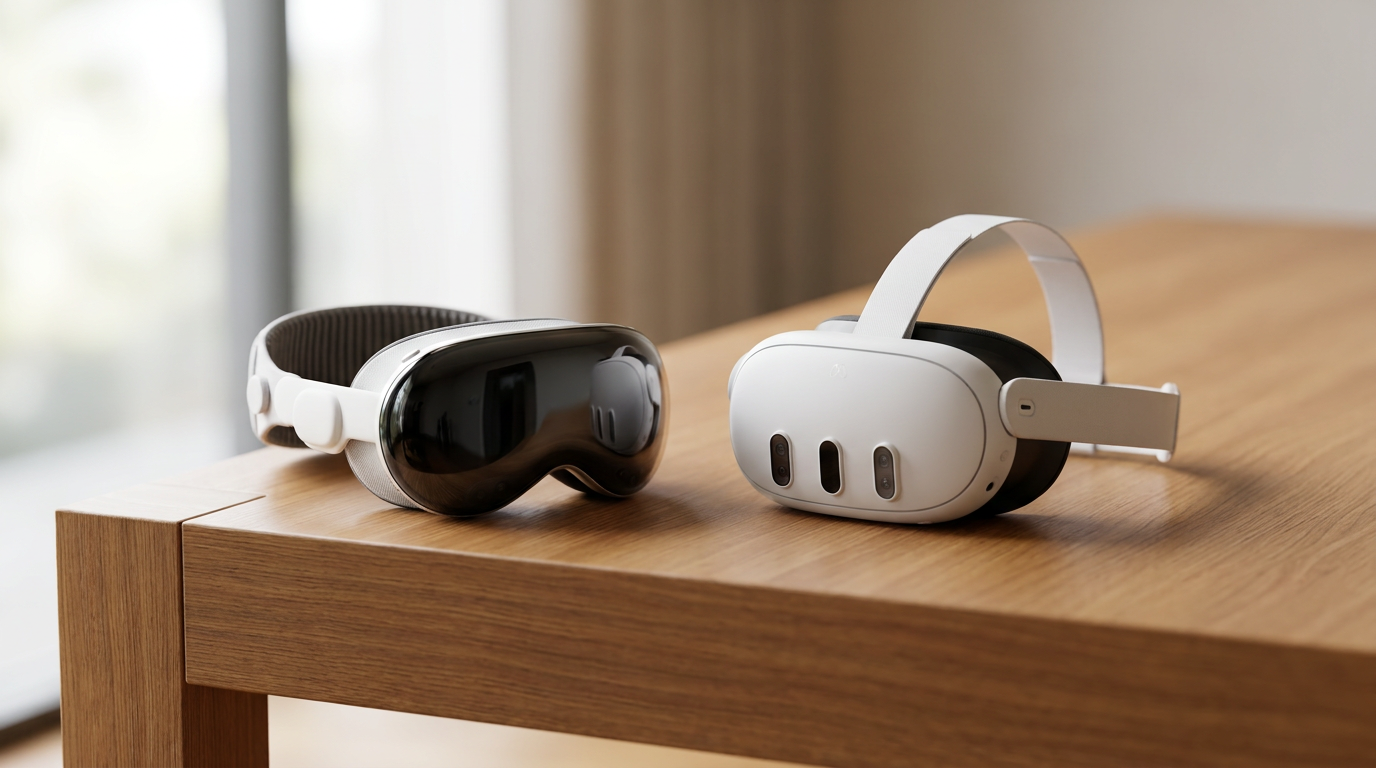
On one side of this divide sits the Meta Quest 3 and its budget counterpart, the Quest 3S, which continue to dominate the mainstream market. On the other side is the Apple Vision Pro, now updated with an M5 chip and a redesigned Dual Knit Band that attempts to solve its predecessor's ergonomic flaws. Both platforms have spent the last two years refining their software, expanding their app libraries, and addressing early hardware complaints. This maturation sets the perfect stage for a definitive side-by-side comparison of what actually works in modern virtual reality, stripping away the marketing hype to examine real-world performance.[5][7]
When evaluating the Meta Quest 3 and its budget sibling, the Quest 3S, the value proposition is undeniable for mainstream consumers. **For:** Unbeatable value and versatility. At $349, the Quest 3S provides access to a massive library of over 500 standalone games, while the $599 Quest 3 adds superior pancake lenses and a higher 2064 x 2208 per-eye resolution. **Against:** The LCD panels exhibit gray blacks in dark scenes, and the default head strap requires an immediate aftermarket upgrade to prevent facial fatigue. **Evidence:** PC Gamer and CNET both highlight the Quest 3 as the ultimate all-around headset, noting that its Snapdragon XR2 Gen 2 chip delivers smooth performance for both standalone play and PC VR tethering.[2][4]

Turning to the Apple Vision Pro, the experience shifts from accessible gaming to ultra-premium spatial computing. **For:** Unrivaled visual fidelity. The twin micro-OLED displays push 23 million pixels, rendering text with razor-sharp clarity and creating a private 4K cinema that seamlessly blends with the real world. **Against:** An astronomical $3,499 entry price, a cumbersome tethered battery pack, and a persistent lack of native, controller-based gaming experiences. **Evidence:** Multicore and Gentleman's Journal praise the device as a desktop in the clouds and the best personal movie viewer ever made, though both acknowledge the weight remains a physical burden.[5][6]
Turning to the Apple Vision Pro, the experience shifts from accessible gaming to ultra-premium spatial computing.
The control schemes and interaction models represent the starkest philosophical divide between the two tech giants. **For:** Apple's controller-free interface relies on magical eye-tracking and subtle finger pinches, making UI navigation completely frictionless. Conversely, Meta's Touch Plus controllers offer precise, tactile feedback essential for high-speed gaming. **Against:** Apple's lack of controllers alienates traditional gamers and makes fast-paced virtual interactions nearly impossible. Meta's hand-tracking, while improved, still lags behind Apple's instantaneous precision. **Evidence:** Marques Brownlee notes that Apple's eye-tracking feels flawless for productivity, while VR.org emphasizes that Meta's physical controllers are strictly necessary for titles like Beat Saber and competitive shooters.[1][7]
Comfort and wearability remain the ultimate bottleneck for both platforms, dictating how long users can actually stay in virtual reality. **For:** Meta's lightweight plastic chassis (around 515 grams) is highly moddable, allowing users to swap in third-party halo straps for perfect balance. Meanwhile, Apple's new tungsten-weighted Dual Knit Band significantly improves weight distribution over the original 2024 model. **Against:** The Vision Pro's glass and aluminum construction makes it inherently front-heavy, and the external battery wire is a constant physical tether. Meta's default fabric strap is notoriously inadequate. **Evidence:** Reviewers across the board, including Multicore, report that while Apple's new band mitigates the dreaded face sag, the headset is still fatiguing during full workdays compared to Meta's more balanced, wire-free design.[5][6][7]

Ultimately, deciding on the Meta Quest line comes down to your primary use case and budget constraints. **Fits well when:** You want a dedicated gaming console, a virtual fitness tracker, or a highly capable mixed-reality device without breaking the bank. It is the definitive choice for anyone looking to play AAA VR titles or stream PC VR games wirelessly. **Does not fit when:** You require pristine text clarity for reading documents all day, or if you demand cinematic movie viewing with perfect OLED black levels.[2][3]
Conversely, the Apple Vision Pro demands a specific type of user who values seamless ecosystem integration over traditional virtual reality gaming experiences. **Fits well when:** You are a professional deeply embedded in the Mac ecosystem seeking an infinite virtual workspace, or a media enthusiast who wants the ultimate portable 4K theater. It excels in stationary, high-fidelity computing environments. **Does not fit when:** You are on a strict budget, want to play traditional VR games, or find heavy headsets physically exhausting over extended periods of daily use.[5][6]

Looking ahead, the spatial computing landscape will only grow more competitive as new challengers prepare to enter the fray later this year. Industry leaks regarding Valve's upcoming Steam Frame and Meta's highly anticipated Quest 4 suggest that the massive gap between budget gaming and premium spatial computing may soon narrow, bringing high-end features like eye-tracking to more accessible price points. However, for buyers making a purchasing decision today, the choice remains a stark binary dictated by budget and use case. Whether you opt for the frictionless luxury of Apple's ecosystem or the sprawling, tactile gaming library of Meta's hardware, 2026 offers the most capable, polished headsets the industry has ever produced. The technology has finally caught up to the ambition.
How we got here
Feb 2024
Apple launches the original Vision Pro, introducing mainstream spatial computing.
Oct 2024
Meta releases the Quest 3S, cementing its dominance in the budget VR market.
Late 2025
Apple updates the Vision Pro with the M5 chip and the ergonomic Dual Knit Band.
Mid 2026
The VR market bifurcates entirely into budget gaming and premium productivity.
Viewpoints in depth
Mainstream Gamers
Prioritize affordability, massive game libraries, and controller-based input.
For the traditional gaming community, the Meta Quest 3 is the undisputed king. This camp values tactile feedback from physical controllers and the freedom of a completely wireless, untethered experience. They argue that Apple's lack of dedicated VR controllers fundamentally disqualifies the Vision Pro from being a true gaming device, pointing to the Quest's massive library of over 500 native titles and seamless PC VR streaming as the industry standard.
Spatial Computing Professionals
Prioritize visual fidelity, ecosystem integration, and frictionless UI.
Productivity enthusiasts and Mac power users view the Apple Vision Pro as the next evolution of the desktop computer. This camp is willing to overlook the high price tag and heavy hardware in exchange for 4K micro-OLED displays that render text flawlessly. They argue that eye-tracking and pinch gestures are the future of human-computer interaction, valuing the ability to summon infinite virtual monitors over the ability to play fast-paced VR games.
What we don't know
- Whether Apple will release a cheaper 'Vision Air' model to compete directly with Meta's pricing.
- How Valve's rumored 'Steam Frame' headset will disrupt the PC VR market later in 2026.
- If Meta's upcoming Quest 4 will successfully integrate eye-tracking without drastically raising the price.
Key terms
- Spatial Computing
- A technology that blends digital content with the physical world, allowing users to interact with virtual interfaces as if they were real objects.
- Micro-OLED
- An advanced display technology that provides extremely high pixel density and perfect black levels, used in premium headsets like the Vision Pro.
- Pancake Lenses
- Slim optical lenses that reduce the physical bulk of a VR headset while providing a wider, clearer sweet spot for viewing.
- Passthrough
- The ability of a VR headset to use external cameras to show the user their real-world surroundings in full color.
Frequently asked
Can I play PC VR games on the Apple Vision Pro?
While there are third-party workarounds, the Vision Pro is not designed for PC VR gaming and lacks the dedicated controllers required for most SteamVR titles.
Is the Meta Quest 3S worth buying over the Quest 3?
Yes, if you are on a budget. The Quest 3S plays all the same games using the same processor, though it sacrifices the sharper pancake lenses found in the more expensive Quest 3.
Did Apple fix the Vision Pro's weight issue?
Apple introduced a new Dual Knit Band with tungsten counterweights that significantly improves balance, though the headset itself remains heavy during long sessions.
Sources
Source coverage
7 outlets
2 viewpoints surfaced







[1]VR.orgMainstream Gamers
Best VR Headset 2026: Top Picks, Prices & Comparison
Read on VR.org →[2]PC GamerMainstream Gamers
Best VR headset in 2026: my top picks for stunning virtual reality experiences
Read on PC Gamer →[3]PCMagMainstream Gamers
The Best VR Headsets We've Tested for 2026
Read on PCMag →[4]CNETMainstream Gamers
Best VR Headsets of 2026: My Favorite Hardware Right Now
Read on CNET →[5]MulticoreTech Enthusiasts & Professionals
Apple Vision Pro: the 2026 review
Read on Multicore →[6]Gentleman's JournalTech Enthusiasts & Professionals
A Review Of The Apple Vision Pro (2026) | A Triumph of Brilliance
Read on Gentleman's Journal →[7]Marques BrownleeTech Enthusiasts & Professionals
Apple Vision Pro review 2026
Read on Marques Brownlee →

Every angle. Every day.
Get meta stories with full source coverage and perspective breakdowns delivered to your inbox.