
How SpaceX's Record-Breaking IPO is Rewriting the Rules of Index Investing
SpaceX's $1.8 trillion public debut is so massive that major stock indexes are changing their inclusion rules, meaning millions of everyday investors will soon automatically own a piece of the aerospace giant.
By Factlen Editorial Team
- Index Modernizers
- Argue that benchmarks must rapidly adapt to include trillion-dollar IPOs to accurately reflect the modern economy.
- Traditional Benchmark Defenders
- Believe in strict seasoning periods and profitability metrics to protect index stability from IPO volatility.
- Everyday Passive Investors
- Rely on index funds for broad market exposure and benefit from faster inclusion of generational tech companies.
What's not represented
- · Active Hedge Fund Managers
- · Venture Capitalists
Why this matters
If you have a 401(k) or own broad market index funds, your portfolio is about to automatically buy into the largest IPO in history. The rule changes triggered by SpaceX mean everyday retirement accounts will capture the growth of generational tech companies much faster than before.
Key points
- SpaceX's $75 billion IPO is the largest in history, valuing the company at nearly $1.8 trillion.
- Major index providers like Nasdaq and CRSP changed their rules to allow mega-cap companies to join their benchmarks in as little as five days.
- The S&P 500 committee rejected rule changes, meaning SpaceX won't join the widely tracked index for at least 12 months.
- Because only 4% of SpaceX shares are public, index funds will use float-adjusted weighting to buy a smaller, proportional slice of the company.
- These rule changes ensure that everyday passive investors will automatically gain exposure to generational tech companies much faster than in previous decades.
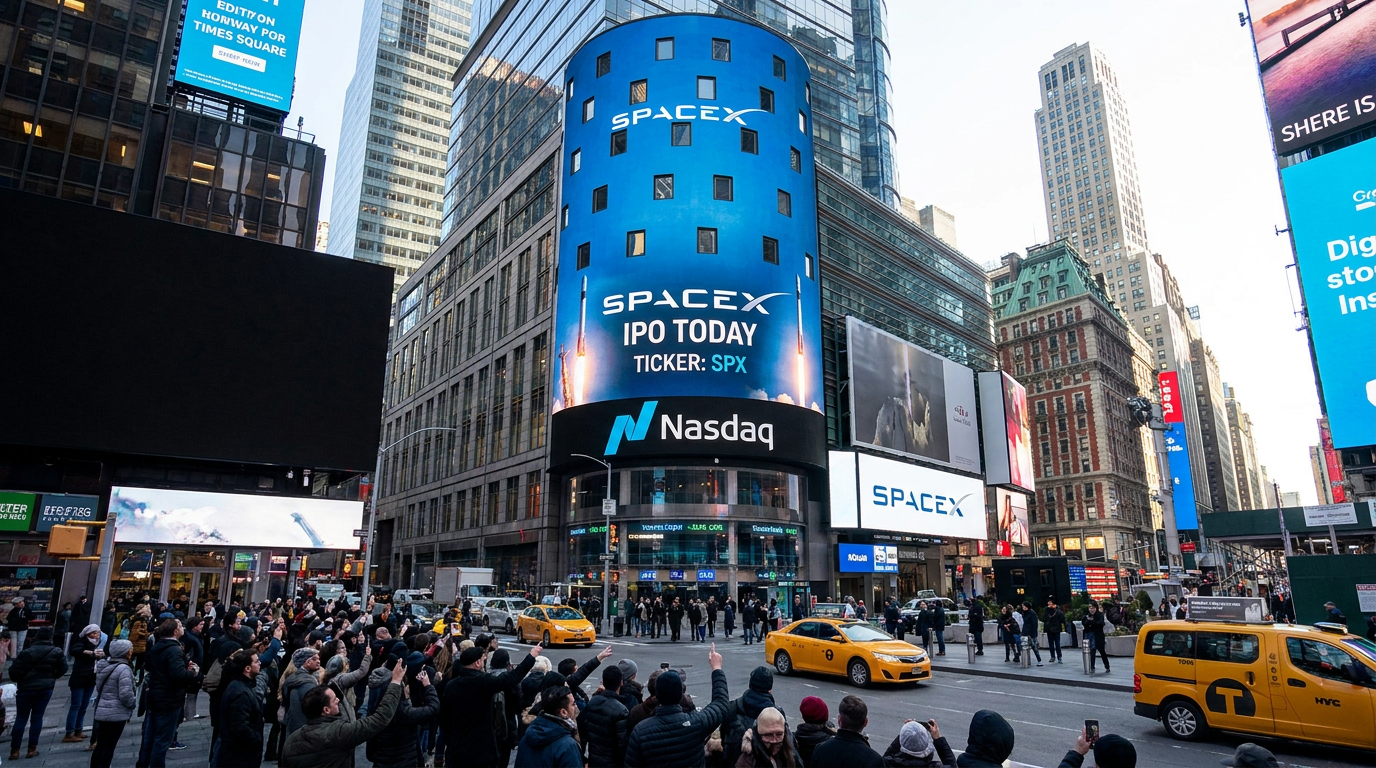
When SpaceX rang the opening bell at the Nasdaq MarketSite on June 12, 2026, it didn't just break records—it fundamentally altered the plumbing of the U.S. stock market. Raising $75 billion at a valuation approaching $1.8 trillion, the aerospace giant executed the largest initial public offering in history. The sheer gravity of a nearly two-trillion-dollar company suddenly appearing on the public markets has sent shockwaves through Wall Street. But the most significant impact isn't being felt by day traders or hedge funds. It is directly affecting the retirement accounts of millions of everyday Americans.[3][4]
In the modern financial era, the vast majority of retail investors do not pick individual stocks. Instead, they rely on passive investing, funneling their 401(k) contributions into index funds that blindly track benchmarks like the S&P 500 or the Nasdaq-100. This strategy is designed to be boring, safe, and automatic. However, the unprecedented scale of the SpaceX IPO has forced the architects of these indices to rewrite their rulebooks on the fly, accelerating how quickly retail investors gain exposure to generational tech companies.[2][5]
Historically, newly public companies had to wait in purgatory before joining the major indices. The logic was simple: give the stock time to settle, allow early volatility to cool, and ensure the company is financially stable before forcing millions of retirement accounts to buy in. But SpaceX's debut broke that logic. Leaving a $1.8 trillion behemoth out of a broad market index would mean the benchmark no longer accurately reflects the reality of the U.S. economy.[3][5]
Faced with this discrepancy, major index providers scrambled to adapt. Nasdaq introduced a "Fast Entry" rule specifically tailored for mega-cap companies. Under the new guidelines, top-tier corporations valued at over $100 billion can bypass the traditional waiting periods and join the Nasdaq-100 in just 15 trading days. They also eliminated previous minimum float requirements, ensuring that massive companies with tightly held shares could still be represented.[3]

The Center for Research in Security Prices (CRSP), which powers Vanguard's immensely popular Total Market ETF, went even further. CRSP tweaked its policies to allow newly public mega-caps to join its indices after a mere five trading days. For the millions of Americans holding Vanguard's broad market funds, this meant their portfolios began automatically purchasing SpaceX shares within a week of the IPO, seamlessly integrating the space exploration company into their long-term savings.[3]
Yet, integrating a company of this magnitude comes with unique mechanical challenges, primarily due to the concept of "free float." While SpaceX boasts a headline valuation near $1.8 trillion, only about 4% of its shares were actually made available to the public during the IPO. The vast majority of the equity remains locked up by CEO Elon Musk, early employees, and private institutional backers.[4]
Because modern index funds use "float-adjusted weighting," they only buy stock based on the shares available to the public, not the total theoretical value of the company. If an index fund tried to buy shares based on SpaceX's full $1.8 trillion valuation, it would exhaust the tiny 4% public supply almost instantly, sending the stock price into the stratosphere. Consequently, SpaceX's initial footprint in your retirement account will be relatively modest, growing gradually as insider lock-up periods expire and more shares enter the public market.[3][4]
Despite this float adjustment, the sheer volume of passive capital tracking these indices is staggering. Approximately $1.4 trillion is benchmarked to the Nasdaq-100 alone. When index funds are mandated to buy a stock, they do so regardless of the current price. This forced buying creates a massive, price-agnostic demand that analysts have described as "striking," providing a powerful tailwind for the stock in its early weeks of trading.[1][3]

Despite this float adjustment, the sheer volume of passive capital tracking these indices is staggering.
However, not every index provider succumbed to the pressure to modernize. The S&P Dow Jones Indices committee, which oversees the gold-standard S&P 500, took a decidedly traditional stance. Following a consultation with market participants in May 2026, the committee announced it would make no exceptions for mega-cap IPOs.[3]
To enter the S&P 500, a company must still trade publicly for 12 months and demonstrate positive earnings over its most recent four quarters. Because SpaceX is prioritizing aggressive growth and capital expenditure over immediate profitability, it does not currently meet these criteria. As a result, investors holding the Vanguard S&P 500 ETF—the most widely held index fund in the world—will sit on the sidelines for at least a year before SpaceX enters their portfolios.[3][4]
This divergence between index providers highlights a growing philosophical debate in modern finance. On one side, modernizers argue that indices must be agile, capturing the value of transformative companies as soon as they hit the market. On the other, traditionalists maintain that strict seasoning periods protect everyday investors from the wild price swings that often accompany highly hyped public debuts.[5]

The retail investor response to the IPO has been overwhelmingly enthusiastic. Recognizing the intense public interest, SpaceX set aside roughly 20% of its IPO shares specifically for individual retail investors—a significantly higher allocation than the typical 5% to 10% seen in traditional Wall Street offerings. This democratization of access allowed everyday enthusiasts to participate directly in the opening days of trading.[4]
For those who missed the initial allocation, the rapid inclusion of SpaceX into funds like the Vanguard Total Market ETF ensures they aren't left behind. It represents a structural shift in how wealth is generated and distributed. In the past decade, the most explosive growth of tech companies occurred in private markets, accessible only to venture capitalists and ultra-wealthy accredited investors.[2][5]
The SpaceX IPO, and the subsequent rule changes by index providers, signal a reversal of that trend. By fast-tracking mega-caps into public benchmarks, the financial industry is ensuring that the gains of the next generation of technological innovation flow directly into the 401(k)s and pension funds of the broader public.[5]
This mechanical shift is just the beginning. With artificial intelligence heavyweights like OpenAI and Anthropic widely expected to pursue their own mega-IPOs later this year, the new "Fast Entry" rules will soon be tested again. For the everyday passive investor, the message is clear: the stock market's underlying plumbing has been upgraded, and your retirement account is now moving at the speed of the modern tech economy.[3][4]
How we got here
December 2019
Saudi Aramco sets the previous global IPO record by raising $29 billion.
May 2026
Index providers including Nasdaq and CRSP rewrite their inclusion rules to accommodate upcoming mega-cap public offerings.
June 12, 2026
SpaceX goes public on the Nasdaq, raising $75 billion at a valuation approaching $1.8 trillion.
Late June 2026
SpaceX shares begin entering major index funds, triggering automatic purchases by passive retirement accounts.
June 2027
The earliest possible date SpaceX could be considered for inclusion in the S&P 500 index.
Viewpoints in depth
Index Modernizers
Advocates for rapidly adapting benchmarks to reflect the modern economy.
Proponents of the new 'Fast Entry' rules argue that traditional waiting periods are obsolete in an era where companies stay private longer and go public at trillion-dollar valuations. If a benchmark like the Nasdaq-100 is meant to represent the most vital companies in the tech sector, excluding a $1.8 trillion aerospace leader for months would render the index fundamentally inaccurate. They believe that capturing the early growth of these mega-caps is essential for passive investors to maximize their returns.
Traditional Benchmark Defenders
Proponents of strict seasoning periods to protect index stability.
Organizations like S&P Dow Jones Indices maintain that patience is a virtue in public markets. They argue that newly public companies, regardless of their size, are prone to extreme price volatility as early investors exit and the market discovers the true price. By enforcing a strict 12-month waiting period and requiring four quarters of proven profitability, traditionalists aim to protect everyday retirement accounts from the speculative fervor and potential drawdowns that often follow highly hyped IPOs.
Passive Retail Investors
Everyday individuals relying on index funds for long-term wealth generation.
For the millions of Americans who invest through 401(k)s and broad market ETFs, the mechanics of index inclusion dictate their financial futures. This camp generally favors the democratization of access. For years, the most explosive gains in the tech sector were captured exclusively by venture capitalists in private markets. The accelerated inclusion of companies like SpaceX into public indices ensures that everyday workers can finally participate in the growth of generational technologies without needing to actively pick stocks.
What we don't know
- How the massive influx of forced buying from passive index funds will impact SpaceX's stock volatility once the initial IPO hype cools.
- Whether the S&P 500 committee will eventually cave to pressure and amend its 12-month waiting period if OpenAI and Anthropic go public.
Key terms
- Initial Public Offering (IPO)
- The process where a private company offers its shares to the public for the first time.
- Free Float
- The portion of a company's shares that are actively available to be traded by the general public, excluding locked-up insider shares.
- Market Capitalization
- The total value of a publicly traded company, calculated by multiplying the current share price by the total number of outstanding shares.
- Passive Investing
- A strategy that tracks a market index (like the S&P 500) rather than trying to pick individual winning stocks.
- Float-Adjusted Weighting
- A method used by index funds where a company's size in the index is based only on the shares available to the public, not its total valuation.
Frequently asked
Will my 401(k) automatically buy SpaceX stock?
If you own broad market index funds, such as a Vanguard Total Market ETF, your fund will automatically purchase SpaceX shares to match its benchmark index.
Why isn't SpaceX in the S&P 500 yet?
The S&P 500 committee decided to keep its strict rules, which require a company to trade publicly for 12 months and prove consistent profitability before inclusion.
Does Elon Musk still control the company?
Yes. Musk retained roughly 40% of the shares and holds super-voting rights, meaning he maintains firm control over SpaceX's operations and board.
Why did Nasdaq change its rules?
Nasdaq and other index providers altered their rules to ensure their benchmarks accurately reflect the economy, as waiting months to include a $1.8 trillion company would make the index outdated.
Sources
Source coverage
5 outlets
3 viewpoints surfaced





[1]MarketWatchIndex Modernizers
The initial SpaceX frenzy is cooling off — but a new wave of cash is waiting to strike
Read on MarketWatch →[2]WUSF Public MediaEveryday Passive Investors
Is there risk from owning SpaceX in your index fund?
Read on WUSF Public Media →[3]CME GroupIndex Modernizers
The SpaceX IPO: A historic watershed moment
Read on CME Group →[4]Hargreaves LansdownTraditional Benchmark Defenders
SpaceX's record IPO could reshape indices
Read on Hargreaves Lansdown →[5]Factlen Editorial TeamEveryday Passive Investors
Synthesis by Factlen editorial team
Read on Factlen Editorial Team →


Every angle. Every day.
Get finance stories with full source coverage and perspective breakdowns delivered to your inbox.