
How Smartphone AI is Democratizing Sports Analytics for Amateur Athletes
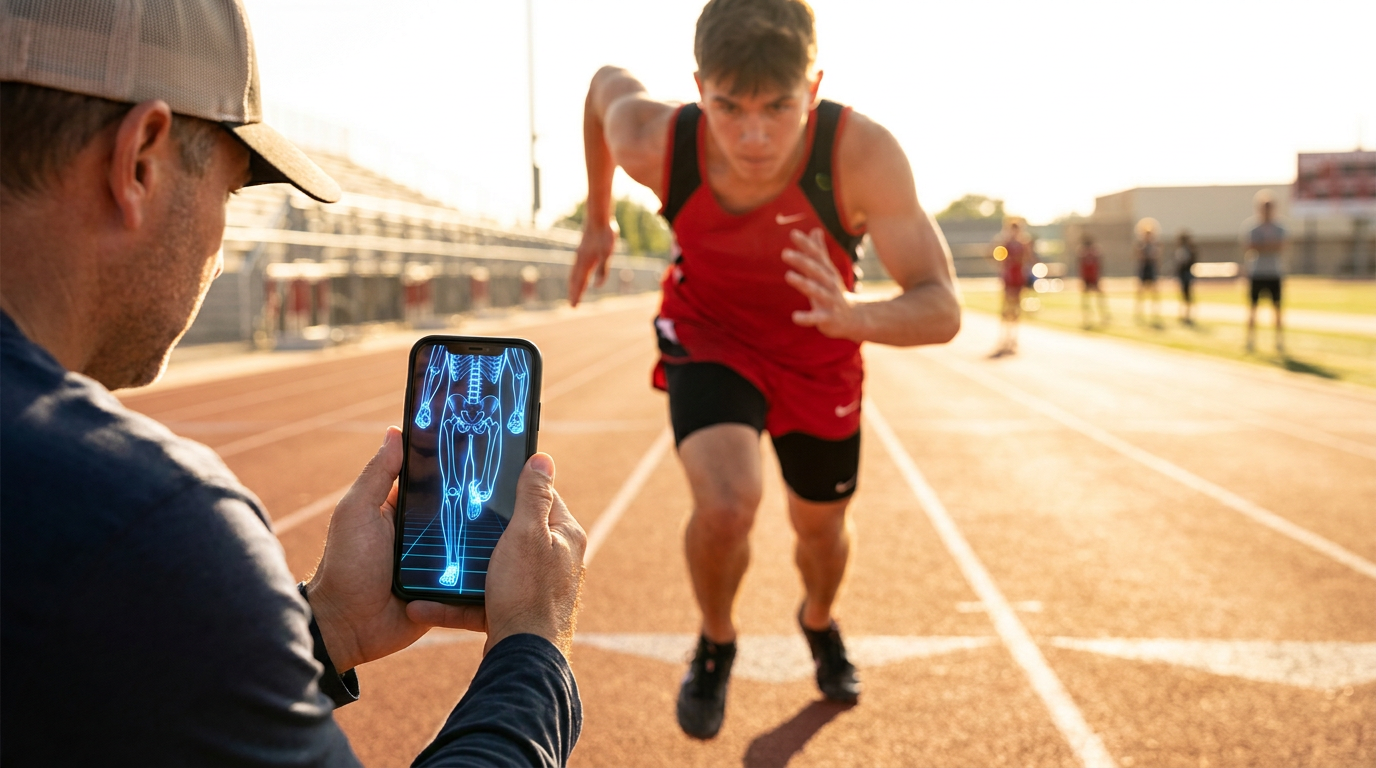
Advancements in computer vision and artificial intelligence are transforming standard smartphones into portable motion-capture laboratories. This open-source revolution is democratizing sports analytics, allowing amateur athletes and grassroots teams to access elite-level biomechanical data and tactical insights for free.
By Factlen Editorial Team
- Clinical Biomechanists
- Medical and research professionals focused on using accessible data to prevent injuries and speed up rehabilitation.
- Open-Source Developers
- Software engineers and data scientists dedicated to breaking down the paywalls of elite sports technology.
- Sports Technologists
- Industry experts analyzing the validation and real-world implementation of mobile tracking tools.
What's not represented
- · Elite professional teams with proprietary systems
- · Data privacy advocates concerned about youth biometric tracking
Why this matters
For decades, advanced sports analytics and injury-preventing biomechanics were luxuries reserved for multi-million-dollar professional franchises. The rise of open-source AI and smartphone tracking is now putting that same elite technology into the hands of high school coaches, amateur athletes, and local physical therapists, fundamentally leveling the playing field for youth development.
Key points
- Traditional motion capture labs cost upwards of $150,000, restricting advanced biomechanics to elite professionals.
- New AI algorithms use standard smartphone cameras to map 3D digital skeletons over 2D video in real time.
- Validation studies show smartphone apps correlate highly with gold-standard force plates, proving their scientific reliability.
- Open-source communities are building free analytical models, breaking down the paywalls of sports technology.
- High school teams now use these tools to prevent injuries, optimize tactics, and share objective data with college recruiters.
For decades, the phrase "sports analytics" conjured images of multi-million-dollar professional franchises. Elite soccer clubs and NBA teams invested heavily in proprietary optical tracking systems, while biomechanics researchers relied on $150,000 laboratory setups requiring athletes to wear dozens of reflective markers. For the 99 percent of athletes playing in high schools, amateur leagues, or recovering in local physical therapy clinics, this level of insight was entirely out of reach.[7]
That paradigm is rapidly collapsing. A quiet revolution is democratizing sports science, driven not by massive budgets, but by the device sitting in nearly everyone's pocket. Advances in artificial intelligence—specifically computer vision and machine learning—are transforming standard smartphones into portable, high-fidelity motion capture laboratories.[1]
The mechanism behind this shift relies on markerless tracking. Historically, capturing an athlete's 3D kinematics required a controlled environment where infrared cameras tracked physical markers glued to the body. Today, AI algorithms are trained on vast datasets of human movement, allowing them to "understand" visual data and map a digital skeleton over a 2D video feed in real time.[2]

Stanford University's OpenCap project exemplifies this breakthrough. Created by bioengineers, the open-source application uses footage from just two smartphones to quantify how a body moves through three-dimensional space. The software calculates joint angles, tendon stretch, and the forces transferred through the body—metrics critical for predicting and preventing injuries.[1]
"It would take us days to analyze the data, so we would only do it a handful of times per year," noted Dr. Scott Uhlrich, director of research at Stanford's human performance lab, regarding the old marker-based methods. With the AI-driven smartphone approach, that same analysis now takes less than ten minutes, fundamentally changing how clinicians can design interventions for athletes with repeat injuries.[1]
The transition from the lab to the smartphone was not without friction. When sports scientist Carlos Balsalobre first submitted a validation paper for his smartphone-based measurement app, My Jump, it was desk-rejected by a top journal whose editor deemed it "not relevant that a smartphone can measure jumps."[3]
However, subsequent independent research vindicated the technology. Validation studies systematically compared the smartphone app's AI measurements against gold-standard Kistler force platforms. The results demonstrated a correlation greater than 0.98, with a precision bias of merely two centimeters. Similar studies published by the National Institutes of Health have confirmed that AI-driven smartphone video analysis can accurately estimate 3D joint angles in the sagittal plane from a simple frontal view.[2][3]

However, subsequent independent research vindicated the technology.
This validation has triggered a wave of innovation aimed at grassroots sports. Developers are building accessible software that bypasses the paywalls of elite sports tech. At the University of Calgary, biomechanics researcher Dr. Victor Cossich developed Mokapp, an AI-powered system that uses standard webcams to flag injury risks and monitor fatigue for amateur athletes who cannot afford traditional motion capture.[5]
Beyond biomechanics, the democratization extends to tactical and event data. The open-source community PySport, founded by Koen Vossen, serves as a hub for sports analytics tools across multiple programming languages. By standardizing disparate tracking data into consistent formats, PySport allows hobbyists, students, and amateur coaches to build advanced predictive models—like expected goals (xG) in soccer—that were once the exclusive domain of professional data departments.[4]
"The most important mission... is to bridge the gap between the clubs and the sports analytics enthusiastic people by using open-source packages," Vossen explained. This collaborative ecosystem encourages domain experts, such as video analysts at smaller clubs, to cross over into coding and share their improvements with the broader community.[4]
Legacy open-source tools are also evolving to meet this moment. Kinovea, a free video annotation tool created by developer Joan Charmant in 2004, has long been a staple for amateur coaches wanting to slow down and measure motion. Now, the integration of modern computer vision APIs allows these grassroots platforms to offer semi-automated tracking that rivals commercial software.[6][7]

The real-world implications of this technology are profound for youth development and amateur athletics. High school teams are utilizing AI-powered analytics to evaluate offensive schemes, identify player fatigue before it leads to a torn ligament, and generate objective statistical breakdowns for college recruiters.[7]
A player from a rural high school can now upload a smartphone video of their sprinting mechanics or pitching motion, run it through an open-source kinematic model, and share professional-grade biomechanical data with scouts. This measurably changes the recruiting landscape, allowing talent evaluators to find undervalued players based on objective movement efficiency rather than just raw, uncontextualized statistics.[7]
Yet, uncertainties remain as the technology scales. While computer vision excels at tracking a single athlete in a controlled frame, accurately mapping complex, multi-player collisions—where bodies occlude one another in a chaotic game environment—remains a significant computational challenge.[7]

Furthermore, the widespread collection of highly precise biometric and kinematic data from minors raises new questions about data privacy. As amateur teams build longitudinal datasets tracking youth players' movement patterns, the sports industry will need to establish clear ethical guidelines regarding consent and data ownership.[7]
Despite these hurdles, the trajectory is clear. The democratization of sports analytics is leveling the playing field, ensuring that data-driven insights, injury prevention, and tactical optimization are no longer luxuries reserved for the elite, but fundamental tools available to anyone with a smartphone and a passion for the game.[7]
How we got here
Early 2000s
Motion capture requires $150,000 lab setups, reflective markers, and days of manual data processing.
2010s
Elite professional teams begin heavily investing in proprietary optical tracking systems like Hawk-Eye and Second Spectrum.
2022
Stanford researchers introduce OpenCap, allowing researchers to capture 3D kinematics using just two smartphones.
2023
Open-source communities like PySport gain traction, standardizing sports data and providing free analytical models.
June 2024
Independent research validates smartphone-based jump tracking against gold-standard force plates, cementing AI's reliability.
2026
AI-powered sports analytics becomes widely accessible to high school and amateur teams, fundamentally changing youth development.
Viewpoints in depth
Clinical Biomechanists
Medical and research professionals focused on using accessible data to prevent injuries and speed up rehabilitation.
For biomechanists, the primary value of smartphone AI is not just performance enhancement, but injury prevention. By democratizing access to kinematic data, physical therapists can regularly monitor how an athlete's joints handle stress over time, rather than relying on a single, expensive lab visit. They argue that widespread use of these tools will drastically reduce chronic injuries in youth sports by catching dangerous movement patterns—like improper landing mechanics—before they result in torn ligaments.
Open-Source Developers
Software engineers and data scientists dedicated to breaking down the paywalls of elite sports technology.
This community believes that advanced analytics should be a public good, not a proprietary advantage hoarded by wealthy franchises. By building free, collaborative platforms like PySport and Kinovea, they aim to standardize sports data formats and provide open-access machine learning models. They argue that the fastest way to innovate in sports science is through transparent, community-driven development where a high school coach can contribute to the same codebase used by professional analysts.
Amateur & High School Coaches
Grassroots leaders utilizing new technology to level the playing field and maximize youth talent.
For coaches at the amateur level, AI analytics represents a paradigm shift in talent identification and tactical planning. Without the budget for dedicated data departments, these coaches rely on automated smartphone apps to generate objective performance metrics. They view this technology as a crucial equalizer that allows players from underfunded programs to showcase verified, professional-grade biomechanical data to college recruiters, ensuring that raw talent is recognized regardless of a program's financial resources.
What we don't know
- How accurately smartphone AI can track complex, multi-player collisions where bodies occlude one another.
- Whether the widespread collection of youth biomechanical data will lead to new privacy regulations.
- How quickly traditional sports science journals and institutions will fully accept markerless tracking as a gold standard.
Key terms
- Kinematics
- The study of motion without considering the forces that cause it, often focusing on joint angles and body positioning.
- Computer Vision
- A field of AI that trains computers to interpret and understand visual information from the world, such as identifying a player's pose from a video.
- Markerless Motion Capture
- Tracking human movement using only video cameras, eliminating the need for athletes to wear physical sensors or reflective markers.
- Sagittal Plane
- An anatomical plane that divides the body into left and right halves, often used to analyze forward-and-backward movements like running or jumping.
Frequently asked
Do I need special equipment to use these AI sports apps?
No. Most modern systems, like OpenCap or My Jump Lab, require only a standard smartphone camera and a tripod to capture high-quality biomechanical data.
Are smartphone apps as accurate as professional motion capture labs?
They are remarkably close. Validation studies show that AI-driven smartphone apps have a greater than 0.98 correlation with gold-standard force plates and traditional marker-based systems.
Is this technology only for professional athletes?
Not anymore. The open-source movement has democratized these tools, making them accessible to high school teams, amateur athletes, and physical therapy patients.
Sources
Source coverage
7 outlets
3 viewpoints surfaced







[1]MDedgeClinical Biomechanists
App turns smartphones into motion-capture lab
Read on MDedge →[2]National Institutes of HealthClinical Biomechanists
Smartphone-based artificial intelligence motion capture system for kinematics
Read on National Institutes of Health →[3]SportsmithSports Technologists
Computer vision, AI and using a phone app to quantify athlete movement
Read on Sportsmith →[4]PySportOpen-Source Developers
Sports Analytics meets Open Source
Read on PySport →[5]University of CalgaryClinical Biomechanists
Biomechanics entrepreneur chooses UCalgary to grow startup Mokapp
Read on University of Calgary →[6]KinoveaOpen-Source Developers
Kinovea: A microscope for your videos
Read on Kinovea →[7]Factlen Editorial TeamSports Technologists
Synthesis by Factlen editorial team
Read on Factlen Editorial Team →
More in sports
See all 6 stories →Freestyle Chess
How Freestyle Chess is Saving the Game from Computer Memorization
6 sources

UFL Championship
From 0-3 to Champions: Louisville Kings Capture 2026 UFL Title in Inaugural Season
6 sources

Women's Soccer
U.S. Women's Soccer Leagues Capitalize on World Cup Fever with Strategic Expansions and Calendar Shifts
6 sources

Chess AI
How Neural Networks and NNUE Transformed Modern Chess Engines
6 sources

Every angle. Every day.
Get sports stories with full source coverage and perspective breakdowns delivered to your inbox.