
Smart Rings vs. Smartwatches: The 2026 Health Tracking Trade-Off
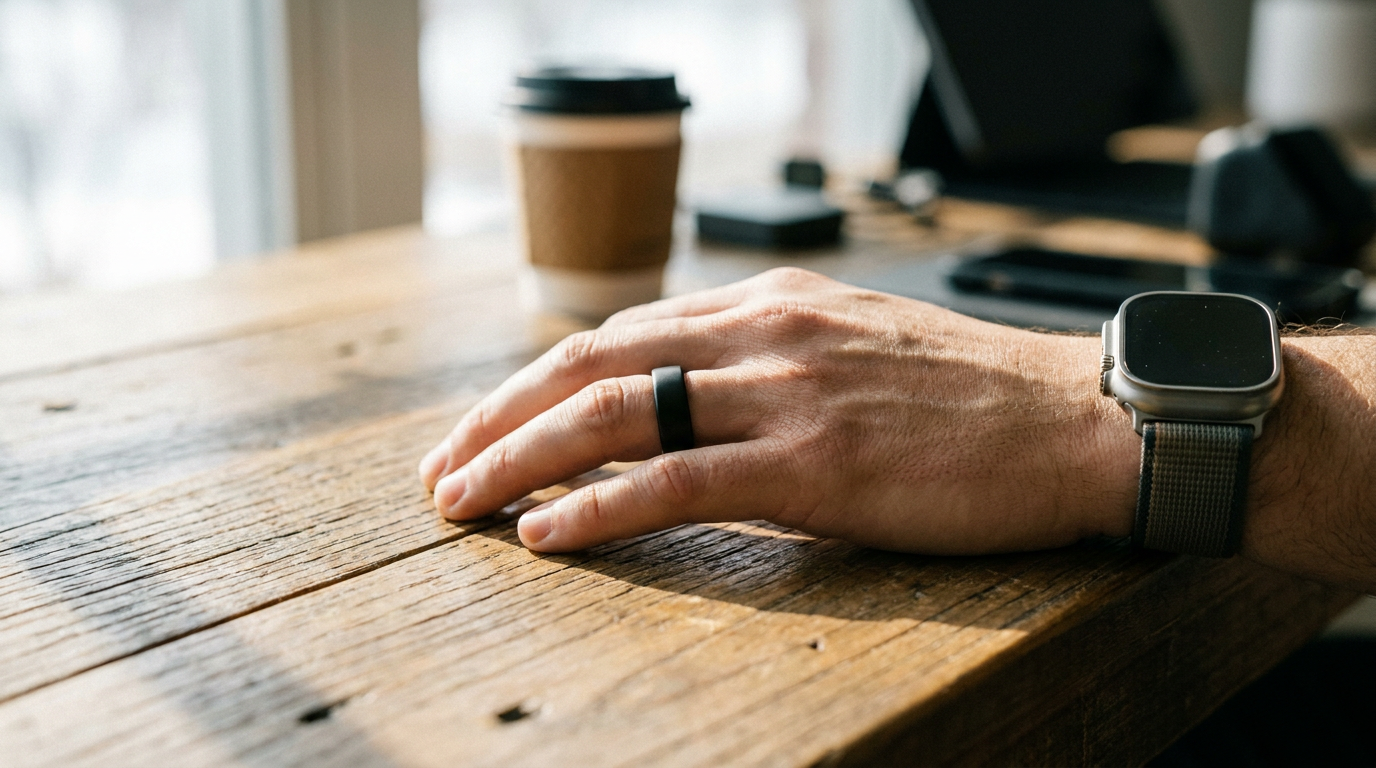
As smart rings reach mainstream maturity in 2026, consumers face a definitive choice between the passive, continuous data collection of a ring and the interactive, feature-rich dashboard of a smartwatch.
By Factlen Editorial Team
- Digital Minimalists
- Advocate for passive health tracking without the distraction of screens and notifications.
- Active Athletes
- Prioritize real-time workout data, GPS accuracy, and on-device coaching.
- Dual-Wearable Adopters
- Enthusiasts who utilize both devices for their respective strengths, swapping them day and night.
What's not represented
- · Traditional watchmakers losing wrist real estate to smartwatches.
- · Medical professionals evaluating the clinical utility of consumer wearable data.
Why this matters
Choosing the right wearable dictates whether you actually stick to your health goals. A mismatched device often ends up abandoned in a drawer, wasting hundreds of dollars and leaving you without the insights needed to improve your sleep and fitness.
Key points
- Smart rings offer superior overnight comfort and more accurate sleep tracking due to finger-based sensor placement.
- Smartwatches remain the undisputed choice for active athletes needing real-time GPS and mid-workout heart rate data.
- Battery life heavily favors smart rings, which typically last 5 to 7 days compared to a smartwatch's 18 to 40 hours.
- The choice ultimately depends on whether a user prefers passive background data collection or an interactive wrist dashboard.
The 2026 wearable landscape has fractured into two distinct philosophies: the ambient data collection of the smart ring and the interactive dashboard of the smartwatch. With the recent maturation of devices like the Samsung Galaxy Ring, the Oura Ring 4, and the Apple Watch Series 11, consumers face a definitive choice between form factors. This is no longer a question of which device is objectively superior, but rather which tracking methodology aligns with a user's daily habits. The market has segmented into those who want their health data to quietly hum in the background and those who want to actively manage it from their wrist.[1][3][5]
Analyzing the trade-offs for physical comfort reveals a stark contrast in wearability. The argument for the smart ring centers on its nearly imperceptible footprint; devices like the Galaxy Ring weigh a mere three grams and seamlessly blend into everyday attire. The evidence against the smartwatch in this arena is its inescapable bulk. Wearing a thirty- to fifty-gram metal and glass screen can feel cumbersome during desk work and often catches on clothing, making it a constant physical presence that some users find fatiguing over a twenty-four-hour period.[2][3][4][5]
When evaluating sleep tracking, the side-by-side comparison heavily favors the ring. The case for the smart ring is rooted in superior sensor placement and overnight comfort. Evidence from wearable wellness analysts indicates that finger-based photoplethysmography sensors capture a stronger, cleaner pulse signal from digital arteries than wrist-mounted sensors, which are highly susceptible to motion artifacts. The argument against the smartwatch for sleep is twofold: its bulky chassis often disrupts the very rest it aims to measure, and its glowing screen can be a nighttime distraction.[6][7]

Conversely, the trade-offs for active fitness tracking definitively crown the smartwatch. The argument for the watch is its capacity for real-time feedback and independent functionality. Evidence from fitness testers demonstrates that devices like the Apple Watch Series 11 utilize built-in GPS, multi-sensor arrays, and live OLED displays to guide pacing and heart rate zones mid-run. The case against the smart ring for athletes is its complete lack of a screen and delayed data syncing, rendering it incapable of providing the immediate coaching required during interval training or cycling.[1][5][7]
Battery life and charging cadence present another major divergence in the user experience. The evidence for the smart ring's superiority here is highly quantifiable: premium rings routinely deliver five to seven days of continuous use on a single charge. The argument against the smartwatch is its demanding power consumption, with flagship models typically requiring a daily charge and lasting only eighteen to forty hours. This frequent charging cycle creates inevitable gaps in data collection, particularly if the watch spends the night on a charger rather than tracking vital sleep stages.[1][3][5][7]
Battery life and charging cadence present another major divergence in the user experience.
In the realm of advanced medical screening, the smartwatch retains a definitive edge. The case for the watch includes its ability to perform active electrocardiograms and detect irregular heart rhythms such as atrial fibrillation. The evidence against the smart ring in this category is its reliance on passive optical sensors, which cannot currently match the medical-grade electrical heart sensors built into premium watches. For users monitoring specific cardiovascular conditions, the wrist remains the only viable location for consumer-grade diagnostics.[1][3][7]

Financial structures also diverge, introducing long-term cost considerations. The argument against certain smart rings, notably the Oura Ring, is the requirement of a monthly subscription fee—typically around six dollars—to access comprehensive health metrics, turning a hardware purchase into an ongoing software lease. The case for the smartwatch, and newer rings like Samsung's, is the traditional upfront pricing model. While an Apple Watch or Galaxy Watch may carry a higher initial price tag, the absence of a paywall for basic health data often makes them more cost-effective over a multi-year lifespan.[2][4]
The smart ring fits well when the user prioritizes digital minimalism, sleep comfort, and continuous passive data collection. It is the ideal choice for individuals who want to monitor their recovery, heart rate variability, and overall readiness without adding another distracting screen to their daily routine. It also serves as an excellent companion for those who prefer wearing traditional mechanical timepieces but still want to capture their daily biometric data.[3][7]
The smart ring does not fit when the user needs real-time workout metrics, on-device notifications, or the ability to leave their smartphone at home during a run. It is a poor choice for serious athletes who require live pacing data, or for individuals who rely on their wearable to triage text messages, control smart home devices, or make contactless payments at the grocery store.[1][5]

The smartwatch fits well when the user demands a comprehensive, interactive health and lifestyle hub on their wrist. It excels for runners who require live GPS mapping, hikers who need on-wrist navigation, and professionals who rely on quick notification management. It is the optimal choice for anyone who views their wearable as an extension of their smartphone, offering a suite of applications that actively assist in navigating the day.[2][4][5]
The smartwatch does not fit when the user suffers from screen fatigue, finds wrist wearables uncomfortable during sleep, or despises the daily ritual of charging yet another electronic device. Ultimately, the 2026 wearable market forces a lifestyle decision. For a growing segment of health enthusiasts, the solution has been to adopt both: relying on the watch for daytime productivity and workouts, while switching to the ring for unobtrusive, high-fidelity overnight recovery tracking.[4][7]

How we got here
2015
The original Apple Watch launches, establishing the wrist as the primary hub for consumer health tracking.
2018
Oura releases its Gen 2 ring, proving that finger-based sensors can accurately track sleep stages.
2024
Samsung enters the smart ring market with the Galaxy Ring, validating the form factor for mainstream Android users.
2026
The release of the Oura Ring 4 and Apple Watch Series 11 solidifies the distinct divide between passive and active wearables.
Viewpoints in depth
Digital Minimalists
Advocates for passive health tracking without the distraction of screens.
This camp argues that the primary benefit of a wearable is the data it collects, not the notifications it delivers. By removing the screen, smart rings eliminate the anxiety of constant connectivity. Minimalists point to the psychological benefits of reviewing health data on a smartphone once a day, rather than being interrupted by hourly stand reminders or incoming text messages on the wrist.
Active Athletes
Users who prioritize real-time workout data and on-device coaching.
For serious runners, cyclists, and weightlifters, a wearable is a real-time tool, not just a passive recorder. This perspective emphasizes that heart rate zones, pacing, and GPS mapping must be visible mid-workout to be useful. Athletes argue that while a ring might provide excellent morning recovery scores, it is fundamentally incapable of guiding a high-intensity interval session or tracking a route without a tethered phone.
The Dual-Wearable Adopters
Enthusiasts who utilize both devices for their respective strengths.
A growing segment of the market refuses to compromise, choosing to wear both a smartwatch and a smart ring. This camp utilizes the watch during the day for productivity, contactless payments, and workout tracking, but removes it at night to charge. They rely entirely on the smart ring for sleep staging and overnight heart rate variability, seamlessly merging the data in aggregator apps like Apple Health or Google Fit.
What we don't know
- Whether future smart rings will successfully integrate non-invasive blood glucose monitoring, a feature heavily rumored but not yet realized.
- How long-term subscription fatigue will impact the market share of companies like Oura compared to subscription-free alternatives.
- If miniaturization will eventually allow smart rings to incorporate haptic feedback motors for silent alarms without sacrificing battery life.
Key terms
- Photoplethysmography (PPG)
- An optical sensor technology that uses light to measure changes in blood volume, commonly used to track heart rate.
- Heart Rate Variability (HRV)
- The variation in time between consecutive heartbeats, used as a key indicator of physical recovery and stress levels.
- Electrocardiogram (ECG)
- A medical-grade test that measures the electrical activity of the heart to detect irregularities like atrial fibrillation.
Frequently asked
Can a smart ring track my runs via GPS?
No. Current smart rings lack built-in GPS antennas due to size constraints. They rely on a tethered smartphone to map outdoor workouts.
Do I have to pay a monthly subscription for a smart ring?
It depends on the brand. The Oura Ring requires a $5.99 monthly subscription for full data access, while the Samsung Galaxy Ring and RingConn do not.
Which device is more accurate for sleep tracking?
Smart rings generally provide more accurate sleep data because finger-based sensors capture a stronger pulse signal and the devices are less prone to shifting during the night.
Sources
Source coverage
7 outlets
3 viewpoints surfaced







[1]ForbesActive Athletes
Oura Ring Vs. Apple Watch: Fitness Tracking
Read on Forbes →[2]CosmopolitanDual-Wearable Adopters
Oura Ring vs. Apple Watch: Which Should You Buy?
Read on Cosmopolitan →[3]WareableDigital Minimalists
Samsung Galaxy Ring vs Galaxy Watch – what's the difference?
Read on Wareable →[4]EsquireDual-Wearable Adopters
Oura Ring vs. Apple Watch
Read on Esquire →[5]TechWiserActive Athletes
Samsung Galaxy Ring vs. Galaxy Watch 7
Read on TechWiser →[6]Wearable Wellness GuideDigital Minimalists
Stress Tracker Comparison 2026: Ring, Watch & Biofeedback
Read on Wearable Wellness Guide →[7]Smart Ring HQDigital Minimalists
Smart Ring vs Smartwatch: The Honest 2026 Comparison
Read on Smart Ring HQ →

Every angle. Every day.
Get shopping stories with full source coverage and perspective breakdowns delivered to your inbox.