
The Pollen-Eating Butterflies That Defy Biological Aging
A newly published study reveals that tropical Heliconius butterflies can live up to a year by consuming pollen, offering researchers a novel model for understanding how animals can delay physiological senescence.
By Factlen Editorial Team
- Longevity Researchers
- View these butterflies as a highly tractable new model system for uncovering the biological mechanisms that delay physical and cognitive senescence.
- Evolutionary Biologists
- Focus on how ecological shifts, like adapting to digest pollen, trigger a cascade of heritable genetic changes that fundamentally alter an organism's life history.
- Ecologists
- Emphasize the environmental interactions and foraging behaviors that allow these insects to thrive for months in competitive tropical rainforests.
What's not represented
- · Botanists studying the co-evolution of the specific pollen-producing plants that support these butterflies.
- · Conservationists monitoring how habitat loss in Central and South America might threaten these unique long-lived species.
Why this matters
Understanding how certain species naturally halt physical decline provides crucial clues for human longevity research. By studying organisms that have evolved to resist aging, scientists can uncover new genetic and nutritional pathways to extend healthy lifespans.
Key points
- Tropical Heliconius butterflies can live up to 348 days, vastly outliving their close relatives.
- Their extraordinary lifespan is linked to a unique ability to consume and digest pollen as adults.
- Pollen provides essential amino acids that allow the butterflies to maintain muscle mass and avoid age-related decline.
- Experiments show this longevity is now genetically hardwired, as pollen-deprived Heliconius still outlive other species.
- Researchers believe these butterflies could serve as a powerful new model organism for studying biological aging.
Most butterflies are ephemeral creatures. After emerging from their chrysalises, species like the painted lady or the monarch perform spectacular feats of migration, but their adult lives are typically measured in mere weeks. For decades, entomologists accepted this rapid senescence as a biological inevitability for the Lepidoptera order. But deep in the rainforests of Central and South America, one genus of tropical butterfly has been quietly breaking the rules of biological aging.[4][5]
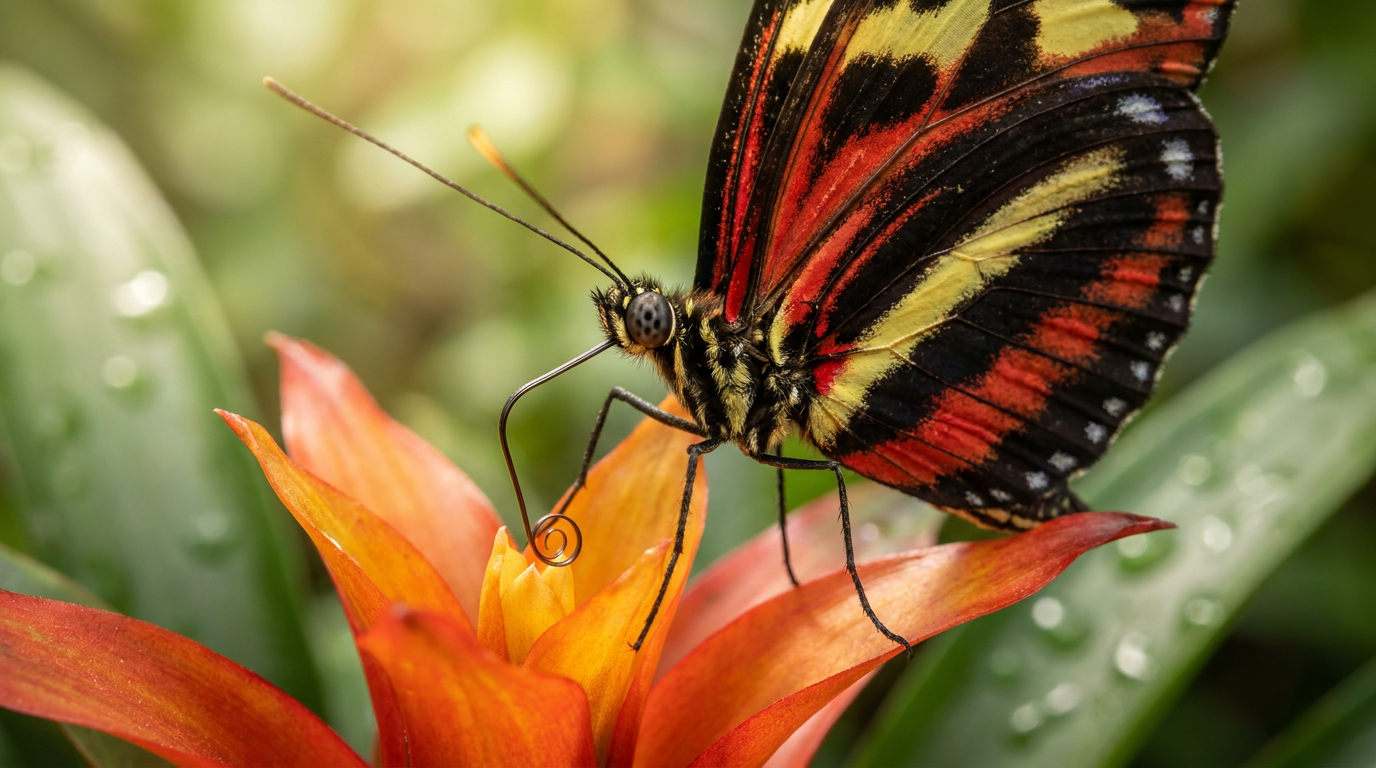
Butterflies of the genus Heliconius can survive for nearly a year in the wild. They do not merely exist in a state of suspended animation or diapause; they remain active, foraging, and reproducing for months on end. A new study published this week in the journal Nature Communications has finally unraveled the mechanics behind this extraordinary lifespan, pointing to a unique dietary innovation and a cascade of evolutionary adaptations that effectively halt physiological decline.[1][2]
The research, led by Dr. Jessica Foley at the University of Bristol in collaboration with the Smithsonian Tropical Research Institute, reveals that Heliconius butterflies have evolved the rare ability to consume and digest pollen. While almost all other butterflies rely exclusively on flower nectar—a simple sugar solution that provides quick energy but little structural nutrition—Heliconius actively collects pollen grains, processing them to extract a rich supply of essential amino acids and fats.[2][3]
This dietary shift is profound. Nectar is the equivalent of a biological sugar rush, sufficient to fuel a few weeks of frantic mating and egg-laying before the insect's body inevitably degrades. Pollen, by contrast, is a complex superfood. By unlocking the ability to digest it, Heliconius secures a steady stream of the building blocks necessary for cellular repair, immune defense, and long-term tissue maintenance.[4][6]

To quantify exactly how this diet impacts aging, the research team compiled the maximum reported lifespans of dozens of butterfly species within the broader Heliconiini tribe. They utilized decades of data from field studies, public butterfly houses, and mark-release-recapture programs. The resulting dataset exposed a staggering 25-fold variation in maximum lifespan among closely related kin.[1][2][4]
The numbers paint a stark picture of evolutionary divergence. Non-pollen-consuming species in the tribe, such as Dione juno, live for an average of just 14 to 58 days. In contrast, the pollen-feeding Heliconius species boast an average maximum lifespan of 177 days. The most extreme outlier, Heliconius hewitsoni, has been documented living for an astonishing 348 days—the longest recorded lifespan for any butterfly in the scientific literature.[1][4][5]

But longevity is only half the story. The researchers were equally interested in "healthspan"—the period of life spent free from the debilitating effects of aging. In most animals, including humans, advancing age brings a predictable decline in muscle mass, motor function, and overall vitality. To test whether Heliconius experiences this typical senescence, the team designed a controlled insectary experiment comparing the pollen-feeding Heliconius hecale with a closely related non-pollen-feeding species, Dryas iulia.[1][2]
The researchers were equally interested in "healthspan"—the period of life spent free from the debilitating effects of aging.
The scientists subjected the aging butterflies to a grip-strength test, effectively a Lepidopteran version of a deadlift, to measure their physical performance over time. The results were striking. While Dryas iulia exhibited the expected age-related physiological decline, rapidly losing muscle function and body mass, Heliconius hecale showed virtually no deterioration. Older individuals maintained their grip strength and body mass just as effectively as their younger counterparts.[2][4]
This absence of physical decline suggests that Heliconius has evolved mechanisms to actively repair cellular damage and maintain muscle integrity over a prolonged period. The amino acids derived from pollen are undoubtedly central to this process, providing the raw materials needed to continuously rebuild tissues that would otherwise degrade.[5][6]

However, the study uncovered a fascinating evolutionary twist that elevates the story beyond a simple dietary intervention. The researchers conducted a dietary manipulation experiment, depriving Heliconius hecale of its pollen-rich diet and forcing it to subsist solely on nectar. They simultaneously offered pollen to the non-pollen-feeding Dryas iulia.[1][4]
If diet were the sole driver of longevity, the lifespans of the two species should have converged. Instead, the pollen-deprived Heliconius hecale still vastly outlived Dryas iulia. Furthermore, Dryas iulia gained no longevity benefits from the pollen-inclusive diet, indicating it lacks the physiological machinery to extract or utilize the nutrients.[4][5]
This strongly suggests that while pollen feeding was the evolutionary trigger, the extended lifespan of Heliconius is now hardwired into its genetics. The genus has developed an "adaptive suite" of heritable traits—from specialized digestive enzymes to enhanced cellular repair mechanisms—that fundamentally alter its biological clock. The diet opened the door, but evolution remodeled the entire house.[1][6]

The implications of this discovery extend far beyond entomology. Research into long-lived species across the animal kingdom holds extraordinary potential for uncovering novel mechanisms of healthy aging. Traditionally, scientists have relied on a handful of model organisms, like mice or nematode worms, to study senescence. The introduction of Heliconius provides a highly tractable new system for investigating how behavioral innovations can trigger a cascade of life-extending adaptations.[2][6]
Because Heliconius butterflies are already supported by considerable ecological and genomic data, researchers can now begin pinpointing the exact genetic pathways responsible for their delayed aging. By comparing their genomes with those of their short-lived relatives, scientists hope to identify the specific mutations that allow these insects to maintain muscle function and cellular health for nearly a year.[1][3]
Ultimately, the story of the Heliconius butterfly is a testament to the power of evolutionary innovation. By finding a way to tap into a new nutritional resource, these vibrant insects have essentially rewritten the rules of their own mortality. As researchers continue to probe the biological secrets hidden within their pollen-dusted proboscises, the findings may one day inform our own quest to extend human healthspan and delay the onset of age-related decline.[2][6]
How we got here
Early 2000s
Researchers first document the unique pollen-feeding behavior of the Heliconius genus.
2012
The genome of the Heliconius melpomene butterfly is fully sequenced, providing a foundation for genetic comparisons.
2020
Field studies confirm that certain Heliconius species can survive for over six months in the wild.
June 2026
Nature Communications publishes the comprehensive study linking pollen diet to delayed physiological senescence and a 348-day maximum lifespan.
Viewpoints in depth
Evolutionary Biologists
Focus on how ecological shifts trigger heritable genetic changes.
For evolutionary biologists, the Heliconius genus represents a textbook example of an 'adaptive suite.' The initial behavioral innovation—learning to consume and process pollen—created a new evolutionary pressure. Because pollen provided the raw materials for longer life, natural selection began to favor genetic mutations that delayed senescence and maintained muscle function, allowing the butterflies to reproduce over a much longer window. This demonstrates how a single ecological shift can fundamentally rewrite an organism's life history.
Longevity Researchers
View these butterflies as a new model system for uncovering the mechanisms of delayed senescence.
Researchers focused on the biology of aging see Heliconius as a highly tractable new model organism. Unlike traditional models such as mice or fruit flies, these butterflies offer a natural comparative experiment: closely related species with vastly different aging trajectories. By studying how Heliconius maintains its 'grip strength' and cellular integrity for months, scientists hope to isolate the specific genetic and metabolic pathways that prevent age-related physiological decline, offering potential insights for human healthspan interventions.
Ecologists
Emphasize the environmental interactions and foraging behaviors that support this extended lifespan.
From an ecological perspective, the extended lifespan of Heliconius is intimately tied to its environment. These butterflies inhabit highly competitive tropical rainforests where resources can be unpredictable. By establishing complex 'traplines'—memorized foraging routes to specific pollen-producing plants—they secure a reliable food source. Ecologists study how this advanced spatial memory and foraging behavior co-evolved with their longevity, allowing them to thrive in complex ecosystems for nearly a year.
What we don't know
- The exact genetic mutations that allow Heliconius to process pollen and delay cellular senescence remain unidentified.
- It is unclear how the butterflies' advanced spatial memory and cognitive function hold up over their extended lifespans.
- Researchers do not yet know if similar dietary innovations could trigger extended lifespans in other undiscovered insect lineages.
Key terms
- Senescence
- The condition or process of deterioration with age, characterized by a decline in physiological function and cellular health.
- Lepidoptera
- The order of insects that includes butterflies and moths.
- Adaptive Suite
- A group of multiple, co-adapted traits that evolve together in response to a specific ecological shift or behavioral innovation.
- Diapause
- A period of suspended development or dormancy in insects, often used to survive unfavorable environmental conditions.
- Proboscis
- The elongated, tubular feeding organ of a butterfly, used to suck up nectar and, in the case of Heliconius, gather pollen.
Frequently asked
Why do most butterflies have such short lifespans?
Most butterflies rely on flower nectar, which provides quick energy but lacks the essential amino acids and fats needed for long-term cellular repair and tissue maintenance.
How does Heliconius digest pollen?
Unlike other butterflies, Heliconius species collect pollen on their proboscis and secrete specialized enzymes to break down the grains, absorbing the nutrient-rich contents over several hours.
Could feeding pollen to other insects make them live longer?
No. The recent study showed that when non-pollen-feeding relatives were given a pollen diet, they gained no longevity benefits, indicating they lack the evolved physiological machinery to process it.
What does this mean for human aging research?
By comparing the genomes of long-lived Heliconius butterflies with their short-lived relatives, scientists hope to identify specific genetic pathways that delay physical decline, which could eventually inform human longevity therapies.
Sources
Source coverage
6 outlets
3 viewpoints surfaced






[1]Nature CommunicationsLongevity Researchers
Dietary innovation and the evolution of extended lifespan in Heliconius butterflies
Read on Nature Communications →[2]University of BristolEvolutionary Biologists
A long-lived butterfly's secret to graceful ageing
Read on University of Bristol →[3]Smithsonian Tropical Research InstituteEvolutionary Biologists
Heliconius longevity and pollen feeding behavior
Read on Smithsonian Tropical Research Institute →[4]ScienceAlertEcologists
An Incredibly Long-Lived Butterfly May Hold The Secret To Slower Aging
Read on ScienceAlert →[5]Discover MagazineEcologists
The Nutritional Key to a Long Life
Read on Discover Magazine →[6]Factlen Editorial TeamLongevity Researchers
Synthesis by Factlen editorial team
Read on Factlen Editorial Team →


Every angle. Every day.
Get science stories with full source coverage and perspective breakdowns delivered to your inbox.