
The Hidden Power Plant in Your Garage: How VPPs Are Rewiring the Grid
Virtual power plants are networking thousands of home batteries, EVs, and smart thermostats to stabilize the grid, offering a cheaper and cleaner alternative to fossil-fuel peaker plants.
By Factlen Editorial Team
- Grid Operators & Utilities
- Focus on reliability, managing peak load, and deferring expensive infrastructure upgrades.
- Consumer Advocates
- Focus on lowering energy bills, democratizing energy markets, and ensuring homeowners are fairly compensated.
- Environmental Groups
- Focus on decarbonization, retiring fossil-fuel peaker plants, and integrating variable renewable energy.
- Industry Analysts
- Focus on standardizing device protocols, expanding adoption, and removing regulatory barriers.
What's not represented
- · Fossil-fuel power plant operators
- · Traditional utility monopolies resisting decentralization
Why this matters
By turning everyday appliances into grid assets, virtual power plants allow homeowners to earn money while preventing blackouts and accelerating the retirement of highly polluting fossil-fuel plants.
Key points
- A Virtual Power Plant (VPP) is a cloud-based network that coordinates thousands of small energy devices to act as a single power plant.
- VPPs utilize existing home batteries, EVs, and smart thermostats to balance grid supply and demand in real time.
- They offer a cheaper, cleaner alternative to building new fossil-fuel "peaker" plants or high-voltage transmission lines.
- The U.S. Department of Energy aims to deploy 80 to 160 gigawatts of VPP capacity by 2030.
- Participating consumers can earn money or bill credits for allowing the network to manage their devices during peak hours.
- Widespread VPP adoption could save the U.S. grid $10 billion annually, lowering electricity rates for all consumers.
The electricity grid is facing a math problem it was not built to solve. Driven by the rapid electrification of transportation, the resurgence of domestic manufacturing, and the insatiable power demands of artificial intelligence data centers, peak electricity demand is surging at an unprecedented rate.[1]
Historically, grid operators solved this by building more centralized infrastructure: massive coal or natural gas plants, and thousands of miles of high-voltage transmission lines. But today, building a new power plant or transmission line can take a decade and cost billions of dollars, while interconnection queues stretch for years.[1]
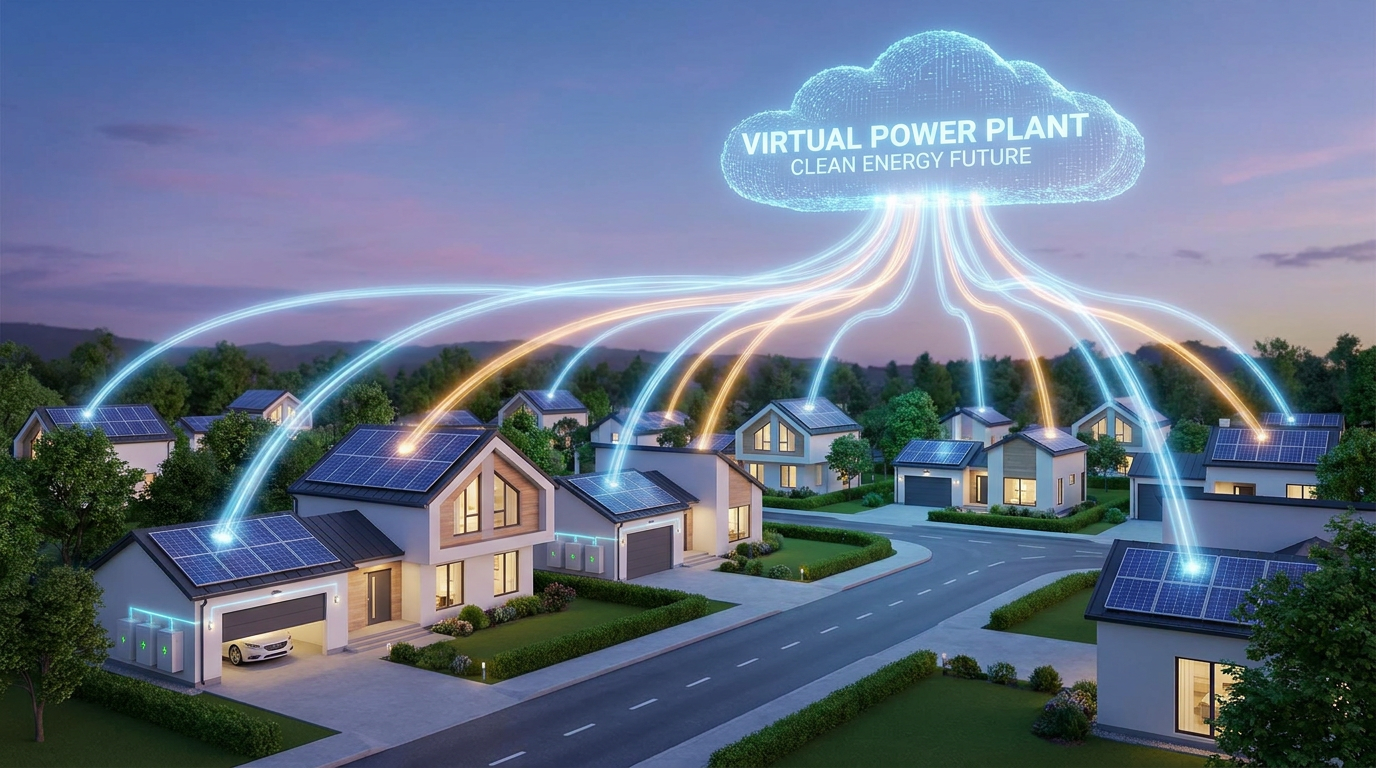
Instead of pouring concrete, energy planners are increasingly looking to a digital alternative: the Virtual Power Plant (VPP). Rather than generating power from a single, centralized facility with smokestacks, a VPP is a cloud-based network that aggregates thousands of small, decentralized energy devices to act as a single, massive power plant.[4][7]
These devices, known as Distributed Energy Resources (DERs), are already sitting in millions of homes and businesses. They include rooftop solar panels, home battery storage systems, electric vehicle (EV) chargers, smart thermostats, and electric water heaters. By networking them together, a VPP can provide the exact same grid services as a traditional power plant—but faster, cheaper, and without the emissions.[1][2][3]

The mechanism relies on advanced software, artificial intelligence, and two-way communication. A VPP operates through a communication layer that connects every participating device to a central platform, and a control layer that optimizes the entire portfolio in real time.[7]
When the grid is stressed—such as during a 6:00 p.m. heatwave when solar production drops but air conditioning demand spikes—the VPP operator sends a secure signal. Instantly, thousands of smart thermostats might adjust their temperature up by a single degree, a shift barely noticeable to the occupants.[4][5]
Simultaneously, the VPP might pause EV charging across a designated region for 30 minutes, and command thousands of home batteries to discharge their stored solar energy back into the grid. Together, these micro-adjustments shed megawatts of demand and inject critical supply, stabilizing the network in milliseconds.[2][5]
This approach directly challenges the 20th-century grid model, which was built on a highly inefficient premise. Traditional grids are sized to handle the single highest hour of demand of the entire year. To meet that rare peak, utilities rely on "peaker plants"—fast-starting fossil-fuel generators that sit idle for most of the year and only run for a few hundred hours.[4][7]
This approach directly challenges the 20th-century grid model, which was built on a highly inefficient premise.
Peaker plants are incredibly expensive to maintain and are often located in lower-income communities, emitting high levels of localized pollution. VPPs offer a direct replacement. According to the U.S. Department of Energy (DOE), a VPP can deliver peak power needs at roughly 40% to 60% of the cost of a conventional gas peaker plant.[1][2][3]
In hard numbers, the DOE projects that a new 400-megawatt VPP would have a net cost of about $43 per kilowatt-year, compared to $99 per kilowatt-year for a new gas peaker plant. Because VPPs utilize infrastructure that consumers and businesses have already purchased, the capital expenditure for the utility is drastically lower.[3][7]

The financial benefits extend directly to the participants, fundamentally changing the relationship between consumers and the grid. Historically, energy flowed one way, and consumers simply paid the bill. In a VPP model, homeowners become "prosumers."[4][7]
By opting into a VPP program, participants are financially compensated for allowing the network to manage their devices during critical events. This can take the form of upfront rebates for buying a battery, monthly bill credits, or direct payments for the energy they export back to the grid.[4][5][6]
The scale of the transition required is massive. The DOE estimates that the United States will need to add enough new resources to serve approximately 200 gigawatts (GW) of peak demand by 2030. To help meet this, the agency is pushing to deploy 80 to 160 GW of VPP capacity by the end of the decade—effectively tripling the current scale.[1]
Achieving that target could redirect grid spending away from centralized fossil-fuel plants and into the pockets of participating consumers, while reducing overall grid costs by $10 billion per year. Because these savings lower the total cost of operating the grid, even ratepayers who do not own smart devices or participate in the VPP see a reduction in their energy bills.[1][2]

The concept is already proving its worth globally. In Australia, where rooftop solar penetration is among the highest in the world, VPPs are transitioning from emergency backup tools to daily market participants. Australian VPPs routinely buy cheap electricity when wholesale prices drop, store it in home batteries, and sell it back when prices peak, offering daily arbitrage profits to homeowners.[5][6]
Despite the clear economic and environmental advantages, significant hurdles remain. The most pressing is simply the lack of hardware. While adoption is growing, energy researchers note that less than 15% of U.S. households currently have any form of distributed energy resource installed.[4]
Furthermore, enrolling in a VPP can be a fragmented and confusing process for consumers, often requiring them to navigate complex utility regulations, third-party aggregators, and incompatible hardware standards. Many utility companies, whose traditional business models rely on building centralized infrastructure to guarantee returns, have been slow to embrace decentralized networks they do not fully own.[4][7]
To reach commercial liftoff, industry experts argue that regulators must mandate standardized communication protocols between devices and force utilities to fairly compensate distributed energy resources.[2][3]

As extreme weather events become more frequent and the electrification of the economy accelerates, the grid's margin for error is shrinking. Virtual power plants offer a rare scenario where everyone wins: they provide grid operators with the flexibility they desperately need, they accelerate the retirement of polluting fossil-fuel plants, and they finally pay everyday consumers for the energy sitting in their garages and basements.[1][2][4][7]
How we got here
2016
Early pilot VPPs begin operating in regions like Southern California to manage local capacity constraints.
2022
Extreme heatwaves in California prove the viability of VPPs as distributed networks help avoid statewide blackouts.
2023
The U.S. Department of Energy releases its "Pathways to Commercial Liftoff" report, officially championing VPPs.
2025
VPPs successfully stabilize grids during severe summer heatwaves in New England and Texas.
2026
VPP capacity targets accelerate globally as grid operators race to meet the power demands of AI data centers and electrification.
Viewpoints in depth
Grid Operators' View
Focuses on the urgent need for flexible capacity to prevent blackouts.
For utility companies and grid operators, the primary appeal of VPPs is reliability and capital efficiency. Facing unprecedented load growth from AI data centers and electrification, operators are struggling to build physical infrastructure fast enough. VPPs offer a 'non-wires alternative' that can be deployed rapidly, allowing utilities to defer multi-billion-dollar investments in new substations and transmission lines while maintaining grid stability during extreme weather events.
Consumer Advocates' View
Focuses on democratizing the energy market and lowering household bills.
Consumer groups view VPPs as a tool for economic empowerment. For decades, ratepayers have funded the construction of expensive, centralized power plants that guarantee profits for utility monopolies. By turning homes into mini-power stations, VPPs allow everyday citizens to capture a share of those energy market revenues. Advocates stress that VPP programs must be designed equitably, ensuring that low-income households can also access the hardware needed to participate.
Environmentalists' View
Focuses on accelerating the retirement of polluting fossil-fuel infrastructure.
Climate and environmental organizations champion VPPs as the fastest way to kill the 'peaker plant.' Because traditional grid peaks are met by firing up highly polluting natural gas or coal generators—often located in marginalized communities—shaving those peaks with distributed batteries and smart thermostats directly reduces greenhouse gas emissions and localized air pollution. They argue VPPs are the missing link to a 100% renewable grid.
What we don't know
- Whether utility monopolies will fully embrace decentralized networks that they do not own or control.
- How quickly the industry can standardize communication protocols so devices from different manufacturers can seamlessly interact.
- If consumer adoption of home batteries and EVs will scale fast enough to meet the Department of Energy's 2030 capacity targets.
Key terms
- Virtual Power Plant (VPP)
- A cloud-based network that aggregates decentralized energy resources, like home batteries and smart thermostats, to act as a single, dispatchable power plant.
- Distributed Energy Resource (DER)
- Small-scale energy generation or storage technologies located close to where electricity is used, such as rooftop solar panels or electric vehicles.
- Peaker Plant
- A traditional power plant, usually powered by natural gas, that only runs during times of exceptionally high electricity demand.
- Demand Response
- Programs that encourage consumers to reduce or shift their electricity usage during peak periods to help balance the grid.
- Prosumer
- An individual who both consumes and produces electricity, typically by generating solar power and storing it in a home battery.
Frequently asked
Do I lose control of my thermostat or battery if I join a VPP?
No. Participants can always opt out of specific events or set minimum reserve levels for their batteries. The VPP only manages the devices within the parameters you approve.
How much money can a homeowner make from a VPP?
Compensation varies widely by region and program, ranging from upfront rebates for purchasing a battery to hundreds of dollars a year in bill credits or direct payments for exporting energy.
Do I need solar panels to participate in a VPP?
Not necessarily. While solar-plus-battery systems are common, many VPPs also enroll standalone smart thermostats, electric water heaters, and EV chargers to help shift demand.
What happens to a VPP if the internet goes down?
VPPs rely on cloud communication to coordinate devices. If a home loses internet connection, its devices will simply revert to their standard, localized operation until the connection is restored.
Sources
Source coverage
7 outlets
4 viewpoints surfaced







[1]U.S. Department of EnergyGrid Operators & Utilities
Pathways to Commercial Liftoff: Virtual Power Plants
Read on U.S. Department of Energy →[2]Rocky Mountain InstituteEnvironmental Groups
Virtual Power Plants, Real Benefits
Read on Rocky Mountain Institute →[3]Pew Charitable TrustsGrid Operators & Utilities
How States Are Advancing Distributed Energy
Read on Pew Charitable Trusts →[4]Union of Concerned ScientistsConsumer Advocates
I can't believe it's not a real power plant!
Read on Union of Concerned Scientists →[5]Solar ChoiceConsumer Advocates
Virtual Power Plants Explained (VPP) Australia Ultimate Guide
Read on Solar Choice →[6]Solar VictoriaConsumer Advocates
What is a virtual power plant?
Read on Solar Victoria →[7]Factlen Editorial TeamIndustry Analysts
Synthesis by Factlen editorial team
Read on Factlen Editorial Team →
Every angle. Every day.
Get energy stories with full source coverage and perspective breakdowns delivered to your inbox.