
SpaceX IPO Frenzy Cools as Wall Street Braces for $1.77 Trillion Index Inclusion
Following the largest initial public offering in history, retail momentum for SpaceX stock is stabilizing. However, a massive wave of institutional cash is preparing to enter as the company secures fast-tracked inclusion into major market indices.
By Factlen Editorial Team
- Growth Investors & Tech Bulls
- Focus on the AI pivot, launch monopoly, and index inclusion driving structural demand.
- Value Analysts & Skeptics
- Argue the $1.77T valuation is disconnected from fundamentals and warn of lock-up expiration risks.
- Institutional Indexers
- Focused purely on the mechanics of the Nasdaq-100 inclusion and the forced buying it will trigger.
- Governance Watchdogs
- Concerned about the dual-class share structure giving Elon Musk 85% voting control.
What's not represented
- · Retail investors who were priced out of the initial allocation
- · Competitors in the aerospace sector reacting to SpaceX's new capital
Why this matters
SpaceX's $1.77 trillion debut has fundamentally reweighted the stock market and introduced a massive new asset class for retirement accounts. As the stock enters major indices like the Nasdaq-100, anyone holding a broad market index fund will soon become a SpaceX shareholder.
Key points
- SpaceX completed the largest IPO in history on June 12, raising $75 billion at a $1.77 trillion valuation.
- The stock (SPCX) opened at $150 and closed its first day at $161, making Elon Musk the world's first trillionaire.
- A second wave of institutional buying is expected as the stock is fast-tracked into the Nasdaq-100 index.
- The company's valuation is heavily tied to its recent acquisition of xAI and plans for orbital data centers.
- Value analysts warn the stock is significantly overvalued, citing a $63 fair value estimate.
- Lawmakers have raised concerns over a dual-class share structure that gives Musk 85% voting control.
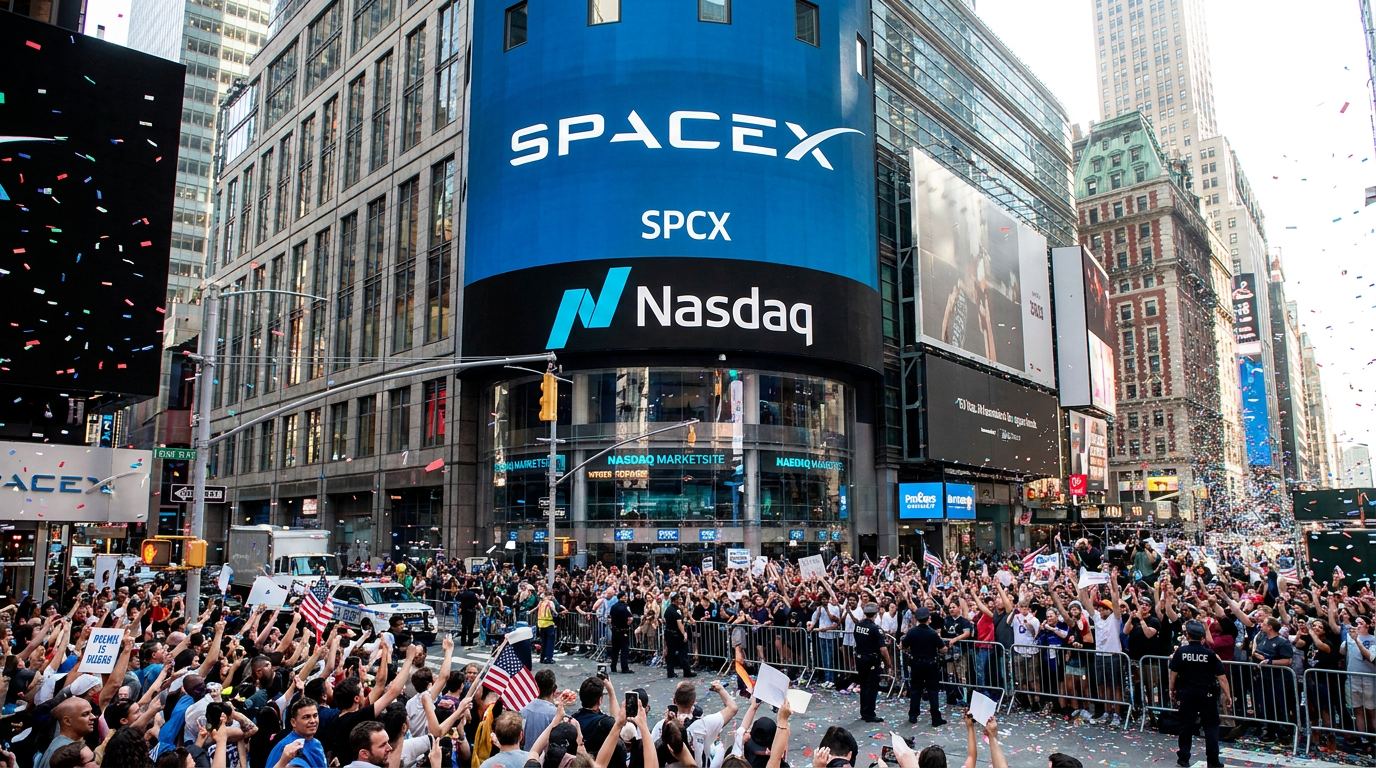
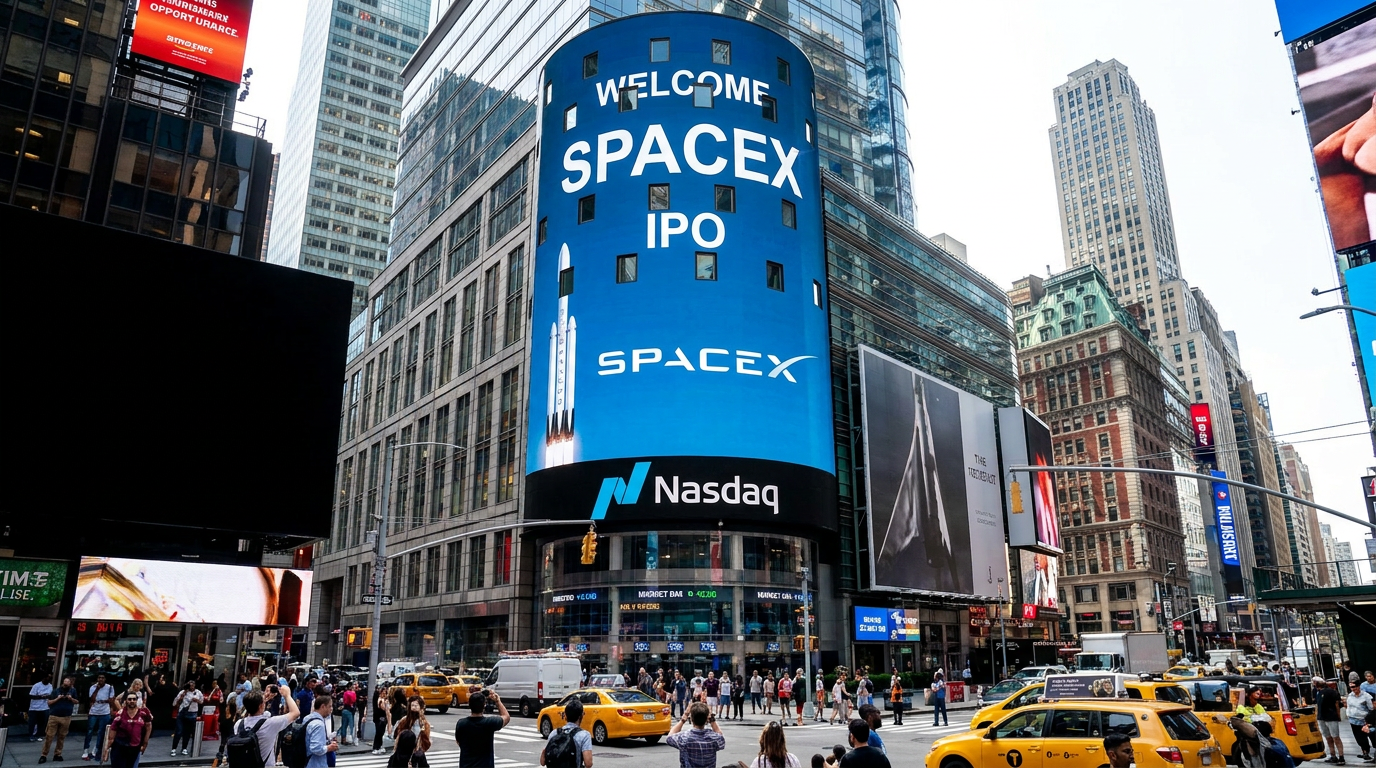
The aerospace and technology landscape was permanently altered last week when SpaceX completed the largest initial public offering in history. Debuting on the Nasdaq under the ticker SPCX on June 12, the company raised a staggering $75 billion, achieving an implied valuation of $1.77 trillion.[5][7]
The sheer scale of the offering immediately reshuffled the ranks of the world's most valuable public companies. Opening at $150—an 11% premium over its $135 IPO price—the stock surged to close its first day near $161, pushing its market capitalization past $2.1 trillion. This catapulted SpaceX ahead of legacy giants like Broadcom and Saudi Aramco, cementing its status as a foundational pillar of the modern market.[2][7]
The historic debut also marked a personal milestone for founder Elon Musk. With his retained equity in the newly public entity, Musk's net worth eclipsed the $1 trillion mark, making him the world's first trillionaire. The wealth generation extended to early employees and private backers who had sustained the company through two decades of capital-intensive development.[2][7]

Now, just over a week after the opening bell, the initial retail frenzy that drove unprecedented trading volumes is beginning to cool. Shares have experienced typical post-IPO volatility as early momentum traders take profits. However, market analysts warn that a second, potentially larger wave of capital is quietly preparing to strike.[1]
The catalyst for this impending surge is SpaceX's fast-tracked inclusion into major market indices. Having secured a rare rule change, SPCX is slated to enter the Nasdaq-100 index just 15 trading days after its IPO, alongside entry into the CRSP US Total Market Index.[4][7]
This accelerated timeline forces passive index funds and institutional asset managers to accumulate massive positions in a highly compressed window. Because these funds must mirror the index composition, their buying is price-agnostic, creating a structural demand shock that could easily overwhelm the relatively small 5% public float.[4][7]
The enthusiasm driving both retail and institutional demand is rooted in SpaceX's transformation from a pure-play rocket builder into a diversified technology conglomerate. The company currently operates three distinct business segments, each with radically different financial profiles and growth trajectories.[4]
The foundational pillar remains its launch business, which has achieved a near-monopoly in orbital delivery. In 2025, SpaceX was responsible for 83% of the global mass delivered to orbit, leveraging its reusable rocket architecture to slash launch costs by more than 95% compared to legacy competitors.[4]
The foundational pillar remains its launch business, which has achieved a near-monopoly in orbital delivery.
The second engine is Starlink, the satellite internet constellation that has rapidly scaled to over 9 million active users. While average revenue per user has slightly declined as the service expands into emerging markets, Starlink provides the recurring, high-margin subscription revenue that Wall Street traditionally rewards.[4][6]

But the true driver of the $1.77 trillion valuation is the company's aggressive pivot into artificial intelligence. In February 2026, SpaceX acquired Musk's AI venture, xAI, integrating its Grok models and proprietary Colossus data centers into the broader aerospace framework.[5][7]
The company's S-1 prospectus leaned heavily on this AI integration, outlining long-term ambitions to build orbital data centers that bypass terrestrial power constraints. A recently secured long-term contract to provide AI compute infrastructure for Anthropic has lent early credibility to this third revenue stream, positioning SpaceX as an AI infrastructure play rather than just an aerospace firm.[4][7]
Despite the overwhelming market enthusiasm, a vocal contingent of value analysts is urging caution. Morningstar recently initiated coverage of SPCX with a fair value estimate of just $63 per share—roughly 55% below its IPO price.[3]
These skeptics argue that while the launch and Starlink businesses possess a narrow economic moat, the AI segment's prospects remain highly speculative. They caution that pricing the company at nearly 94 times its trailing 2025 revenue of $18.7 billion leaves virtually no margin of safety for public investors.[3][4]
Furthermore, analysts warn of a looming "Max Q" event for the stock: the expiration of lock-up periods. While Musk and key insiders are restricted from selling for 366 days, other pre-IPO investors face a staggered 180-day lock-up. When these successive tranches of stock flood the public market, the increased supply could exert immense downward pressure on the share price.[3][7]

Corporate governance has also emerged as a flashpoint. SpaceX listed as a controlled company, utilizing a dual-class share structure that grants Musk approximately 85% of the shareholder voting power. He concurrently holds the titles of CEO, CTO, and Chairman.[2][4][7]
This unprecedented concentration of power has drawn scrutiny from lawmakers. Senator Elizabeth Warren has publicly called for an SEC review of the IPO, arguing that the governance structure leaves traditional investors with significantly fewer rights and demanding greater transparency regarding the company's valuation metrics.[2]
Nevertheless, the sheer gravity of the SpaceX listing has fundamentally reshaped the financial landscape. Retail brokerages reported record-breaking order flows, with individual investors requesting more than $70 billion in shares prior to the debut.[2]
As the 15-day countdown to Nasdaq-100 inclusion ticks away, Wall Street remains transfixed by the SPCX ticker. Whether the stock stabilizes at its trillion-dollar valuation or faces a harsh atmospheric reentry, the SpaceX IPO has already secured its legacy as the defining financial event of the decade.[1][6]
How we got here
Feb 2026
SpaceX acquires Elon Musk's AI venture, xAI, integrating its Grok models and data centers.
May 20, 2026
The SEC publicly discloses SpaceX's S-1 filing, detailing plans for the historic public offering.
June 11, 2026
SpaceX finalizes its IPO price at $135 per share, raising $75 billion.
June 12, 2026
SPCX debuts on the Nasdaq, opening at $150 and closing at $161, making Musk a trillionaire.
Late June 2026
SpaceX is scheduled to be fast-tracked into the Nasdaq-100 index, triggering institutional buying.
Viewpoints in depth
Growth Investors & Tech Bulls
Viewing SpaceX as a generational monopoly that justifies its premium valuation.
Bullish investors argue that traditional valuation metrics fail to capture SpaceX's unique market position. By controlling 83% of global mass-to-orbit and rapidly expanding its Starlink user base, the company has effectively monopolized the space economy. Furthermore, they view the integration of xAI and the concept of orbital data centers as a massive multiplier, arguing that the structural demand from upcoming index inclusions will easily absorb the limited public float and drive the stock higher.
Value Analysts & Skeptics
Warning that the stock is priced for perfection with zero margin of safety.
Skeptics, led by firms like Morningstar, caution that an enterprise value of nearly 94 times trailing revenue is dangerously overextended. They argue that while the launch business is solid, the AI infrastructure pivot is highly speculative and capital-intensive. These analysts warn that retail investors are buying into a hype cycle and that the stock will face severe downward pressure—a financial 'Max Q'—once the 180-day lock-up periods expire and insiders begin liquidating their shares.
Governance Watchdogs
Raising alarms over the unprecedented concentration of corporate control.
Corporate governance advocates and lawmakers are deeply concerned by the dual-class share structure that grants Elon Musk 85% of the voting power. Because SpaceX is listed as a 'controlled company,' traditional shareholders have virtually no mechanism to influence corporate strategy, executive compensation, or board appointments. Critics argue this structure poses a systemic risk given the company's $1.77 trillion footprint in the public markets.
What we don't know
- Whether the orbital AI data center concept is technologically and economically viable.
- How the stock will react when the 180-day and 366-day insider lock-up periods expire.
- If regulatory agencies will take action regarding the company's dual-class governance structure.
Key terms
- Public Float
- The portion of a company's shares that are available for trading by the general public, excluding closely held shares.
- Dual-Class Share Structure
- A corporate structure where different classes of shares have different voting rights, often used to keep control with founders.
- Index Inclusion
- The process of a stock being added to a major market index (like the Nasdaq-100), which forces index-tracking funds to buy the stock.
- Lock-Up Period
- A predetermined window of time after an IPO during which company insiders and early investors are restricted from selling their shares.
- Max Q
- An aerospace term for maximum dynamic pressure on a rocket; used metaphorically here for the period of highest selling pressure on the stock.
Frequently asked
What is SpaceX's stock ticker and where does it trade?
SpaceX trades on the Nasdaq exchange under the ticker symbol SPCX.
How much is SpaceX worth after the IPO?
The IPO priced the company at $1.77 trillion, though its market capitalization briefly exceeded $2.1 trillion on its first day of trading.
Can anyone buy SpaceX stock now?
Yes, following its June 12 debut, SPCX shares are available to retail and institutional investors through standard brokerage accounts.
Why is the stock expected to see a 'new wave of cash'?
SpaceX is scheduled to be added to the Nasdaq-100 index 15 trading days after its IPO, which will force passive index funds to automatically purchase the stock.
Sources
Source coverage
7 outlets
4 viewpoints surfaced







[1]MarketWatchInstitutional Indexers
The initial SpaceX frenzy is cooling off — but a new wave of cash is waiting to strike
Read on MarketWatch →[2]ForbesGovernance Watchdogs
SpaceX Opened Trading At $150 Following Largest-Ever IPO
Read on Forbes →[3]MorningstarValue Analysts & Skeptics
SpaceX SPCX Stock Has Been Priced at $135. We Think Shares Are Significantly Overvalued
Read on Morningstar →[4]GraniteSharesGrowth Investors & Tech Bulls
SpaceX IPO: What Investors Need to Know About SPCX and How to Play It
Read on GraniteShares →[5]Nasdaq NewsroomGrowth Investors & Tech Bulls
SpaceX (SPCX): Rocket Company Launches Historic IPO
Read on Nasdaq Newsroom →[6]TradingKeyGrowth Investors & Tech Bulls
SpaceX IPO targets June 12, 2026 on Nasdaq (SPCX)
Read on TradingKey →[7]Wikipedia
Initial public offering of SpaceX
Read on Wikipedia →

Every angle. Every day.
Get finance stories with full source coverage and perspective breakdowns delivered to your inbox.