
The 2026 European Night Train Renaissance: New Routes, Solo Pods, and the Push to Replace Short-Haul Flights
A wave of new overnight rail routes and next-generation sleeper cars is transforming European travel in 2026, offering a climate-friendly alternative to flying.
By Factlen Editorial Team
- State-Backed Rail Giants
- Argue that the future of night trains requires massive upfront capital investment in custom-built, high-tech rolling stock.
- Independent Rail Cooperatives
- Believe that citizen funding and agile operations can bypass state monopolies to rapidly open new cross-border routes.
- Sustainable Mobility Advocates
- Focus on the environmental necessity of shifting from air to rail, demanding lower track access charges and unified ticketing.
- Travel & Tourism Industry
- Value the convenience, romance, and time-saving aspects of city-center to city-center overnight travel.
What's not represented
- · Airlines losing short-haul market share
- · National track infrastructure managers
Why this matters
Overnight rail allows travelers to save a hotel night and bypass airport security while drastically reducing their carbon footprint. The 2026 expansion makes flight-free European travel practical and comfortable for millions of tourists and business commuters.
Key points
- The European night train network is undergoing a massive expansion in 2026, driven by climate goals and consumer demand.
- European Sleeper has launched a highly anticipated Paris-Berlin route, with plans to expand to Hamburg and Milan.
- Austria's ÖBB is rolling out a €500 million fleet of 'new generation' Nightjet trains capable of 230 km/h.
- New train designs feature 'Mini Cabins' for solo travelers and en-suite private showers in premium cabins.
- Advocates continue to push for lower track access charges and unified cross-border ticketing to support the rail transition.
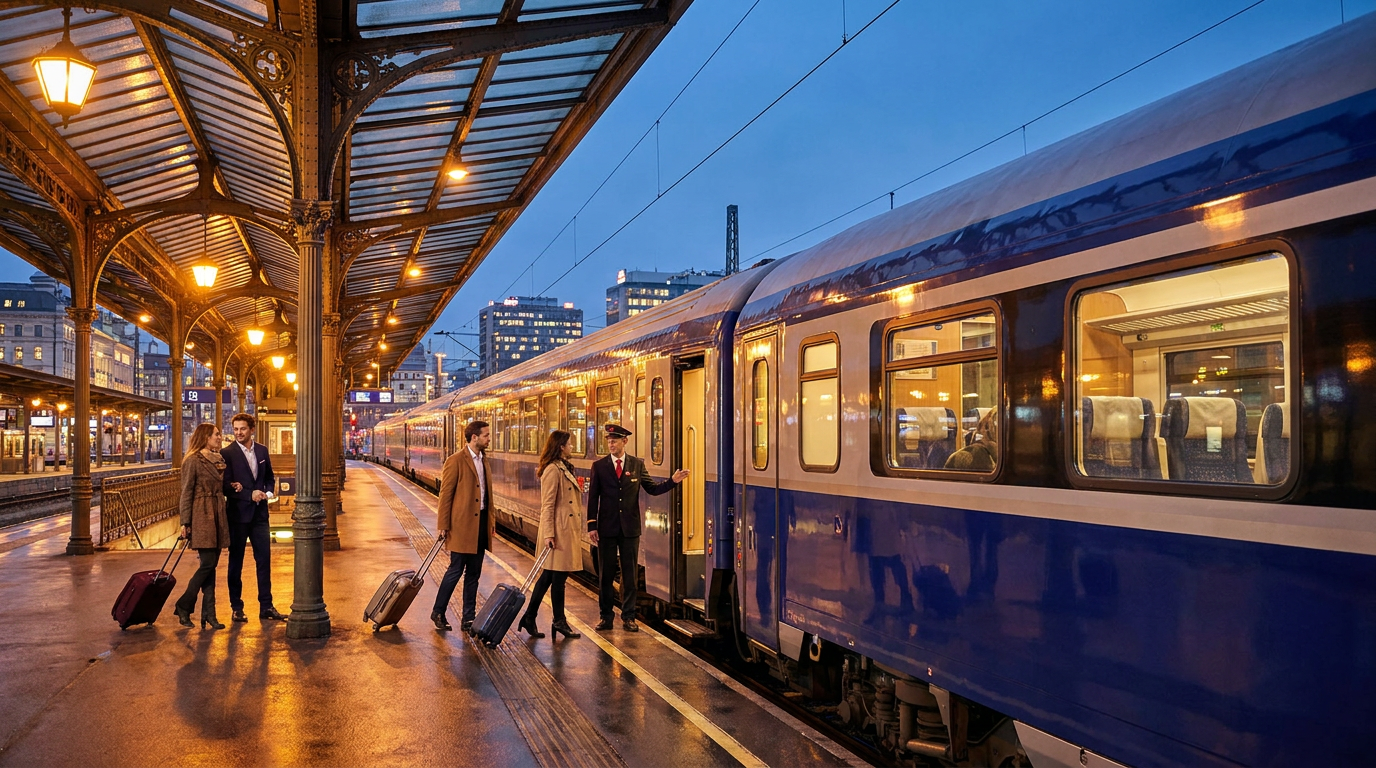
For decades, the European night train was written off as a romantic relic, steadily driven to extinction by the rise of ultra-low-cost airlines and high-speed daytime rail. But in 2026, overnight rail has become the most dynamic and rapidly expanding sector in European travel.[2][5]
Driven by a combination of climate consciousness, a desire for "slow travel," and sheer practical convenience, passengers are abandoning short-haul flights in favor of falling asleep in one country and waking up in another.[2][8]
This year marks a definitive turning point. A wave of new routes, next-generation rolling stock, and disruptive railway operators are transforming the continent's rail map.[1][5]
Leading the charge in 2026 is the Belgian-Dutch cooperative European Sleeper. On March 26, the operator officially resurrected the highly anticipated Paris-to-Berlin route, stepping in after state operators abandoned the line.[1][5][6]
The cooperative isn't stopping there. In July 2026, the Paris-Berlin service will extend to Hamburg, and by September, European Sleeper plans to launch a spectacular north-south route connecting Brussels and Amsterdam to Milan, crossing the Alps via the legendary Simplon Pass.[1][5][6]

What makes European Sleeper unique is its funding model. Founded by two rail enthusiasts, the company is backed by more than 6,000 citizen investors, proving that consumer demand for overnight rail is strong enough to bypass traditional state-funded monopolies.[5][6]
Meanwhile, Austria’s state railway, ÖBB, is deploying its massive hardware upgrade. ÖBB’s "Nightjet" network has been the backbone of Europe's sleeper revival, and in 2026, its "new generation" trains are rolling out across major corridors, including routes from Amsterdam to Vienna and Innsbruck.[4][7]
Built by Siemens Mobility at a cost of over €500 million, these new 230 km/h trains represent a total rethink of overnight comfort. They eliminate the cramped, outdated designs of the 20th century in favor of modern hotel-like amenities.[4][5][7]
The most celebrated innovation is the "Mini Cabin." Designed for solo travelers, these compact, lockable sleeping pods offer complete privacy, wireless charging, and electronic access—bridging the gap between a communal hostel-style couchette and an expensive private sleeper.[4][7]

For those booking premium sleeper cabins, the new generation trains now feature en-suite bathrooms with private showers and toilets, a luxury that was once unthinkable on standard European rail lines.[4][7]
The economic logic of the sleeper train is also winning over pragmatic travelers. While a flight from Paris to Berlin takes just 90 minutes in the air, the door-to-door journey—factoring in airport transit, security lines, and baggage claim—often consumes five to six hours of waking daylight.[3]
The economic logic of the sleeper train is also winning over pragmatic travelers.
A night train, by contrast, reclaims that time. Passengers board in the city center after dinner, sleep through the 12-to-14-hour transit, and step off directly into the heart of their destination at breakfast. Crucially, the train ticket also covers a night's accommodation, offsetting the higher upfront fare.[2][3]
Then there is the climate math. According to the European Union's transport data, a passenger on a night train emits a fraction of the carbon dioxide compared to someone taking the equivalent short-haul flight.[8]
This environmental imperative is why the EU has integrated rail expansion into its broader climate strategy, aiming to double high-speed rail traffic by 2030 and triple it by 2050.[8]

Yet, despite the surging consumer demand and shiny new trains, the renaissance remains politically and logistically fragile. Operating a train across multiple European borders is notoriously difficult.[3]
Unlike the aviation industry, which enjoys standardized air traffic control and tax-exempt jet fuel, rail operators must navigate a fragmented patchwork of national track systems, varying electrical voltages, and uncoordinated booking platforms.[3]
Furthermore, track access charges—the tolls operators pay to national infrastructure managers to use the rails—are prohibitively high, especially for heavy night trains that cross multiple countries.[3]
This friction boiled over in December 2025 during the "pyjama protests." Activists and travelers gathered on platforms from Stockholm to Strasbourg in their sleepwear, demanding that European governments lower track fees and mandate cross-border ticketing interoperability.[3]

Despite these structural bottlenecks, the momentum in 2026 feels irreversible. Budget operators like the Czech Republic's RegioJet are aggressively expanding into Poland, offering ultra-low-cost couchettes that make cross-border travel accessible to students and budget backpackers.[5]
How we got here
May 2023
European Sleeper launches its first citizen-funded route between Brussels and Berlin.
December 2023
ÖBB introduces the first 'new generation' Nightjet trains on the Hamburg-Vienna route.
December 2025
Activists stage 'pyjama protests' across Europe to demand better political support for cross-border night trains.
March 2026
European Sleeper officially resurrects the highly anticipated Paris-Berlin overnight route.
September 2026
A new north-south sleeper route launches, connecting Brussels and Amsterdam to Milan via the Alps.
Viewpoints in depth
Independent Rail Cooperatives
Believe that citizen funding and agile operations can bypass state monopolies to rapidly open new cross-border routes.
Operators like European Sleeper and RegioJet are proving that billions in state subsidies are not strictly necessary to run a successful night train. By relying on citizen investors and pragmatic rolling stock leases, they are opening routes that state operators previously abandoned as unprofitable. Their agility allows them to test new markets quickly, though they often operate on razor-thin margins and face steep hurdles when negotiating track access across multiple countries.
State-Backed Rail Giants
Argue that the future of night trains requires massive upfront capital investment in custom-built, high-tech rolling stock.
State operators like Austria's ÖBB believe that to truly pull passengers away from budget airlines, the night train experience must be fundamentally modernized. Their strategy hinges on massive capital investments—such as their €500 million order for custom Siemens trains—to offer a premium, hotel-like experience. They argue that only state-backed entities have the financial weight to procure next-generation trains and maintain comprehensive, reliable networks across the continent.
Sustainable Mobility Advocates
Focus on the environmental necessity of shifting from air to rail, demanding lower track access charges and unified ticketing.
Climate advocates argue that the night train renaissance is being artificially constrained by outdated regulations. They point out the hypocrisy of European governments subsidizing aviation through tax-exempt jet fuel while charging rail operators exorbitant track access fees. These advocates, who organized the 2025 'pyjama protests,' demand that governments treat cross-border rail as a public climate good, calling for unified European ticketing platforms and zero-VAT policies on international train tickets.
What we don't know
- Whether the European Union will successfully mandate a unified cross-border rail booking platform by 2030.
- How budget airlines will adjust their pricing and routes in response to the growing popularity of overnight rail.
- If independent cooperatives like European Sleeper can maintain profitability as they expand their networks.
Key terms
- Couchette
- A budget-friendly sleeping compartment on a train, typically featuring 4 to 6 bunk beds and shared bathroom facilities.
- Rolling Stock
- The physical vehicles used on a railway, including locomotives, passenger cars, and sleeper carriages.
- Track Access Charges
- The fees that train operators must pay to national infrastructure managers for the right to run their trains on the tracks.
- Interoperability
- The ability of different national railway systems to work together seamlessly, allowing trains to cross borders without changing locomotives or signaling systems.
Frequently asked
What is a 'Mini Cabin' on a sleeper train?
A Mini Cabin is a compact, lockable sleeping pod designed for solo travelers, featuring a bed, reading light, wireless charging, and secure luggage storage, offering privacy at a lower cost than a full cabin.
How far in advance should I book European night trains?
Tickets for popular routes like Paris-Berlin or Amsterdam-Vienna should be booked 3 to 6 months in advance, especially for summer travel, as sleeper cabins frequently sell out.
Do night trains have showers?
Yes, the new generation of ÖBB Nightjet trains features en-suite bathrooms with private showers and toilets in their premium sleeper cabins, though budget couchette cars still use shared facilities.
Is taking a night train actually cheaper than flying?
While the upfront ticket price can sometimes be higher than a budget airline fare, night trains save travelers the cost of a hotel night and expensive airport transfers, often making the total trip cheaper.
Sources
Source coverage
8 outlets
4 viewpoints surfaced








[1]ForbesTravel & Tourism Industry
These 4 European Night Trains Are Debuting In 2026
Read on Forbes →[2]Time OutTravel & Tourism Industry
The best European sleeper trains to ride in 2026
Read on Time Out →[3]Green European JournalSustainable Mobility Advocates
Can Europe Wake Up the Sleeper Train?
Read on Green European Journal →[4]The Man in Seat 61State-Backed Rail Giants
Guide to the new generation Nightjet sleeper trains
Read on The Man in Seat 61 →[5]PixidiaIndependent Rail Cooperatives
European Night Trains 2026: 10 New Routes You Need to Try
Read on Pixidia →[6]HourrailIndependent Rail Cooperatives
Brussels-Milan European Sleeper night train: itinerary, timetable, fares
Read on Hourrail →[7]ÖBB NightjetState-Backed Rail Giants
Nightjet of the new generation
Read on ÖBB Nightjet →[8]The Better NewsSustainable Mobility Advocates
Europe's climate strategy on rails
Read on The Better News →
Every angle. Every day.
Get lifestyle stories with full source coverage and perspective breakdowns delivered to your inbox.