
The Rise of Liquid-Cooled Data Centers: How the Cloud is Solving AI's Massive Heat Problem
As artificial intelligence pushes traditional air-cooled servers to their physical limits, the cloud computing industry is rapidly adopting direct-to-chip and immersion liquid cooling. These advanced thermal technologies are slashing energy use, eliminating water waste, and paving the way for sustainable digital infrastructure.
By Factlen Editorial Team
- Cloud Hyperscalers
- Focus on maximizing compute density and scaling AI infrastructure without hitting power grid limits.
- Sustainability Advocates
- Focus on eliminating water waste and reducing the carbon footprint of data centers through heat reuse.
- Hardware Engineers
- Focus on the physical limits of silicon and the necessity of phase-change cooling to prevent thermal throttling.
What's not represented
- · Local Municipalities
- · Legacy IT Technicians
Why this matters
The AI tools we rely on daily require staggering amounts of electricity and water to operate. By transitioning to liquid cooling, the tech industry can continue to advance artificial intelligence without draining local water supplies or overwhelming the power grid.
Key points
- The generative AI boom has pushed traditional air-cooled data centers to their physical thermal limits.
- Direct-to-chip cooling uses liquid-filled cold plates to remove heat directly from processors, enabling ultra-dense server racks.
- Immersion cooling submerges entire servers in non-conductive dielectric fluid, eliminating the need for fans.
- Liquid cooling can reduce a data center's cooling energy consumption by up to 70% while virtually eliminating water waste.
- The captured thermal energy can be repurposed for municipal district heating, turning data centers into zero-carbon heat sources.
The artificial intelligence boom is largely invisible to the end user, experienced through seamless chatbots and instantly generated images on a screen. But behind the cloud lies a massive, rapidly expanding physical footprint. As the demand for generative AI surges, the data centers that power these models are running into hard physical limits regarding power availability and water consumption. The sheer scale of the infrastructure required to support modern digital life is staggering, and the environmental toll is becoming a central challenge for the technology sector.[1]
The primary culprit behind this resource crunch is the modern graphics processing unit, or GPU. The chips required to train massive AI models and process complex inferencing tasks are incredibly powerful, but they are also incredibly power-hungry. A single next-generation AI rack can draw hundreds of kilowatts of power, with individual chips routinely exceeding 700 to 1,000 watts of electricity. All of that electrical energy is ultimately converted into thermal energy, creating an unprecedented heat management crisis inside the server room.[5]
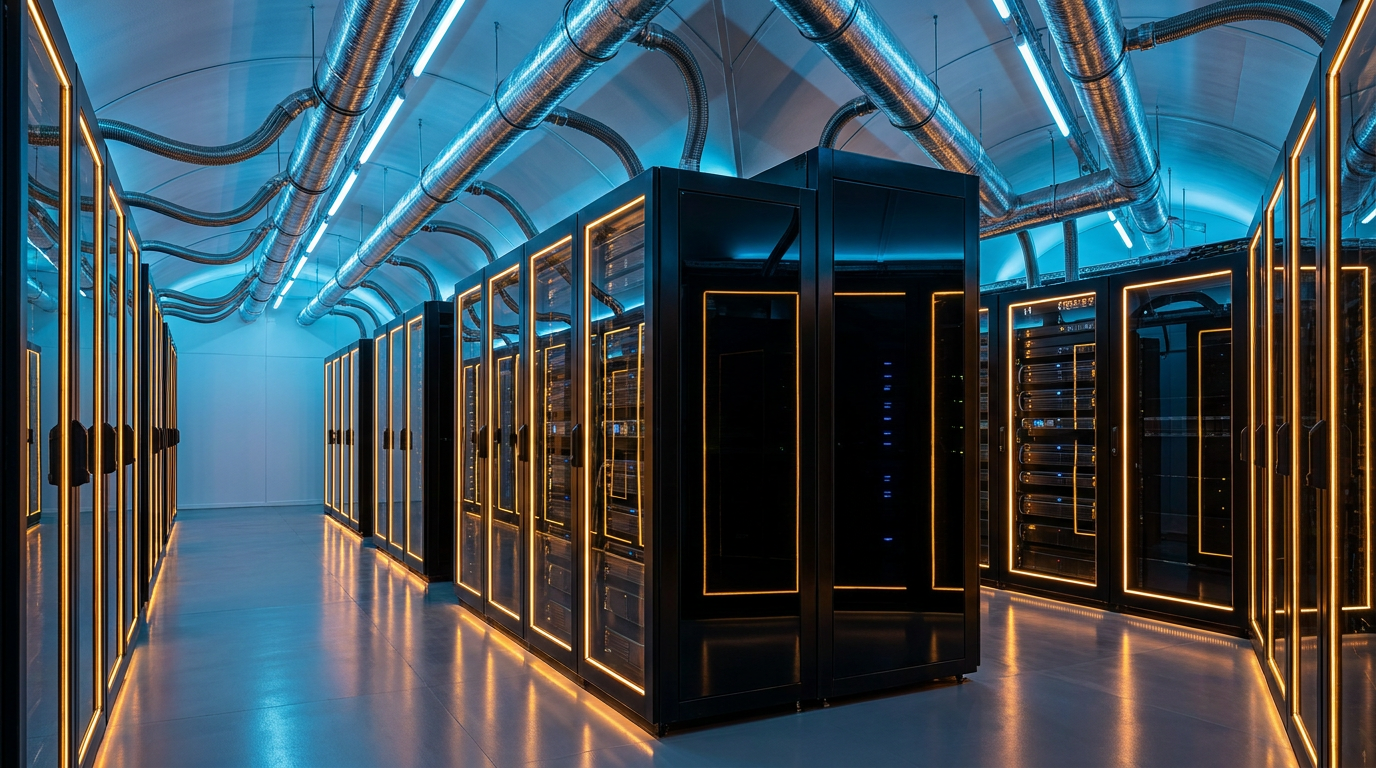
For decades, the cloud computing industry relied on a simple, brute-force method to keep its servers from melting: blowing massive amounts of cold air across them. Traditional data centers are designed with raised floors and hot-and-cold aisles, using giant industrial fans and air conditioning units to push chilled air through the server racks. However, air is fundamentally a poor conductor of heat. As rack densities climb toward 370 kilowatts, air cooling has hit a strict physical wall; it simply cannot carry thermal energy away fast enough to prevent the chips from throttling or failing.[2][5]

To compensate for air's inefficiency, traditional data centers rely on massive cooling towers that evaporate water to reject heat into the atmosphere. This process is highly effective but ecologically devastating. Some large legacy data centers consume up to five million gallons of fresh water every single day just to keep their servers operational. This linear correlation between high-performance computing and massive water waste has made data center expansion a contentious political issue, particularly in regions already facing severe water scarcity and drought conditions.[1]
In response to this existential bottleneck, the cloud computing industry is undergoing a massive, multi-billion-dollar architectural shift in 2026. To save the AI boom from its own thermal exhaust, operators are abandoning traditional air conditioning in favor of advanced liquid cooling technologies. By decoupling computing growth from natural resource consumption, the industry aims to make the next generation of data centers quieter, cooler, and vastly more sustainable.[5][6]
The first major pillar of this transition is known as direct-to-chip cooling. Instead of attempting to cool the entire ambient air of a server room, this method targets the heat exactly where it is generated. Engineers mount specialized, micro-channeled cold plates directly onto the surface of the processors. These plates act as highly efficient thermal bridges, capturing the heat the moment it leaves the silicon die before it can radiate into the surrounding server chassis.[4]
The first major pillar of this transition is known as direct-to-chip cooling.
A specially formulated coolant—often deionized water treated with corrosion inhibitors, or a proprietary waterless fluid—is pumped continuously through these microchannels. Because liquid is a vastly superior heat transfer medium compared to air, it absorbs the thermal energy instantly and carries it away in a closed loop. This targeted approach allows cloud providers to pack significantly more compute power into the exact same physical footprint, enabling the ultra-high-density racks required for modern AI workloads without triggering a thermal meltdown.[4][5]

The second, and arguably more radical, approach gaining widespread adoption is immersion cooling. In this setup, the traditional server chassis is completely reimagined. The high-speed cooling fans are physically removed from the hardware, and entire server blades are lowered bodily into large, horizontal vats of liquid. While submerging expensive electronics in liquid sounds counterintuitive, it is rapidly becoming the gold standard for extreme-density computing environments.[3]
The secret to immersion cooling lies in the fluid itself. These tanks are filled with specialized dielectric liquids—synthetic fluids that possess excellent thermal conductivity but absolutely zero electrical conductivity. Because the fluid cannot carry an electrical charge, the exposed motherboards, memory modules, and processors can operate flawlessly while completely underwater. The liquid surrounds every single component, absorbing heat uniformly and eliminating the dangerous thermal hotspots that plague air-cooled systems.[3]
The most advanced iteration of this technology is two-phase immersion cooling. In these systems, the dielectric fluid is engineered to have a very low boiling point. As the submerged processors generate heat, the liquid in direct contact with the chips actually begins to boil. This phase change—from liquid to vapor—absorbs a massive amount of thermal energy. The vapor rises to the top of the sealed tank, hits a chilled condenser coil, turns back into liquid, and rains back down onto the servers in a continuous, highly efficient cycle.[2]

The efficiency gains unlocked by these liquid cooling methodologies are staggering. By eliminating the need for thousands of high-speed server fans and massive industrial air handlers, direct-to-chip and immersion systems can slash a data center's cooling energy consumption by up to 70 percent. Furthermore, closed-loop liquid systems and advanced membrane technologies operate with near-zero water waste, completely eliminating the need for the evaporative cooling towers that drain local municipal water supplies.[4][5]
Beyond mere conservation, liquid cooling unlocks the holy grail of sustainable cloud computing: heat reuse. When a data center is cooled by air, the resulting low-grade hot air is simply vented into the atmosphere and wasted. Liquid cooling, however, captures heat in a dense, easily transportable medium. The hot fluid exiting the server racks can be piped through heat exchangers and integrated into municipal district heating networks, providing zero-carbon warmth to nearby residential neighborhoods, commercial greenhouses, and public swimming pools.[1]
Despite the overwhelming benefits, the transition to a liquid-cooled cloud is not without friction. Retrofitting legacy data centers to support the immense weight of fluid-filled tanks and the complex plumbing of coolant distribution units requires massive capital expenditure. Furthermore, it fundamentally changes data center operations; IT technicians can no longer simply walk down an aisle and swap out a faulty hard drive in seconds. Maintenance on immersion-cooled systems requires specialized hoists to lift servers out of the fluid, and careful protocols to prevent contamination.[3][6]

Nevertheless, the major cloud hyperscalers have recognized that they have no other choice. The physics of modern silicon dictate that the era of air-cooled data centers is drawing to a close. As artificial intelligence continues to scale and integrate into every facet of the global economy, liquid cooling is no longer viewed as an experimental luxury. It is the fundamental, invisible enabler of the future cloud—ensuring that the digital revolution can continue to accelerate without boiling the planet in the process.[5][6]
How we got here
Early 2000s
Air cooling with raised floors and hot/cold aisles dominates data center architecture.
Late 2010s
Direct-to-chip cooling emerges for niche supercomputing and early AI training workloads.
2023–2025
The generative AI boom pushes rack power densities beyond the physical limits of air cooling.
2026
Major cloud providers mandate liquid and immersion cooling for all new high-density AI infrastructure.
Viewpoints in depth
Cloud Hyperscalers
Focus on maximizing compute density and scaling AI infrastructure without hitting power grid limits.
For the world's largest cloud providers, liquid cooling is a matter of basic arithmetic. The physical footprint required to build data centers fast enough to meet AI demand is staggering. If they continue to rely on air cooling, they cannot pack enough GPUs into a single building to train the next generation of models without the facility melting down. Liquid cooling allows them to condense massive amounts of compute power into a fraction of the space, maximizing their real estate and ensuring they can continue to scale their AI offerings.
Sustainability Advocates
Focus on eliminating water waste and reducing the carbon footprint of data centers through heat reuse.
Environmental groups and sustainability researchers view the AI boom's water and power consumption as a looming ecological crisis. They argue that the tech industry has a moral obligation to decouple its growth from natural resource depletion. For this camp, liquid cooling is not just an operational upgrade; it is the only ethical path forward. By virtually eliminating the need for evaporative cooling towers and enabling zero-carbon district heating, they believe data centers can transform from resource drains into beneficial civic utilities.
Hardware Engineers
Focus on the physical limits of silicon and the necessity of phase-change cooling to prevent thermal throttling.
From a purely technical perspective, hardware engineers argue that silicon has reached a thermal wall. Modern processors are drawing so much power that air is physically incapable of carrying the heat away fast enough. Without the superior thermal conductivity of liquid—and specifically the massive energy absorption of phase-change boiling in two-phase immersion systems—modern chips will inevitably throttle their performance or suffer catastrophic failure under heavy workloads.
What we don't know
- It remains unclear how quickly legacy data centers can be retrofitted for liquid cooling, given the immense structural weight and plumbing requirements.
- The long-term environmental impact of manufacturing and disposing of synthetic dielectric fluids at a global scale is still being studied.
Key terms
- Power Usage Effectiveness (PUE)
- A metric used to determine how energy efficient a data center is, calculated by dividing the total power entering the facility by the power used to run the IT equipment.
- Dielectric Fluid
- A specialized synthetic liquid that conducts heat efficiently but does not conduct electricity, allowing electronics to be safely submerged.
- Direct-to-Chip Cooling
- A cooling method where liquid is pumped through micro-channeled cold plates mounted directly onto the surface of a computer processor.
- Immersion Cooling
- A thermal management technique where entire servers are submerged in a tank of non-conductive liquid to absorb heat.
- Hyperscaler
- A massive cloud service provider, such as Google, Microsoft, or Amazon, that operates data centers on a global scale.
Frequently asked
Is immersion cooling safe for computer parts?
Yes. The liquid used in immersion cooling is a specialized dielectric fluid that does not conduct electricity, meaning the electronics can operate safely while completely submerged.
Why can't data centers just use bigger fans?
Air is a poor conductor of heat. Modern AI chips generate so much thermal energy that air simply cannot carry it away fast enough, regardless of how large or fast the fans are.
Does liquid cooling save water?
Yes. Traditional air-cooled data centers rely on massive cooling towers that evaporate millions of gallons of water. Closed-loop liquid systems use almost zero water.
What happens to the hot liquid after it cools the servers?
In advanced setups, the heated liquid is pumped through heat exchangers and used to provide zero-carbon district heating for nearby homes, greenhouses, and public facilities.
Sources
Source coverage
6 outlets
3 viewpoints surfaced






[1]World Economic ForumSustainability Advocates
How data centres can tackle the energy crunch
Read on World Economic Forum →[2]MIT NewsHardware Engineers
Cooling the AI boom
Read on MIT News →[3]SupermicroHardware Engineers
Immersion cooling and direct-to-chip solutions
Read on Supermicro →[4]ZutaCoreCloud Hyperscalers
Waterless Liquid Cooling For NeoCloud Infrastructures
Read on ZutaCore →[5]Digital EdgeCloud Hyperscalers
The 2026 data center cooling revolution
Read on Digital Edge →[6]Factlen Editorial TeamSustainability Advocates
Synthesis by Factlen editorial team
Read on Factlen Editorial Team →
Every angle. Every day.
Get technology stories with full source coverage and perspective breakdowns delivered to your inbox.