
How AI and Reverse Logistics Are Building the Circular Supply Chain
Driven by advanced AI and new recycling breakthroughs, businesses are abandoning the linear 'take-make-dispose' model in favor of circular supply chains that turn waste into profitable raw materials.
By Factlen Editorial Team
- Supply Chain Executives
- Focused on profitability, cost reduction, and operational resilience.
- Circular Economy Advocates
- Focused on zero-waste systems, environmental sustainability, and material recovery.
- Technology Integrators
- Focused on deploying AI, digital twins, and automation to solve logistical complexities.
What's not represented
- · Consumers navigating complex return policies
- · Workers in traditional waste management and landfill operations
Why this matters
As raw materials become scarcer and more expensive, companies that master the circular economy will secure their own supply lines, while consumers will benefit from more sustainable, repairable products.
Key points
- The traditional 'take-make-dispose' linear supply chain is being replaced by circular models.
- AI and computer vision are automating reverse logistics, making material recovery highly profitable.
- Advanced recycling techniques are solving the EV battery bottleneck by recovering critical minerals.
- New regulations in the US and EU are mandating high recovery rates for electronics and batteries.
- The global reverse logistics market is projected to surpass $812 billion by 2027.
For decades, global commerce has operated on a simple, linear premise: take raw materials, make a product, and dispose of it when it breaks. This "take-make-dispose" model optimized for speed and scale, but it generated staggering amounts of waste and left companies vulnerable to resource shocks.[5][7]
In 2026, a fundamental shift is rewriting the rules of global manufacturing and retail. The linear model is being replaced by the "circular supply chain"—a system designed to retain the value of materials for as long as possible through reuse, refurbishment, and recycling.[5][7]
The operational backbone of this shift is "reverse logistics," the complex process of moving goods backward from consumers to manufacturers. Historically, reverse logistics was viewed as a costly headache, plagued by unpredictable return volumes, manual sorting, and high transportation expenses.[4][5]

Today, artificial intelligence is transforming reverse logistics from a cost center into a major revenue driver. By deploying machine learning, computer vision, and predictive analytics, companies are automating the once-tedious process of handling returned, recycled, or excess products.[6]
The financial impact is substantial. AI-powered circular systems are cutting waste disposal costs by up to 23% while recovering 41% more value from excess inventory. The global reverse logistics market, fueled by these newfound efficiencies, is projected to reach $812.6 billion by the end of 2027.[5][6]

The AI intervention begins before a product is even returned. Predictive demand forecasting analyzes historical data, market trends, and economic indicators to match supply closely with actual demand. This precision prevents overproduction, stopping waste before it ever enters the supply chain.[1][6]
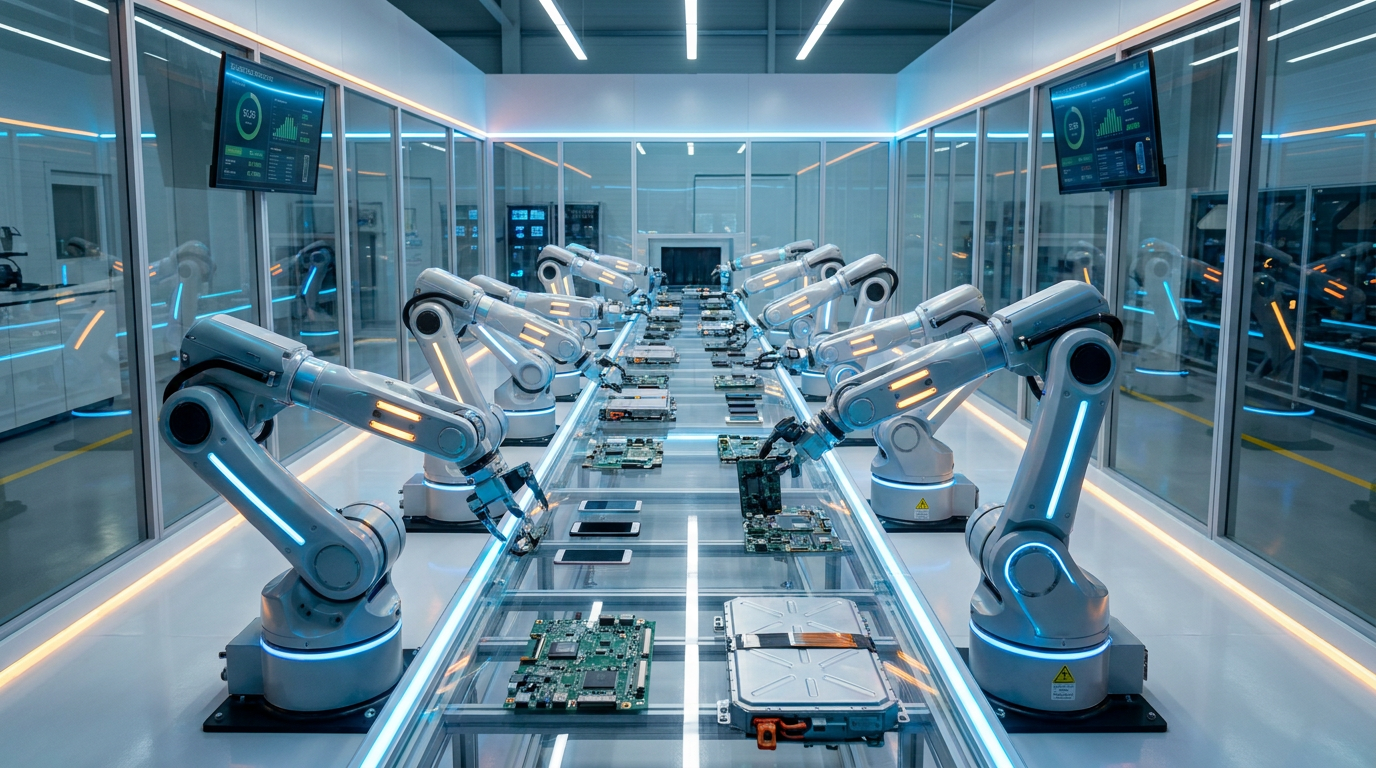
When products do come back, AI-enabled computer vision systems take over at centralized return centers. These automated systems instantly inspect, grade, and sort returned items, determining in milliseconds whether a product should be restocked, refurbished, or broken down for raw materials.[4][6]

When products do come back, AI-enabled computer vision systems take over at centralized return centers.
Nowhere is this circular revolution more critical than in the electric vehicle sector. With over 17 million EVs sold globally in 2024, the industry is facing a looming wave of end-of-life lithium-ion batteries that require highly specialized handling.[3]
Without closed-loop recycling, millions of tons of spent batteries would end up in landfills, wasting economically vital concentrations of lithium, cobalt, nickel, and manganese. To prevent this, the industry is scaling advanced recycling methods at an unprecedented pace.[3][7]
Breakthroughs in hydrometallurgy—which uses aqueous leaching to extract battery-grade metals at lower temperatures—and direct recycling techniques are preserving material integrity while cutting greenhouse gas emissions. Another emerging technique, flash Joule heating, enables the rapid, high-temperature separation of battery metals with minimal energy consumption.[3]
These innovations are yielding "black mass," an intermediate product rich in critical metals that can be refined and injected directly back into the battery manufacturing process. The urgency is reflected in intellectual property: international patent families for battery recycling and reuse have surged by 700% over the last decade.[3][7]

Regulatory pressure is also forcing the issue. In the European Union, updated battery regulations mandate recovery rates of 90% for cobalt, copper, and nickel by late 2025. In the United States, the Inflation Reduction Act ties lucrative tax credits to the domestic recovery and processing of critical minerals, making localized circular supply chains a financial necessity.[3][5]
To manage the sheer complexity of these new circular networks, supply chain leaders are turning to "digital twins." These virtual simulations allow companies to model reverse logistics routes, test facility layouts, and validate recycling workflows in a risk-free digital environment before deploying capital.[1][2]
Despite the momentum, scaling circular supply chains presents hurdles. High upfront costs for automated sorting facilities, fragmented data across global partners, and the challenge of incentivizing consumer participation remain significant bottlenecks for smaller enterprises.[2][5]
To overcome these barriers, some manufacturers are entirely rethinking their business models. Instead of selling products outright, companies are shifting to "Product-as-a-Service" models—retaining ownership of the hardware and leasing its function, ensuring the materials automatically return to the manufacturer at the end of their lifecycle.[5][7]
Ultimately, the transition to a circular supply chain is no longer just an environmental aspiration. Driven by AI, robotics, and stringent new regulations, reverse logistics has become a structural advantage, allowing companies to secure their own raw materials and build resilience against global shocks.[2][7]
How we got here
2017
Global EV sales surpass one million units, triggering a surge in patent filings for battery recycling technologies.
2022
The US passes the Inflation Reduction Act, incentivizing the domestic recovery and processing of critical minerals.
2024
AI-enhanced supply chain activities contribute an estimated $97 billion to the US GDP.
2025
The European Union implements strict new battery regulations, mandating 90% recovery rates for cobalt and nickel.
2026
AI and computer vision become standard in reverse logistics, dramatically lowering the cost of material sorting.
Viewpoints in depth
Supply Chain Executives
Focused on profitability and resilience.
For corporate leaders, the shift to circularity is primarily an economic and strategic imperative. By mastering reverse logistics, companies can insulate themselves from volatile raw material markets and geopolitical trade shocks. Executives view AI and automation as the key to making material recovery profitable, turning returned goods and excess inventory into a reliable, internal supply of resources.
Regulatory Bodies
Focused on compliance and domestic security.
Policymakers view circular supply chains as a tool for national security and environmental protection. Through mechanisms like the EU's Battery Regulation and the US Inflation Reduction Act, regulators are forcing manufacturers to take responsibility for the entire lifecycle of their products. Their goal is to mandate high recovery rates for critical minerals, reducing reliance on foreign mining and minimizing landfill waste.
Technology Integrators
Focused on data unification and automation.
Engineers and software providers argue that the circular economy is fundamentally a data problem. They emphasize that without AI, computer vision, and digital twins, the sheer complexity of sorting and routing millions of used products is impossible to manage profitably. Their focus is on breaking down data silos so that a product's material composition can be tracked from the moment it is manufactured to the day it is recycled.
What we don't know
- Whether consumer behavior will shift enough to consistently return end-of-life products to manufacturers.
- How quickly smaller businesses will be able to afford the high capital costs of AI-driven sorting infrastructure.
Key terms
- Circular Supply Chain
- A system that reuses, refurbishes, and recycles materials to retain their value, replacing the traditional linear model.
- Reverse Logistics
- The process of moving goods backward from the consumer to the manufacturer for returns, repair, or recycling.
- Hydrometallurgy
- A recycling technique that uses liquid chemical solutions to extract valuable metals from spent batteries.
- Black Mass
- An intermediate powder created by shredding end-of-life batteries, rich in critical metals like lithium, cobalt, and nickel.
- Digital Twin
- A virtual simulation of a physical supply chain used to test and optimize logistics without real-world risk.
- Extended Producer Responsibility (EPR)
- A policy approach that makes manufacturers financially and physically responsible for their products at the end of their lifecycle.
Frequently asked
What makes a supply chain circular?
Instead of the traditional 'take-make-dispose' model, a circular supply chain is designed to continuously reuse, repair, and recycle materials, minimizing waste and the need for new raw resources.
How is AI used in reverse logistics?
AI powers predictive demand forecasting to prevent overproduction, and uses computer vision to instantly inspect, grade, and sort returned products at processing centers.
Why is EV battery recycling a major focus?
With millions of electric vehicles reaching the end of their lifespans, recycling is essential to recover valuable metals like lithium and cobalt, preventing toxic landfill waste and securing domestic supply chains.
What is a Product-as-a-Service model?
It is a business model where companies lease the function of a product rather than selling it outright, ensuring the physical materials are returned to the manufacturer for recycling.
Sources
Source coverage
7 outlets
3 viewpoints surfaced







[1]Strategic Market ResearchTechnology Integrators
AI in Supply Chain Market By Component, Technology, Application, and Geography
Read on Strategic Market Research →[2]ABI ResearchTechnology Integrators
Key Priorities for Scaling AI-Driven Supply Chains
Read on ABI Research →[3]Green Li-ionCircular Economy Advocates
Breakthroughs in Lithium Ion Battery Recycling Methods in 2025
Read on Green Li-ion →[4]Global Market InsightsSupply Chain Executives
Reverse Logistics Market Trends and Forecast
Read on Global Market Insights →[5]Council FireSupply Chain Executives
The Circular Supply Chain: A Roadmap for Manufacturers
Read on Council Fire →[6]ForthclearTechnology Integrators
How AI Reduces Waste in Circular Supply Chains
Read on Forthclear →[7]Factlen Editorial TeamCircular Economy Advocates
Synthesis by Factlen editorial team
Read on Factlen Editorial Team →

Every angle. Every day.
Get business stories with full source coverage and perspective breakdowns delivered to your inbox.