
How AI Tutors Are Finally Solving Education's '2 Sigma Problem'
Generative AI tutoring platforms are moving from experimental pilots to statewide rollouts in 2026, offering personalized, adaptive instruction that mimics one-on-one human tutoring at scale.
By Factlen Editorial Team
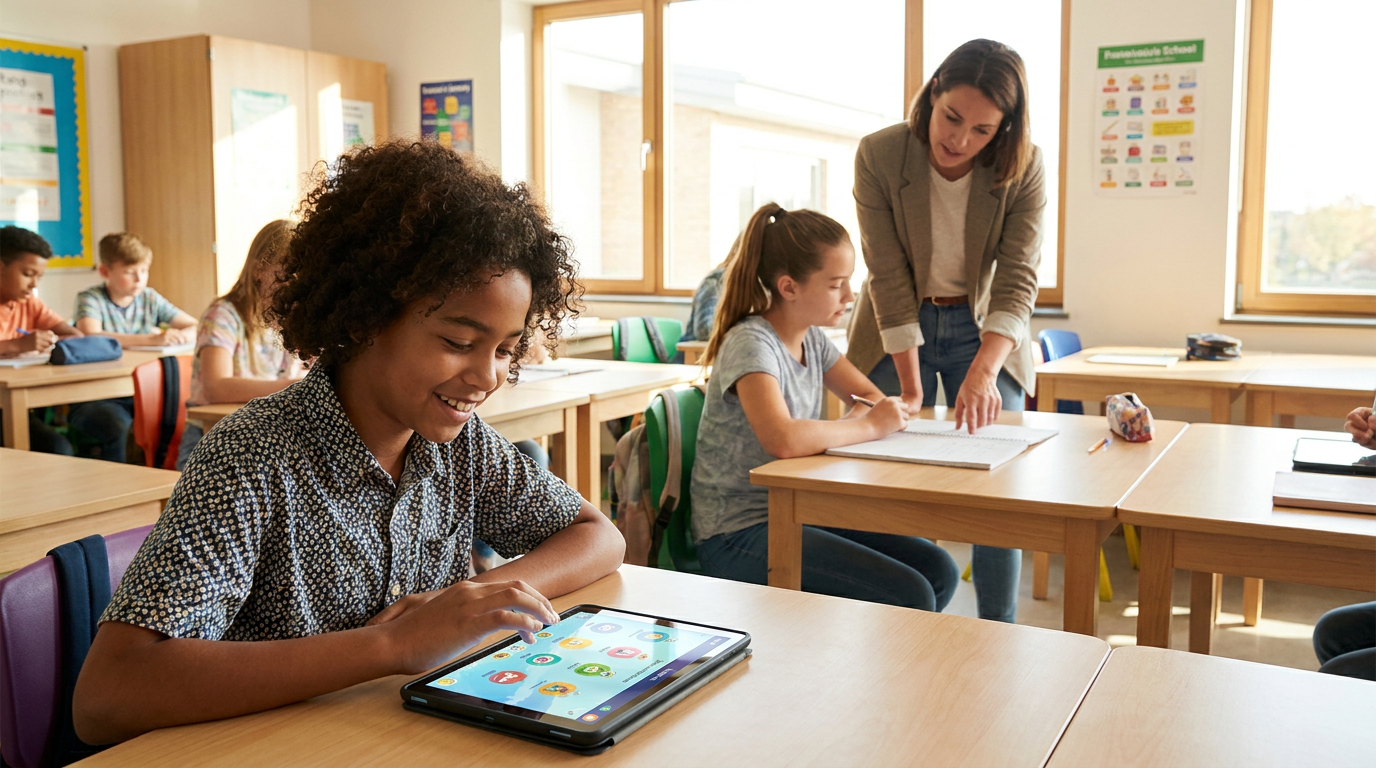
- Education Technologists
- Focus on the unprecedented scale and personalization that AI brings to learning.
- Classroom Educators
- Emphasize AI as a tool to reduce burnout and enhance, rather than replace, human teaching.
- Equity Advocates
- Highlight the potential to close achievement gaps, while warning of the digital divide.
What's not represented
- · Student privacy advocates concerned about data collection
- · Parents navigating the shift from traditional homework to AI-guided practice
Why this matters
For decades, the highest standard of education—one-on-one personalized tutoring—was restricted to families who could afford it. The maturation of AI tutors in 2026 is beginning to democratize this level of instruction, potentially closing persistent achievement gaps and fundamentally changing the role of human teachers.
Key points
- AI tutors use Socratic dialogue to guide students to answers, rather than just providing solutions.
- Personalized AI problem sequencing can yield the equivalent of 6 to 9 months of extra learning.
- State governments, including Arizona and Iowa, are rolling out AI tutors to hundreds of thousands of students.
- AI is projected to automate 20% to 40% of teachers' administrative tasks, freeing time for mentoring.
- The technology aims to replicate the '2 Sigma' performance boost of human 1-on-1 tutoring at scale.
In 1984, educational psychologist Benjamin S. Bloom published a landmark finding that would haunt educators for the next four decades. He discovered that students who received one-on-one tutoring combined with mastery learning performed two standard deviations—or "two sigmas"—better than students in traditional classrooms. The average tutored student outperformed 98% of their conventionally taught peers.[7]
Bloom called this the "2 Sigma Problem." The problem was not the method, but the math: providing a dedicated human tutor for every single student is financially and logistically impossible for public education systems. For forty years, the two-sigma advantage remained a luxury largely reserved for affluent families who could afford private instruction.[7]

In 2026, that paradigm is fracturing. The rapid maturation of generative artificial intelligence has birthed a new category of educational software: the AI tutor. Moving far beyond the rigid, rule-based software of the 2010s, today's AI tutors leverage large language models to engage students in fluid, adaptive conversations that mimic the pedagogical strategies of expert human teachers.[1][7]
The defining characteristic of a modern AI tutor is its refusal to simply hand over the answer. Platforms like Khan Academy's Khanmigo are explicitly programmed to employ Socratic dialogue. When a student is stuck on a math problem, the AI does not provide the solution; instead, it analyzes the student's work, identifies the specific misconception, and asks a probing question to guide the student toward the realization themselves.[2]
This "teach, not tell" approach is grounded in cognitive science. Studies evaluated by the Brookings Institution demonstrate that students using generative AI without specific pedagogical guardrails show limited reflection on the material. However, when AI is constrained to act as a Socratic guide, breaking down complex issues to manage cognitive load, students exhibit substantial learning gains and improved motivation.[1]
The efficacy of these systems is now being quantified in large-scale academic studies. Recent research from the University of Pennsylvania's Wharton School isolated the impact of AI personalization in a five-month high school programming course. Researchers found that when an AI dynamically adjusted the difficulty of practice problems based on a student's real-time performance, the students gained the equivalent of six to nine months of additional learning compared to a control group.[3]

Crucially, this personalization ensures that advanced students are not held back by the median pace of the classroom, while struggling students are not left behind. The AI provides the "productive struggle" necessary for deep learning, tailoring the trajectory to the individual's exact level of mastery.[1][3]
Crucially, this personalization ensures that advanced students are not held back by the median pace of the classroom, while struggling students are not left behind.
Developers are continuously refining these models to reduce friction. Khan Academy's recent efficacy trials focused heavily on latency, finding that reducing the AI's response time by just fractions of a second was critical to maintaining the illusion of a natural conversation. By surfacing prerequisite skills before introducing harder problems, the platform improved "next-item correctness"—a key metric of immediate learning—by nearly three percent across millions of sessions.[2]
Recognizing this potential, state governments are moving from pilot programs to widespread deployment. In Arizona, 170,000 public school students—roughly 16% of the state's total—are now using the Khanmigo platform, backed by a $1.5 million state investment. Iowa has similarly launched a $3 million initiative deploying Amira, an AI-powered personalized reading tutor for elementary students.[5]
Despite the technological leap, the consensus among educational technologists is that AI will not replace human teachers. Instead, it is poised to fundamentally alter how educators spend their time. Research from McKinsey & Company indicates that 20% to 40% of a teacher's current workload—primarily administrative tasks, grading, and lesson preparation—can be automated by existing AI tools.[4]

By offloading routine grading and the delivery of baseline content to AI tutors, teachers can redirect those reclaimed hours toward high-impact direct engagement. As eSchool News analysts note, the teacher of 2026 is evolving into a "learning architect," focusing on critical thinking, emotional support, and complex problem-solving that algorithms cannot replicate.[4][6]
However, the integration of AI into public education is not without friction. Researchers caution that generative models are still susceptible to "hallucinations"—presenting false information as fact. This necessitates robust guardrails and continuous human oversight to ensure that the AI does not inadvertently teach incorrect concepts.[1][7]
Furthermore, equity advocates warn that while AI tutors can democratize instruction, they also risk exacerbating the digital divide. A highly effective AI tutor is useless to a student without reliable broadband access or a dedicated device at home. Ensuring that the hardware infrastructure matches the software innovation remains a critical hurdle for policymakers.[7]
Data privacy also remains a paramount concern. Because AI tutors rely on vast amounts of personal interaction data to build their adaptive profiles, school districts must navigate complex legal and ethical frameworks to protect student information from commercial exploitation.[1][7]
Ultimately, the promise of 2026 is not a dystopian classroom run by machines, but a hybrid model that leverages the best of both worlds. AI provides the infinite patience and personalized cognitive scaffolding required to solve the 2 Sigma Problem, while human educators provide the empathy, motivation, and moral guidance that turn information into true education.[6][7]
How we got here
1984
Benjamin Bloom publishes 'The 2 Sigma Problem', identifying the massive benefits of 1-on-1 tutoring.
2023
Khan Academy launches Khanmigo, an early generative AI tutor built on GPT-4.
2024
Iowa and Indiana launch multi-million dollar state-level AI tutoring initiatives.
Oct 2025
Arizona announces that 170,000 public school students are actively using the Khanmigo platform.
Jun 2026
Wharton publishes research showing AI-personalized problem sequencing yields massive learning gains.
Viewpoints in depth
Education Technologists
Focus on the unprecedented scale and personalization that AI brings to learning.
This camp views AI tutors as the holy grail of educational technology. For decades, software could only offer rigid, multiple-choice pathways. Technologists argue that large language models finally allow software to understand nuance, engage in Socratic dialogue, and adapt to a student's emotional state and pacing in real-time. They point to massive efficacy gains in early trials as proof that the '2 Sigma Problem' is finally solvable at a global scale.
Classroom Educators
Emphasize AI as a tool to reduce burnout and enhance, rather than replace, human teaching.
Teachers generally welcome AI as a means to alleviate crushing administrative burdens, such as grading and lesson planning. However, they firmly reject the narrative that AI can replace the classroom experience. Educators argue that learning is inherently social and emotional; an AI can explain a math concept with infinite patience, but it cannot inspire a disenfranchised student, manage classroom dynamics, or provide the human empathy necessary for holistic child development.
Equity Advocates
Highlight the potential to close achievement gaps, while warning of the digital divide.
Equity-focused groups see AI tutors as a powerful democratizing force, offering low-income students the kind of elite, one-on-one tutoring previously reserved for the wealthy. However, they caution that this benefit is entirely dependent on hardware and internet access. If affluent districts deploy advanced AI while underfunded districts lack the basic devices to run them, the technology could inadvertently widen the very educational gaps it promises to close.
What we don't know
- How the long-term use of AI tutors will affect students' social development and peer-to-peer collaboration skills.
- Whether the hardware infrastructure in underfunded school districts can support the widespread adoption of AI tools.
- How data privacy regulations will evolve to protect the massive amounts of behavioral data collected by adaptive learning platforms.
Key terms
- The 2 Sigma Problem
- An educational phenomenon where students receiving one-on-one tutoring perform two standard deviations better than those in traditional classrooms.
- Socratic Dialogue
- A teaching method where the instructor asks probing questions to lead the student to discover the answer themselves, rather than lecturing.
- Adaptive Learning
- Educational technology that dynamically adjusts the difficulty, pacing, and sequence of content based on a student's real-time performance.
- Next-Item Correctness
- A metric used to measure immediate learning by tracking whether a student correctly answers the very next problem after receiving tutoring.
- Productive Struggle
- The process of learning where a student is given a task just beyond their current ability, requiring effort that leads to deeper understanding.
Frequently asked
Will AI tutors replace human teachers?
No. Experts agree that AI will handle routine instruction and grading, allowing human teachers to focus on complex problem-solving, emotional support, and mentorship.
Do AI tutors just give students the answers?
Modern educational AI tutors are explicitly programmed not to give direct answers. Instead, they use Socratic dialogue to ask questions and guide students to figure out the solutions themselves.
How much do AI tutors cost compared to human tutors?
While high-quality human tutoring can cost thousands of dollars per year, AI tutors are highly scalable and are increasingly being provided for free to students through state-funded public school initiatives.
What happens if the AI makes a mistake?
AI models can still 'hallucinate' or provide incorrect information. Educational platforms are building strict guardrails to minimize this, but human oversight from teachers remains a critical component of the learning process.
Sources
Source coverage
7 outlets
3 viewpoints surfaced







[1]Brookings InstitutionEquity Advocates
Generative AI as tutor: The evidence for effectiveness
Read on Brookings Institution →[2]Khan AcademyEducation Technologists
How Khan Academy Is Building a Better AI Tutor: Our Most Recent Learnings
Read on Khan Academy →[3]University of PennsylvaniaEducation Technologists
New Wharton research reveals how personalizing AI tutors for students can improve learning
Read on University of Pennsylvania →[4]McKinsey & CompanyClassroom Educators
How Artificial Intelligence Will Impact K-12 Teachers
Read on McKinsey & Company →[5]K-12 DiveEquity Advocates
State-led AI tutoring initiatives gain momentum in 2026
Read on K-12 Dive →[6]eSchool NewsClassroom Educators
Predictions on the future of EdTech in 2026
Read on eSchool News →[7]Factlen Editorial Team
Synthesis by Factlen editorial team
Read on Factlen Editorial Team →

Every angle. Every day.
Get education stories with full source coverage and perspective breakdowns delivered to your inbox.