
2026 Rivian R2 vs. Tesla Model Y: Comparing the Top Electric SUVs
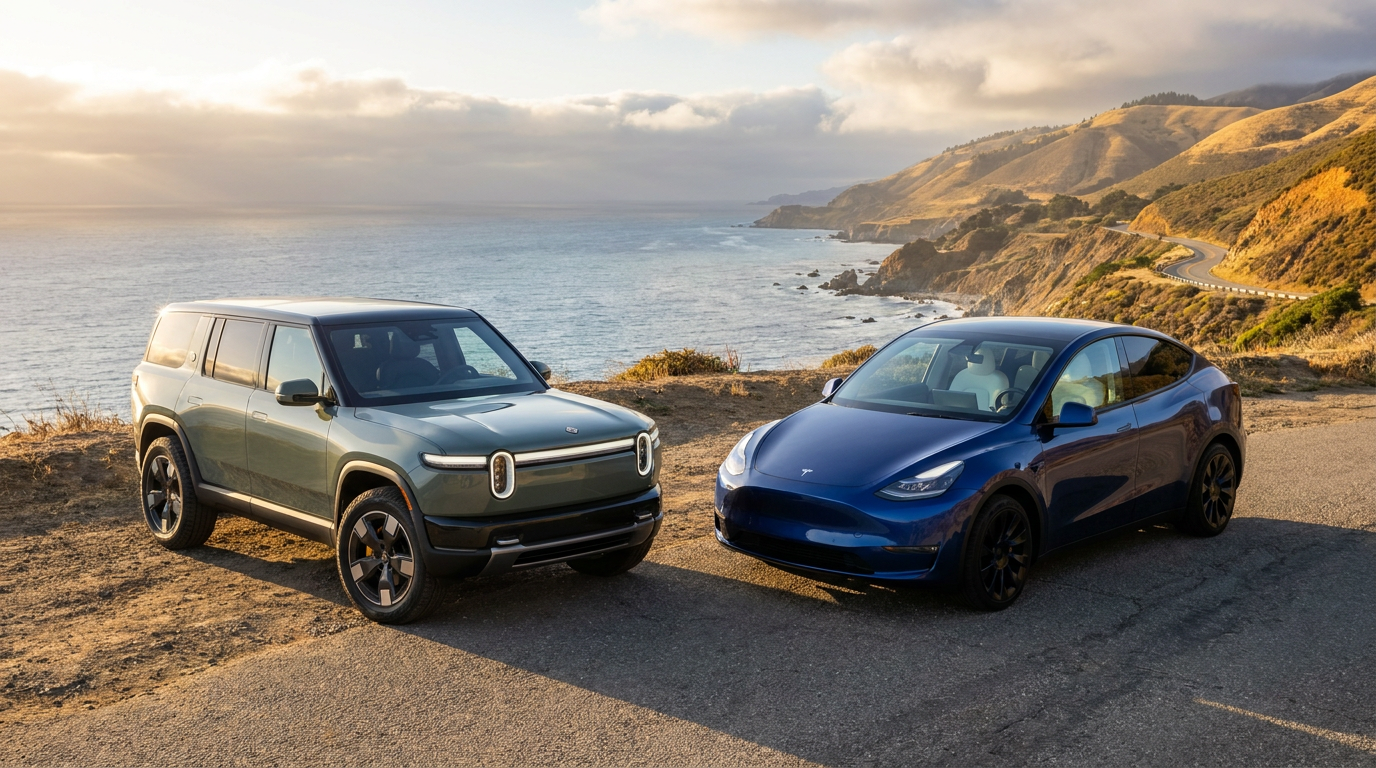
The 2026 Rivian R2 and the refreshed Tesla Model Y offer two distinct approaches to the electric SUV, pitting rugged utility against aerodynamic efficiency. A side-by-side analysis reveals that while they overlap in price and footprint, they serve fundamentally different driver needs.
By Factlen Editorial Team
- Efficiency & On-Road Advocates
- Prioritize aerodynamic design, highway range, and sporty handling for daily commuting.
- Utility & Outdoor Enthusiasts
- Demand rugged capability, flexible cargo space, and traditional SUV aesthetics.
What's not represented
- · Traditional Dealership Advocates who prefer in-person service networks over the direct-to-consumer models used by both Tesla and Rivian.
Why this matters
For buyers entering the electric vehicle market in 2026, the midsize SUV segment is the most competitive and practical choice. Understanding the exact trade-offs between the market-leading Tesla and the highly anticipated Rivian ensures consumers match their $45,000-plus investment to their actual daily driving habits.
Key points
- The Tesla Model Y starts at a lower price ($39,990) and is available immediately in all trims.
- The Rivian R2 Performance matches the Model Y Performance in price (~$57,900) but offers 656 horsepower.
- The R2 provides significantly more utility, featuring 9.6 inches of ground clearance and 90.1 cubic feet of cargo space.
- The Model Y remains the efficiency king at the base level, achieving up to 357 miles of range.
- Both vehicles use the NACS charging port, granting them equal access to the Tesla Supercharger network.
- The R2 includes a dedicated driver display, while the Model Y relies entirely on its central touchscreen.
The midsize electric SUV segment in 2026 is defined by two heavyweights that share a similar footprint but entirely different philosophies. On one side sits the Tesla Model Y, fresh off its "Juniper" update, which refined the world's best-selling EV with better materials and a quieter cabin. On the other side is the newly launched Rivian R2, a scaled-down, more accessible version of the brand's rugged R1 platform. While they overlap significantly in price at the top of their respective ranges, a side-by-side comparison reveals that they are engineered for fundamentally different lifestyles.[4]
Pricing and availability dictate the entry point for this comparison. The Tesla Model Y holds a distinct advantage for budget-conscious buyers shopping today, with its rear-wheel-drive base model starting at $39,990. Rivian's entry-level R2, targeting the $45,000 mark, will not reach customers until 2027. However, for buyers looking at the premium tier in 2026, the gap vanishes. The Rivian R2 Performance Launch Edition arrives at $57,990, lining up almost exactly with the Tesla Model Y Performance at $57,490. At this price parity, the decision shifts entirely from cost to capability.[1][4]
For the Tesla Model Y, the primary argument centers on aerodynamic efficiency and sports-sedan driving dynamics. The evidence is clear in the numbers: its sleek, teardrop shape allows the rear-wheel-drive variant to achieve up to 357 miles of range and an industry-leading 139 MPGe. On twisty roads, the Model Y sits lower to the ground, offering a firmer, more nimble ride that prioritizes cornering stability. Against the Model Y, critics point to its limited utility as a true SUV. Its 6.0 inches of ground clearance and sloping roofline restrict off-road capability and limit bulky cargo capacity, making it function more like a lifted hatchback than a rugged utility vehicle.[1][3][4]

For the Rivian R2, the core argument is built around maximum utility, interior space, and genuine off-road capability. The evidence is immediately visible in its dimensions: while slightly shorter in length than the Tesla, the R2 is three inches taller and boasts a massive 9.6 inches of ground clearance. This boxy geometry yields 90.1 cubic feet of total cargo space—including a larger 5.2-cubic-foot frunk—compared to the Model Y's 76 cubic feet. Furthermore, the R2 features seats that fold completely flat, transforming the cabin into a cavernous hauling space. Against the R2, the trade-offs include a heavier curb weight and a less agile feel on paved backroads, where its taller stance and off-road suspension cannot match the Tesla's cornering precision.[1][2][3]
For the Rivian R2, the core argument is built around maximum utility, interior space, and genuine off-road capability.
When comparing straight-line performance, both vehicles deliver the instant torque that EV buyers expect, but they achieve it differently. The evidence shows the Rivian R2 Performance generating a massive 656 horsepower, significantly more than the Model Y Performance's estimated 456 horsepower. Despite this power deficit, the lighter Tesla is actually quicker, hitting 60 mph in 3.3 seconds compared to the Rivian's 3.6 seconds. However, Rivian managed a surprising engineering feat with the R2 Performance: it achieved an EPA rating of 109 MPGe and 330 miles of range on 21-inch wheels, edging out the Model Y Performance's 104 MPGe. This means Rivian built a heavier, boxier, off-road-capable SUV that is somehow 5% more efficient at the top trim level than Tesla's aerodynamic equivalent.[1][2][4]

Inside the cabin, the two automakers take divergent approaches to technology and user experience. For the Model Y, the argument is minimalist simplicity. The evidence is a single, central 15.4-inch touchscreen that controls everything from navigation to wiper speed, completely omitting a traditional driver's gauge cluster. Against this approach, many drivers find looking to the center screen for speed and range distracting. The Rivian R2 counters with a dual-screen setup, featuring a 15.6-inch central display paired with a dedicated 12.3-inch digital gauge cluster behind the steering wheel. The R2 also leans into a more traditional luxury aesthetic, utilizing open-pore wood and premium cloth accents, whereas the Tesla maintains a stark, clinical interior. Neither vehicle offers Apple CarPlay or Android Auto, relying instead on highly responsive, proprietary software.[3][4]

Charging infrastructure, once the ultimate trump card for Tesla, is now a dead heat. The evidence shows that both the 2026 Model Y and the Rivian R2 come equipped with native North American Charging Standard (NACS) ports. This grants Rivian drivers seamless, adapter-free access to the vast Tesla Supercharger network. While the Model Y still charges slightly faster—completing a 10-to-80 percent fast charge in roughly 27 minutes compared to the R2's 29 minutes—the difference is negligible in real-world road-tripping. The great equalizer of charging means buyers can choose their vehicle based on hardware rather than network anxiety.[4][5]
Ultimately, this side-by-side comparison yields clear guidance for prospective buyers. The Tesla Model Y fits well when a driver prioritizes maximum highway efficiency, sports-car acceleration, and a lower starting price today. It is the ideal choice for commuters who want a refined, tech-forward daily driver that handles like a sedan and rarely leaves the pavement. It does not fit well when the buyer needs to haul oversized cargo, desires a dedicated instrument cluster, or plans to navigate rutted trails and deep snow.[3][4]

Conversely, the Rivian R2 fits well when a buyer demands genuine outdoor capability, massive and flexible cargo space, and a more traditional, rugged SUV aesthetic. It is the perfect match for families who need fold-flat seating for camping, a larger frunk for messy gear, and the ground clearance to reach remote trailheads. It does not fit well when the buyer is strictly shopping under a $50,000 budget in 2026, or when they prefer the low-slung, nimble handling of a performance car. There is no single winner; the choice simply depends on whether the destination requires an elevated sports sedan or a modernized utility vehicle.[1][2][4]
How we got here
2020
Tesla launches the Model Y, which quickly becomes the world's best-selling electric vehicle.
March 2024
Rivian officially unveils the R2, promising a smaller, more affordable alternative to its flagship R1S.
Late 2025
Tesla rolls out the 'Juniper' refresh for the Model Y, upgrading interior materials and cabin insulation.
Spring 2026
The first Rivian R2 Performance models begin reaching customers, directly challenging the top-tier Model Y.
2027
Rivian plans to release the entry-level $45,000 R2, bringing it into direct price competition with the base Model Y.
Viewpoints in depth
Efficiency & On-Road Advocates
Drivers and analysts who prioritize aerodynamic design, highway range, and sporty handling.
This camp views the Tesla Model Y as the benchmark for a reason. They argue that for 95% of drivers, an SUV is used for commuting, grocery runs, and highway road trips—environments where the Model Y's teardrop shape and 139 MPGe (in RWD form) shine. They point out that carrying around the extra weight and aerodynamic drag of a boxy off-roader like the R2 is wasteful if the vehicle rarely leaves the pavement. For these buyers, the Model Y's sports-sedan handling and lower entry price make it the pragmatic choice.
Utility & Outdoor Enthusiasts
Drivers who demand rugged capability, flexible cargo space, and traditional SUV aesthetics.
This perspective champions the Rivian R2 as a return to what an SUV is actually supposed to be. They argue that the Model Y is simply a lifted hatchback that compromises on utility. By pointing to the R2's 9.6 inches of ground clearance, fold-flat seats, and 90.1 cubic feet of cargo space, they emphasize that a true utility vehicle must be ready for hardware store runs, camping trips, and rutted trails. To this camp, the slight penalty in base-model efficiency is a small price to pay for a vehicle that can genuinely handle the outdoors.
What we don't know
- How the base $45,000 Rivian R2 will perform in real-world efficiency testing once it launches in 2027.
- Whether Tesla will introduce an off-road focused trim of the Model Y to compete directly with Rivian's rugged appeal.
- How long-term reliability and repair costs for the newly engineered R2 platform will compare to the mature Model Y.
Key terms
- MPGe
- Miles Per Gallon Equivalent, a metric used by the EPA to compare the energy efficiency of electric vehicles to traditional gas-powered cars.
- NACS
- North American Charging Standard, the charging plug design originally developed by Tesla that has now been adopted by nearly all major EV manufacturers.
- Frunk
- A front trunk, providing enclosed storage space under the hood where a traditional gas engine would normally be located.
- Torque Vectoring
- A system that actively distributes power to individual wheels to improve grip, handling, and off-road capability.
Frequently asked
Which vehicle has more cargo space?
The Rivian R2 has significantly more room, offering 90.1 cubic feet of total cargo space with the seats folded flat, compared to the Model Y's 76 cubic feet.
Do both cars have access to Tesla Superchargers?
Yes. The 2026 Rivian R2 is built with a native NACS port, allowing it to plug directly into Tesla Superchargers without needing an adapter.
Which SUV is faster?
While the Rivian R2 Performance has more horsepower (656 hp), the lighter Tesla Model Y Performance is quicker, reaching 60 mph in 3.3 seconds compared to the R2's 3.6 seconds.
Does the Rivian R2 have Apple CarPlay?
No. Both the Rivian R2 and the Tesla Model Y use their own proprietary infotainment software and do not support Apple CarPlay or Android Auto.
Sources
Source coverage
6 outlets
2 viewpoints surfaced






[1]ElectrekUtility & Outdoor Enthusiasts
Rivian R2 vs Tesla Model Y dimensions and efficiency
Read on Electrek →[2]CarBuzzUtility & Outdoor Enthusiasts
How the Rivian R2 beats the Model Y
Read on CarBuzz →[3]CarwowUtility & Outdoor Enthusiasts
Rivian R2 vs Tesla Model Y: prices and standard equipment
Read on Carwow →[4]Road EthosEfficiency & On-Road Advocates
Tesla Model Y: An Honest Comparison For 2026 Buyers
Read on Road Ethos →[5]EV.careUtility & Outdoor Enthusiasts
Rivian Automotive R2 vs Tesla Model Y — quick spec snapshot
Read on EV.care →[6]Discover EVsEfficiency & On-Road Advocates
Compare Tesla Model Y vs Rivian R2
Read on Discover EVs →
Every angle. Every day.
Get automotive stories with full source coverage and perspective breakdowns delivered to your inbox.