
Buying a Move-In Ready Home vs. a Fixer-Upper: 2026 Market Analysis
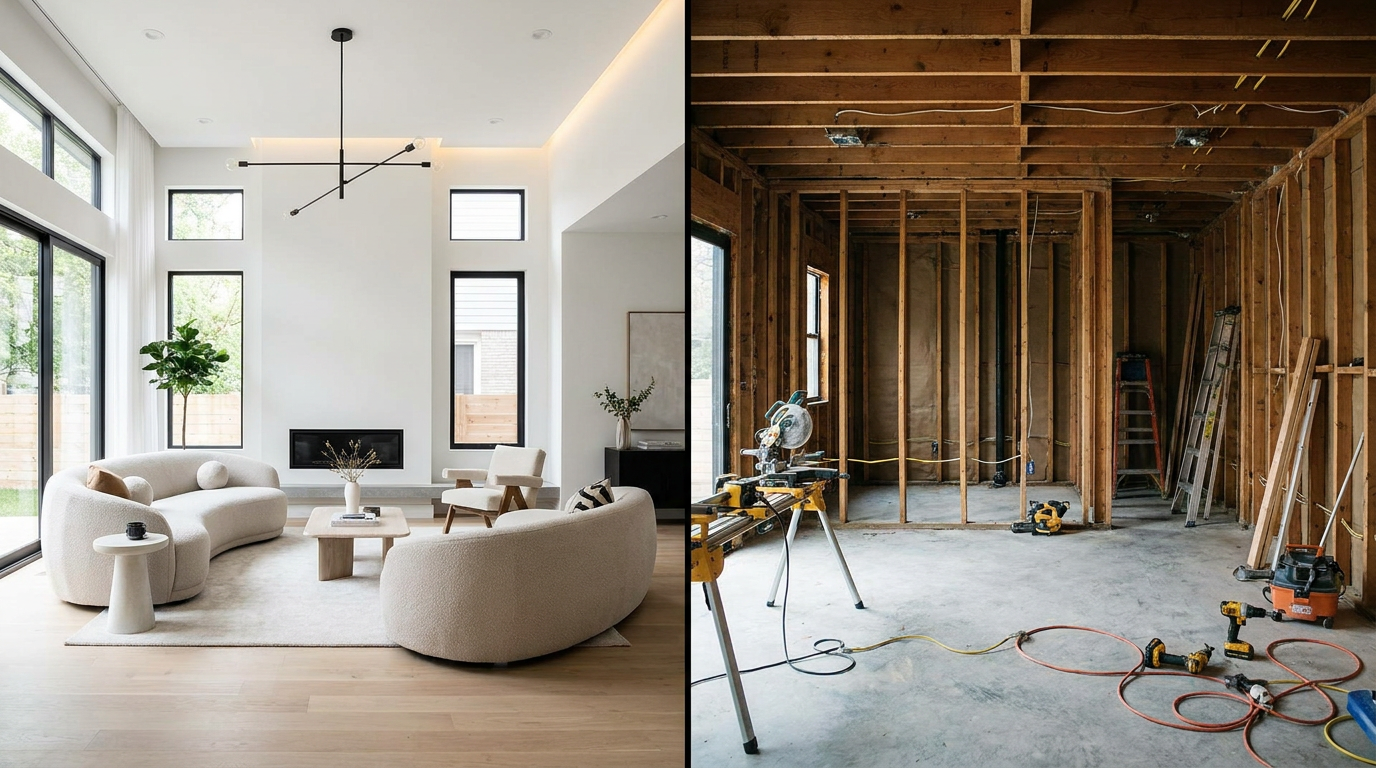
As construction costs remain elevated and housing inventory stays tight, the financial calculus between buying a turnkey property and taking on a renovation project has shifted. A side-by-side analysis reveals the true costs, risks, and long-term equity potential of both paths in the 2026 real estate market.
By Factlen Editorial Team
- Turnkey Advocates
- Prioritizing time, predictability, and immediate comfort over maximum equity extraction.
- Value Investors
- Focusing on forced appreciation, the 70 percent rule, and building sweat equity.
- Market Analysts
- Evaluating the macroeconomic factors that impact both renovation costs and home prices.
What's not represented
- · Local zoning boards
- · General contractors
Why this matters
Choosing between a turnkey home and a fixer-upper is one of the largest financial decisions a buyer will make. Understanding the hidden costs of 2026 renovations versus the upfront premium of move-in ready homes empowers buyers to protect their budgets and build long-term wealth without unexpected stress.
Key points
- Fixer-uppers sell for an average of 22 percent less than comparable move-in ready homes, offering a lower barrier to entry.
- Renovation projects in 2026 frequently exceed their initial budget estimates by 20 to 50 percent due to labor and material costs.
- The 70 percent rule advises that total investment (purchase plus repairs) should not exceed 70 percent of the home's after-repair value.
- Turnkey homes offer financial predictability and immediate comfort but command a premium price and attract higher buyer competition.
The 2026 housing dilemma is defined by a challenging combination of high interest rates and tight inventory, forcing many prospective homebuyers to weigh a difficult choice: pay a steep premium for a home that needs no work, or purchase a discounted property that requires significant renovation. Both paths offer distinct financial mechanisms for building wealth, but they carry vastly different risk profiles. As the real estate landscape continues to evolve, understanding the true costs of construction versus the premium of convenience has never been more critical for protecting a household budget.[5][6]
The case for the fixer-upper centers entirely on entry price and the potential for forced appreciation. Buyers willing to take on properties needing significant cosmetic or structural work face a much smaller pool of competing offers, which translates directly to negotiating power. In highly competitive neighborhoods where turnkey homes spark bidding wars, a property marketed "as-is" or as a "handyman special" provides a rare foothold into a desirable zip code. This lower barrier to entry allows buyers to preserve their initial capital or purchase in a location that would otherwise be entirely out of reach.[1][2]
The evidence supporting this strategy is compelling for those who execute it correctly. Market data indicates that homes listed as needing work sell for an average of 22 percent less than comparable move-in ready homes in the exact same neighborhoods. For a buyer looking at a neighborhood where renovated homes command $400,000, finding a property for $310,000 leaves a substantial margin. That $90,000 gap represents the opportunity to build immediate equity through strategic upgrades, transforming a dated property into a modern asset while theoretically keeping total costs below market value.[1]

The case against the fixer-upper lies in the unpredictable reality of 2026 construction costs. The era of cheap materials and abundant contractors has ended. Today, skilled labor shortages, material price volatility, and stricter energy-efficiency building codes have driven renovation costs to historic highs. What appears to be a simple cosmetic update can quickly spiral into a massive financial burden once walls are opened and outdated electrical wiring, plumbing leaks, or structural deficiencies are exposed to the light of day.[4]
The evidence against the renovation path is found in the budget overruns that routinely plague inexperienced buyers. Industry benchmarks show that residential renovations frequently exceed their initial estimates by 20 to 50 percent due to unforeseen complications. Furthermore, homeowners typically recover only 60 to 75 percent of their project costs at resale. This means the initial purchase discount must be exceptionally large to absorb both the cost of the work and the inevitable surprises, otherwise the buyer risks sinking more money into the home than it will ever be worth.[2][3]
The evidence against the renovation path is found in the budget overruns that routinely plague inexperienced buyers.
To mitigate this immense financial risk, real estate professionals rely heavily on the 70 percent rule. This mathematical boundary dictates that a buyer's total investment—the purchase price plus the estimated cost of repairs—should never exceed 70 percent of the home's projected after-repair value. If a fully renovated home in the neighborhood will sell for $500,000, the maximum allowable spend for the purchase and all repairs combined is $350,000. This strict formula leaves a 30 percent buffer to absorb construction overruns and guarantee built-in equity upon completion.[1][2]

The case for the move-in ready home is built on financial predictability, immediate utility, and the preservation of time. Turnkey properties allow buyers to move in on closing day without managing contractors, living in a dust-filled construction zone, or making exhausted decisions about tile grout at midnight. The home inspection confirms the condition upfront, allowing buyers to lock in their total housing cost with a single, predictable monthly mortgage payment. For many, the mental peace of a finished product is worth every penny of the premium.[3]
The evidence supporting the turnkey approach is rooted in financing simplicity and lifestyle preservation. Lenders underwrite move-in ready homes seamlessly, whereas financing a fixer-upper often requires specialized products like FHA 203(k) or Fannie Mae HomeStyle loans. While these renovation mortgages allow buyers to roll repair costs into their loan with a low down payment, they require detailed contractor bids upfront, rigorous appraisals, and strict timelines that can complicate and delay the closing process. Turnkey homes bypass this bureaucratic friction entirely.[2]
The case against the move-in ready home is primarily financial. Buyers pay a steep premium for convenience, essentially reimbursing the previous owner or developer for the cost of the renovations, plus a healthy profit margin. Because these pristine homes attract the vast majority of the buyer pool—especially first-time buyers who are already overwhelmed by the mortgage process—they frequently command multiple offers. This high demand pushes the final sale price to the absolute top of the market, leaving little to no room for immediate equity growth.[3][5]

Furthermore, buyers of turnkey homes often sacrifice deep personalization. The finishes, layouts, and materials were selected by someone else, often designed to appeal to the broadest possible denominator rather than specific tastes. While the home is fully functional and aesthetically pleasing, the new owner may spend the next decade living with a kitchen layout or flooring choice that does not perfectly align with their personal preferences, having already paid top dollar for those exact features.[3]
Ultimately, the fixer-upper path fits well when buyers possess a high tolerance for stress, have secure access to cash reserves or specialized renovation financing, and plan to stay in the home for at least five to seven years. It is the ideal strategy for those who prioritize neighborhood location over immediate luxury, possess some project management skills, and are willing to trade their weekends and comfort for the opportunity to build substantial sweat equity.[2][6]
Conversely, the move-in ready path fits well when buyers have strict timelines, demanding careers, or limited cash reserves to cover unexpected construction overruns. It is the superior choice for those who value the mental peace of a fixed budget and are willing to pay a premium to bypass the chaos of living through a major home renovation. In a market defined by high costs on all sides, the best choice depends entirely on which type of risk the buyer is most equipped to handle.[3][6]
Viewpoints in depth
The Turnkey Advocate's View
Prioritizing time, predictability, and immediate comfort over maximum equity extraction.
Turnkey advocates argue that the premium paid for a move-in ready home is actually an insurance policy against the unpredictable nature of construction. They point out that in a high-interest-rate environment, rolling the cost of a finished home into a 30-year fixed mortgage is often safer than depleting cash reserves to fund a renovation. For this camp, the mental peace of a fixed budget and the ability to immediately enjoy the property far outweigh the theoretical equity gains of a fixer-upper.
The Value Investor's View
Focusing on forced appreciation, the 70 percent rule, and building sweat equity.
Value investors and DIY enthusiasts view turnkey homes as a missed financial opportunity. By purchasing a property at a 20 to 30 percent discount, they believe buyers can force appreciation through strategic upgrades, effectively creating wealth out of thin air. This camp relies heavily on strict mathematical formulas, such as the 70 percent rule, to ensure they never overpay. They argue that trading short-term comfort for long-term financial leverage is the smartest way to climb the property ladder.
The Market Analyst's View
Evaluating the macroeconomic factors that impact both renovation costs and home prices.
Real estate economists and market analysts focus on the broader trends shaping the 2026 landscape. They highlight that chronic labor shortages and volatile material costs have fundamentally altered the math of renovating. While fixer-uppers still offer a discount, analysts warn that the margin for error has shrunk significantly. They advise buyers to meticulously weigh local construction costs against neighborhood appreciation rates before committing to either path.
What we don't know
- How long current labor shortages in the skilled trades will persist, which directly impacts future renovation timelines and costs.
- Whether local municipalities will ease zoning and permitting regulations to make extensive home renovations faster and more affordable.
Key terms
- After-Repair Value (ARV)
- The estimated market value of a property after all planned renovations and repairs have been completed.
- FHA 203(k) Loan
- A government-backed mortgage that allows buyers to finance both the purchase of a house and the cost of its rehabilitation through a single loan.
- Sweat Equity
- The value added to a property through the unpaid labor and physical effort of the homeowner.
- Turnkey Property
- A home that is completely renovated, updated, and ready for immediate move-in without requiring any repairs.
Frequently asked
Can I finance the cost of renovations into my mortgage?
Yes. Specialized products like FHA 203(k) and Fannie Mae HomeStyle loans allow buyers to roll the purchase price and renovation costs into a single mortgage, often with a low down payment.
Do home renovations always increase a property's value?
Not dollar-for-dollar. On average, homeowners recover only 60 to 75 percent of their project costs at resale, meaning the initial purchase price must be low enough to absorb the difference.
Why are renovation costs so high in 2026?
A combination of skilled labor shortages, volatile material prices, and stricter energy-efficiency building codes have kept construction and renovation costs elevated across the market.
Sources
Source coverage
6 outlets
3 viewpoints surfaced




[1]AmeriSave MortgageValue Investors
The Real Numbers Behind Buying a Fixer Upper
Read on AmeriSave Mortgage →[2]OpendoorValue Investors
Is Buying a Fixer-Upper Worth It?
Read on Opendoor →[3]Vertex Realty GroupTurnkey Advocates
Turnkey vs Fixer-Upper: Should You Buy New or Renovate?
Read on Vertex Realty Group →[4]MEGG HomesMarket Analysts
How Construction Costs Shape the 2026 Housing Market
Read on MEGG Homes →[5]United SeattleTurnkey Advocates
The Hidden Cost of Moving In Seattle
Read on United Seattle →[6]Factlen Editorial TeamMarket Analysts
Synthesis by Factlen editorial team
Read on Factlen Editorial Team →
Every angle. Every day.
Get real estate stories with full source coverage and perspective breakdowns delivered to your inbox.